
Your group operates across five countries, each subsidiary reporting in its local currency. Month-end arrives and your finance team faces the familiar challenge: producing consolidated financial statements foreign subsidiary reporting that presents your group as one economic entity. This guide covers everything from functional currency determination to intercompany eliminations across borders, helping you translate and consolidate foreign operations accurately.
Consolidated Financial Statements for Foreign Subsidiary
Consolidated financial statements foreign subsidiary reporting combines the parent company’s financials with those of its overseas entities to present the group as a single economic entity. The process requires translating the subsidiary’s results from its functional currency into the parent’s presentation currency using IAS 21 (The Effects of Changes in Foreign Exchange Rates). Finance teams must apply closing rates to balance sheet items, average rates to income statement items, and recognise translation differences in Other Comprehensive Income (OCI).
Ready to Automate Your Financial Consolidation?
Stop wrestling with manual consolidations and broken formulas. dataSights automates multi-entity reporting, Xero consolidations, and Power BI connections. Join 300+ businesses already transforming their financial reporting with our platform, rated 5.0 out of 5 by 90+ verified Xero users.
Table of Contents
What Are Consolidated Financial Statements for Foreign Subsidiaries?
Consolidated financial statements aggregate the financial position and performance of a parent company and all its subsidiaries into one comprehensive report. When subsidiaries operate in foreign countries and report in different currencies, the consolidation process gains additional complexity.
IFRS 10 Consolidated Financial Statements establishes the core principle: an entity that controls one or more subsidiaries must present consolidated financial statements. Control exists when the parent has power over the investee, exposure to variable returns, and the ability to use that power to affect those returns.
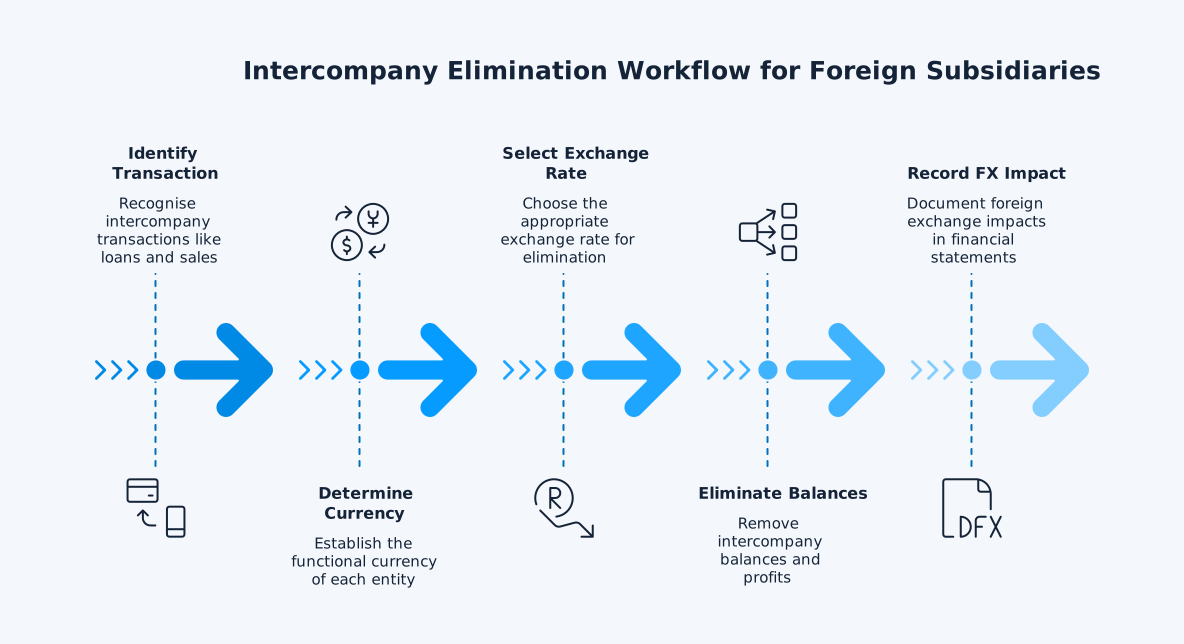
For foreign subsidiaries specifically, the consolidation process involves three key steps:
- Determine the subsidiary’s functional currency based on its primary economic environment
- Translate the subsidiary’s financial statements into the parent’s presentation currency
- Eliminate intercompany transactions and balances, accounting for foreign exchange impacts
The result presents assets, liabilities, equity, income, expenses, and cash flows as if the entire group were a single entity operating in one currency.
Why Foreign Subsidiary Consolidation Matters
Including foreign subsidiaries in consolidated statements serves multiple purposes. Comprehensive financial analysis requires visibility across all geographies. Investors and stakeholders need a global perspective on group operations. Regulatory frameworks like IFRS and US GAAP (ASC 810) require consolidation when the parent controls the investee (IFRS 10) or holds a controlling financial interest (ASC 810), regardless of location.
The consolidation also enables effective risk management. Understanding how currency fluctuations, geopolitical factors, and regional market dynamics affect the group requires seeing foreign subsidiary performance within the consolidated picture.
Functional Currency vs Presentation Currency: Getting the Foundation Right
Before translating any foreign subsidiary’s statements, finance teams must determine the correct functional currency. This distinction forms the foundation of accurate consolidation.
What Is Functional Currency?
Functional currency is the currency of the primary economic environment where an entity operates. Under ASC 830 (US GAAP) and IAS 21 (IFRS), every entity must use a functional currency that reflects its economic reality.
The functional currency isn’t necessarily the local currency where the subsidiary is registered. A Japanese subsidiary of a UK company might sell primarily in dollars and pay suppliers in dollars. In that case, the US dollar, not the Japanese yen, is the functional currency.
Primary Indicators for Functional Currency Determination
IAS 21 provides specific guidance on identifying functional currency. The primary indicators include:
- The currency that mainly influences sales prices for goods and services
- The currency of the country whose competitive forces and regulations mainly determine sales prices
- The currency that mainly influences labour, material, and other operating costs
For example, if a European subsidiary sells 80% of products in euros, pays staff in euros, and finances operations with euro-denominated loans, the euro is the functional currency.
Secondary Indicators
When primary indicators don’t point to a single currency, secondary factors help determine functional currency:
- The currency in which funds from financing activities are generated
- The currency in which receipts from operating activities are retained
- The nature of activities between the parent and subsidiary
Management must document this analysis consistently across entities. Regulators and auditors expect evidence-based determination, not management preference.
What Is Presentation Currency?
Presentation currency is the currency used to report consolidated financial statements. A UK parent typically presents in GBP, even though subsidiaries may have functional currencies in USD, EUR, or other currencies.
The distinction matters because translation methods differ depending on whether you’re translating from functional to presentation currency or recording foreign currency transactions within an entity’s books.
Translation Methods for Foreign Subsidiaries
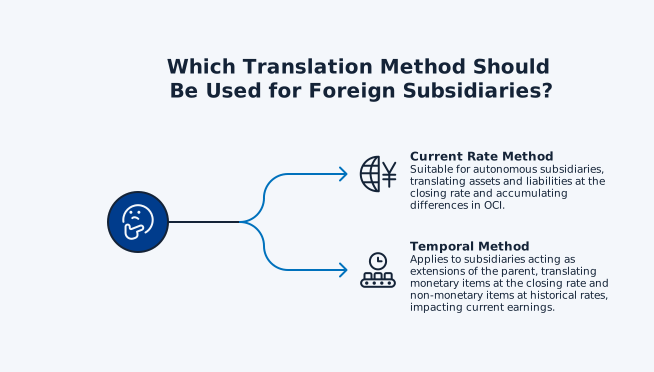
Once you’ve determined functional currency, the next step is translating the subsidiary’s statements into the parent’s presentation currency. Two primary methods exist, each suited to different subsidiary types.
The Current Rate Method (Closing Rate Method)
The current rate method applies to autonomous foreign subsidiaries that operate independently from the parent. Most foreign subsidiaries fall into this category.
Under this method, per IAS 21 paragraphs 39-43:
- Assets and liabilities translate at the closing rate (the exchange rate at the balance sheet date)
- Income statement items translate at the rate on the transaction date, though average rates are acceptable
- Equity items translate at historical rates
- Dividends translate at the rate on the date of payment
- Translation differences accumulate in Other Comprehensive Income (OCI) as a foreign currency translation reserve until the foreign operation is sold or substantially liquidated
This approach recognises that the parent’s net investment in the foreign operation is exposed to currency risk. The translation adjustment in OCI reflects this exposure without affecting current period profit or loss.
The Temporal Method (Remeasurement)
The temporal method, also referred to as remeasurement, applies under ASC 830 when a subsidiary is not economically autonomous and effectively operates as an extension of the parent. These entities typically transact primarily with the parent or in the parent’s functional currency.
Remeasurement Rules Under ASC 830
- Monetary items (cash, receivables, payables) are remeasured at the closing exchange rate.
- Non-monetary items (inventory, fixed assets) are remeasured at historical exchange rates.
- Income statement items are remeasured at transaction-date exchange rates.
- Foreign exchange gains and losses are recognised in profit or loss, not OCI.
Key Distinction
The temporal method impacts current earnings, whereas the current rate method records foreign currency translation adjustments in equity through OCI.
Exchange Rate Selection
Applying consistent exchange rates across the consolidation process requires clear policies. IAS 21 specifies:
- Closing rate: The spot exchange rate at the end of the reporting period
- Average rate: Used for income and expense items where individual transaction rates are impractical, provided exchange rates do not fluctuate significantly
- Historical rate: The exchange rate at the transaction date, applied to equity items and non-monetary items measured at historical cost
Non-monetary items measured at fair value are translated using the exchange rate at the date the fair value is determined.
For subsidiaries operating in hyperinflationary economies, financial statements are first restated in accordance with IAS 29 before being translated into the presentation currency under IAS 21.
Intercompany Eliminations in Foreign Currency Contexts
Intercompany eliminations prevent double-counting when consolidating group entities. With foreign subsidiaries, currency translation adds complexity to this process.
Types of Intercompany Transactions Requiring Elimination
Under IFRS 10 paragraph B86, all intragroup assets, liabilities, equity, income, expenses, and cash flows arising from transactions between group entities are eliminated in full on consolidation.
Common examples of intercompany transactions eliminated in practice include:
- Intercompany loans and advances, including related interest income and expense
- Intercompany sales and purchases of goods or services
- Dividend distributions between parent and subsidiaries
- Management fees and service charges billed within the group
- Cost allocations and recharges for shared functions such as IT, finance, or HR
Each transaction type gives rise to corresponding intragroup receivables and payables, and revenues and expenses, which must be eliminated on consolidation to present the group as a single economic entity.
Foreign Exchange on Intercompany Balances
Here’s where foreign subsidiary consolidation gets complex. Intercompany balances denominated in currencies other than the functional currency create foreign exchange gains and losses that survive consolidation, even though the intercompany balances themselves eliminate.
Consider this example: a UK parent (functional currency GBP) lends USD 100,000 to a Mexican subsidiary (functional currency MXN). The parent records the loan in GBP, remeasuring it each period based on GBP/USD rates. The subsidiary records the loan in MXN, remeasuring based on MXN/USD rates.
On consolidation:
- The loan receivable (parent) and loan payable (subsidiary) eliminate
- The foreign currency transaction gains and losses on each entity’s books do not eliminate
- These FX impacts flow through consolidated profit or loss
This occurs because each entity’s foreign currency exposure is real and reflects economic reality. The intercompany nature of the transaction doesn’t eliminate the currency risk each entity faces.
Net Investment in Foreign Operations
One exception exists for long-term intercompany balances that form part of the parent’s net investment in the foreign operation. Per IAS 21 paragraph 32, if settlement isn’t planned or likely in the foreseeable future, exchange differences on these items are recognised in OCI rather than profit or loss.
This treatment aligns with the broader principle that the parent’s net investment is exposed to translation risk, recorded in the foreign currency translation reserve until the foreign operation is sold or substantially liquidated.
Intercompany Profit Elimination Across Currencies
When one group entity sells inventory or assets to another at a profit, that unrealised profit must be eliminated until the goods are sold to external parties. With foreign subsidiaries, the elimination happens at the exchange rate when the original sale occurred.
For instance, a US subsidiary sells inventory to a UK parent for $100,000, including $20,000 profit. If the UK parent still holds this inventory at year-end, the $20,000 unrealised profit eliminates at the historical exchange rate, not the closing rate.
Cumulative Translation Adjustment (CTA): What Finance Teams Need to Know
The Cumulative Translation Adjustment represents accumulated translation gains and losses arising from the consolidation of foreign subsidiaries. Understanding CTA is essential for accurate foreign subsidiary consolidation.
How CTA Accumulates
When translating foreign subsidiary statements using the current rate method, differences arise between:
- Balance sheet items translated at closing rates
- Income statement items translated at average rates
- Equity items retained at historical rates
These differences accumulate in Accumulated Other Comprehensive Income (AOCI) as the foreign currency translation reserve or CTA per IAS 21 paragraph 39. The balance grows or shrinks each period based on exchange rate movements.
CTA on Disposal
Cumulative translation differences are recycled from equity to profit or loss on disposal of a foreign operation when the parent disposes of or substantially liquidates the foreign subsidiary (IAS 21, para 48). This recycling ensures the total foreign currency impact over the investment’s life ultimately affects earnings.
For partial disposals, CTA treatment depends on whether control is lost:
- If control is retained, the relevant share is reattributed within equity (typically to NCI) rather than recycled to profit or loss.
- If control is lost, the accumulated CTA is recycled to profit or loss (IAS 21, para 48C).
Goodwill and Fair Value Adjustments
Goodwill and fair value adjustments arising from the acquisition of a foreign subsidiary are treated as assets and liabilities of the foreign operation in accordance with IAS 21. Under the current rate method, these balances are translated at the closing rate at each reporting date, with resulting translation differences recognised in Other Comprehensive Income and accumulated in the cumulative translation adjustment.
Common Challenges in Foreign Subsidiary Consolidation
Finance teams managing multi-currency consolidation face several recurring challenges.
1. Currency Volatility
Exchange rate movements between reporting periods can significantly impact consolidated results. A subsidiary might report strong local currency performance, only to see gains reduced when translated into a weaker presentation currency.
This volatility affects:
- Reported revenues and expenses
- Asset and liability valuations
- Equity and accumulated translation reserves
- Key financial ratios used by analysts and lenders
2. Data Collection Across Disparate Systems
Multinational groups often operate multiple accounting systems across regions. Collecting, standardising, and consolidating data from these systems creates operational challenges:
- Different chart of accounts structures
- Varying reporting calendars and cut-off dates
- Multiple currencies and exchange rate sources
- Inconsistent accounting policy application
Manual consolidation in spreadsheets amplifies these challenges, creating error risk and audit trail gaps.
3. GAAP Differences
Subsidiaries in different jurisdictions may prepare local statutory accounts under different accounting frameworks. Converting these to group accounting policies before consolidation adds time and complexity.
Common adjustments include:
- Revenue recognition timing differences
- Inventory valuation methods
- Fixed asset depreciation approaches
- Provision and accrual treatments
4. Timing and Reporting Date Mismatches
IFRS 10 paragraph B93 permits reporting date differences of up to three months between parent and subsidiary when alignment isn’t practical. However, adjustments must be made for significant transactions occurring between the subsidiary’s reporting date and the parent’s consolidation date.
5. Transfer Pricing Complexity
Intercompany pricing affects not only tax positions but also consolidated results after elimination. Ensuring transfer prices comply with OECD Transfer Pricing Guidelines while maintaining accurate group consolidation requires coordination between tax and finance functions.
How Automation Transforms Foreign Subsidiary Consolidation
Manual spreadsheet consolidation struggles with the complexity of multi-currency, multi-entity reporting. Modern consolidation automation addresses these challenges directly.
Near Real-Time Currency Conversion
Automated consolidation platforms maintain exchange rate tables that update based on your configured schedule. Currency conversions are applied consistently across all entities using standard accounting rates:
- Closing rates for balance sheets
- Average rates for income statements
- Historical rates for equity, where applicable
Translation differences are tracked in Other Comprehensive Income (OCI) until disposal, eliminating manual rate lookups and reducing calculation errors.
Automated Elimination Rules
Rather than manually identifying and eliminating intercompany transactions each period, automation applies configured elimination rules consistently. The system matches intercompany balances, flags mismatches for investigation, and documents every elimination with a complete audit trail.
Note for Xero users: Xero has no native intercompany module, so eliminations are typically handled outside Xero (in your consolidation software or reporting layer).
This approach addresses a core pain point: intercompany reconciliation errors are a common driver of consolidation delays and rework.
Standardised Reporting Across Entities
When subsidiary data flows into a central database, finance teams gain a single source of truth for consolidated reporting. Pre-formatted management packs are generated automatically and include full drill-down to transaction-level detail, such as:
- Consolidated Profit & Loss (P&L)
- Balance Sheet
- Cash Flow
- Trial Balance
- Budget vs Actual with Variance Analysis
- KPI Dashboards with Entity-to-Transaction Drill-through
dataSights delivers this capability to Xero users through automated multi-entity consolidation, with outputs available on the web platform and refreshable models in Excel and Power BI via Power Query. Teams consolidate data from multiple Xero entities with automatic eliminations and currency conversions; teams we work with often reduce month-end close from over 15 business days to under 5 (results vary by entity count, data quality, and close workflows).
Trial Balance as the Foundation
Every accurate consolidation starts with Trial Balance reconciliation. Foreign subsidiary translation applies to the Trial Balance first, ensuring all accounts balance before eliminations. dataSights pulls full Trial Balance data from each Xero entity, maintaining reconciliation integrity across the consolidation process.
Best Practices for Foreign Subsidiary Consolidation
Effective foreign subsidiary consolidation requires clear processes and appropriate tools.
1. Document Functional Currency Determination
For each foreign subsidiary, maintain documentation supporting the functional currency determination. Include analysis of primary and secondary indicators, rationale for conclusions, and evidence of consistent application.
2. Establish Group Accounting Policies
Ensure all subsidiaries apply uniform accounting policies before consolidation per IFRS 10 paragraph 19. Where local statutory requirements differ, prepare separate policy adjustment schedules as part of the consolidation workpapers.
3. Implement Consistent Exchange Rate Sources
Use a single, authoritative source for all exchange rates. Document which rates (closing, average, historical) apply to which elements and maintain rate tables with full audit trails.
4. Automate Intercompany Matching
Configure automated matching rules for intercompany transactions. Set tolerance thresholds for timing differences while flagging material mismatches for investigation before month-end.
5. Maintain Translation Reserve Tracking
Track the CTA balance by subsidiary and by acquisition layer. This detail becomes essential when assessing disposal impacts or explaining year-over-year equity movements.
Frequently Asked Questions
What Exchange Rate Should I Use for Translating Foreign Subsidiary Revenue?
Under IAS 21, income and expense items translate at the exchange rate on the transaction date. In practice, average rates for the reporting period are acceptable when individual transaction rates aren’t practical. The average rate should approximate the rates at individual transaction dates.
How Do I Account for Goodwill in a Foreign Subsidiary Acquisition?
Goodwill from the acquisition of a foreign subsidiary is recognised as an asset of the foreign operation under IFRS 3. Under the current rate method, goodwill retranslates at each closing rate, with translation differences recognised in OCI. Under IFRS, goodwill is tested for impairment annually under IAS 36, not amortised.
What Happens to Cumulative Translation Adjustments When I Sell a Foreign Subsidiary?
When disposing of a foreign subsidiary, CTA accumulated in equity reclassifies to profit or loss per IAS 21 paragraph 48. The previously deferred translation gains or losses become realised as part of the disposal gain or loss. For partial disposals, CTA treatment depends on whether control is lost.
Can I Use Different Reporting Dates for Foreign Subsidiaries?
IFRS 10 paragraph B93 permits reporting date differences of up to three months when aligning reporting dates is impractical. However, you must adjust for significant transactions and events occurring between the subsidiary’s reporting date and the group’s consolidation date.
How Do Intercompany Loans Affect Consolidated Financial Statements With Foreign Subsidiaries?
Intercompany loans denominated in currencies other than the functional currency create foreign exchange gains and losses that survive consolidation. While the loan receivable and payable eliminate, the FX transaction gains and losses on each entity’s books flow through consolidated profit or loss because they represent real economic exposures.
What Is the Difference Between Translation and Remeasurement?
Translation applies to autonomous foreign subsidiaries using the current rate method per IAS 21. Balance sheet items translate at closing rates, with differences in OCI. Remeasurement applies to subsidiaries operating as extensions of the parent, using the temporal method per ASC 830. Monetary items translate at closing rates, non-monetary at historical rates, with differences in profit or loss.
How Do I Eliminate Unrealised Profit on Intercompany Inventory Held by a Foreign Subsidiary?
Unrealised profit on intercompany inventory eliminates at the exchange rate when the original intercompany sale occurred, not the closing rate. The elimination affects consolidated inventory and group profit by the historical-rate-translated unrealised profit amount per IFRS 10 paragraph B86.
Is NCI Affected by Foreign Subsidiary Translation?
Yes. Non-controlling interest in a foreign subsidiary shares the translation exposure. When translating subsidiary results, NCI’s share of translation differences is attributed to NCI within equity, separate from the parent’s share of CTA per IFRS 10 paragraph B94.
From Multi-Currency Complexity to Consolidated Clarity
Foreign subsidiary consolidation demands precision across functional currency determination, translation methods, intercompany eliminations, and CTA tracking. The difference between struggling through spreadsheets and delivering accurate group results lies in your consolidation approach. With the right automated multi-entity consolidation process, your team transforms weeks of manual work into days of focused analysis. Your stakeholders get the complete picture, your auditors get the trail they need, and you get month-end back.
Automate Your Multi-Currency Xero Consolidation
Ready to eliminate manual consolidation processes for your foreign subsidiaries? dataSights automates Xero consolidation across multiple entities with built-in currency translation, automatic eliminations, and complete audit trails. Rated 5.0 by 90+ Xero users. Join 300+ businesses who’ve reduced month-end close from weeks to days.
About the Author
Kevin Wiegand
Founder & Client happiness
I’m Kevin Wiegand, and with over 25 years of experience in software development and financial data automation, I’ve honed my skills and knowledge in building enterprise-grade solutions for complex consolidation and reporting challenges. My journey includes developing custom solutions for data teams at Gazprom Marketing & Trading and E.ON, before founding dataSights in 2016. Today, dataSights helps over 300 businesses achieve 100% report automation. I’m passionate about sharing my expertise to help CFOs and Financial Controllers reduce their month-end close time and eliminate the manual Excel exports that drain their teams’ valuable time.