
Managing a group of companies means dealing with internal transactions every day. One subsidiary sells to another. Your parent company loans money to a subsidiary. Shared services get allocated across entities. These intercompany transactions consolidated financial statements require systematic elimination to show your group’s true financial position. Without proper eliminations, your consolidated balance sheet inflates revenues and overstates assets, misleading investors and triggering compliance issues. This guide shows you exactly what intercompany transactions are, why eliminations matter, and how to automate the process.
What Are Intercompany Transactions Consolidated Financial Statements
Intercompany transactions consolidated financial statements combine parent and subsidiary data after removing all internal dealings between group entities. IFRS 10 and ASC 810 require full elimination of intercompany transactions to prevent double-counting and present your group as a single economic entity. Finance teams using manual Excel processes typically spend days identifying, reconciling, and eliminating these transactions during month-end close.
Ready to Automate Your Financial Consolidation?
Stop wrestling with manual consolidations and broken formulas. dataSights automates multi-entity reporting, Xero consolidations, and Power BI connections. Join 300+ businesses already transforming their financial reporting with our platform, rated 5.0 out of 5 by 77+ verified Xero users.
Table of Contents
What Are Intercompany Transactions?
Intercompany transactions are financial exchanges between entities under the same parent company. When Subsidiary A sells inventory to Subsidiary B, both record the transaction in their individual books. Subsidiary A records revenue and accounts receivable. Subsidiary B records an expense and accounts payable. These mirror entries create artificial inflation when you combine entity-level financials without adjustment.
Your group cannot make a profit for itself. That principle drives the entire elimination process. If Subsidiary A sells goods to Subsidiary B for £100,000 with a 25% margin, Subsidiary A books £25,000 profit. But if Subsidiary B still holds that inventory at period-end, the profit hasn’t been realised through external sale. Your consolidated statements must defer that £25,000 until an outside customer buys the goods.
Common intercompany transactions include:
- Sales of goods or services between subsidiaries
- Loans advanced from parent to subsidiary
- Shared cost allocations (IT, HR, management fees)
- Dividend payments from subsidiary to parent
- Asset transfers between entities
- Royalty payments for intellectual property use
Why Intercompany Eliminations Matter for Consolidated Financial Statements
Intercompany eliminations, required under IFRS 10 Consolidated Financial Statements, remove all intra-group balances and transactions before presenting consolidated results. The objective is simple: show only transactions with external parties. When you eliminate intercompany dealings, your consolidated statements reflect genuine economic activity, not internal shuffling of assets.
Consider this scenario. Your parent company sells inventory to three subsidiaries for a total of £500,000. Without eliminations, your consolidated income statement shows £500,000 in revenue from these internal transactions. But these sales involved no external customer. Your group simply moved inventory between its own entities. The intercompany portion of revenue must be eliminated; these £500,000 of internal sales should not appear in consolidated revenue until external sales occur.
Both IFRS and US GAAP mandate intercompany eliminations. Failing to eliminate creates:
- Overstated revenues and expenses: Internal sales inflate top-line figures without corresponding external economic benefit.
- Distorted asset balances: Intercompany receivables and inventory containing unrealised profit misrepresent actual asset values.
- Inflated liabilities: Intercompany loans show amounts the group owes to itself.
- Misleading profit margins: Profit on goods remaining within the group hasn’t been earned through arm’s-length transactions.
- Compliance violations: Regulators require accurate consolidated statements. Material misstatements trigger audit findings and potential penalties.
Three Types of Intercompany Eliminations
Consolidation requires three distinct elimination categories to remove internal transactions completely.
1. Intercompany Debt Eliminations
Loans between group entities create offsetting balances that must be cancelled. If your parent company advances £200,000 to a subsidiary, the parent records a £200,000 receivable and the subsidiary records a £200,000 payable. From the group’s perspective, you owe money to yourself. The consolidated balance sheet cannot show this loan.
The elimination entry removes both the receivable and payable:
Dr. Loan Payable (Subsidiary) £200,000
Cr. Loan Receivable (Parent) £200,000
Interest on intercompany loans requires elimination, too. The parent’s interest income and the subsidiary’s interest expense both disappear in consolidation. Only interest paid to or received from external lenders appears in consolidated statements.
2. Intercompany Revenue and Expense Eliminations
Sales between group entities inflate both revenue and cost of goods sold without economic substance. Full elimination removes these transactions regardless of profit margins or ownership percentages.
Example: Subsidiary A sells goods to Subsidiary B for £100,000. Subsidiary A’s cost was £75,000, generating £25,000 gross profit.
One common presentation of the elimination entry:
Dr. Revenue (Subsidiary A) £100,000
Cr. Cost of Goods Sold (Subsidiary B) £100,000
Alternative presentations exist depending on your system and chart of accounts. Some organisations use Dr. Sales / Cr. Purchases, while others post eliminations to dedicated elimination accounts that net to the same result. The principle remains consistent: remove the intercompany revenue and the corresponding expense so that consolidated statements reflect only external transactions.
This elimination cancels the intercompany sale from the consolidated income statement. Revenue and COGS both decrease by £100,000. The net effect on consolidated profit is nil because equal amounts are removed from both sides.
If Subsidiary B still holds the inventory at period-end, you need a second elimination for unrealised profit:
Dr. Cost of Goods Sold £25,000
Cr. Inventory £25,000
This adjustment writes down inventory to Subsidiary A’s original cost (£75,000) and defers the £25,000 profit until external sale.
3. Investment Elimination Entries
Investment elimination entries remove the parent’s investment account against the subsidiary’s equity to prevent double-counting. In practice, this elimination is more complex than simply offsetting current balances. The process must account for acquisition-date versus post-acquisition equity movements, fair value adjustments to identifiable net assets, any resulting goodwill or bargain purchase gain, and non-controlling interests where ownership is less than 100%.
The basic concept is straightforward: if your parent company owns 100% of a subsidiary with net assets of £1,000,000, the parent’s “Investment in Subsidiary” account and the subsidiary’s equity both represent the same underlying value. Without elimination, combined equity would be overstated.
A simplified illustration for a 100%-owned subsidiary acquired at book value:
Dr. Share Capital (Subsidiary) £700,000
Dr. Retained Earnings (Subsidiary) £300,000
Cr. Investment in Subsidiary (Parent) £1,000,000
In real-world consolidations, additional considerations apply:
- Acquisition-date mechanics: The elimination is performed against the subsidiary’s equity at the acquisition date, with post-acquisition profits flowing through consolidated retained earnings.
- Fair value adjustments: Where the subsidiary’s identifiable assets and liabilities were revalued at acquisition, these adjustments must be incorporated into the elimination process.
- Goodwill recognition: When purchase consideration exceeds the fair value of net assets acquired, goodwill arises. Under IFRS 3, goodwill is recognised at acquisition and tested annually for impairment under IAS 36. (Note for FRS 102 users: UK GAAP permits goodwill amortisation over useful economic life, with a rebuttable presumption of maximum 10 years.)
- Non-controlling interests: For less-than-100% ownership, NCI’s share of subsidiary equity appears as a separate line within consolidated equity. Under IFRS 3, NCI at acquisition can be measured at fair value or at the NCI’s proportionate share of identifiable net assets.
Watch how dataSights handles automated intercompany eliminations across multiple Xero entities with full audit trails and real-time consolidated reporting.
Understanding Transaction Directions: Upstream, Downstream, and Lateral
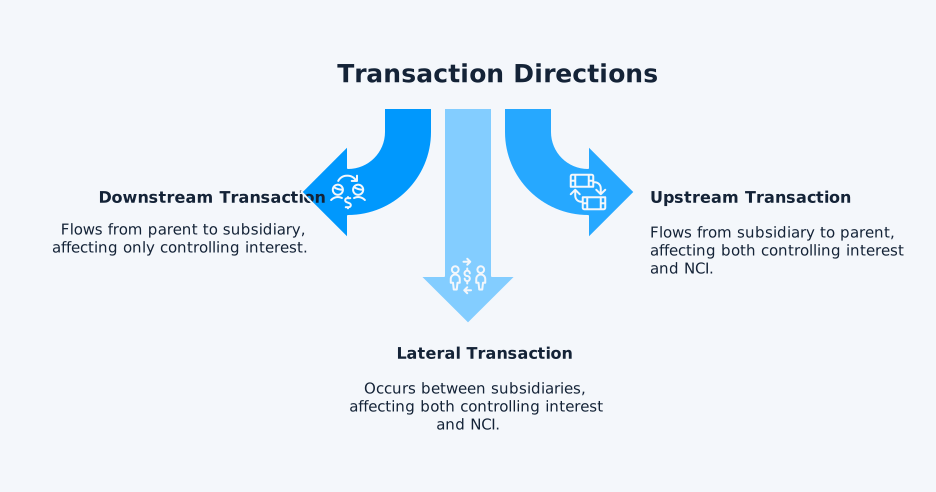
Transaction direction affects how you allocate elimination impacts between controlling and non-controlling interests.
Downstream Transactions
Downstream transactions flow from parent to subsidiary. The parent sells goods, provides loans, or charges management fees to its subsidiaries. The parent initiates these transactions and records any resulting profit or loss.
For wholly-owned subsidiaries, downstream eliminations impact only the controlling interest. All unrealised profit eliminates against the parent’s accounts. Non-controlling interest (NCI) isn’t affected because the parent, not the subsidiary, generated the profit.
Upstream Transactions
Upstream transactions flow from subsidiary to parent. The subsidiary sells to or provides services to the parent company. The subsidiary records the profit or loss.
Upstream eliminations become more complex when you don’t own 100% of the subsidiary. The unrealised profit elimination must be allocated proportionally between the controlling interest and NCI. If your 80%-owned subsidiary books £10,000 profit on a sale to the parent and the goods remain unsold, you eliminate £10,000. But £2,000 (20%) of that elimination reduces NCI’s share of subsidiary profit.
Lateral Transactions
Lateral transactions occur between subsidiaries at the same organisational level. Neither entity has ownership control over the other. Subsidiary A sells to Subsidiary B, both wholly-owned by the same parent.
Accounting treatment for lateral transactions mirrors upstream transactions. The selling subsidiary records profit, and elimination impacts both the controlling interest and any NCI proportionally based on ownership percentages.
Unrealised Profit Elimination in Intercompany Inventory Sales
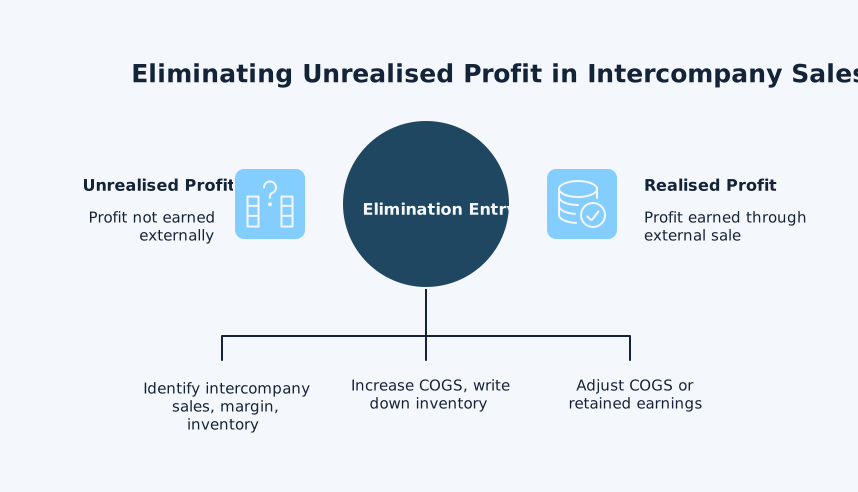
Unrealised profit elimination prevents recognising profit on inventory still held within the group. When one entity sells to another at a markup and the buying entity hasn’t resold to external customers, profit remains unrealised from the group’s perspective.
The Unrealised Profit Calculation
Calculate unrealised profit by identifying:
- Intercompany sales during the period
- Profit margin on those sales
- Inventory from intercompany purchases remaining at period-end
Example: Subsidiary A sells £200,000 of goods to Subsidiary B at a 30% gross profit margin. At period-end, Subsidiary B holds £60,000 of these goods in inventory.
Unrealised profit calculation:
£60,000 (ending inventory) × 30% (profit margin) = £18,000
The £18,000 represents profit Subsidiary A recorded but the group hasn’t earned through external sale. Your consolidation must defer this profit.
The Elimination Entry
Dr. Cost of Goods Sold £18,000
Cr. Inventory £18,000
This entry increases consolidated COGS by £18,000 (reducing consolidated profit) and writes down consolidated inventory to cost-to-the-group. The inventory value becomes £42,000 (£60,000 – £18,000), matching what Subsidiary A originally paid for the goods.
Realising the Profit in Subsequent Periods
When Subsidiary B sells the inventory to external customers in the following period, the deferred profit becomes realised. The treatment of this reversal depends on your consolidation approach and whether the prior period is closed.
Common approaches include:
Current period COGS adjustment: Some systems reverse through current period cost of goods sold:
Dr. Inventory (beginning balance) £18,000
Cr. Cost of Goods Sold £18,000
Opening retained earnings adjustment: Other methods run the reversal through opening consolidated retained earnings or a consolidation reserve, particularly when the prior period is closed:
Dr. Opening Retained Earnings £18,000
Cr. Cost of Goods Sold £18,000
The outcome is the same: profit is recognised in consolidated statements when the external sale occurs. Your consolidation software or methodology determines the specific entry mechanics. Automated systems typically handle this reversal automatically based on configured rules.
Common Challenges in Intercompany Transaction Elimination
Manual elimination processes create numerous operational challenges that delay financial close and introduce errors.
1. Timing Differences Between Entities
One subsidiary books a transaction on 31 March. The counterparty subsidiary books it on 2 April. This timing mismatch creates an automatic imbalance. Monthly cut-offs differ, reconciliation fails, and you spend hours investigating discrepancies that stem purely from timing.
2. Currency Exchange Rate Fluctuations
Multi-currency groups face exchange rate complications. Subsidiary A in Germany records a €100,000 sale in euros. Subsidiary B in the United States records the purchase in dollars. Daily exchange rate movements mean the euro and dollar values never match precisely. Manual processes using spreadsheets often miss these fluctuations entirely.
Under IAS 21, The Effects of Changes in Foreign Exchange Rates, each entity records transactions in its functional currency and then translates results into the group’s presentation currency for consolidation. Differences between booking dates and exchange rates create translation variances that must be reconciled before elimination.
3. Inconsistent Accounting Policies
Different subsidiaries may use different depreciation methods, revenue recognition timing, or inventory valuation approaches. IFRS 10 requires uniform accounting policies across consolidated entities, where practicable. You must adjust subsidiary policies to match the parent before consolidation, adding another layer of complexity.
4. Tracking Thousands of Transactions
Large organisations process hundreds of thousands of intercompany transactions annually. Each requires identification, reconciliation with its counterparty entry, and proper elimination. Spreadsheet-based tracking breaks down rapidly at scale.
5. Missing Unrealised Profit Adjustments
Unrealised profit in inventory, fixed assets, or other transferred goods requires calculation and elimination. These adjustments often get missed in manual processes because finance teams lack visibility into which goods remain within the group versus those sold externally.
6. Audit Trail Gaps
Spreadsheet eliminations lack systematic documentation. Who made the elimination entry? When? Based on what supporting calculation? Auditors require complete trails from consolidated statements back to source transactions. Manual spreadsheets provide no system-level audit trail. IFRS-based consolidations require documented adjustments showing who made each elimination, when, and based on what support. Without this, reconciliation gaps surface during audits and delay sign-off.
How dataSights Automates Intercompany Eliminations
dataSights delivers consolidated Management Reports with automated intercompany eliminations, real-time updates, and full audit trails directly through the platform. Your Xero data flows into a dedicated SQL database, where elimination logic is applied before feeding your management packs. Finance teams preferring spreadsheets can automate custom Excel reports, and Power BI users can access drill-down dashboards connected to the same consolidated data model.
Automated Elimination Rules
Configure elimination rules once in your SQL database layer. When intercompany transactions post, the system identifies counterparties and applies elimination logic automatically. Auto-eliminations handle:
- Intercompany debt cancellation (loans, advances, receivables, payables)
- Revenue and expense elimination (sales between entities)
- Unrealised profit calculation and deferral
- Investment vs equity elimination for ownership interests
All eliminations include timestamps, user identification, and supporting calculations. Auditors can trace every adjustment from consolidated statements back to source transactions.
Real-Time Consolidated Visibility
Your Xero consolidation updates continuously rather than waiting for month-end. Intercompany issues surface daily when the context is fresh. You fix mismatches immediately instead of discovering problems two weeks after the period close.
Management reports deliver consolidated P&L, Balance Sheet, and Trial Balance with eliminations already applied. Your board-ready reports update automatically as transactions post, cutting month-end close from more than 15 days to under 5 days.
Multi-Currency Handling
Exchange rate tables update daily in your SQL database. Multi-currency eliminations apply current rates automatically. Timing differences between entity postings get flagged for reconciliation before they create consolidation errors.
Excel and Power BI Automation
Excel automation brings consolidated data with eliminations into spreadsheets for custom analysis. Power Query refreshes automatically, eliminating CSV exports and manual manipulation.
Power BI connections enable drill-down from consolidated figures to underlying transactions. You can trace any elimination back to its source entries across entities with full visibility.
Compliance and Control Environment
Centralised elimination rules create a stronger control environment than ad-hoc spreadsheet adjustments. Your consolidation logic lives in documented SQL procedures rather than scattered across multiple Excel workbooks. Changes require deliberate updates to central procedures, creating natural change management controls.
External auditors can review consolidation logic in transparent SQL views, test elimination rules, and verify that adjustments follow consistent, documented standards.
Frequently Asked Questions
What's the Difference Between ASC 810 and IFRS 10 for Intercompany Eliminations?
Both ASC 810 (US GAAP) and IFRS 10 require full elimination of intercompany transactions and balances. The core principle is identical: consolidated statements present the group as a single economic entity. Minor differences exist in terminology (GAAP uses “intercompany,” IFRS uses “intragroup”) and specific implementation guidance, but elimination mechanics remain the same.
How Does Non-Controlling Interest Affect Intercompany Eliminations?
ASC 810 states that elimination amounts aren’t affected by non-controlling interest. You eliminate 100% of intercompany transactions regardless of ownership percentage. However, the allocation of elimination impacts differs. Downstream eliminations (parent to subsidiary) reduce only the controlling interest. Upstream eliminations (subsidiary to parent) reduce both controlling interest and NCI proportionally.
Why Do Consolidation Systems Require Double-Entry Logic?
Double-entry logic prevents one-sided elimination entries that compromise financial statements. When you eliminate an intercompany loan, both the receivable and payable must cancel simultaneously. Software lacking double-entry capabilities can create unbalanced eliminations where one side gets removed but the counterparty entry remains.
How Do You Handle Intercompany Transactions in Different Currencies?
Currency translation occurs before elimination. Convert all transactions to the group’s presentation currency using appropriate exchange rates. Then eliminate the translated amounts. Timing differences between when entities book transactions can create mismatches if exchange rates change between booking dates.
What Happens if Intercompany Accounts Don't Reconcile?
Unreconciled intercompany accounts delay consolidation and signal control weaknesses. Investigate immediately to identify whether the mismatch stems from timing differences, missing transactions, exchange rate variations, or errors. Monthly reconciliation of intercompany accounts prevents period-end surprises and ensures eliminations balance.
Can You Eliminate Intercompany Profit on Services?
Services consumed immediately don’t create unrealised profit requiring elimination. If Subsidiary A provides IT support to Subsidiary B for £50,000, you eliminate the revenue and expense, but no profit deferral is needed. The service was consumed, so the earnings process is complete. Profit elimination applies only to transactions creating assets that remain on group books.
Do You Need to Eliminate All Intercompany Transactions?
Yes. IFRS 10 requires eliminating intra-group balances, transactions, income, and expenses in full. This includes sales, purchases, loans, dividends, management fees, and any other intercompany activities. The only exception is when accounting for equity method investments rather than consolidation, where partial elimination may apply.
How Do You Automate Unrealised Profit Calculations?
Automated systems track which inventory items originated from intercompany purchases and calculate unrealised profit based on configured profit margins. When goods sell to external customers, the system processes the reversal based on your configured consolidation methodology, whether through current period COGS, opening retained earnings, or consolidation reserves. Manual tracking fails rapidly as transaction volumes increase.
Keeping Group Results Accurate and Audit-Ready
Intercompany transactions can overwhelm consolidation when eliminations aren’t timely or documented. By applying IFRS 10 and ASC 810 principles consistently, finance teams gain clarity, control, and confidence in group results. Automated eliminations surface issues early and reduce the manual effort that slows month-end. With structured processes and the right tools, producing accurate consolidated statements becomes far more manageable.
Transform Your Consolidation Reporting with Automated Eliminations
Stop spending weeks on manual intercompany eliminations that lack audit trails and introduce errors. dataSights’ Xero consolidation solution automates elimination entries with full documentation, cutting your month-end close from more than 15 days to under 5. Rated 5.0 out of 5 by 77+ Xero users, dataSights handles consolidation for small and large groups of entities with automatic intercompany elimination and real-time management reports. Join 300+ businesses who’ve already transformed their financial consolidation.
About the Author
Kevin Wiegand
Founder & Client happiness
I’m Kevin Wiegand, and with over 25 years of experience in software development and financial data automation, I’ve honed my skills and knowledge in building enterprise-grade solutions for complex consolidation and reporting challenges. My journey includes developing custom solutions for data teams at Gazprom Marketing & Trading and E.ON, before founding dataSights in 2016. Today, dataSights helps over 250 businesses achieve 100% report automation. I’m passionate about sharing my expertise to help CFOs and Financial Controllers reduce their month-end close time and eliminate the manual Excel exports that drain their teams’ valuable time.