
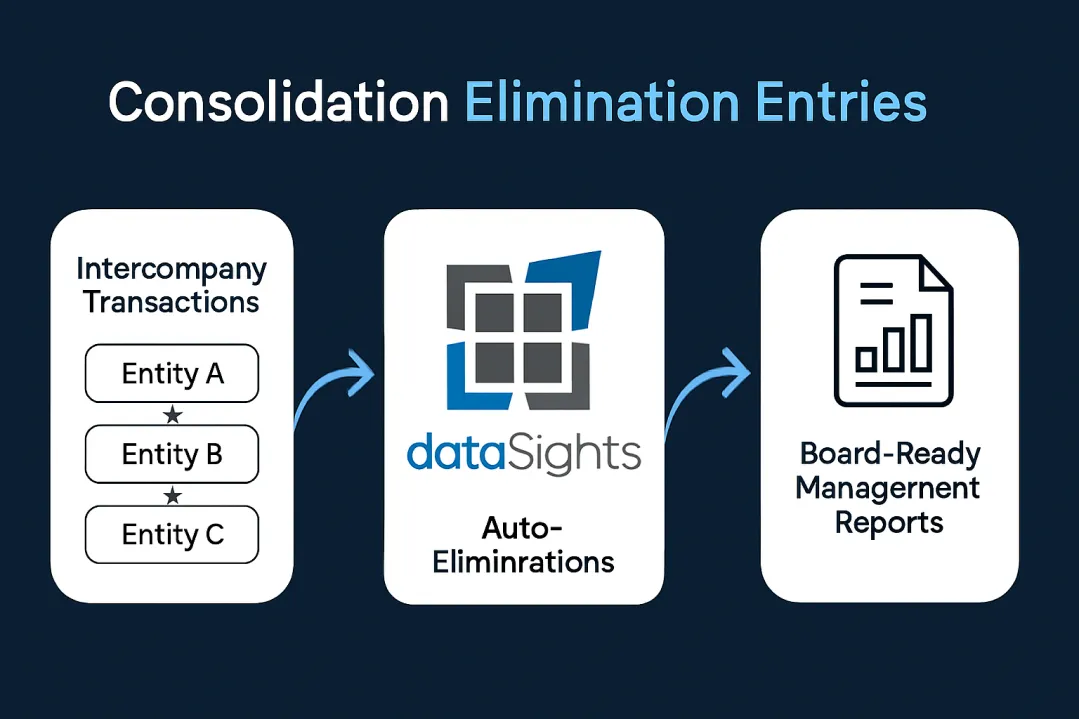
Your month-end close stretches into week three because intercompany balances refuse to reconcile. One subsidiary recorded a sale the other forgot to book as a purchase, and now the consolidated profit and loss overstates revenue by six figures. Consolidation elimination entries are the journal adjustments that fix this problem, removing internal transactions so your group financials reflect only external business activity. Getting these entries right is the difference between a clean close and days of detective work across spreadsheets. This guide covers every type of elimination entry, shows you exactly how to record them, and explains how automation removes the manual effort that causes most errors.
What Are Consolidation Elimination Entries?
Consolidation elimination entries remove intra-group balances, income, expenses, dividends and unrealised profits so the consolidated financial statements show only external activity. Under IFRS 10 and ASC 810, group financials must be presented as a single economic entity, which is why intercompany sales, loans, and internal distributions need to be eliminated before reporting. The main categories include intercompany revenue and expense, debt, unrealised profit, investment eliminations and intercompany dividends. Elimination journals net to zero in the consolidation column: debits equal credits so the consolidated totals reflect only external activity.
Ready to Automate Your Financial Consolidation?
Stop wrestling with manual consolidations and broken formulas. dataSights automates multi-entity reporting, Xero consolidations, and Power BI connections. Join 300+ businesses already transforming their financial reporting with our platform, rated 5.0 out of 5 by 90+ verified Xero users.
Table of Contents
Why Consolidation Elimination Entries Matter
Framework note: This guide primarily references IFRS 10, IFRS 3, IAS 21 and IAS 36, which are common reference points for UK-adopted IFRS reporting. UK groups using FRS 102 follow similar consolidation principles, but areas such as goodwill treatment and some exemption rules differ.
When a parent company and its subsidiaries operate as separate legal entities, they each record transactions between themselves in their own books. From a group perspective, these internal transactions must be removed before presenting consolidated financial statements. Without proper elimination entries, your consolidated reports will:
- Overstate revenue
- Inflate assets
- Misrepresent the group’s true financial position
The Single Entity Principle
The core principle behind elimination entries is straightforward: a group cannot make a profit from itself. Under IFRS 10, consolidated financial statements present the assets, liabilities, equity, income, expenses and cash flows of a parent and its subsidiaries as those of a single economic entity. This means every intercompany transaction creates mirror entries that must cancel out on consolidation.
What Happens Without Proper Eliminations
Consider a group where Entity A sells services worth £100,000 to Entity B. Without elimination entries:
- Consolidated revenue is overstated by £100,000
- Consolidated expenses are overstated by £100,000
- Intercompany receivables and payables inflate the balance sheet
- Stakeholders, auditors and regulators see distorted figures
The elimination entry removes both the £100,000 revenue in Entity A and the £100,000 expense in Entity B. The group has not earned anything from itself.
Required Components of Consolidated Financial Statements
Consolidated financial statements are not just one report. IAS 1 specifies what a complete set must include, while IFRS 10 sets when a group must prepare them and how results (including non-controlling interests) are presented. Use the checklist below to align your group close and disclose your basis of consolidation and significant accounting policies in the notes.
A full set of consolidated financial statements includes:
- Statement of financial position (balance sheet)
- Statement of profit or loss and other comprehensive income (IAS 1 permits this as a single combined statement or as two separate statements)
- Statement of changes in equity
- Statement of cash flows
- Notes, including significant accounting policies and other explanatory information
Five Types of Consolidation Elimination Entries
Each type of elimination entry addresses a different category of intercompany activity. Understanding all five is critical to producing accurate consolidated financial statements. Below is a breakdown of each type with worked examples you can apply directly.
1. Intercompany Revenue and Expense Eliminations
When one entity sells goods or services to another entity in the same group, the revenue and related cost must be eliminated. When one group entity provides goods or services to another, the intercompany portion of revenue and the matching intercompany expense must be eliminated so the consolidated statements show only external activity. IFRS 10 requires intra-group income and expenses to be removed on consolidation.
Worked example:
Entity A provides management services to Entity B for £200,000. Entity A records £200,000 revenue. Entity B records £200,000 management fee expense.
Elimination entry:
| Account | Debit | Credit |
| Revenue (Entity A) | £200,000 | |
| Management Fee Expense (Entity B) | £200,000 |
This entry removes the internal management fee from consolidated revenue and the corresponding expense, ensuring the group’s income statement reflects only transactions with external parties.
2. Intercompany Debt Eliminations
Intercompany loans create matching receivables and payables across entities. On consolidation, these offsetting balances must be removed because the group cannot owe money to itself. Any related interest income and interest expense must also be eliminated.
Worked example:
Parent lends £500,000 to Subsidiary at 5% annual interest. Both the £500,000 loan balance and the £25,000 interest income/expense eliminate on consolidation – no cash has entered or left the group.
| Account | Debit | Credit |
| Intercompany Payable (Subsidiary) | £500,000 | |
| Intercompany Receivable (Parent) | £500,000 | |
| Interest Income (Parent) | £25,000 | |
| Interest Expense (Subsidiary) | £25,000 |
3. Unrealised Profit on Inventory Transfers
When one entity sells inventory to another at a markup and the receiving entity has not resold that inventory by year-end, the unrealised profit must be eliminated from consolidated inventory and group profit. This adjustment is easy to overlook during financial consolidation because it requires tracking unsold inventory across entities at each reporting date. ACCA’s consolidation guidance explains that until inventory is sold to entities outside the group, any profit is unrealised and should be eliminated from the consolidated financial statements.
Worked example:
Entity A sells £50,000 of inventory to Entity B at a £10,000 markup. Entity B has not resold it by year-end. The £10,000 unrealised profit must be eliminated from consolidated inventory and group profit.
| Account | Debit | Credit |
| Cost of Goods Sold | £10,000 | |
| Inventory | £10,000 |
Once Entity B resells the inventory to an external customer, the profit becomes realised and no further elimination is needed.
If the transfer is upstream (subsidiary to parent), the unrealised profit elimination also affects the amount attributed to non-controlling interests. If it is downstream (parent to subsidiary), it reduces the parent’s profit but does not reduce the NCI share.
4. Investment (Equity) Elimination Entries
At the point of acquisition, the parent’s investment in a subsidiary must be eliminated against the subsidiary’s identifiable net assets at fair value. This prevents double-counting of the subsidiary’s net assets. Any difference between the purchase price and the fair value of identifiable net assets acquired is recognised as goodwill under IFRS 3.
Worked example:
Parent pays £800,000 for 100% of Subsidiary. At acquisition, the subsidiary’s identifiable net assets have a fair value of £600,000 (comprising £100,000 share capital, £300,000 retained earnings and a £200,000 fair value uplift on property). The £200,000 difference is recognised as goodwill on the consolidated balance sheet.
| Account | Debit | Credit |
| Share Capital (Subsidiary) | £100,000 | |
| Retained Earnings (Subsidiary) | £300,000 | |
| Fair Value Uplift on Net Assets | £200,000 | |
| Goodwill | £200,000 | |
| Investment in Subsidiary (Parent) | £800,000 |
Note: Xero does not calculate or track goodwill. This adjustment must be made in your consolidation layer. Goodwill is recognised under IFRS 3 at acquisition; impairment testing is governed by IAS 36.
For UK groups using FRS 102 rather than UK-adopted IFRS, goodwill treatment can differ because amortisation may apply instead of an impairment-only model.
5. Intercompany Dividend Eliminations
Dividends paid by subsidiaries to the parent represent internal distributions. The dividend income in the parent eliminates against the dividend declared by the subsidiary. Only dividends paid to external shareholders appear in the consolidated statements.
Worked example:
Subsidiary declares £50,000 dividend. Parent owns 100% and records £50,000 dividend income.
| Account | Debit | Credit |
| Dividend Income (Parent) | £50,000 | |
| Dividends Declared (Subsidiary) | £50,000 |
See Auto-Eliminations in Action
dataSights delivers consolidated Management Reports through its web platform as the primary output, with Excel automation available for finance teams that prefer spreadsheet workflows and Power BI available for deeper drill-down and custom dashboards. The walkthrough below shows how automated elimination entries feed the reporting stack.
How to Record Consolidation Elimination Entries
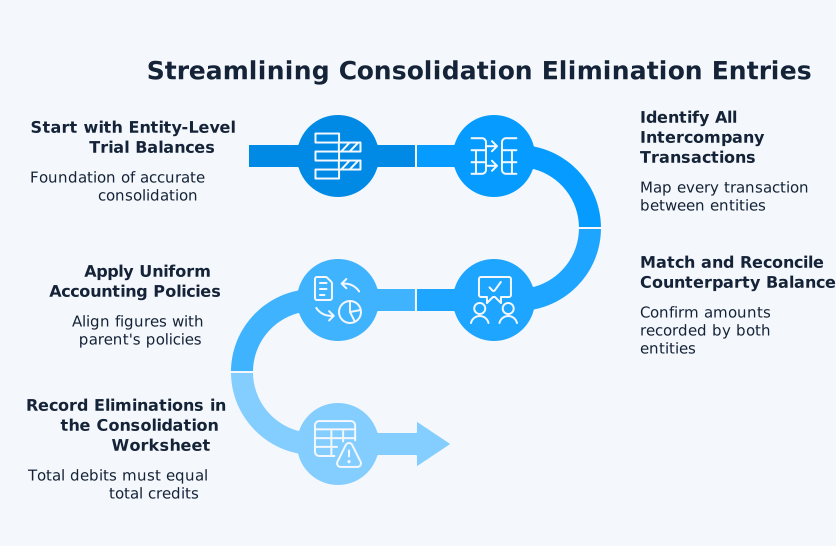
Recording elimination entries follows a structured process that starts with your entity-level Trial Balances and ends with a balanced consolidation worksheet. Whether you use spreadsheets or automated software, the steps below apply.
Step 1: Start with Entity-Level Trial Balances
Your Trial Balance is the foundation of accurate consolidation. Every elimination entry must reconcile back to entity-level Trial Balances. Without this alignment, your consolidated reports lack credibility. dataSights pulls full Trial Balance data from each Xero entity automatically via API, ensuring consolidations always tie back to source systems.
Step 2: Identify All Intercompany Transactions
Map every transaction between entities in your group. This includes sales, purchases, loans, interest charges, management fees, dividends and asset transfers. Use designated intercompany account codes in your chart of accounts to flag these transactions for elimination.
Step 3: Match and Reconcile Counterparty Balances
Before recording eliminations, confirm that the amounts recorded by both entities agree. If Entity A shows a £100,000 receivable from Entity B, Entity B must show a matching £100,000 payable. Discrepancies here are the most common cause of consolidation delays.
Step 4: Apply Uniform Accounting Policies
If subsidiaries use different accounting policies, adjust their figures to align with the parent’s policies before consolidation. IFRS 10 requires uniform accounting policies for similar transactions across the group.
Step 5: Record Eliminations in the Consolidation Worksheet
Your consolidation worksheet should include columns for each entity, elimination debits, elimination credits, and the final consolidated balance. Total elimination debits must equal total elimination credits. The consolidated column shows the group result after all adjustments.
Documentation Requirements
Proper documentation of elimination entries is critical for maintaining audit trails and ensuring compliance. The consolidation journal entries must detail:
- The source transactions
- Entities involved
- Amounts eliminated
- The business rationale
This documentation supports both internal reviews and external audits.
Include supporting schedules showing:
- Intercompany reconciliations
- Ownership percentages for NCI calculations
- Subsidiary equity rollforwards
These working papers demonstrate the completeness and accuracy of your elimination process. Keep documentation that ties each elimination to source transactions, including descriptions, references and user/date stamps.
Common Challenges in Processing Elimination Entries
While the principles of consolidation eliminations are straightforward, real-world application often brings complications that finance teams must navigate carefully.
1. Timing Differences and Cut-off Issues
Transactions recorded in different periods by related entities create reconciliation problems. One entity might record a sale in March, while the buyer records the purchase in April due to goods in transit. These timing differences must be identified and adjusted before elimination to ensure accurate consolidation.
Cut-off procedures become critical at period-end. Establish clear policies about when intercompany transactions are recognised and ensure all entities follow consistent practices to minimise timing discrepancies.
2. Different Year-End Dates
If subsidiaries have reporting dates that differ from the parent’s, IFRS 10 Appendix B (paragraph B92) requires alignment with the parent’s reporting date. A maximum three-month difference is allowed; however, adjustments must be made for any significant transactions that occur between the two reporting periods. This ensures group results reflect consistent reporting periods across all entities.
Common Errors in Consolidation Elimination Entries
Even experienced finance teams make mistakes with elimination entries. A 2024 peer-reviewed literature review covering 35 years of spreadsheet-error research concluded that, across industries, approximately 94% of operational spreadsheets contain faults (Poon et al., Frontiers of Computer Science). In consolidation specifically, manual elimination management in spreadsheets is a leading source of reconciliation errors because it lacks audit trails and automated matching. Below are the most frequent problems and how to avoid them.
1. Mismatched Intercompany Balances
When Entity A records a £150,000 receivable but Entity B only shows a £145,000 payable, the £5,000 difference creates an imbalance that flows through to the consolidated balance sheet. Common causes include timing differences, foreign exchange rate discrepancies and simple data entry errors.
2. Forgetting Unrealised Profit Adjustments
Eliminating the intercompany sale is only half the process. If the receiving entity holds unsold inventory at year-end, you must also eliminate the unrealised profit markup. Missing this adjustment overstates consolidated inventory and group profit.
3. Incomplete Elimination of Interest
Teams often eliminate the loan principal but forget to eliminate the corresponding interest income and expense. Both sides of every intercompany transaction must be addressed.
4. Version Control Failures in Spreadsheets
Spreadsheets remain useful, but managing elimination entries across multiple entities amplifies three specific risks:
- Version-control failures when several people edit the same consolidation file
- Formula errors propagate silently through linked workbooks
- Weak audit trails make it difficult to trace who changed what and when
These are the same categories of risk identified in the Poon et al. research above, and they become particularly acute during consolidation because elimination entries involve repeated cross-entity adjustments under tight month-end deadlines.
5. Volume and Complexity at Scale
Large organisations with numerous entities face exponential complexity in elimination processing. Manual spreadsheet-driven consolidation increases reconciliation effort and error risk compared with systems that apply repeatable elimination rules and audit trails. The sheer volume of transactions requiring elimination can overwhelm traditional spreadsheet-based approaches, particularly when managing eliminations across different business units, varying accounting policies, and multiple reporting requirements.
Manual vs Automated Elimination Entries
The choice between manual and automated eliminations directly affects your close speed, error rate and audit readiness. Here is how the two approaches compare for multi-entity groups.
Manual elimination processes often:
- Extend the close
- Weaken audit trails
- Make intercompany mismatches harder to trace across entities
With configured automation:
- Elimination entries are applied consistently
- Counterparty mismatches surface earlier
- Many finance teams reduce month-end close from over 15 days to under 5
dataSights supports both small and large groups of entities, with outputs delivered first through Management Reports, then Excel automation for spreadsheet-led teams, and Power BI for deeper drill-down analysis.
Note for Xero users: Xero supports accounting for separate entities, but has no native intercompany module. All eliminations must be managed outside Xero through specialist consolidation software or your reporting layer. dataSights supports this process through configured elimination logic, account mappings, and audit trails across your Xero entities. Once mappings, counterparties, and policy decisions are set correctly, intercompany eliminations can be processed consistently each period with far less manual spreadsheet work.
Automated eliminations matter because they feed board-ready Management Reports, not just compliant consolidated statements. dataSights delivers those outputs first through the web platform, then into Excel through Office Add-In and Power Query for spreadsheet-led teams, with Power BI available where deeper visualisation and drill-down are required.
Best Practices for Consolidation Elimination Entries
Beyond the mechanics, successful elimination processing depends on consistent standards, strong controls, and clear documentation across all entities.
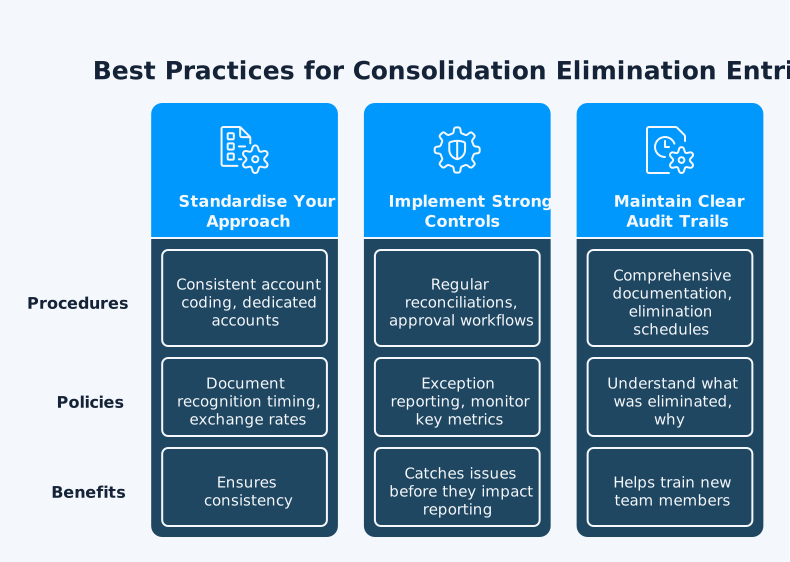
1. Standardise Your Approach
Successful elimination processing starts with standardised procedures across all entities. Establish consistent account coding for intercompany transactions, making them easily identifiable during consolidation. Use dedicated intercompany accounts rather than mixing external and internal transactions in the same general ledger accounts.
Document your elimination policies in full detail, covering recognition timing, exchange rate methodologies, and profit margin calculations. This standardisation ensures consistency regardless of who performs the consolidation.
2. Implement Strong Controls
Elimination entries require strong controls to ensure completeness and accuracy. Regular intercompany reconciliations should occur throughout the period, not just at month-end. Implement approval workflows for elimination journals and maintain segregation of duties between recording and reviewing eliminations.
Establish exception reporting to flag unusual or missing eliminations. Monitor key metrics like intercompany balance mismatches and unreconciled differences to catch issues before they impact consolidated reporting.
3. Maintain Clear Audit Trails
Every elimination entry requires complete documentation that links back to the source transactions. Maintain elimination schedules that show opening balances, current period activity, eliminations processed, and closing positions for all intercompany accounts.
Your audit trail should enable any reviewer to understand what was eliminated, why it was necessary, and how the amounts were calculated. This documentation proves invaluable during audits and helps train new team members on your consolidation process.
Elimination Entries and Non-Controlling Interest
When the parent owns less than 100% of a subsidiary, non-controlling interest (NCI) represents the portion of equity and profit attributable to outside shareholders. Full consolidation includes 100% of the subsidiary’s balances, then separately accounts for the NCI share.
Worked example:
Parent owns 80% of Sub A. Sub A reports £100,000 profit after eliminations. The full £100,000 appears on the consolidated income statement, but £20,000 (20%) is attributed to non-controlling interests. On the balance sheet, NCI appears as a separate equity line.
All intercompany balances still eliminate in full at group level, regardless of ownership percentage. However, transaction direction matters for profit attribution. Downstream eliminations (parent to subsidiary) reduce the parent’s profit, while upstream eliminations (subsidiary to parent) reduce subsidiary profit and therefore reduce the amount attributed to non-controlling interests.
Foreign Currency and Elimination Entries
For IFRS-reporting groups, IAS 21 governs how foreign operations are translated before consolidation. Each subsidiary first measures transactions in its functional currency, then its financial statements are translated into the group’s presentation currency for consolidation:
- Assets and liabilities are translated at the closing rate
- Income and expenses are translated at transaction-date rates or appropriate period averages
- Translation differences are recognised in other comprehensive income through the foreign currency translation reserve
- Retained earnings are built from prior-period translated balances rather than a single historical-rate line item
When eliminating intercompany loan balances across currencies, the receivable and payable may translate to different amounts due to exchange rate movements. The treatment of the resulting exchange difference depends on the nature of the intercompany item:
- Regular intercompany monetary items (such as short-term trade receivables): Exchange differences are recognised in profit or loss in the individual entity accounts and remain in consolidated results after elimination of the underlying balance
- Monetary items forming part of a net investment in a foreign operation (such as a long-term intercompany loan with no planned settlement): Under IAS 21.32, exchange differences are recognised in profit or loss in each entity’s separate or individual financial statements. However, in the consolidated financial statements, those same differences are recognised in other comprehensive income (OCI) and accumulated in the foreign currency translation reserve (FCTR) until disposal of the foreign operation
In both cases, a difference between the translated receivable and payable is an exchange difference governed by IAS 21, not an elimination error. Configured FX tables and audit trails reduce manual rate-selection errors and make the translation method easier to review at audit time.
Jurisdictional Exemptions
Not all groups are legally required to prepare consolidated accounts:
- UK: Under the Companies Act 2006, small groups may be exempt from preparing consolidated financial statements. Check current thresholds as these change periodically.
- Australia: Under AASB 10, intermediate parents may be exempt from preparing consolidated financial statements if the conditions in paragraph 4(a) are met and a higher-level parent produces IFRS-compliant consolidated accounts. The ultimate Australian parent cannot be exempt (AASB 10, paragraph Aus 4.2).
- New Zealand: NZ IFRS 10 provides equivalent intermediate parent exemptions, but the ultimate New Zealand parent must always prepare consolidated financial statements (NZ IFRS 10, paragraph NZ 4.2).
Even when exemptions apply, many organisations still prepare management consolidations for boards, lenders, and investors. dataSights supports these management consolidations alongside statutory requirements.
Frequently Asked Questions
What Is the Difference Between Elimination Entries and Adjusting Entries?
Elimination entries remove the effects of intercompany transactions during consolidation. Adjusting entries correct errors or align accounting policies in individual entity books before consolidation. Both are required for accurate consolidated financial statements, but they serve different purposes and are recorded at different stages.
Do Elimination Entries Appear in the Individual Entity's General Ledger?
No. Elimination entries are recorded only in the consolidation worksheet or consolidation software. They do not affect the individual financial statements of any entity. Each subsidiary continues to report its own transactions as normal on a standalone basis.
When Should Consolidation Elimination Entries Be Recorded?
Elimination entries are typically recorded at each reporting period-end when preparing consolidated financial statements. However, many organisations now process eliminations continuously throughout the period using automated systems, providing near-real-time consolidated visibility rather than waiting for month-end.
How Do You Calculate Unrealised Profit in Inventory?
Calculate unrealised profit by applying the markup percentage to the value of goods remaining in the purchasing entity’s inventory at period-end. For example, if goods were sold at a 20% markup on cost and £60,000 of transfer-price inventory remains unsold, unrealised profit equals £10,000 (£60,000 x 20/120).
Do All Intercompany Transactions Require Elimination?
Yes. IFRS 10 requires eliminating intra-group balances, transactions, income and expenses in full. This includes sales, purchases, loans, dividends, management fees and any other intercompany activities that would inflate the group’s financial position if left unadjusted.
What Happens if Intercompany Balances Do Not Match?
Mismatched intercompany balances must be investigated and resolved before recording elimination entries. Common causes include timing differences (one entity recorded the transaction in a different period), foreign exchange rate variations, and data entry errors. Automated reconciliation tools flag these discrepancies before they reach the consolidated statements.
Are Consolidation Elimination Entries Reversing Entries?
That depends on the consolidation system, not on an accounting rule. Many platforms recalculate elimination entries each period on a year-to-date basis, effectively reversing and reposting them automatically. Others carry forward prior-period eliminations and layer incremental adjustments on top. The accounting standards require that all intra-group balances are fully eliminated in each set of consolidated financial statements, but they do not prescribe how the software should handle period transitions. Check how your specific consolidation tool manages this so your team understands whether eliminations reset or roll forward at period-end.
Can You Automate Consolidation Elimination Entries in Xero?
Xero has no native intercompany module or built-in elimination functionality. However, consolidation software like dataSights connects directly to your Xero entities via API, identifies intercompany transactions, and applies pre-configured elimination rules automatically with full audit trails.
What Documentation Is Required for Elimination Entries?
Documentation should include intercompany reconciliations, elimination journal entries with clear descriptions, supporting calculations for unrealised profit, ownership percentage schedules for NCI calculations and audit trails linking eliminations to source transactions. This documentation supports both compliance and audit requirements.
What About Associates and Joint Ventures?
Associates and joint ventures are not fully consolidated in the same way as subsidiaries. Where the group has significant influence rather than control, IAS 28 generally requires the equity method. Joint ventures are also typically accounted for using the equity method under IFRS 11, rather than line-by-line consolidation.
How Long Should the Elimination Process Take?
The time required depends on entity count, transaction volume and close design. For manual spreadsheet processes, eliminations often represent a significant portion of the overall close cycle because each intercompany balance must be identified, matched and journalled individually. Automated solutions reduce this by applying configured rules as data refreshes, so eliminations that previously consumed days of manual effort can be processed in minutes.
Should Elimination Entries Be Posted to a Separate Entity?
Many organisations create a separate elimination entity or journal set to clearly distinguish consolidation adjustments from actual entity transactions. This approach provides clearer audit trails and simplifies reversal of eliminations for the next period.
Stop Chasing Intercompany Errors at Month-End
Consolidation elimination entries are the foundation of accurate group financial reporting. The five types covered in this guide, from intercompany revenue eliminations through to investment and dividend adjustments, follow consistent patterns once you understand the underlying principle: a group cannot transact with itself. The difference between a clean five-day close and a painful fifteen-day close comes down to whether your elimination process is manual or automated. With the right tools and clear processes, your team moves from fixing data to analysing results.
Turn Elimination Entries Into Board-Ready Management Reports
dataSights delivers automated Management Reports with reconciled Trial Balance data, intercompany eliminations, and full audit trails through the web platform. For teams that prefer spreadsheets, the same consolidated data refreshes into Excel through Office Add-In and Power Query, while Power BI is available for deeper drill-down and custom visualisation. Rated 5.0 by 90+ Xero users and used by 300+ businesses, dataSights helps finance teams move from manual reconciliation work to faster, cleaner group reporting.
About the Author
Kevin Wiegand
Founder & Client happiness
I’m Kevin Wiegand, and with over 25 years of experience in software development and financial data automation, I’ve honed my skills and knowledge in building enterprise-grade solutions for complex consolidation and reporting challenges. My journey includes developing custom solutions for data teams at Gazprom Marketing & Trading and E.ON, before founding dataSights in 2016. Today, dataSights helps over 300 businesses achieve 100% report automation. I’m passionate about sharing my expertise to help CFOs and Financial Controllers reduce their month-end close time and eliminate the manual Excel exports that drain their teams’ valuable time.