
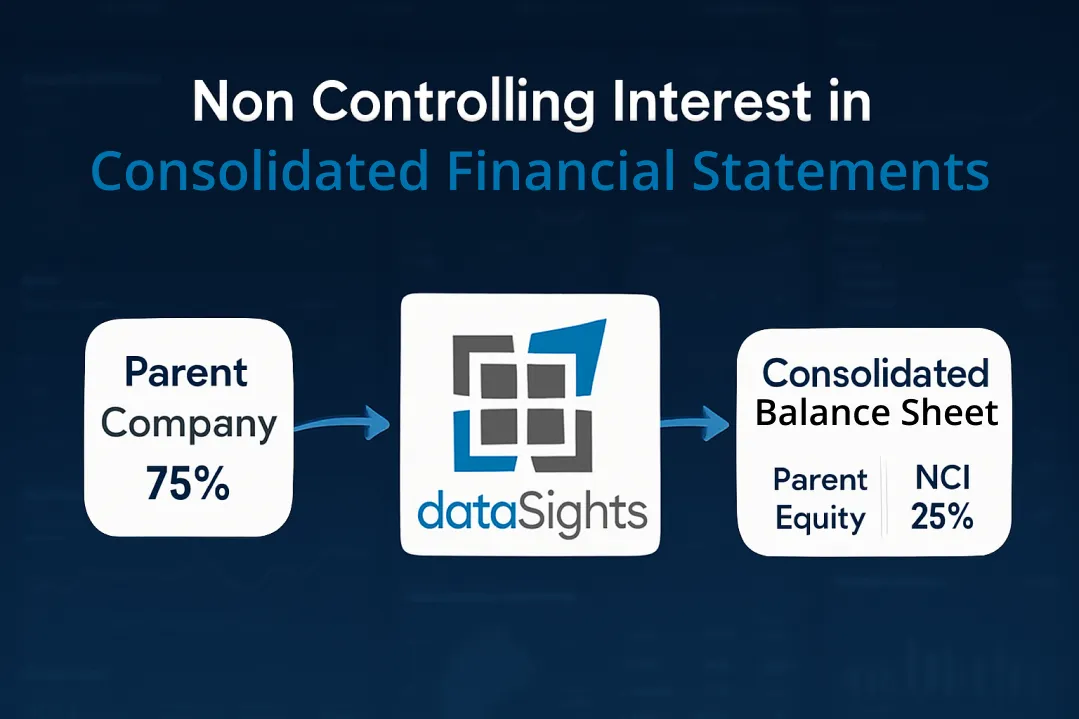
You own 75% of a subsidiary but consolidate 100% of its financials – then your accountant creates something called “non controlling interest in consolidated financial statements” for the remaining 25%. This represents the equity and earnings belonging to minority shareholders who don’t control the company. IFRS 10 requires presenting 100% of subsidiary assets, liabilities, revenues, and expenses when you control an entity, even if you don’t own all of it. Understanding non controlling interest in consolidated financial statements is essential for accurate multi-entity reporting and compliance with accounting standards.
What is Non Controlling Interest in Consolidated Financial Statements?
Non controlling interest in consolidated financial statements represents the portion of a subsidiary’s equity and profit that belongs to minority shareholders, not the parent company. Under IFRS 10 and ASC 810, you consolidate 100% of a controlled subsidiary’s assets, liabilities, income, and expenses, then allocate profit and equity between the parent and non controlling interest. This structure gives boards a clear view of total group performance while still showing how much value flows to external minority investors.
Ready to Automate Your Financial Consolidation?
Stop wrestling with manual consolidations and broken formulas. dataSights automates multi-entity reporting, Xero consolidations, and Power BI connections. Join 300+ businesses already transforming their financial reporting with our platform, rated 5.0 out of 5 by 90+ verified Xero users.
Table of Contents
Understanding Non Controlling Interest in Consolidation
NCI exists because of one accounting rule: when you control a subsidiary, you consolidate 100% of its financials regardless of ownership percentage. This creates a mismatch between what your consolidated statements show (100% of subsidiary performance) and what your shareholders actually own (your percentage only). NCI separates the portions, showing which equity and earnings belong to parent shareholders versus minority investors who lack control.
What Is Non Controlling Interest?
Non controlling interest is defined under ASC 810-10-20 as the portion of equity (net assets) in a subsidiary not attributable, directly or indirectly, to a parent. This occurs in partial acquisitions where the parent company acquires controlling interest (typically over 50% of voting rights) but not complete ownership of the subsidiary.
The key principle: when you control a subsidiary, you consolidate 100% of its financials regardless of your ownership percentage. Once you establish control, the degree of consolidation remains unchanged – you report as if you own the entire subsidiary. Control under IFRS 10 requires power over relevant activities, exposure to variable returns, and ability to affect those returns through your power.
Control Determines Consolidation, Not Ownership Percentage
Under IFRS 10, control – not ownership percentage – determines whether you consolidate. You consolidate when you have:
- Power over the investee’s relevant activities
- Exposure or rights to variable returns from the investee
- Ability to use your power to affect those returns
Ownership above 50% usually indicates control, but you can control with less than 50% through voting arrangements, board representation, or contractual rights. Conversely, owning more than 50% doesn’t guarantee control if other shareholders have protective rights or joint control arrangements exist.
From Minority Interest to Non Controlling Interest
The terminology changed from “minority interest” to “non controlling interest” with FASB Statement 160 in 2008. The old term didn’t encompass all scenarios – for example, a majority owner might not have control in bankruptcy situations, or conversely, an owner with less than 50% might have control through voting arrangements. “Non controlling interest” more accurately describes shareholders who have economic interests without control, regardless of the specific ownership percentage.
Why Full Consolidation Creates NCI
Full consolidation presents consolidated financial statements as if the parent controls 100% of the subsidiary’s operations. Every line item – revenues, expenses, assets, liabilities—includes 100% of the subsidiary’s amounts. This creates a mismatch: the consolidated statements show 100% of net assets and profits, but the parent’s shareholders only have a claim to their proportionate share.
NCI resolves this by appearing as:
- A separate line in the equity section of the consolidated balance sheet
- A deduction in the consolidated income statement showing profit attributable to NCI
- An allocation in the statement of comprehensive income between parent and NCI
This presentation gives stakeholders transparency into which portion of consolidated performance belongs to parent shareholders versus external minority shareholders.
Where Non Controlling Interest Appears in Financial Statements
NCI appears in three places across your consolidated financials. Each location serves a specific purpose – showing minority shareholders’ claims on assets, earnings, and comprehensive income. Understanding where NCI sits helps you verify your consolidation accuracy and explain ownership structures to stakeholders.
Balance Sheet Presentation
Under IFRS 10.22, NCI must be presented within equity in the consolidated statement of financial position, separate from equity attributable to owners of the parent. It typically appears as a separate line item at the bottom of the equity section, after parent shareholders’ equity.
For example, Walmart’s consolidated balance sheet shows NCI as a distinct equity line after retained earnings and accumulated other comprehensive income. This equity classification replaced the old practice where some companies presented minority interest in a “mezzanine” section between liabilities and equity – a practice no longer acceptable under current standards.
The balance sheet NCI amount represents:
- The NCI’s proportionate share of the subsidiary’s fair value net assets at acquisition
- Plus the NCI’s share of the subsidiary’s post-acquisition retained earnings
- Less the NCI’s share of dividends paid by the subsidiary
- Adjusted for the NCI’s share of other comprehensive income
Income Statement Presentation
Consolidated income statements present net income for the entire enterprise, then allocate it between the parent and NCI. The allocation typically appears near the bottom of the income statement, after arriving at consolidated net income.
The presentation shows:
- Consolidated revenues and expenses (100% of subsidiary included)
- Consolidated net income (total for the group)
- Less: Net income attributable to non controlling interest
- Net income attributable to parent company shareholders
Earnings per share calculations use only the income attributable to the parent, not the total consolidated net income. This ensures EPS reflects returns available to parent company shareholders.
Statement of Comprehensive Income
The consolidated total of accumulated other comprehensive income (AOCI) must also be allocated between the controlling and noncontrolling interests. Items like foreign currency translation adjustments, unrealised gains on available-for-sale securities, and pension adjustments flow through OCI and accumulate in equity. Both the parent’s and NCI’s shares of these amounts must be separately identified.
How to Measure Non Controlling Interest at Acquisition
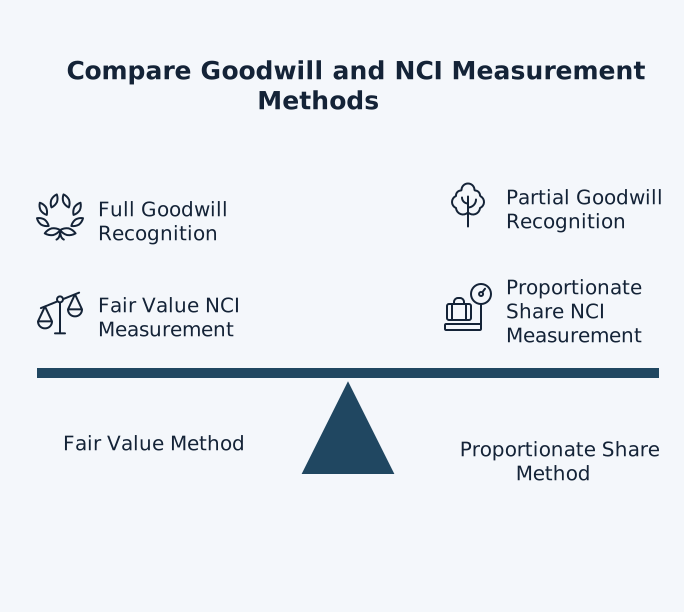
You choose how to measure NCI at acquisition, and this choice affects goodwill permanently. IFRS 3 offers two methods – fair value or proportionate share. Your decision impacts initial balance sheets, subsequent impairment tests, and future transactions with minority shareholders.
IFRS 3 provides two measurement options for NCI at acquisition, and this choice affects the amount of goodwill recognised. The measurement method is an accounting policy choice made on a transaction-by-transaction basis.
Fair Value Method (Full Goodwill)
The fair value method measures NCI at its fair market value on the acquisition date. This approach recognises 100% of the goodwill in the acquiree – both the acquirer’s share and the NCI’s share. It’s sometimes called the “full goodwill model.”
Example: Parent pays £800,000 for an 80% interest in Subsidiary. The fair value of the Subsidiary’s identifiable net assets is £750,000. Using valuation techniques, the fair value of the remaining 20% (the NCI) on the acquisition date is determined to be £180,000.
Goodwill calculation:
- Consideration paid by parent: £800,000
- Fair value of NCI: £180,000
- Total: £980,000
- Less: Fair value of identifiable net assets: £750,000
- Goodwill recognised: £230,000
Proportionate Share Method (Partial Goodwill)
The proportionate share method measures NCI at the NCI’s proportionate share of the acquiree’s identifiable net assets. This method only recognises the acquirer’s share of goodwill – a lesser amount than under the fair value method.
Using the same example:
Goodwill calculation:
- Consideration paid by parent: £800,000
- Less: 80% of fair value of identifiable net assets (£750,000 × 80%): £600,000
- Goodwill recognised: £200,000
NCI measured at:
- £750,000 × 20% = £150,000
The difference between methods:
- Fair value method: £230,000 goodwill, £180,000 NCI
- Proportionate method: £200,000 goodwill, £150,000 NCI
The choice affects subsequent impairment testing and transactions with NCI. Under fair value, both parent and NCI bear impairment losses proportionately. Under the proportionate share method, a notional adjustment is required for impairment calculations.
Note: US GAAP only allows fair value accounting for NCI, whereas IFRS gives the choice between the two methods.
How to Calculate Non Controlling Interest
NCI calculations follow straightforward formulas, but you must apply them correctly at acquisition and every reporting period after. Start with the basic percentage calculation, then track how subsidiary performance and dividends change NCI over time. These calculations feed directly into your consolidated equity and income allocations.
Basic NCI Formula
The formula for calculating NCI uses the subsidiary’s net assets multiplied by the minority ownership percentage:
NCI = Subsidiary’s Net Assets × NCI Ownership Percentage
Net assets equal total assets minus liabilities. For acquisition date calculations, use the fair value of identifiable net assets.
Worked Calculation Example
Company A acquires 75% of Company B for £50 million. At acquisition:
- Fair value of Company B’s net assets: £40 million
- Book value of Company B’s net assets: £35 million
NCI at acquisition date: NCI = £40 million × 25% = £10 million
This can be broken down as:
- Proportionate share of book value net assets: £35 million × 25% = £8.75 million
- Plus proportionate share of fair value adjustment: (£40m – £35m) × 25% = £1.25 million
- Total NCI: £10 million
Subsequent Period NCI Calculation
After acquisition, NCI changes based on the subsidiary’s performance and dividend policy. The formula for subsequent balance sheet dates:
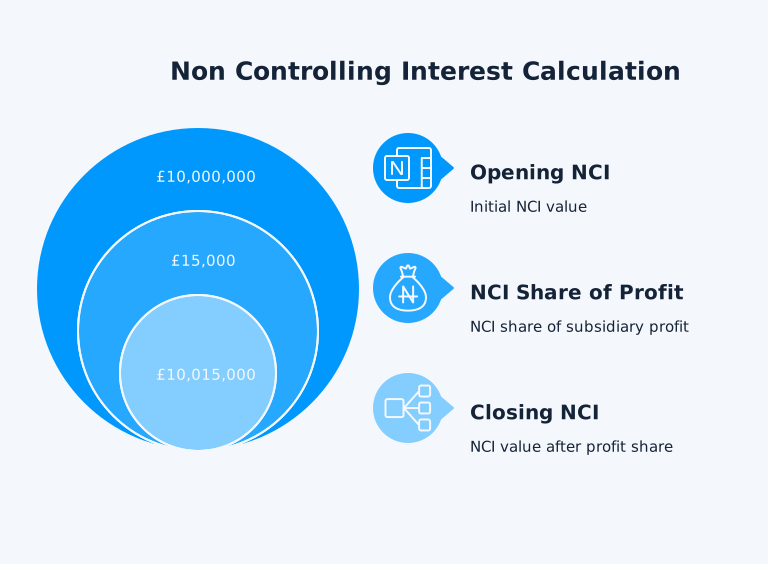
NCI = Opening NCI + (Subsidiary Net Income × NCI %) – (Subsidiary Dividends × NCI %)
Continuing the example, assume one year after acquisition:
- Subsidiary net profit: £60,000
- No dividends paid
NCI one year after acquisition:
- Opening NCI: £10,000,000
- Add: NCI share of profit (£60,000 × 25%): £15,000
- Closing NCI: £10,015,000
This base analysis approach tracks how NCI moves through the financial statements – starting with the balance sheet, connecting to income statement earnings, and returning to the balance sheet.
NCI Impact on Consolidation and Goodwill
Your NCI measurement choice creates permanent differences in goodwill recognition. Fair value records both parent and minority goodwill. Proportionate share records only your portion. This affects impairment calculations and how you account for intercompany eliminations when subsidiaries aren’t fully owned.
Goodwill Calculation Differences
The choice of NCI measurement method directly affects goodwill recognised at acquisition. Under the full goodwill model (fair value method), you recognise 100% of goodwill including the NCI’s share. Under partial goodwill (proportionate method), only the parent’s share of goodwill appears.
This matters for:
- Initial balance sheet presentation
- Subsequent impairment testing
- Transactions with NCI after acquisition
These goodwill calculations happen in the consolidation layer rather than within entity ledgers like Xero. Xero does not calculate or track goodwill automatically – the adjustment is applied through your consolidation software or reporting layer.
Impairment Testing with NCI
When testing a cash-generating unit with NCI for impairment, the methodology differs based on initial measurement method.
- With fair value method: Compare the carrying amount (including full goodwill) directly to recoverable amount. Any impairment loss is allocated between parent and NCI based on their relative interests.
- With proportionate method: IAS 36 requires a notional adjustment to gross up the goodwill before comparing to the recoverable amount.
If parent’s goodwill is £160 representing 80%, the notional NCI goodwill would be £40 (£160 × 20%/80%), giving total goodwill of £200 for impairment testing.
Consolidation Eliminations and NCI
When preparing consolidated financial statements with elimination entries, the direction of intercompany transactions affects NCI attribution:
- Downstream transactions (parent → subsidiary): Eliminations reduce the parent’s profit. NCI is not affected because the transaction originated from the parent.
- Upstream transactions (subsidiary → parent): Eliminations reduce the subsidiary’s profit, and therefore the NCI’s share decreases accordingly. The parent’s share of the elimination also increases proportionately.
This distinction ensures consolidated statements accurately reflect how intercompany profit eliminations affect different shareholder groups.
Changes in Ownership Without Loss of Control
When you buy additional subsidiary shares or sell portions while keeping control, the accounting differs completely from acquisition accounting. No gain or loss hits your income statement. No assets get revalued. The entire transaction adjusts equity directly, reallocating amounts between parent shareholders and NCI.
Equity Transaction Accounting
Under both IFRS 10 and ASC 810-10, changes in ownership interest that don’t result in loss of control are accounted for as equity transactions. This means:
- No gain or loss is recognised in profit or loss
- No remeasurement of assets or liabilities to fair value
- The difference between consideration paid/received and the change in NCI is recorded in equity
Increasing Ownership (Buying Out NCI)
When a parent purchases additional shares from NCI holders:
- Debit: NCI (for the carrying amount being eliminated)
- Credit: Cash (consideration paid)
- The difference adjusts parent’s equity
Example: Parent owns 70% of Subsidiary with NCI carrying amount of £300,000. Parent purchases the remaining 30% for £350,000.
- Reduce NCI by £300,000
- Pay cash £350,000
- Reduce parent’s equity by £50,000 (the excess paid over NCI carrying amount)
No goodwill is recognised on this subsequent purchase – the entire amount is an equity adjustment.
Decreasing Ownership (Selling to Create NCI)
When a parent sells a portion of its interest while retaining control:
- Receive cash from NCI investors
- Increase NCI for the carrying amount of the interest sold
- The difference adjusts parent’s equity
This commonly occurs when subsidiaries undergo IPOs or when parent companies need to raise capital without losing control.
NCI and Enterprise Value Calculations
Enterprise value calculations require adding back NCI to avoid valuation errors. Your consolidated EBITDA includes 100% of subsidiary performance, so your enterprise value numerator must reflect 100% of claims – including minority shareholders. Skip this adjustment and your valuation multiples understate true enterprise value.
Adding NCI to Enterprise Value
When calculating enterprise value for valuation purposes, NCI must be added back. Enterprise value represents the value available to all capital providers, not just equity holders.
Since consolidated metrics like EBITDA include 100% of subsidiaries’ performance, the valuation numerator must also reflect 100% of claims:
Enterprise Value = Market Cap + Debt + NCI – Cash
This ensures the numerator and denominator in valuation multiples (like EV/EBITDA) are compatible – both representing 100% of the consolidated entity.
NCI in DCF Valuations
When valuing a parent company using discounted cash flow:
- Project cash flows for the entire consolidated group
- Discount at the consolidated weighted average cost of capital
- The resulting enterprise value includes claims from both parent shareholders and NCI
- Subtract NCI’s fair value to arrive at equity value attributable to parent shareholders
Failing to account for NCI in enterprise value calculations creates a valuation mismatch – the cash flows include 100% of subsidiary performance, but the value wouldn’t recognise NCI holders’ claims on those cash flows.
Automating Multi-Entity Consolidation with NCI
Manual NCI calculations across multiple subsidiaries extend month-end close beyond two weeks. You track opening balances, allocate subsidiary profits, adjust for dividends, then reconcile consolidated equity – repeated for every subsidiary with minority shareholders. dataSights automates this entire workflow from Trial Balance through to final NCI attributions.
Trial Balance Foundation for NCI Calculations
Every consolidation involving NCI must start from accurate entity-level Trial Balances. The Trial Balance ensures all subsidiary accounts reconcile before you begin attribution between parent and NCI. Without this foundation, you risk misallocating profits and equity between shareholder groups.
dataSights delivers pre-formatted management packs with consolidated Trial Balance data across all your Xero entities. When calculating NCI, our platform:
- Pulls full Trial Balance data from each subsidiary’s Xero account
- Ensures all subsidiary accounts balance before consolidation
- Maintains complete audit trails showing data lineage from subsidiary accounts through to NCI calculations
- Validates that consolidated equity correctly splits between parent and NCI
Excel Automation for NCI Calculations
For teams wanting to automate NCI calculations in Excel, dataSights’ Xero consolidation solution automates data imports with scheduled refreshes. The OfficeAddIn and Power Query eliminate manual CSV exports, letting you:
- Build NCI calculation models that refresh automatically with live consolidated data
- Create subsidiary-level models showing profit attribution between parent and NCI
- Develop rolling forecasts incorporating NCI dividend policies
- Automate month-end NCI reconciliations without manual data manipulation
75% of dataSights customers automate Excel for their reporting workflows. You maintain full control over your NCI calculation logic while we handle the data automation.
Power BI for Multi-Entity NCI Visualisation
For teams requiring advanced NCI visualisation, Power BI integration provides real-time connections and interactive dashboards. Connect directly to your consolidated Xero data to:
- Visualise NCI changes across multiple subsidiaries simultaneously
- Drill down from group-level NCI to individual subsidiary contributions
- Track NCI profit attribution across fiscal periods
- Compare actual NCI movements against forecasts
dataSights connects your consolidated Xero data directly to Power BI with automatic refresh—no manual data exports required.
Handling Small and Large Entity Groups
dataSights manages consolidation for both small and large entity structures at scale without performance degradation. One client consolidated data from 72 Xero entities within 3 seconds. Whether you’re consolidating two subsidiaries with NCI or managing complex group structures with multiple minority interests, automated data sync maintains accuracy across all ownership levels.
For multi-entity groups with NCI, automation removes the manual reconciliation burden that typically extends month-end close beyond two weeks. dataSights clients consistently reduce month-end close from over 15 days to under 5 – fully reconciled Trial Balances with NCI calculations complete.
Frequently Asked Questions
Is Non Controlling Interest the Same as Minority Interest?
Yes, they’re the same concept. The terminology changed from “minority interest” to “non controlling interest” with FASB Statement 160 in 2008. The new term more accurately describes shareholders who have economic interests without control, regardless of specific ownership percentages. Both terms refer to the equity portion of a subsidiary not owned by the parent company.
Where Does NCI Appear on the Balance Sheet?
IFRS 10.22 requires NCI to be presented within equity in the consolidated statement of financial position, separate from the equity attributable to owners of the parent. It appears as a distinct line item at the bottom of the equity section, after parent shareholders’ equity, but still within total equity.
How Do You Calculate the NCI Percentage?
The NCI percentage equals the portion of subsidiary shares not owned by the parent. If the parent owns 80% of subsidiary shares, NCI is 20%. To calculate NCI value: multiply the subsidiary’s net assets by the NCI percentage. For ongoing periods, start with opening NCI, add the NCI’s share of subsidiary profit, and subtract the NCI’s share of dividends.
What Happens to NCI When the Subsidiary Makes Losses?
NCI can maintain a negative balance due to cumulative losses attributed to it, even in the absence of an obligation to invest further. The parent allocates losses to NCI based on their ownership percentage. If losses exceed NCI’s equity, the balance becomes negative. The parent only absorbs additional losses beyond NCI’s interest if it has a legal or constructive obligation to do so.
Does NCI Affect the Parent's Earnings Per Share?
Earnings per share calculations use only the income attributable to the parent company shareholders, not total consolidated net income. The consolidated income statement shows total net income, then deducts the portion attributable to NCI, and only the remainder factors into EPS calculations. This ensures EPS reflects returns available to parent shareholders.
Can Non Controlling Interest Be Negative?
Yes. Under IFRS 10.B94, non controlling interests can have a negative balance when cumulative losses allocated to them exceed their initial investment and subsequent profits. The parent continues allocating losses to NCI until NCI becomes negative, unless the parent has an obligation to absorb those losses under a contractual arrangement or constructive obligation.
How Does NCI Impact Enterprise Value Calculations?
NCI must be added when calculating enterprise value because enterprise value represents claims from all capital providers, not just parent shareholders. Since EBITDA includes 100% of the subsidiary’s performance, adding NCI to market cap ensures the numerator and denominator are consistent – both reflecting 100% of the consolidated entity.
What's the Difference Between Direct and Indirect NCI?
Direct NCI allocates both pre-acquisition and post-acquisition equity proportionately to minority shareholders from the acquisition date. Indirect NCI only accounts for post-acquisition profits that minorities receive. Direct NCI is more common under current standards, where NCI receives its full proportionate share from the moment control is established.
Do I Need to Consolidate If I Own Exactly 50%?
Consolidation depends on control, not ownership percentage alone. Under IFRS 10, an investor controls an investee when it has power over relevant activities, exposure to variable returns, and ability to affect those returns through its power. At exactly 50% ownership, additional factors determine control – such as casting votes, board control, or contractual arrangements. If you have control, consolidate with 50% NCI. Without control, IFRS 11 joint venture or IAS 28 equity method accounting applies.
How Does NCI Treatment Differ Between IFRS and US GAAP?
Both IFRS 10 and ASC 810-10 require NCI presentation within equity, separate from parent equity. The major difference: IFRS allows choosing between fair value or proportionate share methods for measuring NCI at acquisition, while US GAAP requires fair value only. Both frameworks allocate subsidiary profit/loss between parent and NCI, and both treat ownership changes without loss of control as equity transactions.
Getting NCI Right Matters for Accurate Consolidation
NCI isn’t just an accounting technicality – it shows stakeholders which portions of consolidated assets, profits, and equity belong to parent shareholders versus minority investors. Your measurement choice (fair value or proportionate share) affects goodwill, impairment testing, and ownership transactions. Manual NCI calculations across entity spreadsheets extend month-end close beyond two weeks. Automated Trial Balance consolidation with integrated NCI tracking completes in days with full audit trails.
Automate Your NCI Calculations with Xero Consolidation
Ready to stop manually calculating NCI across multiple spreadsheets? dataSights’ Xero consolidation solution automates multi-entity reporting with full Trial Balance reconciliation and board-ready management packs. Our platform handles both small and large entity consolidations at scale, maintaining complete audit trails from subsidiary accounts through to final NCI attributions. Rated 5.0 out of 5 by over 90 Xero users. Join 300+ businesses that’ve transformed their financial consolidation.
About the Author
Kevin Wiegand
Founder & Client happiness
I’m Kevin Wiegand, and with over 25 years of experience in software development and financial data automation, I’ve honed my skills and knowledge in building enterprise-grade solutions for complex consolidation and reporting challenges. My journey includes developing custom solutions for data teams at Gazprom Marketing & Trading and E.ON, before founding dataSights in 2016. Today, dataSights helps over 300 businesses achieve 100% report automation. I’m passionate about sharing my expertise to help CFOs and Financial Controllers reduce their month-end close time and eliminate the manual Excel exports that drain their teams’ valuable time.