
Managing multiple Xero entities is hard – intercompany balances, FX translations, and late adjustments can wreck your close. This guide clarifies unconsolidated vs consolidated financials: what each shows, when to use them, and how they affect reporting. You’ll see how control (not just ownership %) drives consolidation, what to eliminate, and where NCI and goodwill fit. By the end, you’ll know exactly which set to present and how to keep it audit-ready.
Unconsolidated vs Consolidated Financials: What's the Difference?
In short, unconsolidated (parent-only) financials show a single entity, while consolidated financials present the parent and subsidiaries as one economic entity, removing intercompany balances and showing non-controlling interests separately. Consolidation is required when the parent controls another entity under IFRS 10 – Consolidated Financial Statements (power over relevant activities, exposure to variable returns, and the ability to affect those returns). Ownership above 50% often indicates control, but it isn’t mandatory if control exists by other means.
Ready to Automate Your Financial Consolidation?
Stop wrestling with manual consolidations and broken formulas. dataSights automates multi-entity reporting, Xero consolidations, and Power BI connections. Join 300+ businesses already transforming their financial reporting with our platform, rated 5.0 out of 5 by 90+ verified Xero users.
Table of Contents
What Are Consolidated Financials?
Consolidated financials combine the assets, liabilities, revenues, and expenses of a parent company and all its subsidiaries into unified financial statements. IFRS 10 establishes control as the basis for consolidation. Control exists when the parent has power over relevant activities, exposure to variable returns, and the ability to use that power to affect returns.
Who Must Prepare Consolidated Financials
Reporting frequency depends on your jurisdiction. In the United States, SEC registrants file quarterly reports on Form 10-Q (SEC Rule 13a-13). In the UK, listed issuers publish half-yearly reports in line with FCA DTR 4.2 (IAS 34).
For private companies, consolidation is driven by law and the reporting framework: in the UK/EU, parent companies generally must prepare group (consolidated) accounts unless an exemption applies (e.g., Companies Act 2006 s.399, Directive 2013/34/EU), while in the U.S. they don’t file with the SEC but must consolidate under ASC 810 when they have a controlling financial interest.
The requirements apply when:
- Parent owns more than 50% of the voting stock
- Parent has controlling interest despite lower ownership
- Parent controls decision-making through contractual arrangements
Certain UK small groups are exempt from group accounts; see Companies Act 2006, Part 15, Group Accounts. Exemptions also apply to some intermediate parents (e.g., section 401) where an upstream parent publishes IFRS-compliant consolidated accounts. Always check current thresholds and filing rules on GOV.UK – Preparing and filing accounts.
What’s Included in Consolidated Statements
A complete set of IFRS financial statements comprises:
- Statement of Financial Position: Combined assets, liabilities, and equity of parent and subsidiaries. Intercompany balances eliminated. Non-controlling interests are shown separately.
- Statement of Profit or Loss and Other Comprehensive Income: Combined revenues and expenses. Intercompany sales eliminated. Profit attributed to parent and non-controlling interests.
- Statement of Changes in Equity: Movement in retained earnings, share capital, and non-controlling interests.
- Cash Flow Statement: Combined operating, investing, and financing activities. Intercompany payments eliminated.
- Notes: Accounting policies, nature of control, treatment of non-controlling interests, and elimination policies.
What Are Unconsolidated Financials?
Unconsolidated financial statements show the financial position of individual entities separately without combining results. Each subsidiary maintains its own balance sheet, income statement, and cash flow statement. The parent company’s unconsolidated statements show investments in subsidiaries as single line items, not detailed assets and liabilities.
When to Use Unconsolidated Statements
You prepare unconsolidated statements when:
- No Subsidiaries Exist: Single entities have no consolidation requirements.
- Internal Management Reporting: Division managers need entity-level performance data for operational decisions.
- Subsidiary Analysis: Investors want to evaluate specific subsidiary performance separately from the group.
- Legal Requirements: Some jurisdictions require parent-only statements in addition to consolidated statements. US SEC registrants provide Schedule I – Condensed financial information of registrant when restricted net assets of consolidated subsidiaries exceed 25% of consolidated net assets.
- Tax reporting (jurisdiction-aware): Tax filing is jurisdiction-specific: some countries permit group/consolidated returns (e.g., U.S. affiliated groups may elect a consolidated Form 1120), while others require separate company returns (e.g., UK companies file a CT600 per entity, with group relief mechanisms rather than a consolidated return).
Unconsolidated statements work for operational visibility. They don’t work for statutory reporting when you control subsidiaries.
Key Differences Between Unconsolidated and Consolidated Financials
The differences affect how you report, what you show investors, and how long month-end close takes.
Reporting Scope
- Consolidated: Shows parent and all subsidiaries as a single entity. Includes 100% of subsidiary assets and liabilities even if the parent owns less than 100%.
- Unconsolidated: Shows individual entity results. Parent’s investment in subsidiaries appears as a single asset line.
Intercompany Transactions
- Consolidated: All intercompany transactions eliminated. Sales between entities removed to avoid double-counting revenue.
- Unconsolidated: Intercompany transactions remain. Each entity records its sales to related parties.
Non-Controlling Interest
- Consolidated: Shows portion of subsidiaries owned by external shareholders separately in the equity section.
- Unconsolidated: Non-controlling interest doesn’t appear. Only parent’s direct ownership shown.
Preparation Complexity
- Consolidated: Requires elimination entries, fair value adjustments, and foreign currency translation; more work than parent-only reporting.
- Unconsolidated: Each entity prepares standalone statements. No eliminations required. Faster preparation but incomplete group picture.
Regulatory Compliance
- Consolidated: Required whenever a parent controls one or more entities – this applies to public and private groups. Under IFRS 10, consolidation is based on control; under US GAAP (ASC 810), entities with a controlling financial interest (voting-interest or VIE models) must consolidate. Many jurisdictions (e.g., UK/EU) also legally require parent companies to prepare group (consolidated) accounts unless an exemption applies.
- Unconsolidated: Acceptable for private companies without subsidiaries or for supplemental reporting.
Our automated consolidation handles all elimination entries and adjustments automatically. Clients cut month-end close from over 15 days to under 5 days.
The Consolidation Process: How It Works
Consolidation combines individual entity statements through systematic adjustments and eliminations.
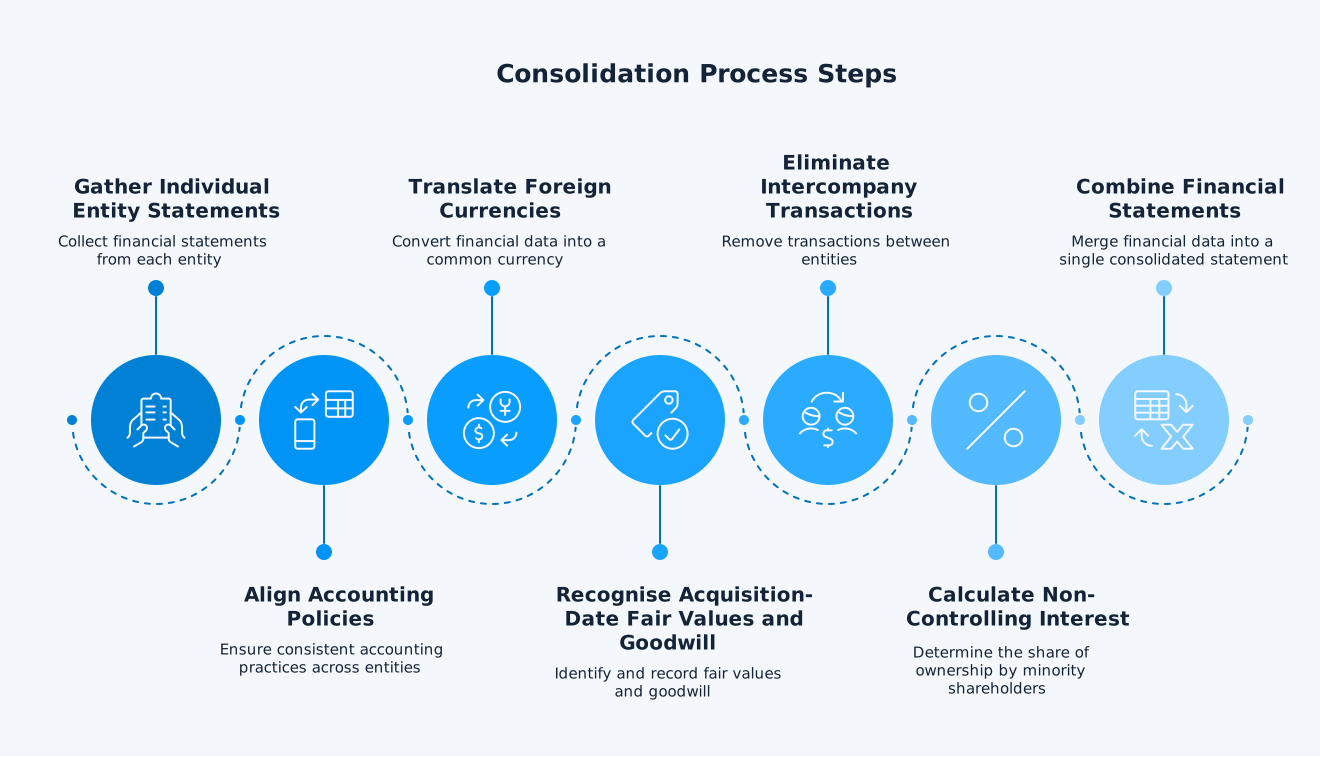
Step 1: Gather Individual Entity Statements
Collect balance sheets, income statements, and cash flow statements from parent and all subsidiaries. Ensure reporting dates align (IFRS permits a maximum three-month difference with adjustments for significant intervening transactions).
Step 2: Align Accounting Policies
Prepare consolidated financial statements using uniform accounting policies for like transactions and other events in similar circumstances. If any subsidiary uses different policies, adjust that subsidiary’s financial statements to conform to the group’s policies before consolidation as required by IFRS 10 (B87).
Step 3: Translate Foreign Currencies
Translate a foreign operation’s assets and liabilities at the closing rate and its income and expenses at transaction-date rates (an average rate may be used if it approximates the actual).
Step 4: Recognise Acquisition-date Fair Values and Goodwill (IFRS 3)
- Measure the acquiree’s identifiable assets and liabilities at fair value on the acquisition date.
- Measure non-controlling interest (NCI) at either (a) fair value or (b) proportionate share of identifiable net assets – this choice affects goodwill.
Goodwill formula:
Goodwill = consideration transferred + NCI + fair value of any previously held interest – fair value of net identifiable assets acquired.
- Recognise goodwill on the consolidated statement of financial position and test annually for impairment (no amortisation).
- If a bargain purchase arises (negative goodwill), reassess the measurements; any remaining excess is recognised in profit or loss.
See IFRS 3 – Business Combinations for the goodwill calculation and acquisition-date measurements, and IAS 36 – Impairment of Assets for annual impairment testing (no amortisation).
Step 5: Eliminate Intercompany Transactions
Eliminate in full intragroup:
- Assets
- Liabilities
- Equity
- Income
- Expenses
- Cash flows
Profits or losses recognised in assets (e.g., inventory, fixed assets):
- Eliminate in full
- Note: Intragroup losses may indicate an impairment that requires recognition
IAS 12 applies to temporary differences created by these eliminations.
This is where manual consolidation breaks. A 2024 QuickBooks survey found businesses spend 25 hours weekly on manual data entry and reconciling data across applications.
Intercompany Sales Elimination:
Subsidiary A sells £100,000 of goods to Subsidiary B. On consolidated statements:
- Remove £100,000 revenue (Subsidiary A)
- Remove £100,000 cost of goods sold (Subsidiary B)
- Net effect: Zero impact on consolidated profit
Sales between subsidiaries must be eliminated because the parent company’s consolidated net assets remain unchanged.
Intercompany Debt Elimination:
Parent loans £50,000 to subsidiary. On consolidated statements:
- Remove £50,000 receivable (parent balance sheet)
- Remove £50,000 payable (subsidiary balance sheet)
- Eliminate interest income and interest expense
Step 6: Calculate Non-Controlling Interest
When parent owns less than 100% of subsidiary, calculate external shareholders’ portion:
Parent owns 80% of subsidiary. Subsidiary reports £100,000 profit.
- Consolidated income statement shows £100,000 profit
- £20,000 attributed to non-controlling interest
- £80,000 attributed to parent
Step 7: Combine Financial Statements
Add together all line items from parent and subsidiaries after eliminations. Present the following:
- Consolidated balance sheet
- Income statement
- Cash flow statement
- Statement of changes in equity
Manual processes increase the risk of out-of-balance consolidations; automation reduces rework and makes the final tie-out dependable. Errors in elimination entries cause consolidations not to balance.
dataSights automates this entire process. Connect your Xero entities, map your accounts once, and run consolidations in seconds with automatic elimination entries.
When Consolidation Isn’t Required: Equity Method Accounting
Use the equity method for associates (significant influence) and joint ventures. Only the investor’s share of unrealised gains/losses on upstream/downstream transactions is eliminated while the asset remains within the group (IAS 28).
How the Equity Method Works
The equity method reports the investor’s proportionate share of the investee’s equity as a single line investment.
Investor owns 30% of Associate Company. Associate reports £100,000 net income and pays £50,000 dividends.
Investor’s accounting:
- Record investment at cost initially
- Increase investment by 30% of net income (£30,000)
- Decrease investment by 30% of dividends received (£15,000)
- Net increase to investment account: £15,000
Unlike full consolidation, the equity method eliminates only intercompany profits on assets still held, not all intercompany transactions.
Equity Method vs Full Consolidation
Ownership Level:
- Equity method: For associates (significant influence) and joint ventures
- Full consolidation: Parent controls the investee
Balance Sheet Treatment:
- Equity method: Single line item “Investment in Associate”
- Full consolidation: All subsidiary assets and liabilities included
Income Statement Treatment:
- Equity method: Single line “Share of profit of associates”
- Full consolidation: All subsidiary revenues and expenses included
Elimination Requirements:
- Equity method: Only the investor’s share of unrealised profits/losses on upstream and downstream transactions while the asset remains within the investor’s group
- Full consolidation: All intercompany transactions eliminated
Consolidation is required when the parent controls the investee; ownership above 50% often indicates control, but the test is control – not a percentage. Below that threshold with significant influence, equity method applies.
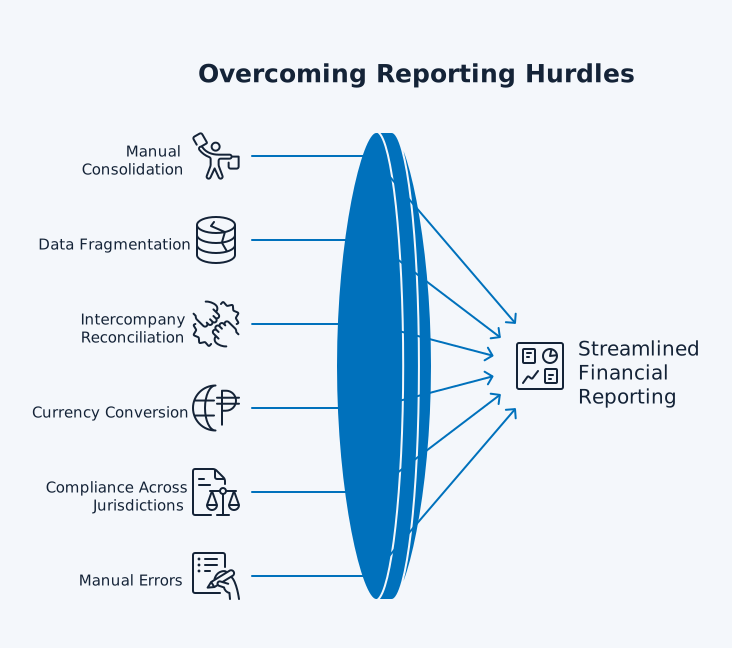
Multi-Entity Reporting Challenges
Manual consolidation creates bottlenecks that extend month-end close and increase error risk.
Data Fragmentation
Financial data is scattered across different Xero organisations, Excel spreadsheets, and local systems. Obtaining a comprehensive view becomes a mammoth task when data is dispersed. Without centralised visibility, you miss intercompany mismatches until they appear in unbalanced consolidations at month-end.
Intercompany Reconciliation
Matching intercompany transactions between entities causes delays. Subsidiary A records the sale to Subsidiary B on a different date than B records the purchase. Amounts don’t match due to timing differences. Intercompany transactions create reconciliation nightmares for finance teams. Finding and eliminating every transaction manually takes days.
Currency Conversion
Multi-jurisdiction groups must convert subsidiary results to parent currency. Exchange rate fluctuations significantly affect consolidated results. Manual currency conversion with spreadsheets introduces calculation errors.
Compliance Across Jurisdictions
Different subsidiaries follow different accounting standards. UK entities use FRS 102, Australian subsidiaries use AASB, and US operations follow GAAP. Reconciling these differences before consolidation adds complexity.
Manual Errors
Spreadsheet-based consolidation exposes you to formula errors, copy-paste mistakes, and broken links. One wrong cell reference breaks your entire consolidation. Our Xero consolidation solution eliminates these challenges. Connect unlimited Xero entities, automate intercompany eliminations, and generate consolidated statements in seconds.
How Automation Solves Consolidation Problems
Automated consolidation transforms month-end from 15-day marathons to 5-day sprints.
Automatic Intercompany Eliminations
The system identifies matching intercompany transactions across entities and creates elimination entries. Set rules once, apply forever.
Parent sells to Subsidiary for £50,000. System automatically:
- Eliminates £50,000 revenue from parent
- Eliminates £50,000 expense from subsidiary
- Creates audit trail documenting elimination
Real-Time Consolidation
View the consolidated balance sheet and income statement anytime – no waiting until month-end to discover problems. When intercompany transactions don’t match, you see it immediately. Fix issues while the context is fresh, not two weeks after month-end.
Trial Balance Foundation
All consolidations must tie back to entity Trial Balances. dataSights consolidations are always reconciled to the Trial Balance, giving you confidence in the accuracy of the data.
Multi-Currency Support
Automatically convert foreign subsidiaries to the parent reporting currency. Apply appropriate exchange rates to balance sheet and income statement items.
Audit Trails
Every elimination entry documented with a timestamp, user, and rationale. System-level audit logs show who changed what and when. Transform audit from interrogation to confirmation.
dataSights connects your Xero data directly to Power BI and Excel through automated imports. Create custom consolidated reports that update automatically with live data. No CSV exports, no manual processes.
Frequently Asked Questions
What's the Difference Between Combined and Consolidated Financial Statements?
Combined financial statements present entities under common control separately within one document. Consolidated statements merge parent and subsidiaries into a single entity presentation with intercompany eliminations.
Can I Use Unconsolidated Statements if I Have Subsidiaries?
Unconsolidated statements work for internal management but don’t meet statutory requirements. Consolidated statements are mandatory when you control a subsidiary. Ownership above 50% typically indicates control, but it’s not required if control exists by other means.
How Do I Know if I Need to Consolidate?
Under IFRS 10, consolidation is required when you control an investee through power over relevant activities, exposure to variable returns, and ability to use that power. Ownership over 50% typically indicates control, but the test is control – not a percentage.
What if My Subsidiary Has a Different Year-End?
If a subsidiary’s reporting date differs, align dates or consolidate using its most recent statements adjusted for significant intervening transactions; in any case, the date difference must be no more than three months. Make adjustments for significant transactions occurring between subsidiary’s close and the parent reporting date.
Do I Eliminate 100% of Intercompany Transactions?
Yes. Eliminate all intercompany transactions even if you own less than 100% of the subsidiary. Non-controlling interest adjustments happen separately.
How Long Should Consolidation Take?
Manual consolidation of 30+ entities often takes 15+ days. With automated consolidation software, the process completes in under 5 days. dataSights clients consolidate small and large groups of entities in seconds.
What Accounting Standards Govern Consolidation?
IFRS 10 governs international consolidation requirements. US companies follow ASC 810 under GAAP. Both require consolidation based on control.
Can I Avoid Consolidation for Small Groups?
Certain UK small groups may be exempt from group accounts; see Companies Act 2006 – Group accounts and check GOV.UK for current thresholds (they change periodically).
Stop Wrestling With Manual Consolidation
The takeaway is simple: use consolidated financials when you control subsidiaries, and parent-only (unconsolidated) when you need entity-level results or specific disclosures. Handle eliminations, NCI, FX and goodwill systematically so the group view is accurate, comparable and audit-ready. If you’re closing multiple entities in spreadsheets today, it’s time to streamline the workflow and cut friction before the next close.
Automate Your Xero Consolidation Today
Ready to cut month-end close from over 15 days to under 5? dataSights automates Xero consolidation across small and large groups of entities. Rated 5.0 out of 5 by 90+ Xero users. Join 300+ businesses who’ve already transformed their financial reporting with automated intercompany eliminations, real-time dashboards, and Trial Balance reconciliation.
About the Author
Kevin Wiegand
Founder & Client happiness
I’m Kevin Wiegand, and with over 25 years of experience in software development and financial data automation, I’ve honed my skills and knowledge in building enterprise-grade solutions for complex consolidation and reporting challenges. My journey includes developing custom solutions for data teams at Gazprom Marketing & Trading and E.ON, before founding dataSights in 2016. Today, dataSights helps over 300 businesses achieve 100% report automation. I’m passionate about sharing my expertise to help CFOs and Financial Controllers reduce their month-end close time and eliminate the manual Excel exports that drain their teams’ valuable time.