
Managing several entities means juggling separate Trial Balances, delayed reporting, and constant audit queries. If you need clear group-level visibility, consolidated group accounts become essential for accurate reporting and compliance. This guide explains what consolidated group accounts are, when UK law requires them, and how to prepare them without days of manual work. Let’s break down the process in a practical, CFO-friendly way.
What Are Consolidated Group Accounts?
Consolidated group accounts present a parent and its subsidiaries as one economic entity. They are required under the Companies Act 2006 when control exists and ensure accurate, transparent group reporting. They remove intercompany transactions, include non-controlling interests, and give finance teams a single reconciled view of the group’s financial performance.
Ready to Automate Your Financial Consolidation?
Stop wrestling with manual consolidations and broken formulas. dataSights automates multi-entity reporting, Xero consolidations, and Power BI connections. Join 300+ businesses already transforming their financial reporting with our platform, rated 5.0 out of 5 by 90+ verified Xero users.
Table of Contents
When UK Law Requires Group Accounts
Under section 399 of the Companies Act 2006, directors must prepare group accounts if their company is a parent at the financial year-end. Under Section 1162 of the Companies Act 2006, control is typically evidenced by:
- Voting rights exceeding 50%, or
- Rights to appoint or remove a majority of directors, or
- Dominant influence through provisions in the articles or control contract
Small groups qualify for exemption when meeting two of these three tests (thresholds increased from 6 April 2025):
- Annual turnover not exceeding £15m
- Balance sheet total not exceeding £7.5m
- Fewer than 50 employees on average
Under Section 400 of the Companies Act 2006, a UK subsidiary company is exempt from preparing consolidated accounts if it’s included in its parent’s consolidated accounts prepared under UK-adopted IFRS (or equivalent) and those accounts are publicly available.
The Technical Consolidation Process
This guide primarily references International Financial Reporting Standards (IFRS 10, IFRS 3, IAS 21, IAS 36) as most UK listed and large groups apply UK-adopted IFRS. UK groups using FRS 102 (UK GAAP) follow similar consolidation principles with some key differences highlighted in the FAQ section. The Companies Act 2006 legal requirements apply regardless of your chosen accounting framework.
Preparing consolidated group accounts requires a structured workflow, starting with entity-level accuracy and ending with group-level adjustments. The steps below outline the core technical processes finance teams must follow to produce compliant consolidated statements.
Start with Trial Balance Foundations
Every accurate consolidation begins with entity-level trial balances. Your consolidated balance sheet reconciles only when each subsidiary’s trial balance balances first. Without this foundation, eliminations create reconciliation gaps that surface weeks into month-end close.
Pull trial balances to the same reporting date. IFRS 10 permits up to a three-month reporting date difference when alignment is impracticable, with adjustments made for significant intervening transactions.
Combine and Eliminate
Add together all assets, liabilities, income, and expenses across entities. Then eliminate what doesn’t reflect external economic reality:
- Intercompany receivables and payables: Your parent owes the subsidiary £500k? That receivable/payable pair cancels out – the group owes nothing to itself.
- Intercompany sales and purchases: Parent sold inventory to subsidiary for £100k? Remove that £100k from both sales and purchases, so consolidated revenue reflects only external customer sales.
- Unrealised profit: Subsidiary bought inventory from parent for £80k (cost to parent: £60k). The subsidiary hasn’t resold it yet. Write down consolidated inventory by £20k to cost-to-group, deferring that profit until external sale.
When eliminating unrealised profit, direction matters. Downstream transactions (parent to subsidiary) reduce the parent’s profit only. Upstream transactions (subsidiary to parent) reduce the subsidiary’s profit, which also reduces the share attributable to non-controlling interest.
Recognise Goodwill Under IFRS 3
Goodwill represents future economic benefits from assets not individually identified in the business combination. Calculate it at acquisition as:
Consideration paid + Non-controlling interest – Fair value of net assets = Goodwill
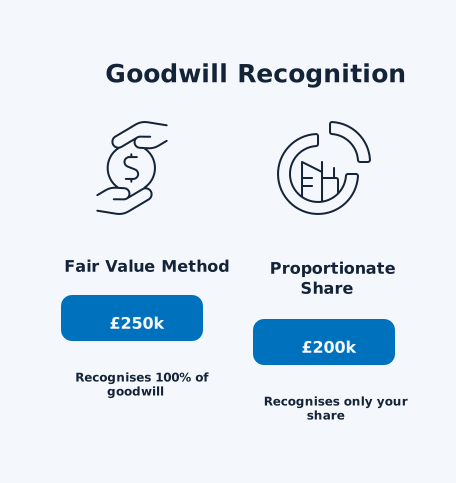
You paid £800k for 80% of a subsidiary with net assets fairly valued at £750k. Under the fair value method, NCI is measured at its fair value at acquisition date. If the fair value of 100% of the subsidiary is determined to be £1,000k (through valuation techniques), then NCI’s 20% share equals £200k. Consolidated goodwill: £800k (consideration) + £200k (NCI fair value) – £750k (fair value of net assets) = £250k.
Under the proportionate share method, NCI equals 20% x £750k = £150k. Goodwill: £800k + £150k – £750k = £200k. The fair value method recognises 100% of goodwill (including NCI’s share); the proportionate method recognises only your share.
Test goodwill annually for impairment under IAS 36. Don’t amortise it. (Note for FRS 102 users: UK GAAP permits goodwill amortisation over useful economic life, with a rebuttable presumption of maximum 10 years, rather than impairment-only testing.)
Calculate Non-Controlling Interest
Non-controlling interest (NCI) represents equity in your subsidiary not owned by you. Own 75%? The other 25% is NCI.
Present NCI separately in consolidated equity. In the income statement, split consolidated profit between amounts attributable to parent shareholders and NCI based on ownership percentages.
If your 75%-owned subsidiary earns £100k post-elimination, consolidated income includes all £100k. But £25k attributes to NCI, leaving £75k for parent shareholders.
Apply Uniform Accounting Policies
IFRS 10 requires uniform policies across the group. If your subsidiary depreciates a plant over 10 years while you use 15, adjust the subsidiary’s accounts to your policy before consolidating. Where adjustment proves impracticable, disclose the unadjusted differences and their effects.
Common Challenges in Manual Consolidation
Manual spreadsheet-based consolidation introduces delays, inconsistencies, and avoidable reconciliation errors. These challenges often compound as entity counts and intercompany volumes grow.
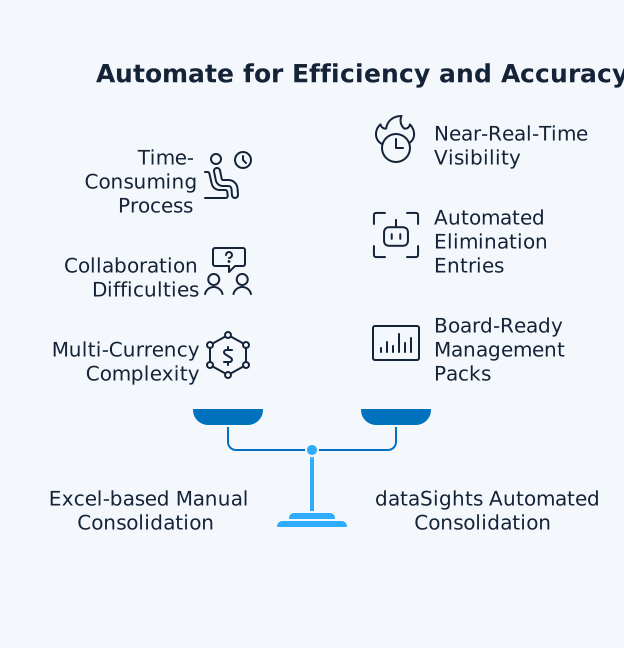
Time-Consuming Spreadsheet Dependency
Excel-based consolidation involves complex formulas, difficult to audit and prone to error. Finance teams spend days gathering data from multiple entities, importing into master workbooks, validating intercompany balances, calculating eliminations manually, and recalculating when mismatches surface.
Groups managing 10+ entities with hundreds of intercompany transactions face consolidation bottlenecks. One entity’s delayed close delays the entire group. Manual elimination journals lack audit trails showing who posted what, when, and why.
Limited Real-Time Visibility
Static month-end consolidations provide snapshot visibility only. Your board sees last month’s position while operational data moves daily. Discovering elimination errors two weeks after close means rework when context has faded and team members have moved to next month’s tasks.
Collaboration Difficulties
Teams working across locations struggle with shared spreadsheets. Version control breaks down. Entity controllers work in isolation, discovering intercompany mismatches only during group consolidation when both sides should have reconciled continuously.
Multi-Currency Complexity
Subsidiaries operate in different base currencies. Under IAS 21, subsidiaries measure transactions in their functional currency and then translate results into the group’s presentation currency. Assets and liabilities are translated at the closing rate, income and expenses at average rates. Equity is translated at historical rates, and the cumulative translation reserve remains in OCI until the foreign operation is disposed of. Foreign exchange translation adjustments flow through Other Comprehensive Income (OCI). Manual processes introduce calculation errors and inconsistent rate application.
Automating Group Consolidation
dataSights automates the entire consolidation workflow from multiple Xero entities into consolidated trial balances, management packs, and board reports.
Trial Balance to Consolidated Statements
Pull trial balances automatically from each Xero entity into your dedicated Azure SQL database. Consolidations reconcile because entity-level accounts balance before the combination. dataSights customers consolidate 72 entities in under 3 seconds.
Automated Elimination Entries
Configure intercompany elimination rules once. dataSights applies them automatically with full audit trails documenting every adjustment. Intercompany receivables/payables are eliminated automatically. Unrealised profit calculations process through documented database logic, not ad-hoc spreadsheet formulas.
Board-Ready Management Packs
dataSights delivers consolidated management packs directly through the platform. For finance teams that prefer spreadsheets, Excel automation refreshes consolidated data automatically using Power Query and the OfficeAddIn. For advanced analytics and drill-down dashboards, Power BI connects directly to the consolidated data model.
Near-Real-Time Group Visibility
Scheduled refresh keeps consolidated views current. Issues surface daily, not two weeks after month-end. Financial Controllers correct intercompany mismatches while context remains fresh, transforming month-end from discovery to confirmation.
Frequently Asked Questions
Who Prepares Consolidated Group Accounts?
Financial Controllers or Group Accountants typically prepare consolidated accounts, with CFOs reviewing and approving before board presentation. Smaller groups might use external accountants. The parent company’s directors are legally responsible for ensuring group accounts comply with Companies Act requirements.
What Financial Statements Comprise Group Accounts?
Under IAS 1 Presentation of Financial Statements, a complete set of consolidated financial statements comprises: Statement of Financial Position (balance sheet), Statement of Profit or Loss and Other Comprehensive Income, Statement of Changes in Equity, Statement of Cash Flows, and notes comprising significant accounting policies and other explanatory information.
How Do FRS 102 and IFRS 10 Differ on Consolidation?
Both require consolidation when control exists and prescribe similar procedures for combining statements and eliminating intercompany items. Key differences include NCI measurement (IFRS offers fair value or proportionate share; FRS 102 uses proportionate only) and goodwill treatment (IFRS prohibits amortisation; FRS 102 allows it over useful economic life, rebuttably presumed at 20 years maximum).
Can Subsidiaries Be Excluded from Consolidation?
Under FRS 102 Section 9, exclude subsidiaries if immaterial to presenting a true and fair view, under severe long-term restrictions preventing control exercise, or held exclusively for resale, in which case they’re measured at fair value less costs to sell (per FRS 102 Section 34) rather than consolidated. For other exclusions, document the exclusion basis and present excluded investments using the equity method or at cost.
Under IFRS 10, exclusion criteria are more restrictive. IFRS 10 doesn’t provide a broad immateriality exemption; if a subsidiary is controlled and material to the group, it must be consolidated. The only substantive exclusion applies when a parent meets the investment entity criteria under IFRS 10 paragraphs 27-33, in which case it measures subsidiaries at fair value through profit or loss rather than consolidating them.
What About Associates and Joint Ventures?
Associates (typically 20-50% ownership with significant influence) and joint ventures (joint control arrangements) use the equity method under IAS 28 and IFRS 11, not full consolidation. Your consolidated balance sheet shows a single line item for the investment. Your consolidated income statement includes your share of the associate’s or joint venture’s profit or loss. This differs from full consolidation where you combine all assets, liabilities, income, and expenses line-by-line, then eliminate intercompany transactions and recognise non-controlling interests.
What Happens if Reporting Dates Differ?
IFRS 10 permits up to three months’ difference when alignment proves impracticable. Adjust for significant transactions and events between the subsidiary’s reporting date and parent’s date. FRS 102 contains similar provisions. Document the difference and disclose material intervening events.
How Often Must Goodwill Be Tested?
Under IFRS, test goodwill annually for impairment and whenever indicators suggest impairment might exist. Compare the recoverable amount of the cash-generating unit containing goodwill with its carrying amount, including goodwill. Recognise impairment losses immediately.
Do All Parent Companies Need Audited Group Accounts?
Audit requirements depend on group size under Companies Act thresholds. Medium and large groups require statutory audit of consolidated accounts. Small groups exempt from preparing consolidated accounts are also exempt from group audit requirements, though parent and subsidiary individual accounts may still require audit if they individually exceed small company thresholds.
Where Do Intercompany Profits Appear After Elimination?
Eliminated intercompany profits disappear from consolidated statements entirely. Unrealised profit on inventory held within the group reduces consolidated profit and inventory carrying value. The profit reappears in consolidated accounts only when the group sells the inventory to external customers.
Transform Weeks of Consolidation into Days
Finance teams manually consolidating multiple entities spend weeks reconciling intercompany balances, calculating eliminations, validating data, and producing board packs. Those same teams using automated consolidation complete the entire process in under 5 days. dataSights customers reduce month-end close from over 15 days to under 5 days through automated trial balance consolidation, documented elimination entries, and pre-formatted management packs. Balance sheets reconcile automatically. Intercompany transactions are eliminated through configured rules. KPI dashboards refresh without manual exports.
Automate Your Xero Group Consolidation Today
Turn complex multi-entity consolidation into automated workflows that balance every time. dataSights’ Xero consolidation solution delivers consolidated trial balances, management packs, and board-ready reports with full elimination trails and NCI attribution – rated 5.0 by 90+ Xero users. Join 300+ businesses who’ve already transformed their group financial reporting.
About the Author
Kevin Wiegand
Founder & Client happiness
I’m Kevin Wiegand, and with over 25 years of experience in software development and financial data automation, I’ve honed my skills and knowledge in building enterprise-grade solutions for complex consolidation and reporting challenges. My journey includes developing custom solutions for data teams at Gazprom Marketing & Trading and E.ON, before founding dataSights in 2016. Today, dataSights helps over 300 businesses achieve 100% report automation. I’m passionate about sharing my expertise to help CFOs and Financial Controllers reduce their month-end close time and eliminate the manual Excel exports that drain their teams’ valuable time.