
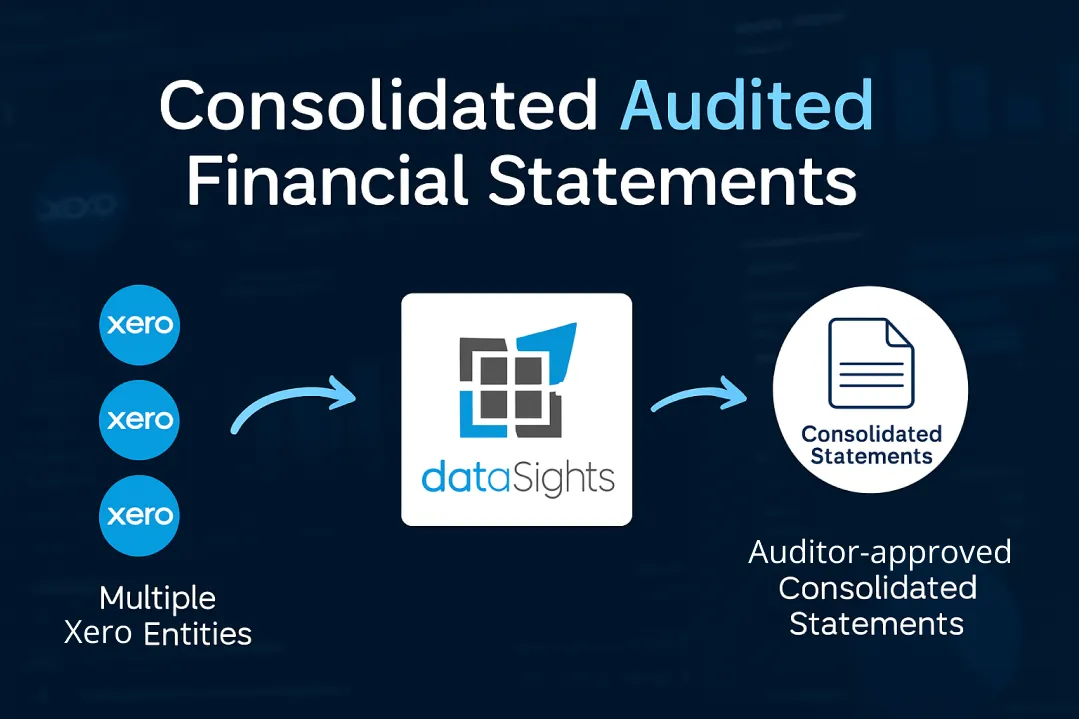
Your auditors have requested consolidated financial statements for the year-end review, and the clock is ticking. For CFOs managing multiple entities across different systems, the challenge isn’t just producing consolidated figures – it’s ensuring those figures will pass scrutiny. Intercompany eliminations that don’t balance, missing audit trails, and inconsistent accounting policies across subsidiaries can transform a routine audit into a weeks-long investigation. This guide explains exactly what auditors look for in consolidated audited financial statements and how to prepare reports that satisfy even the most thorough external review.
Understanding Consolidated Audited Financial Statements
Consolidated audited financial statements are group-level financial reports that combine the parent company and all controlled subsidiaries, verified by an independent external auditor to confirm accuracy and compliance with accounting standards. Under IFRS 10, a parent must present consolidated financial statements when it controls one or more other entities – consolidation based on power over relevant activities, exposure to variable returns, and ability to affect those returns. The audit provides assurance that management has presented a true and fair view of the group’s financial position, with intercompany transactions properly eliminated and non-controlling interests correctly disclosed.
Ready to Automate Your Financial Consolidation?
Stop wrestling with manual consolidations and broken formulas. dataSights automates multi-entity reporting, Xero consolidations, and Power BI connections. Join 300+ businesses already transforming their financial reporting with our platform, rated 5.0 out of 5 by 90+ verified Xero users.
Table of Contents
What Makes Financial Statements “Consolidated”
Consolidated financial statements present the assets, liabilities, equity, income, expenses, and cash flows of a parent and its subsidiaries as those of a single economic entity. According to the IFRS Foundation, the consolidation process involves two fundamental procedures: cancelling items that appear as an asset in one entity and a liability in another, then combining all remaining items.
The key components of consolidated financial statements include:
- Statement of financial position (consolidated balance sheet) showing combined assets, liabilities, and equity
- Statement of profit or loss and other comprehensive income covering combined revenues and expenses
- Statement of changes in equity reflecting movements across the group
- Statement of cash flows showing combined cash movements
- Notes containing accounting policies and detailed disclosures
For businesses using Xero across multiple entities, producing these combined statements requires extracting data from each organisation and performing eliminations – a process that can take weeks manually. dataSights Xero consolidation automates this extraction and delivers pre-formatted management packs with automated eliminations, reducing month-end close from over 15 days to under 5.
IFRS 10 Requirements for Consolidated Financial Statements
IFRS 10 establishes the single control model for determining which entities must be consolidated. Control exists when an investor has all three elements:
- Power over the investee through voting rights or contractual arrangements
- Exposure or rights to variable returns from involvement with the investee
- Ability to use power to affect those returns
Ownership of more than 50% voting rights is a common indicator of control, but not the definitive test. Two or more investors may collectively control an investee when they must act together to direct relevant activities – in such cases, no single investor consolidates.
Exemptions from Consolidation
Not every parent must prepare consolidated financial statements. According to IFRS Community guidance, exemptions apply when:
- The parent is itself a wholly-owned subsidiary
- The ultimate or intermediate parent produces IFRS-compliant consolidated financial statements
- The parent’s debt or equity instruments are not traded in a public market
- Non-controlling interest holders have been notified and do not object
Note that local laws in the UK, Australia, and New Zealand may mandate consolidated financial statements even when IFRS exemptions technically apply. For groups using Xero, understanding these requirements determines whether your month-end involves individual entity reports or full consolidation with eliminations.
The Audit of Consolidated Financial Statements
When external auditors examine consolidated financial statements, they follow specific standards that govern group audits. The PCAOB establishes that the lead auditor of consolidated financial statements is solely responsible for the audit opinion, even when component auditors perform work on individual subsidiaries.
Auditor Objectives
According to PwC’s audit guidance, auditors aim to obtain reasonable assurance that consolidated financial statements are free from material misstatement, whether due to fraud or error. This requires:
- Evaluating the appropriateness of accounting policies used
- Assessing the reasonableness of accounting estimates made by management
- Evaluating the overall presentation, structure, and content of the consolidated financial statements
- Obtaining sufficient appropriate audit evidence regarding each component’s financial information
For multi-entity Xero users, this means auditors will trace figures from individual Xero organisations through to your consolidated trial balance, verify elimination entries, and test that consolidation adjustments are properly documented.
Group Auditor Responsibilities
The ACCA’s technical guidance on group audits confirms that group auditors must:
- Understand the group structure and significance of each component
- Establish materiality levels for the group and individually significant components
- Determine whether to use component auditors or perform work directly
- Direct and supervise component auditors and review their work
- Evaluate conclusions based on audit evidence as a basis for the group audit opinion
The FRC’s description of auditor responsibilities confirms that the group auditor remains solely responsible for the audit opinion, regardless of the involvement of component auditors.
Intercompany Eliminations: The Audit Focus Area
Intercompany eliminations represent one of the highest-risk areas auditors examine in consolidated financial statements. According to IFRS 10’s consolidation guidance, the general objective is to exclude from consolidated shareholders’ equity any profit or loss arising from transactions within the consolidated entity.
Types of Eliminations Auditors Review
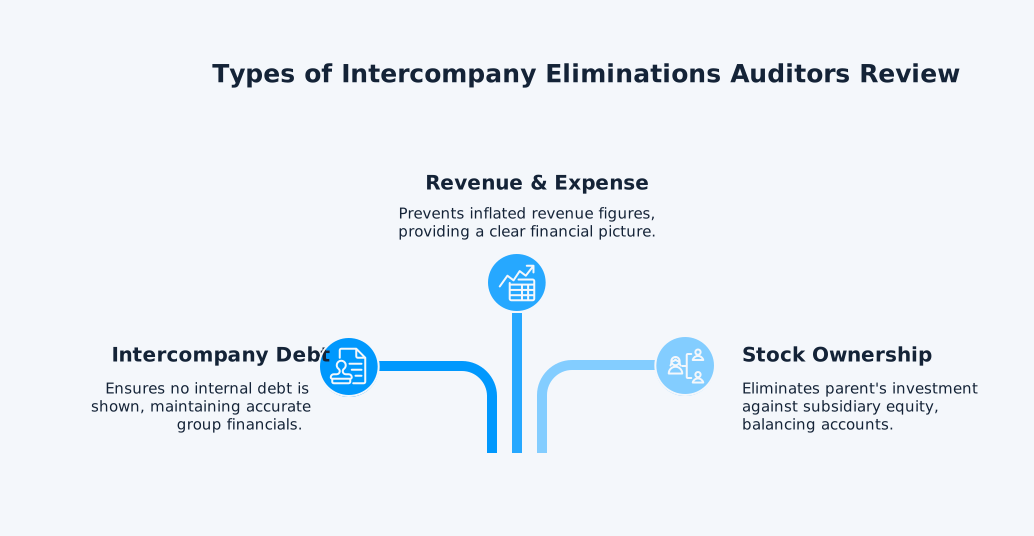
AccountingTools’ intercompany elimination guide identifies the three main types:
- Intercompany debt eliminations: Loans between subsidiaries must be cancelled so the group doesn’t show amounts owed to itself
- Intercompany revenue and expense eliminations: Sales between subsidiaries must be removed to avoid inflating group revenue
- Intercompany stock ownership eliminations: The parent’s investment in subsidiary equity must be eliminated against the subsidiary’s capital accounts
For each elimination, auditors verify that:
- Both sides of intercompany transactions are identified and matched
- Elimination entries are mathematically correct
- The net effect on consolidated equity is zero (debits equal credits)
- Unrealised profits in inventory or fixed assets are properly adjusted
The Audit Trail Requirement
Auditors need a clear audit trail so that consolidation entries and eliminations can be traced from the group financial statements back to the underlying transactions and supporting documents. An audit trail is widely defined as a step-by-step record that tracks financial data back to its source for verification and is crucial for confirming the accuracy of reported figures and detecting discrepancies.
Because double-entry bookkeeping requires that every transaction be recorded with equal and opposite entries in at least two accounts, keeping total debits and credits in balance, it helps prevent unbalanced or one-sided postings that could distort consolidated results. When consolidation eliminations are posted as balanced double-entry journals, this same logic applies to intercompany adjustments: any elimination that would leave the group out of balance is automatically flagged.
Manual consolidation in Excel typically lacks the systematic audit trail auditors require. Spreadsheet eliminations can be modified without version control, making it difficult to demonstrate who made changes and when. dataSights creates documented elimination rules with timestamped entries, showing exactly how each intercompany transaction was identified and eliminated – the kind of audit trail that transforms an interrogation into a confirmation exercise.
Preparing for a Group Audit
Finance teams preparing consolidated financial statements for audit should address several practical considerations as common audit focus areas.
Uniform Accounting Policies
IFRS 10 requires consolidated financial statements to use uniform accounting policies. The ICAEW confirms that like items of assets, liabilities, equity, income, and expenses must be combined using consistent treatment across all entities.
Where subsidiaries use different policies – perhaps revenue recognition timing or depreciation methods – adjustments must be made before consolidation. Auditors will verify that these adjustments are properly documented and consistently applied.
Reporting Date Alignment
When subsidiaries have reporting dates that differ from the parent’s, the IFRS Community notes that the gap should not exceed 3 months. Adjustments must be made for significant transactions occurring between the subsidiary’s reporting date and the parent’s year-end.
For Xero users with entities across different jurisdictions, this often means requesting supplementary financial information from subsidiaries to align periods – adding complexity to an already demanding close process.
Non-Controlling Interest Disclosure
When the parent doesn’t fully own a subsidiary, the portion attributable to non-controlling interests (NCI) must be separately disclosed. Under IFRS 10, NCI is presented as a separate line within consolidated equity.
Auditors verify that:
- NCI is correctly calculated based on ownership percentages
- Profit attribution between parent and NCI is accurate
- Changes in NCI from transactions during the year are properly recorded
- Disclosures meet IFRS 12 requirements for interests in other entities
Common Audit Issues in Consolidated Financial Statements
The US GAO’s fiscal 2024 audit of federal government consolidated financial statements identified three major impediments that prevented the expression of an opinion: serious financial management problems, the inability to adequately account for intragovernmental activity and balances, and weaknesses in the consolidation process itself.
While most corporate groups face less complex scenarios, similar issues arise:
Intercompany Imbalances
When Company A records a £100,000 receivable from Company B, but Company B only shows an £85,000 payable, auditors will flag this mismatch. Common causes include:
- Timing differences in recording transactions
- Currency translation using different exchange rates
- Transactions recorded in different periods
- Errors in one or both entity’s books
Resolving these imbalances before auditors arrive requires a reconciliation process that many finance teams struggle to complete manually.
Elimination Entry Errors
According to ACCA’s audit guide, common risks and errors in the consolidation process include:
- Errors or omissions during transcription of figures from individual financial statements to consolidation workings
- Incorrect classification of components (such as subsidiary, associate, or joint venture)
- Failure to properly cancel intra-group trading, intra-group balances, and allowances for unrealised profit on intra-group transfers
- Misallocation or inaccuracies in the calculation and reporting of goodwill, non-controlling interests, and foreign currency translations
- Arithmetical inaccuracies in the consolidation process
- Omissions in identification and disclosure of related party relationships and transactions
- One-sided elimination entries that create imbalances in the group accounts
Documentation Gaps
Auditors expect to see:
- A complete list of intercompany accounts and their balances
- Reconciliation of intercompany positions at period end
- Journal entries for all consolidation adjustments
- Supporting documentation for significant transactions
- Evidence of management review and approval
Without proper documentation, even correct eliminations may be questioned.
Technology Solutions for Audit-Ready Consolidation
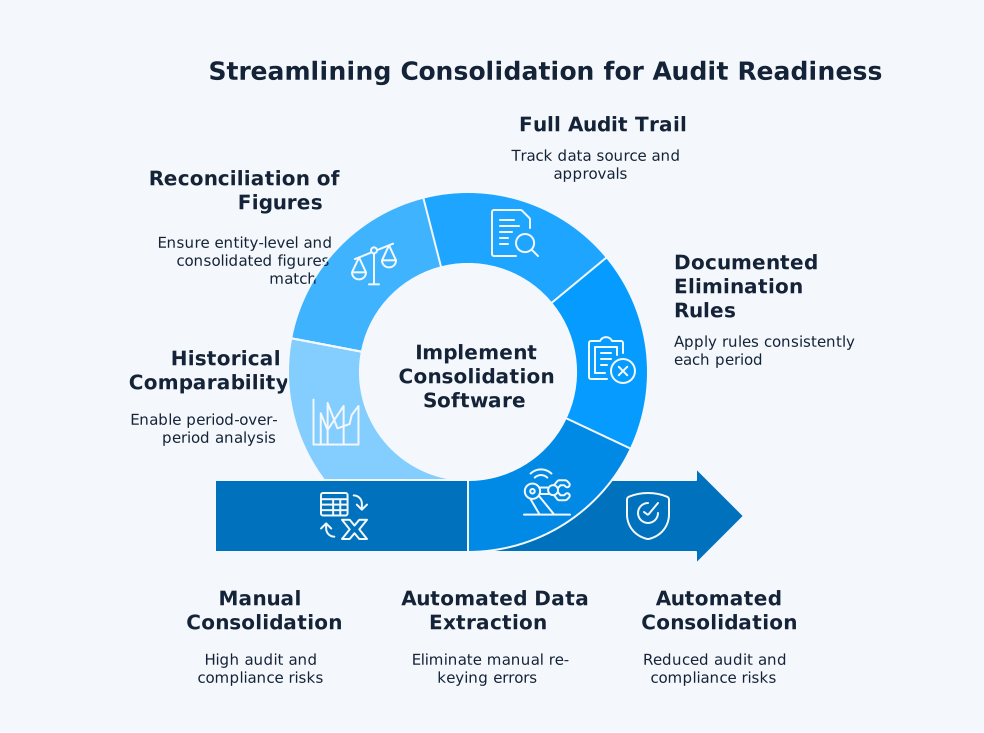
The manual consolidation process – exporting CSVs from each Xero organisation, combining in Excel, performing eliminations, and producing final statements – creates exactly the audit risks described above. Dedicated software helps teams track deadlines, flag discrepancies, and assign accountability.
What Auditors Want to See
Auditors prefer consolidated financial statements produced through systems that provide:
- Automated data extraction with no manual re-keying
- Documented elimination rules applied each period consistently
- Full audit trail showing data source, transformations, and approvals
- Reconciliation between entity-level and consolidated figures
- Historical comparability for period-over-period analysis
dataSights Consolidation Approach
dataSights delivers consolidated financial statements through automated workflows that address each audit requirement:
- Pre-formatted management packs with consolidated P&L, Balance Sheet, and Trial Balance refresh automatically from Xero data
- Automated elimination rules documented in the database layer with full audit trail
- Trial Balance foundation, ensuring all consolidations tie back to source systems
- Multi-entity support handling both small groups and large consolidations without performance degradation
For teams wanting to automate custom Excel reports or month-end tasks, dataSights OfficeAddIn and Power Query deliver refreshable consolidated data directly into spreadsheets – no CSV exports, no manual manipulation. For teams requiring advanced visualisation, Power BI connects directly to consolidated data with real-time refresh capabilities.
Frequently Asked Questions
What Is the Difference Between Consolidated and Consolidating Financial Statements?
Consolidated financial statements present the final combined position of the group as a single economic entity. Consolidating financial statements is the working documents that show individual entity figures side by side with elimination columns, demonstrating how the consolidated figures were derived. Auditors typically review both – the consolidating statements to verify the process and the consolidated statements to form their opinion.
Can Component Auditors Issue the Audit Opinion on Consolidated Financial Statements?
No. According to PCAOB standards, the lead auditor holds sole responsibility for the audit opinion on consolidated financial statements. While the lead auditor may reference the work of a referred-to auditor in specific circumstances, the group auditor directs the overall audit and takes responsibility for the consolidated opinion.
How Do Auditors Handle Subsidiaries With Different Year-Ends?
IFRS 10 permits a maximum three-month gap between subsidiary and parent reporting dates. Auditors verify that adjustments have been made for significant transactions occurring in the intervening period. If the gap exceeds three months, the subsidiary must prepare additional financial information at the parent’s reporting date.
What Happens if Intercompany Balances Do Not Reconcile?
Auditors will investigate the difference to determine its cause and materiality. If the imbalance represents a material misstatement – or indicates control weaknesses in the consolidation process – it could affect the audit opinion. Finance teams should reconcile intercompany balances before auditors arrive and document explanations for any residual differences.
Do Small Groups Need Consolidated Audited Financial Statements?
Requirements vary by jurisdiction. In the UK, the Companies Act 2006 provides exemptions for small groups meeting specific thresholds. In Australia and New Zealand, subsidiaries may be exempt if consolidated into higher-level group accounts. However, many groups prepare consolidated statements for internal management purposes even when not statutorily required – and lenders or investors may require audited consolidated statements regardless of exemptions.
How Are Non-Controlling Interests Treated in the Audit?
Auditors verify that NCI is correctly calculated based on ownership percentages and that profit attribution between parent and NCI follows IFRS requirements. ASC 810 establishes that the amount of intercompany income to be eliminated is not affected by NCI – full elimination occurs regardless of ownership structure, with the allocation effect attributed appropriately between controlling and non-controlling shareholders.
What Documentation Do Auditors Require for Consolidation Adjustments?
Auditors expect journal entry documentation for every consolidation adjustment, including elimination entries, foreign currency translation adjustments, and goodwill impairment. Each entry should identify the preparer, reviewer, supporting calculation, and underlying source documents. Systems that automatically generate this documentation – rather than relying on spreadsheet workpapers – significantly reduce audit time and findings.
Audit-Ready Financial Consolidation Starts with the Right Foundation
Producing consolidated audited financial statements that satisfy external auditors requires more than combining figures from multiple entities. Every intercompany transaction needs documentation. Every elimination needs traceability. Every consolidation adjustment needs evidence of review and approval. For CFOs managing multi-entity groups on Xero, the choice between weeks of manual preparation and automated, audit-ready consolidation determines whether month-end close becomes a confirmation exercise or an extended investigation.
Automate Your Consolidated Financial Statements for Audit Season
Ready to produce consolidated audited financial statements that stand up to scrutiny? dataSights Xero consolidation delivers automated eliminations, documented audit trails, and pre-formatted management packs that refresh in seconds. Rated 5.0 out of 5 by 90+ Xero users. Join 300+ businesses who’ve already transformed their group reporting.
About the Author
Kevin Wiegand
Founder & Client happiness
I’m Kevin Wiegand, and with over 25 years of experience in software development and financial data automation, I’ve honed my skills and knowledge in building enterprise-grade solutions for complex consolidation and reporting challenges. My journey includes developing custom solutions for data teams at Gazprom Marketing & Trading and E.ON, before founding dataSights in 2016. Today, dataSights helps over 300 businesses achieve 100% report automation. I’m passionate about sharing my expertise to help CFOs and Financial Controllers reduce their month-end close time and eliminate the manual Excel exports that drain their teams’ valuable time.