
Your auditor and your board want different things from consolidated financial reporting. The statutory set runs once a year and follows AASB 10 to the letter. The board version runs monthly, lands within days of period end, and nobody signs it. I have watched controllers rebuild the annual model in miniature just to answer one question from a director. This article separates the two jobs and shows what consolidated financial reporting has to survive as a group adds entities.
Consolidated Financial Reporting: Quick Summary
Consolidated financial statements combine a parent and its controlled entities into one set of figures, with intercompany activity eliminated. In Australia they follow AASB 10 and its control test, rather than an ownership percentage. Consolidated financial reporting is the wider monthly job, and whether you must consolidate at all depends on size and type.
Table of Contents
Statutory Consolidation and Management Reporting Are Two Different Jobs
Almost every guide treats these as one activity. One produces consolidated financial statements for the auditor. The other produces a board pack, every month, that nobody signs. They are not the same job, and conflating them is the most expensive mistake I see in multi-entity groups. They differ in timing, in tolerance for error, in who reads them, and in what happens when they are wrong.
The clearest evidence that Australian law separates them is the consolidated entity disclosure statement. ASIC's guidance on the consolidated entity disclosure statement is explicit. It "is a separate statement and does not form part of the notes to the financial statements". ASIC also confirms that the materiality provisions in the accounting standards do not apply to it. Every entity must be listed, including dormant and newly acquired shelf companies.
Read that twice if you run a group with dormant entities. Your management consolidation may ignore them. Your statutory disclosure may not.
Where the Two Jobs Diverge
| Statutory consolidation | Management consolidated reporting | |
|---|---|---|
| Frequency | Annually, half-yearly for disclosing entities | Monthly, sometimes weekly |
| Governing rule | AASB 10, AASB 12, Corporations Act 2001 | Whatever the board asks for |
| Materiality | Applies, except to the disclosure statement | Applies loosely, by judgement |
| Dormant entities | Must be listed | Usually excluded |
| Tolerance for a small imbalance | None | Some, if disclosed |
| Who reviews it | Auditor, ASIC | Directors, lenders |
The Decision That Follows
Run one data pipeline and two presentation layers:
- The pipeline pulls trial balances, maps accounts, and matches intercompany transactions once
- The statutory layer applies full AASB treatment and the complete entity list
- The management layer applies your own materiality floor and drops the entities that do not move
Teams who build two pipelines end up reconciling their own reports against each other. That is a cost with no output.
Here is a short walkthrough of how a consolidation carrying both eliminations and management reporting behaves in practice.
The Australian Rules That Set the Statutory Boundary
Three provisions decide whether you must consolidate, what you must disclose, and when it has to be lodged. Getting these wrong is not a reporting problem. It is a compliance one.
Control, Not Ownership Percentage
AASB 10 sets the test at control, and the standard breaks control into three elements that must all be present:
- Power over the investee
- Exposure, or rights, to variable returns from your involvement with it
- The ability to use that power to affect those returns
Ownership above 50% is usually a strong indicator. It is not the test.
This matters more in Australia than in most markets, because Australian SME groups routinely hold trading trusts. Control tests substance rather than legal form. A trust your group directs, and draws returns from, can therefore fall inside the consolidated group even though no share register shows it. If your structure chart carries trusts and your consolidation does not, raise it with your auditor before year end.
The Ultimate Australian Parent Rule
AASB 10 carries an Australian addition with no equivalent in the international standard. Paragraph Aus4.2 applies to the ultimate Australian parent. It must present consolidated financial statements where legislation requires statements complying with Australian Accounting Standards or accounting standards. That overrides the exemptions in both paragraph 4(a) and paragraph Aus4.1. One carve-out survives, for a parent required to measure all of its subsidiaries at fair value through profit or loss.
The practical effect is narrow but sharp. Say your Australian holding company sits under a foreign parent. You may not be able to lean on the exemption a purely local intermediate parent could use. Check this before assuming a foreign group consolidation covers your obligation.
What Must Be Lodged and When
ASIC's guidance on the lodgement of financial reports sets out who must prepare a financial report under section 292 of the Corporations Act 2001. The list runs to eight entity types:
- Disclosing entities
- Public companies
- Companies limited by guarantee, except small ones
- Large proprietary companies that are not disclosing entities
- Registered schemes
- Registrable superannuation entities
- Small proprietary companies that are foreign-controlled
- Small proprietary companies with one or more crowd-sourced funding shareholders during the year
On timing, ASIC states that disclosing entities, registered schemes and registrable superannuation entities must lodge within three months of year end. All other entities must lodge within four months.
Disclosure of the interests themselves sits under AASB 12. Its stated objective is to require disclosure letting users evaluate the nature of, and risks associated with, an entity's interests in other entities.
What Breaks When a Group Adds Entities
A consolidation that works at four entities can fail at fourteen, and it rarely fails loudly. It degrades. Below are the five failure modes I see most often, in the order they usually appear.
Chart of Accounts Divergence
Every guide tells you to standardise the chart of accounts. Almost none tell you what to do when you cannot, which is the real situation in any group that has grown by acquisition.
An acquired entity arrives with its own account structure and numbering, often with a statutory reason to keep some of it. Forcing a rebuild delays integration and irritates the people you just bought.
The workable answer is a mapping table sitting between the entities and the consolidation, not inside either. Each entity keeps its own chart. The mapping table translates every account to a group reporting code. When a new entity joins, you extend the table instead of restructuring a general ledger.
Watch for this failure condition. An account added at entity level after the mapping table was built carries no group code, so it silently drops out of the consolidation. Your consolidated profit is then wrong by exactly that balance. Because the balance sheet draws on the same source, it can still balance. A monthly exception report listing unmapped accounts is the cheapest control in this article.
Differing Period Locks
Entity A locks its ledger on the third business day. Entity B locks on the eighth. Run the consolidation on the fifth and you are comparing one entity's final numbers against another's draft. The variance you spend Thursday investigating is not a variance at all.
The fix is a group lock date, applied the same way every month:
- Pick a date and publish it to every entity
- Consolidate only once all of them have passed it
- Where one entity genuinely cannot meet it, consolidate that entity on a one-month lag and disclose the lag
A known lag is a reporting policy. An unknown lag is an error you find during the audit.
Entities Joining or Leaving Mid-Year
This is the gap almost nobody covers, and it produces the ugliest month-end surprises.
An entity acquired on 14 November contributes profit from 14 November, not from 1 July. Consolidating its full-year profit and loss overstates group profit by four and a half months of trading. The balance sheet behaves differently. It consolidates in full at the reporting date, because you control the entity at that date.
For example, a group with a June year end acquires Entity C on 1 March. Entity C earns $1.2m AUD across the full year, evenly. The consolidated profit and loss should carry four months, so $400,000 AUD. Its entire closing balance sheet still consolidates. Anyone pulling both from a single full-year export adds $800,000 AUD of profit that the group never earned.
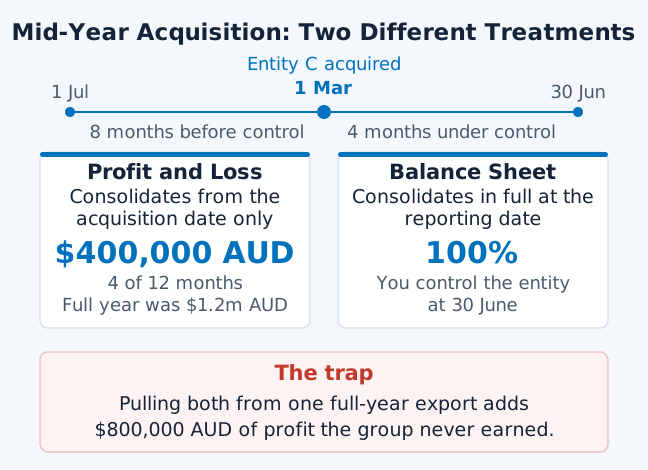
Build an entity register with effective dates, and have the consolidation read those dates rather than a static list.
Intercompany Matching at Volume
At twenty intercompany transactions a month you can eliminate by inspection. At two thousand you cannot, and volume is not the only reason. Timing is.
Entity A raises an intercompany invoice on 30 June. Entity B books it on 2 July. Both entities are correct. The group is out of balance at 30 June, and staring at the two ledgers will not reconcile it. The difference is real, and it is a cut-off difference.
Handle it as a standing procedure rather than a monthly investigation:
- Set a tolerance for the intercompany difference
- Investigate anything above it
- Post the residual to an intercompany suspense account, and clear it next month
What you must not do is force the elimination entry to balance by plugging the gap into a profit and loss account. That buries a timing difference inside your trading result.
Foreign Currency Translation
AASB 121 defines functional currency as the currency of the primary economic environment in which the entity operates. Presentation currency is the currency in which the statements are presented. Those are two different things, and a foreign subsidiary usually has both.
The mechanics create a difference by design. Profit and loss translates at the average rate for the period. The balance sheet translates at the closing rate. Because the two rates differ, the translated statements do not tie, and the gap belongs in a translation reserve within equity rather than in profit.
For example, an Australian parent consolidates a New Zealand subsidiary. The subsidiary earns NZ$2m revenue, translated at an average rate of 0.92, giving A$1.84m. Its NZ$1m closing assets translate at 0.94, giving A$940,000. The difference between the two rates flows to the translation reserve, not to group profit.
A consolidation engine that handles this correctly posts that difference to a balance sheet account automatically. That is how the dataSights consolidation keeps the balance sheet balancing when FX is in play.
Building the Reporting Layer
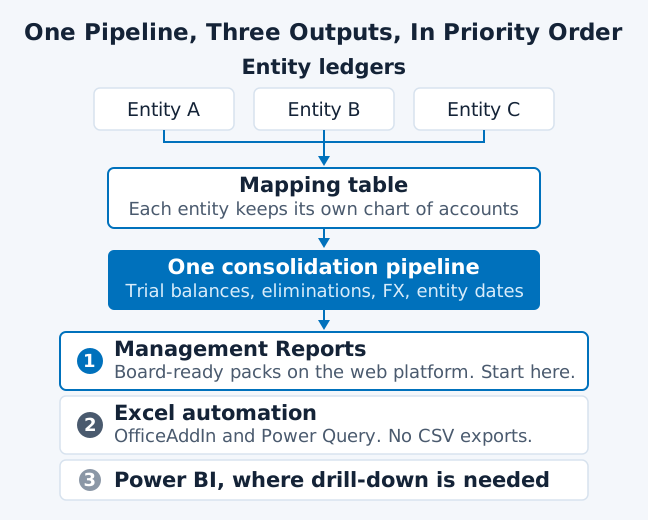
Once you know the two jobs and the five failure modes, the build becomes a question of where each output lives. I would work in this order.
Start With Management Reports
Pre-formatted management packs delivered through the dataSights web platform cover the monthly job directly. They include:
- Consolidated profit and loss with eliminations
- Balance sheet reconciled across entities
- Trial balance with a full audit trail
- AR and AP summary and detail
- Budget and budget variance
- Cash flow
- KPI metrics
Board-ready output without anyone opening a spreadsheet is the point. This is the layer that does not break when an entity is added.
Then Automate Excel
Around 75% of dataSights customers automate Excel, and that is not a fallback. It is where custom reporting actually happens. The dataSights OfficeAddIn and Power Query refresh consolidated Xero data straight into Excel. Month-end tasks, custom cashflow forecasts and reconciliations then run against live consolidated data, with no CSV exports and no reshaping before use. One Excel sheet can also post adjustments back across multiple Xero entities in a single action.
The message is not to leave Excel. It is to stop spending the first two days of every month getting data into it.
Add Power BI Where Drill-Down Is Needed
Some teams need custom visualisation and drill-down beyond the standard packs. Power BI connects directly to your dedicated Azure SQL database and refreshes on your configured schedule. Treat this as the advanced layer, not the starting point.
Manual Against Automated, Honestly
| Manual spreadsheet consolidation | Automated reporting layer | |
|---|---|---|
| New entity added | Rebuild formulas and ranges | Extend the mapping table |
| Elimination errors | Found by review, or not found | Posted against actual balances |
| FX difference | Calculated and posted by hand | Posted to the balance sheet automatically |
| Audit trail | Version history, if you kept it | Trial balance with full trail |
| Cost of a late entity | The whole model waits | Rerun once the entity lands |
Automation does not remove judgement. Control assessments, materiality decisions, and whether a trust sits inside the group all stay with you. What it removes is the rebuilding, and that is time the month-end close rarely gets back.
Frequently Asked Questions
Do Australian Private Groups Need Consolidated Financial Reporting?
Size and type decide this, not whether the group is private. Many mid-sized private groups sit below the lodgement threshold and consolidate anyway, because lenders and incoming investors ask for group figures. If you expect a debt raise or a sale within two years, build the capability before someone requires it.
Is Tax Consolidation the Same as Accounting Consolidation?
No, and treating them as one causes real problems. Tax consolidation is an income tax concept with its own eligibility rules and group boundary. Accounting consolidation under AASB 10 turns on control, so the two entity lists frequently differ.
Can We Consolidate Entities Using Different Accounting Software?
Yes, provided each system produces a trial balance with consistent period boundaries. The integration point is the trial balance and the mapping table, not the software brand. dataSights connects Xero alongside 160+ connectors spanning CRM, payroll, inventory and SaaS systems, so non-financial data sits in the same reporting layer.
How Do We Handle an Entity With a Different Year End?
The three-month gap most guides quote is a fallback, not an entitlement. AASB 10 expects the subsidiary to prepare extra information at the parent's reporting date, and paragraph B93 applies only where that is impracticable. If you rely on it, adjust for significant transactions in the gap and keep that gap the same length every period.
What Should Monthly Consolidated Reporting Actually Take?
Once the mapping table and entity register exist, the recurring work is exception handling rather than assembly. Teams we work with often reduce month-end close from over 15 days to under 5. The variable is rarely entity count, and far more often the volume of unmapped accounts and unmatched intercompany items.
Does Xero Consolidate Multiple Organisations Natively?
Xero does not offer native consolidation across separate organisations. Each Xero organisation reports on itself. Multi-entity groups therefore need either a manual export and combine process, or a consolidation layer above their Xero files.
Reporting That Holds Its Shape as You Grow
The groups handling consolidated financial reporting well are not the ones with the cleverest spreadsheet. They are the ones who decided early that the statutory job and the monthly job differ. They built one pipeline to feed both, then put controls around the five things that quietly break. Do that, and adding an entity becomes an afternoon rather than a rebuild.
Automate Consolidated Reporting Across Your Xero Entities
Stop rebuilding the model every time the group changes shape. The dataSights Xero consolidation platform delivers board-ready reports with automatic eliminations, FX posted to the balance sheet, and Excel and Power BI automation. Rated 5.0 on the Xero App Store by 90+ verified Xero users, and trusted by 300+ businesses.
About the Author
Kevin Wiegand
Founder & Client happiness
I'm Kevin Wiegand, and with over 25 years of experience in software development and financial data automation, I've honed my skills and knowledge in building enterprise-grade solutions for complex consolidation and reporting challenges. My journey includes developing custom solutions for data teams at Gazprom Marketing & Trading and E.ON, before founding dataSights in 2016. Today, dataSights helps 300+ businesses achieve 100% report automation. I'm passionate about sharing my expertise to help CFOs and Financial Controllers reduce their month-end close time and eliminate the manual Excel exports that drain their teams' valuable time.