
Ever closed the month only to have your consolidation tie out – until you split out minority interest? Presentation of minority interest in consolidated financial statements gets tricky when ownership percentages change, intercompany eliminations affect results, and auditors ask why NCI profit and equity don’t reconcile. Put simply, non-controlling interest (NCI) is the portion of a subsidiary that the parent doesn’t own, and it needs to be shown and attributed correctly in both the consolidated balance sheet and income statement. This guide breaks down the IFRS and US GAAP presentation requirements, the practical calculation flow from post-elimination results, and the common errors that create last-minute rework. Keep reading for clear examples you can apply in your next close.
Presentation of minority interest in consolidated financial statements
The presentation of minority interest in consolidated financial statements requires NCI to appear within equity on the balance sheet as a separate line item, distinct from the parent’s shareholders’ equity. On the income statement, consolidated net income must be allocated between the parent and non-controlling interests based on ownership percentages. IFRS 10 defines and governs the presentation and attribution of non-controlling interests, while IFRS 3 sets the acquisition-date measurement policy choice (fair value or proportionate share of identifiable net assets).
Ready to Automate Your Financial Consolidation?
Stop wrestling with manual consolidations and broken formulas. dataSights automates multi-entity reporting, Xero consolidations, and Power BI connections. Join 300+ businesses already transforming their financial reporting with our platform, rated 5.0 out of 5 by 90+ verified Xero users.
Table of Contents
Understanding Minority Interest and Non-Controlling Interest
The terms minority interest and non-controlling interest refer to the same concept. FASB Statement 160, issued in 2008, officially replaced “minority interest” with “non-controlling interest” as the preferred terminology. However, both terms remain in common use, and ASC 810-10-20 explicitly notes that “a noncontrolling interest is sometimes called a minority interest.”
What Qualifies as Non-Controlling Interest
NCI represents the portion of a subsidiary’s equity that the parent company does not own. According to IFRS 10, NCI is defined as “equity in a subsidiary not attributable, directly or indirectly, to a parent.”
For example, if your company owns 80% of a subsidiary with total equity of £500,000, then £100,000 (20%) belongs to outside shareholders and must be recorded as non-controlling interest in your consolidated financial statements.
The key characteristics of NCI include:
- Ownership of less than 50% of voting shares in the subsidiary (by external parties)
- No control over the subsidiary’s relevant activities
- Right to a proportionate share of dividends and net assets on liquidation
- Entitled to share of profits and losses
Why Full Consolidation Creates NCI
Full consolidation rules require the parent to include 100% of a subsidiary’s assets, liabilities, revenues, and expenses in consolidated financial statements, even when the parent owns less than 100%. This creates a mismatch that NCI resolves.
Whether you own 50.1% or 99% of a subsidiary, your consolidated statements show all of that subsidiary’s financial position and performance. The NCI line items then clarify how much of the consolidated totals actually belongs to external shareholders.
Balance Sheet Presentation Requirements
On the balance sheet, non-controlling interest (NCI) sits within equity but must be shown separately from the parent’s equity. This section shows the standard placement, key IFRS vs US GAAP presentation nuances, and a clean equity layout you can copy.
Where NCI Appears on the Balance Sheet
Under both IFRS 10 and US GAAP (ASC 810), non-controlling interest must be presented within the equity section of the consolidated balance sheet, separate from the parent’s shareholders’ equity.
This represents a significant change from historical practice. Before FASB 160, minority interest was often shown in a “mezzanine” section between liabilities and equity. This treatment is no longer acceptable under current standards.
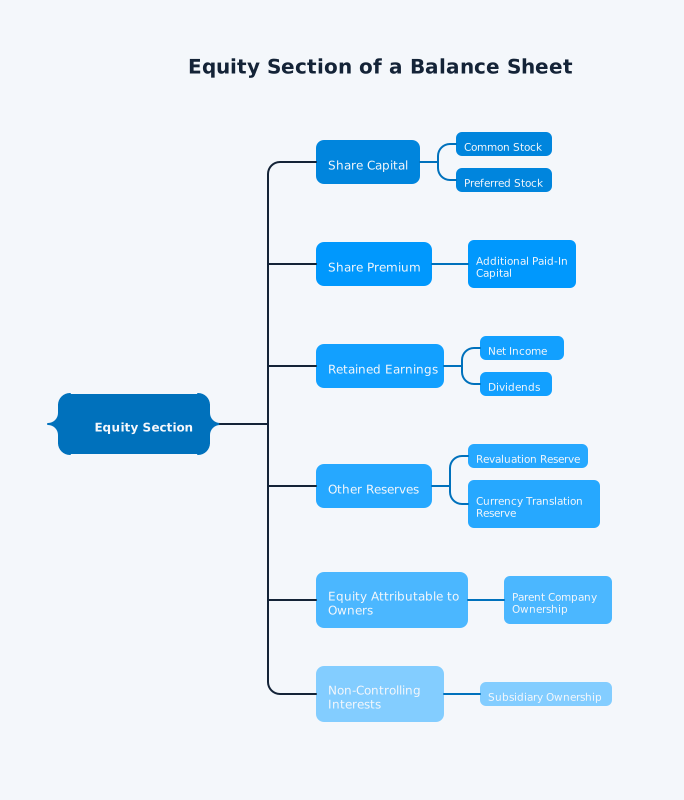
The typical balance sheet presentation looks like this:
Equity Section
- Share capital (parent)
- Share premium (parent)
- Retained earnings (parent)
- Other reserves (parent)
- Equity attributable to owners of the parent
- Non-controlling interests
- Total equity
IFRS 10 vs US GAAP Classification
Both frameworks now classify NCI as equity, but there are some differences in specific situations.
Under IFRS, a parent presents non-controlling interests within equity, separately from the equity attributable to owners of the parent. Under US GAAP, non-controlling interests are also reported in equity; however, SEC registrants must present redeemable equity-classified interests outside permanent equity (often called temporary or mezzanine equity) when redemption is not solely within the issuer’s control.
Practical Balance Sheet Example
Consider a parent company owning 75% of a subsidiary with the following position:
Subsidiary’s Net Assets: £1,000,000
Parent’s Share (75%): £750,000 – This combines with the parent’s own equity
Non-controlling Interest (25%): £250,000 – Presented as a separate line within consolidated equity
The consolidated balance sheet shows:
- Parent shareholders’ equity: £X (including £750,000 from subsidiary)
- Non-controlling interests: £250,000
- Total equity: £X + £250,000
Income Statement Presentation Requirements
NCI also affects performance reporting – you need to attribute consolidated profit (and OCI) between owners of the parent and non-controlling shareholders. Below is the practical calculation flow and how to present the split clearly in the income statement and comprehensive income.
Allocation of Consolidated Net Income
Both IFRS and US GAAP require that consolidated net income be allocated between the parent and non-controlling interests. The amounts attributable to each must be clearly identified and presented on the face of the consolidated income statement.
The format requires:
- Present consolidated profit or loss for the period
- Then show the allocation between:
- Profit attributable to owners of the parent
- Profit attributable to non-controlling interests
This is not merely a disclosure requirement. The allocation must appear on the face of the income statement, not just in the notes.
Calculation Method
NCI’s share of profit is calculated as:
NCI in Net Income = Subsidiary’s Net Income × NCI Ownership Percentage
For example, if the subsidiary’s post-elimination profit (after consolidation adjustments and intercompany eliminations) is £500,000 and the parent owns 80%, then £100,000 is attributed to non-controlling interests.
Loss Attribution Changes Under FASB 160
Before FASB 160, losses that exceeded the NCI’s equity balance were attributed to the parent. The current rules changed this significantly.
Now, losses are attributed to NCI in proportion to their ownership, even if this results in a deficit (negative) NCI balance. This means parents may report higher net income than under old rules when subsidiaries generate losses, because NCI absorbs its proportionate share regardless of the impact on NCI equity.
Comprehensive Income Presentation
The same allocation requirements apply to comprehensive income. Total comprehensive income must be allocated between the parent and non-controlling interests, with separate presentation of each component.
NCI Measurement at Acquisition
Accurate NCI reporting starts at acquisition with the right opening measurement. This section compares the acquisition-date measurement approaches, explains how they change goodwill, and highlights what that means for later impairment and reporting.
The Two Methods Under IFRS 3
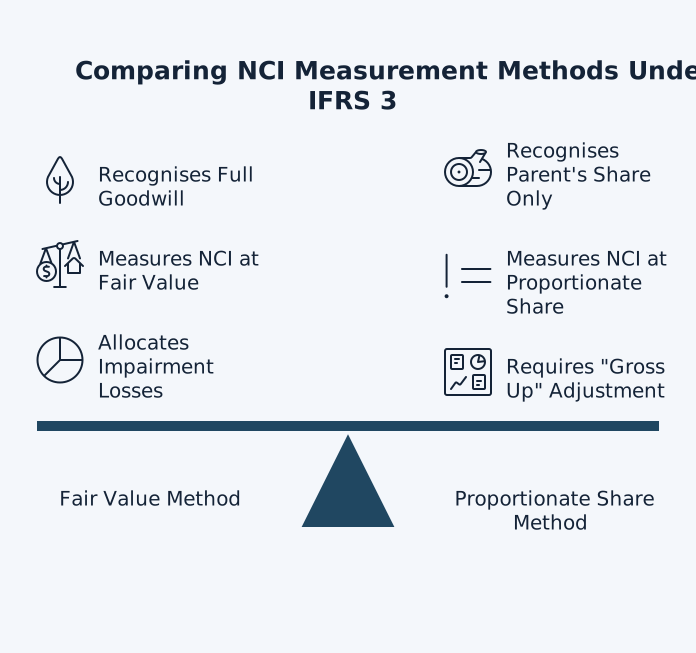
IFRS 3 Business Combinations offers a choice for measuring NCI at the acquisition date. This election is made on a transaction-by-transaction basis, meaning different acquisitions can use different methods.
Method 1: Fair Value (Full Goodwill Method)
NCI is measured at fair value at the acquisition date. This results in recognising 100% of goodwill, both the parent’s share and the NCI’s share. Fair value must be determined in accordance with IFRS 13.
Method 2: Proportionate Share (Partial Goodwill Method)
NCI is measured at its proportionate share of the acquiree’s identifiable net assets. Only the parent’s share of goodwill is recognised. This is the traditional UK method and results in lower recognised goodwill.
Impact on Goodwill Calculations
The measurement choice directly affects goodwill. Consider a parent paying £800,000 for 80% of a subsidiary with identifiable net assets of £750,000. The NCI’s fair value is determined to be £180,000.
Fair Value Method:
- Consideration paid: £800,000
- Fair value of NCI: £180,000
- Less: Net assets acquired: (£750,000)
- Goodwill: £230,000 (full goodwill)
Proportionate Share Method:
- Consideration paid: £800,000
- NCI at proportionate share: £150,000 (20% × £750,000)
- Less: Net assets acquired: (£750,000)
- Goodwill: £200,000 (parent’s share only)
US GAAP Requirements
Under US GAAP, the acquirer measures the non-controlling interest at its acquisition-date fair value (ASC 805 / SFAS 141R). Unlike IFRS, US GAAP does not provide a proportionate-share alternative for measuring NCI at acquisition.
Subsequent Impairment Implications
The initial measurement choice has ongoing consequences for goodwill impairment testing.
- Under the fair value method, impairment losses are allocated between the parent and NCI based on their proportionate interests in the cash-generating unit.
- Under the proportionate share method, a “gross up” adjustment is required for impairment testing because the recoverable amount relates to the whole subsidiary (including NCI’s unrecognised goodwill), but the carrying amount only includes the parent’s goodwill.
Changes in Ownership Without Loss of Control
When ownership changes but control doesn’t, the accounting is treated as an equity transaction, not a gain or loss in profit. Here’s how the adjustment runs through equity and NCI, plus a worked example to follow.
Equity Transaction Treatment
When a parent changes its ownership interest in a subsidiary without losing control, these are treated as equity transactions under both IFRS 10 and ASC 810.
Key implications:
- No gain or loss is recognised in profit or loss
- The difference between consideration paid or received and the change in NCI is recorded directly in equity
- No remeasurement of goodwill occurs
- Assets and liabilities are not revalued
This represents a significant simplification from historical practice where such transactions could trigger purchase accounting or gain/loss recognition.
Practical Example
If a parent owning 80% of a subsidiary acquires an additional 10% from NCI holders for £150,000, and the carrying amount of that 10% NCI is £120,000:
- Debit: NCI £120,000
- Debit: Equity (parent) £30,000
- Credit: Cash £150,000
The £30,000 difference is recorded directly in equity, not as goodwill or in profit or loss.
Enterprise Value Considerations
Enterprise value reflects the value of the entire operating business, not just the parent’s share – so NCI often needs to be included. This section explains why, how it impacts valuation multiples, and the common EV mistake to avoid.
Why NCI Is Added to Enterprise Value
For valuation purposes, minority interest is added to enterprise value. This ensures consistency between the numerator (enterprise value) and denominator (EBITDA, sales, etc.) in valuation multiples.
Since consolidated financial statements include 100% of the subsidiary’s revenues, expenses, and operating metrics, enterprise value must also include 100% of the subsidiary’s value. Adding NCI to equity value achieves this.
Impact on Valuation Multiples
When calculating EV/EBITDA or EV/Sales multiples:
- If NCI is not added to EV, the multiple would be artificially low
- The consolidated EBITDA includes 100% of subsidiary performance
- NCI ensures the ownership claim matches the performance included
This is particularly important for analysts and investors comparing companies with different subsidiary ownership structures.
Common Presentation Errors to Avoid
Most NCI issues come from avoidable presentation and attribution mistakes that surface late in review or audit. Use the checks below to catch classification, calculation, and disclosure errors before they become reconciliation problems.
1. Classification Errors
The most frequent errors in NCI presentation include:
- Presenting NCI outside equity: No longer acceptable under current standards
- Failing to separately identify NCI: Must be a distinct line item, not combined with parent equity
- Incorrect allocation of profits: Must be based on actual ownership percentages after eliminations
- Missing comprehensive income allocation: OCI must also be allocated between parent and NCI
2. Disclosure Deficiencies
Required disclosures that are often incomplete include:
- Reconciliation of changes in NCI during the period
- Dividends paid to non-controlling shareholders
- Restrictions on subsidiary net assets
- Significant judgments in determining control
3. Measurement Errors
Complex capital structures can make NCI measurement challenging:
- Options and convertible instruments may affect NCI percentages
- Different classes of shares may have different rights to profits
- Cumulative preference dividends must be deducted before allocation
Automating NCI Calculations in Multi-Entity Groups
Manual NCI tracking gets fragile fast once you have multiple entities, changing ownership, and eliminations. This section outlines the minimum workflow to automate – ownership tracking, post-elimination allocation, and an audit trail you can defend.
Start with reconciled entity-level trial balances. Your NCI equity and profit allocations only reconcile cleanly when each subsidiary’s trial balance balances first – then you apply consolidation adjustments and eliminations, and only then calculate NCI.
The Manual Consolidation Challenge
For groups with multiple partly-owned subsidiaries, manual NCI tracking becomes increasingly complex. Each subsidiary requires:
- Separate NCI percentage tracking
- Profit allocation calculations
- Balance sheet NCI movements
- Dividend and transaction adjustments
Teams we work with often spend over 15 days on month-end consolidation when managing these calculations manually across spreadsheets.
How Automated Consolidation Handles NCI
dataSights’ Management Reports help finance teams deliver consolidated management packs that include the right NCI equity and profit lines – built from entity trial balances, consolidation adjustments, and eliminations – without manual rework. When you connect multiple Xero entities, the system:
- Automatically tracks ownership percentages per entity
- Calculates NCI profit allocation based on post-elimination profits
- Maintains NCI balance sheet movements with full audit trails
- Handles dividend distributions to NCI holders
- Produces consolidated statements with compliant NCI presentation
The Audit Trail Advantage
Manual NCI calculations in spreadsheets create significant audit risk. There’s no documentation of who made changes, when, or why. Formula errors compound across periods.
Automated consolidation maintains timestamped records of every NCI calculation, with drill-through capability from consolidated totals to underlying entity transactions. External auditors can trace every NCI adjustment back to its source, transforming month-end close from a reconciliation exercise into a confirmation process.
Frequently Asked Questions
What Is the Difference Between Minority Interest and Non-Controlling Interest?
There is no practical difference. FASB Statement 160 changed the official terminology from “minority interest” to “non-controlling interest” in 2008. Both terms refer to the portion of a subsidiary’s equity and profits attributable to shareholders other than the parent company. Current accounting standards use “non-controlling interest” as the preferred term.
Where Should Minority Interest Appear on the Consolidated Balance Sheet?
Under both IFRS 10 and US GAAP, non-controlling interest must appear within the equity section of the consolidated balance sheet. It should be presented as a separate line item, distinct from the parent’s shareholders’ equity. The previous practice of showing NCI in a “mezzanine” section between liabilities and equity is no longer acceptable.
How Is Minority Interest Calculated on the Income Statement?
NCI’s share of profit equals the subsidiary’s net income (after intercompany eliminations) multiplied by the NCI ownership percentage. For example, if a subsidiary earns £100,000 and NCI holds 20%, then £20,000 is attributed to non-controlling interests. Both the parent’s share and NCI’s share must be clearly presented on the face of the income statement.
What Happens When a Subsidiary Makes a Loss?
Under current standards, losses are attributed to NCI in proportion to their ownership percentage, even if this results in a negative NCI balance. Before FASB 160, excess losses were attributed to the parent. This change means NCI can now have a deficit equity position in consolidated financial statements.
What Is the Fair Value Method for NCI Measurement?
The fair value method under IFRS 3 measures NCI at its acquisition-date fair value, resulting in recognition of full goodwill (both the parent’s share and NCI’s share). This contrasts with the proportionate share method, which measures NCI at its share of identifiable net assets and recognises only the parent’s share of goodwill.
Does US GAAP Allow a Choice in NCI Measurement?
No. ASC 810 under US GAAP requires NCI to be measured at fair value at acquisition. Unlike IFRS, there is no option to use the proportionate share method. This represents a key difference for groups reporting under both frameworks.
How Does NCI Affect Enterprise Value Calculations?
NCI is added to enterprise value when calculating valuation multiples. Since consolidated financial statements include 100% of the subsidiary’s operating metrics (revenue, EBITDA), enterprise value must also reflect 100% of the subsidiary’s value. Adding NCI ensures consistency between the numerator and denominator in multiples like EV/EBITDA.
What Happens to NCI When the Parent Buys Out External Shareholders?
When a parent acquires additional shares without losing control, the transaction is treated as an equity transaction. No gain or loss is recognised in profit or loss. The difference between consideration paid and the carrying amount of NCI acquired is recorded directly in equity. Goodwill is not adjusted.
Can NCI Have a Negative Balance?
Yes. Under current standards, NCI can have a negative (deficit) balance if the subsidiary’s accumulated losses exceed NCI’s original investment. Losses continue to be allocated to NCI in proportion to their ownership regardless of the resulting balance.
Keep NCI Presentation Audit-Ready
Presentation of minority interest in consolidated financial statements comes down to three things. Show NCI within equity, split profit/OCI and equity movements between the parent and non-controlling shareholders, and apply a consistent acquisition-date measurement policy. IFRS 10 drives presentation and attribution while IFRS 3 sets the acquisition-date measurement choice; under US GAAP, NCI is presented in equity and measured at acquisition under ASC 805. Set this up once – and automate ownership changes, eliminations, and attribution – and your consolidated numbers reconcile faster and the close stays on schedule.
Transform Your Multi-Entity Consolidation with Automated NCI Tracking
Ready to eliminate manual NCI calculations from your month-end close? dataSights’ Xero consolidation solution handles minority interest tracking automatically, with full audit trails for every adjustment. Rated 5.0 by 90+ Xero verified users. Join 300+ businesses already consolidating multi-entity groups in under 5 days.
About the Author
Kevin Wiegand
Founder & Client happiness
I’m Kevin Wiegand, and with over 25 years of experience in software development and financial data automation, I’ve honed my skills and knowledge in building enterprise-grade solutions for complex consolidation and reporting challenges. My journey includes developing custom solutions for data teams at Gazprom Marketing & Trading and E.ON, before founding dataSights in 2016. Today, dataSights helps over 300 businesses achieve 100% report automation. I’m passionate about sharing my expertise to help CFOs and Financial Controllers reduce their month-end close time and eliminate the manual Excel exports that drain their teams’ valuable time.