
Managing financial data across multiple entities? You’re dealing with complex intercompany transactions, elimination entries that won’t balance, and month-end closes stretching beyond 15 days. The group consolidation process combines financial statements from parent companies and subsidiaries into unified reports, but manual methods using Excel often lead to errors and delays. Here’s exactly how to consolidate your entities accurately, handle eliminations properly, and cut your close time from weeks to day.
What Is the Group Consolidation Process?
Group consolidation process combines financial statements from multiple business entities into a single set of consolidated reports. According to IFRS 10, entities must present consolidated financial statements when they control one or more other entities, with control established as the basis for consolidation. This process eliminates intercompany transactions and provides stakeholders with accurate financial data representing the entire economic entity.
Ready to Automate Your Financial Consolidation?
Stop wrestling with manual consolidations and broken formulas. dataSights automates multi-entity reporting, Xero consolidations, and Power BI connections. Join 300+ businesses already transforming their financial reporting with our platform, rated 5.0 out of 5 by 90+ verified Xero users.
Table of Contents
Understanding the Core Steps of Financial Consolidation
The group consolidation process follows six essential steps that ensure accurate financial reporting across all entities. Let’s examine each step and how automation transforms traditionally manual tasks.
Step 1: Establish Your Consolidation Structure
Your first task involves defining the group structure and determining consolidation methods. SAP’s group reporting documentation indicates you’ll need to identify:
- Parent company and all subsidiaries
- Ownership percentages for each entity
- Consolidation method for each subsidiary
- Reporting currency for the group
IFRS 10 requirements establish control as the basis for consolidation, requiring full consolidation when you control an entity. Control typically exists with majority ownership, but can occur with less than 50% if you have power over relevant activities. According to IAS 28, the equity method applies when an investor has significant influence, typically ownerships of 20% or more, over an entity without exercising control.
The IFRS Foundation notes that proportionate consolidation was eliminated for joint ventures when IFRS 11 replaced IAS 31 in 2013.
Step 2: Collect Financial Data from All Entities
Data collection requires gathering trial balances from every entity in your group. According to NetSuite’s consolidation guide, this involves collecting:
- Balance sheets from all subsidiaries
- Income statements for the consolidation period
- Cash flow statements
- Statements of changes in equity
- Supporting documentation for intercompany transactions
Treat the trial balance as the single source of truth. All consolidations must reconcile back to each entity’s TB. With dataSights, the consolidated TB stays live and ties out to source Xero files.
Modern consolidation platforms automate this collection through API connections, eliminating manual CSV exports. With dataSights’ Xero consolidation solution, data syncs automatically from multiple Xero entities into a centralised database.
Step 3: Standardise Charts of Accounts
Before combining data, you need consistent account structures across all entities. Subsidiaries may need to operate in their own base currency, but at group level, you’ll need standardised reporting structures.
A key part of successful consolidation is the standardisation of the chart of accounts. Without it, rolling up financial data from multiple entities becomes inconsistent and error-prone. Both IFRS 10 (Consolidated Financial Statements) and US GAAP (ASC 810) stress the need for subsidiaries to align their reporting structures with the parent company. Adjust subsidiary accounting policies to align with the parent before consolidation, as required by IFRS 10.
In practice, this means:
- Mapping subsidiary accounts: link each local account to the parent company’s consolidated chart of accounts
- Creating a uniform coding structure: ensure accounts across entities follow the same numbering and categorisation rules
- Aligning financial statement line items: present revenue, expenses, assets, and liabilities consistently across all subsidiaries
- Reviewing and updating regularly: adapt mappings and structures when new accounts, entities, or regulations are introduced
See how dataSights automates the entire consolidation process for Xero users in this detailed demonstration. Watch as multiple entities combine into consolidated reports with automatic eliminations.
Step 4: Convert Foreign Currencies
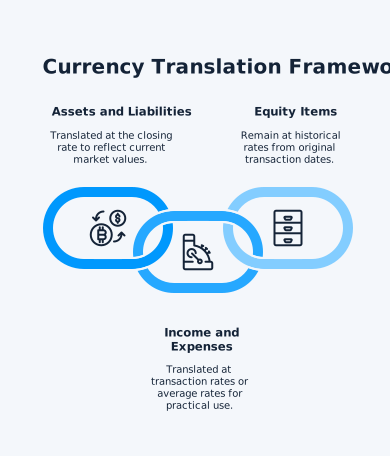
Multi-currency operations require translation to your group reporting currency. IAS 21 prescribes specific exchange rates for different financial statement items.
IFRScommunity IAS 21 explainer confirms the translation requirements:
- Assets and liabilities: Translated at the closing rate (period-end exchange rate)
- Income and expenses: Translated at exchange rates at transaction dates (average period rates often used for practical reasons)
- Equity items: Remain at historical rates from original transaction dates
ICAEW’s IAS 21 summary notes that if exchange rates fluctuate significantly during the period, using average rates becomes inappropriate – you must use actual transaction date rates instead.
IFRS Community research identifies exchange differences arising from these different rates as Cumulative Translation Adjustment (CTA), recognised in other comprehensive income rather than profit or loss.
Step 5: Eliminate Intercompany Transactions
This critical step prevents double-counting of internal transactions. You must eliminate all transactions between group entities before producing consolidated statements.
Note: Xero has no native intercompany module. Eliminations, NCI, and goodwill are managed in your consolidation/reporting layer. dataSights automates these outside Xero while keeping results reconciled to each entity’s TB.
Step 6: Prepare Consolidated Financial Statements
After eliminations, combine the adjusted financial data to create your consolidated reports.
These include the following:
- Statement of financial position (balance sheet)
- Statement of profit or loss and other comprehensive income
- Statement of changes in equity
- Statement of cash flows
- Notes (including significant accounting policies).
Mastering Intercompany Eliminations in Consolidation
Eliminations represent the most complex aspect of group consolidation, and the following are the main categories requiring elimination:
- Eliminate intra-group transactions and balances in full. Direction matters for attribution: downstream (parent→sub) eliminations reduce the parent’s profit without affecting NCI, while upstream (sub→parent) eliminations reduce the subsidiary’s profit and therefore NCI’s share.
- Unrealised profit in closing inventory from intra-group sales must be removed. Inventory is stated at cost to the group; profit is recognised only when sold to external parties.
- For intra-group loans, eliminate both the receivable/payable balance and the associated interest income/expense.
Intercompany Revenue and Expenses
When subsidiaries trade with each other, these internal sales must be removed. For example, if Subsidiary A sells £100,000 of inventory to Subsidiary B, both the sale and the corresponding purchase disappear in consolidation. The consolidated statements only show transactions with external parties.
Intercompany Debt Eliminations
Loans between group entities cancel out in consolidation. If your parent company lends £500,000 to a subsidiary:
- Parent’s books show: £500,000 asset (loan receivable)
- Subsidiary’s books show: £500,000 liability (loan payable)
- Consolidated statement shows: £0 (eliminated)
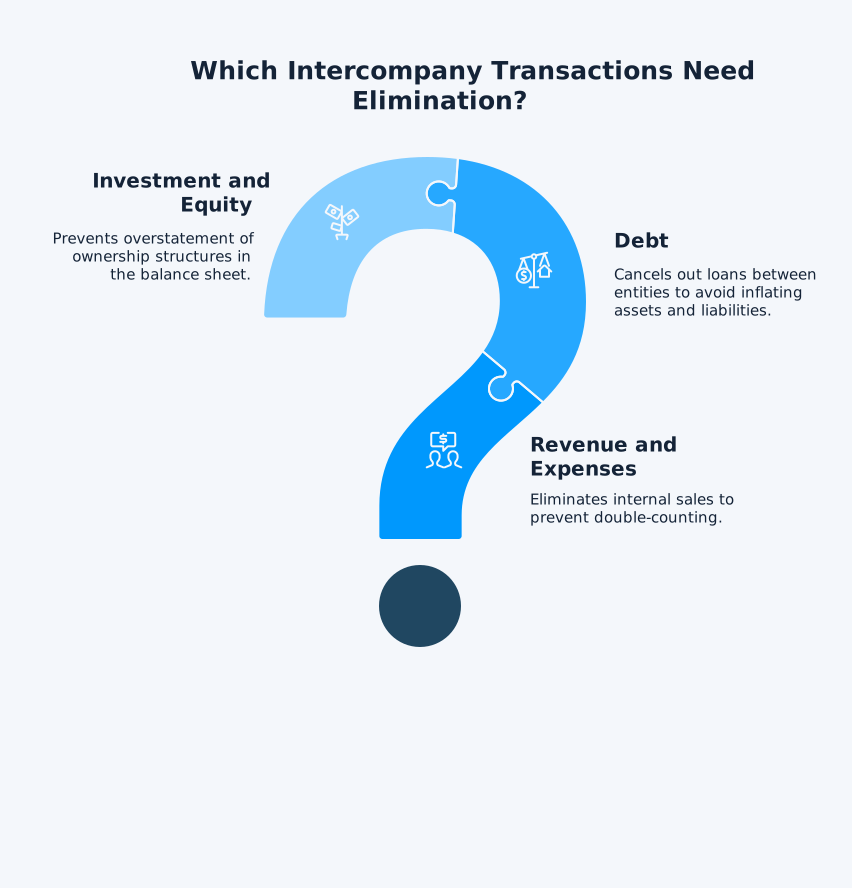
Investment and Equity Eliminations
The parent’s investment in subsidiaries must be eliminated against the subsidiaries’ equity. Corporate Finance Institute notes this prevents inflating the consolidated balance sheet with internal ownership structures.
Different Consolidation Methods Explained
Your ownership percentage determines which consolidation method to apply. Understanding these methods ensures compliance with accounting standards.
Full Consolidation Method
IFRS 10 requires full consolidation when you control an entity, regardless of ownership percentage. Control exists when you have power over the investee, exposure to variable returns, and the ability to affect those returns. Corporate Finance Institute explains that this method includes 100% of the subsidiary’s assets, liabilities, revenues, and expenses.
Even with less than 100% ownership, you consolidate all subsidiary accounts, then separately report non-controlling interests representing minority shareholders’ claims.
Equity Method
Use the equity method when there is significant influence (often presumed at 20% or more), and for joint ventures under IFRS 11 (joint control). The investment is recorded as a single line and adjusted for the investor’s share of profit or loss. According to KPMG, you need to record the investment as a single line item, adjusting it based on your ownership percentage of profits or losses.
Historical Note: Proportionate Consolidation and IFRS
Though no longer permitted under IFRS, understanding proportionate consolidation helps explain the evolution of joint venture accounting.
IFRS 11 Requirements
- SAP’s IFRS 11 analysis confirms:
- “IFRS 11 does not offer any accounting choice: the option for proportionate consolidation has been removed.”
- Joint ventures must now be accounted for using the equity method only.
Transition from IAS 31
- Under IAS 31 (the predecessor to IFRS 11):
- Proportionate consolidation was permitted, alongside the equity method.
- When IFRS 11 became effective in 2013, it:
- Prohibited the use of proportionate consolidation
- Left only the equity method available for joint venture accounting.
Research Insight
- ScienceDirect research highlights that under IAS 31:
- Proportionate consolidation was considered the benchmark treatment.
- The equity method was only an acceptable alternative.
- Under the current IFRS 11 standard:
- Joint ventures must be accounted for exclusively using the equity method.
Automating Your Group Consolidation Process
Manual consolidation using Excel becomes unsustainable as complexity grows. FYIsoft case studies show automation reduces close time by 38% on average.
Benefits of Automated Consolidation
These are the key automation advantages:
- Real-time data synchronisation across entities
- Automatic currency conversions using current rates
- Instant elimination entry generation
- Audit trails for all consolidation adjustments
- Error reduction through validation rules
Manual spreadsheets give you a point-in-time snapshot. dataSights provides a continuous, always-on group view. Issues surface daily, corrections happen in real time, and month-end becomes confirmation rather than discovery.
One global manufacturing client with U.S. and European operations cut monthly financial close time by 38% after automating consolidation across multiple entities with different general ledgers and currencies.
dataSights customers report consolidating 30+ Xero entities in under 5 minutes, compared to 15+ days using manual methods.
Regulatory Compliance for Group Consolidation
Compliance requirements vary by jurisdiction but share common principles. PWC confirms both GAAP and IFRS require consolidated statements for controlling interests.
IFRS 10 Requirements
IFRS 10 states that an investor controls the investee when he has all three elements:
- Power over the investee
- Exposure, or rights, to variable returns from its involvement with the investee
- The ability to use its power over the investee to affect the amount of the investor’s returns
Australian Standards
The Australian Department of Finance confirms that the financial report of an entity must encompass all the entities it controls, accounted for in accordance with the consolidation standard AASB 10 Consolidated Financial Statements.
AASB 10 and IFRS Alignment
- BDO Australia’s consolidation guide highlights that AASB 10 includes an Australian-specific requirement.
- Paragraph Aus 4.2 requires ultimate Australian parent entities to prepare consolidated financial statements.
- While AASB 10 aligns with IFRS 10, it incorporates additional Australian-specific provisions.
Corporations Act 2001 Requirements
Under the Corporations Act 2001:
- Reporting entities must lodge consolidated statements with ASIC.
- This ensures transparency and compliance for Australian businesses operating with subsidiaries.
Disclosure Requirements
IFRS 12 requires entities to disclose information that allows users to evaluate:
- The nature of interests in other entities
- The risks associated with those interests
- The effects on financial position, financial performance and cash flows.
IFRS Community’s IFRS 12 guide specifies that entities must provide information enabling users of consolidated financial statements to understand:
- The interest that non-controlling interests have in the group’s activities and cash flows
- Restrictions on accessing or using the group’s assets and settling liabilities
- Risks associated with interests in consolidated structured entities
- Consequences of changes in ownership without losing control
- The rationale for aggregating similar interests and ensuring transparency
ICAEW’s IFRS 10 summary notes that while IFRS 10 establishes consolidation principles, all disclosure requirements are contained in IFRS 12, including:
- accounting and disclosure requirements for investments in subsidiaries
- joint ventures and associates.
The IFRS 10 guide confirms that a reporting entity should disclose significant judgements and assumptions made in determining whether:
- it controls
- jointly controls
- significantly influences or
- has interests in other entities.
Best Practices for Efficient Consolidation
Leading finance teams follow proven practices to streamline consolidation. Here’s what works based on industry research.
Standardisation Across Entities
Standardised processes are essential for efficient consolidation. Centralising financial data from multiple entities in one location reduces errors and saves time.
Implement these standardisation elements:
- Uniform charts of accounts across all entities
- Consistent accounting policies and procedures
- Standardised reporting calendars
- Common approval workflows
Documentation and Audit Trails
Businesses must have controls in place to record, capture, and eliminate all intercompany transactions correctly. Maintain clear documentation for:
- Elimination entries and supporting calculations
- Currency translation methodologies
- Ownership structure changes
- Consolidation adjustments
- Management judgements and estimates
Technology Integration
Modern consolidation requires integrated systems rather than disconnected spreadsheets. NetSuite’s consolidation documentation confirms that multi-entity and multi-book accounting capabilities, combined with real-time data, make consolidating and reporting financial details extremely easy.
Third-party consolidation tools demonstrate what integrated platforms deliver:
- Consolidate hundreds of entities in minutes, not days
- Automatic cumulative translation adjustments for multi-currency
- Drill-down capability into consolidation journals
- Elimination rules that save days of manual work
dataSights delivers these capabilities through our Xero consolidation platform, with customers consolidating both small and large groups of entities in minutes, not days.
Common Consolidation Challenges and Solutions
Finance teams face recurring obstacles during consolidation. Here’s how to address them effectively.
Challenge: Timing Differences
Subsidiaries operating on different reporting schedules create consolidation delays. IFRS 10 permits up to a three-month difference between reporting dates, with adjustments for significant transactions in the intervening period.
Solution: Implement rolling forecasts and standardise reporting deadlines where possible.
Challenge: Incomplete Eliminations
In PwC’s detailed guidance on the equity method under U.S. GAAP, profit and loss eliminations don’t automatically flow to the balance sheet current earnings.
Solution: Create complete elimination templates covering all intercompany transaction types.
Challenge: Data Quality Issues
Data quality is the primary cause of restatements.
Solution: Implement validation rules and reconciliation controls before consolidation begins.
Frequently Asked Questions
How long should the group consolidation process take?
Manual consolidation typically requires 10-15 days for complex groups. dataSights customers using our Xero consolidation platform complete consolidation in under 5 days.
What ownership percentage requires consolidation?
Consolidation is required when the parent controls the investee. Ownership of more than 50% is a common indicator but not the test. Control can exist with less than 50% if you have power over relevant activities and exposure to variable returns.
Can Excel handle complex consolidations?
Excel is effective for simple structures, but it struggles with handling multiple entities and currencies. Third-party consolidation tools, like dataSights, show that Excel-based consolidation error rates exceed 20% for groups with 10+ entities.
How are minority interests calculated?
Non-controlling interests represent minority shareholders’ proportionate share of subsidiary net assets. ACT Learning explains that if you own 90% of a subsidiary with £80m net assets, minority interest equals £8m (10% × £80m). Note: NCI is attributed after intra-group eliminations.
What happens to goodwill in consolidation?
Goodwill arises when the purchase price exceeds the fair value of the net assets acquired. Goodwill appears only in consolidated statements, not individual entity accounts.
Goodwill = Purchase consideration – fair value of identifiable net assets.
Under IFRS 3, NCI at acquisition can be measured at fair value or at the NCI’s proportionate share of net assets, which affects goodwill. In practice, goodwill is tracked in the consolidation layer rather than inside Xero.
Do all intercompany transactions require elimination?
Yes, all intercompany transactions must be eliminated to prevent double-counting. This includes sales, purchases, loans, dividends, and management fees between group entities.
How often should consolidation occur?
Consolidation frequency matches your reporting requirements. Typically, monthly consolidation is performed for management reporting, while quarterly consolidation is required for external stakeholders such as tax filings or statutory submissions.
What's the difference between consolidated and combined statements?
Consolidated statements represent a single economic entity with elimination of intercompany items. Combined financial statements (often used for entities under common control without a parent) are not defined in IFRS. Practice is jurisdiction-specific. Many combined presentations still eliminate intra-group transactions and balances; the policy should be disclosed.
Master Your Group Consolidation with Confidence
The group consolidation process transforms complex multi-entity data into clear, compliant financial statements. You’ve learned the six essential steps, mastered elimination techniques, and discovered how automation cuts close time by as much as 150%. Smart finance teams automate their consolidation to focus on analysis rather than manual processing.
Transform Your Group Consolidation Process Today
Stop wrestling with broken Excel formulas and missed elimination entries. dataSights’ Xero consolidation solution automates your entire group consolidation process – from data collection through to final reports. With 90+ five-star reviews from finance teams who’ve cut their month-end close from weeks to days, you’ll join 300+ businesses already transforming their multi-entity reporting.
About the Author
Kevin Wiegand
Founder & Client happiness
I’m Kevin Wiegand, and with over 25 years of experience in software development and financial data automation, I’ve honed my skills and knowledge in building enterprise-grade solutions for complex consolidation and reporting challenges. My journey includes developing custom solutions for data teams at Gazprom Marketing & Trading and E.ON, before founding dataSights in 2016. Today, dataSights helps over 300 businesses achieve 100% report automation. I’m passionate about sharing my expertise to help CFOs and Financial Controllers reduce their month-end close time and eliminate the manual Excel exports that drain their teams’ valuable time.