
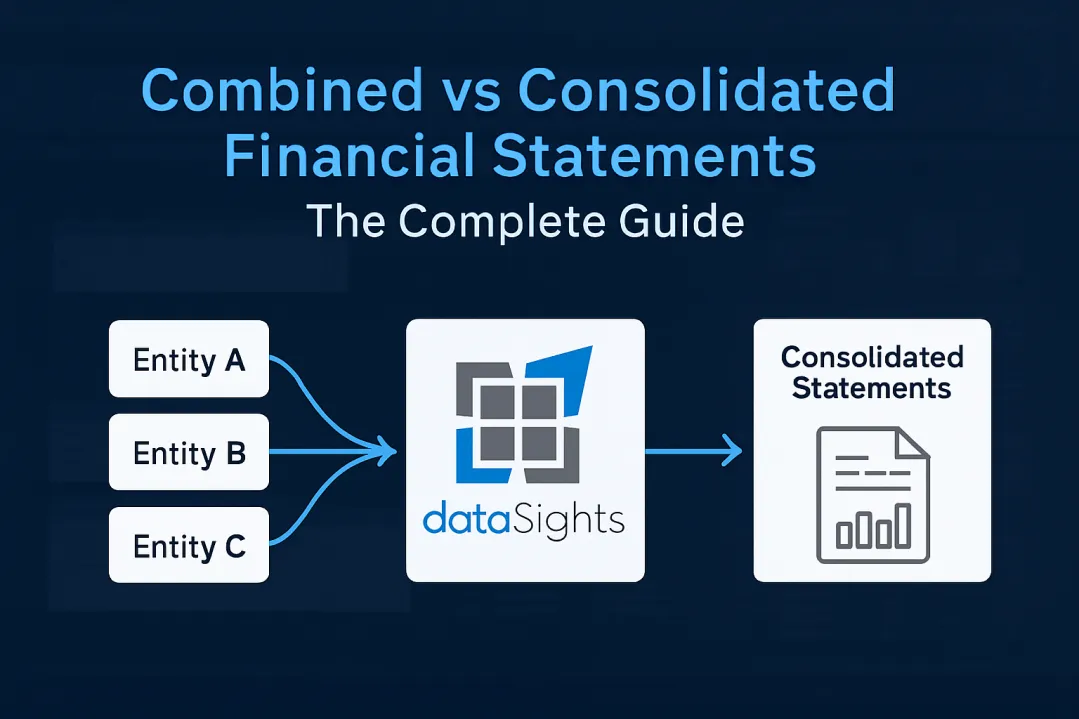
Confused about combined vs consolidated financial statements? If you manage multiple entities, understanding when to consolidate versus when to present a combined view will save days at month-end and prevent audit rework. Below, we break down plain-English definitions, when to use each, and what to eliminate so your reports actually balance. Then we show how automation removes the grunt work.
What Are Combined vs Consolidated Financial Statements?
Under IFRS 10/ASC 810, consolidation is required when the parent controls the investee and presents the group as one economic entity (with intercompany eliminations). Combined statements present entities under common control without a parent–subsidiary relationship and are presented as if consolidated, so intercompany balances and transactions among the entities presented are eliminated.
Ready to Automate Your Financial Consolidation?
Stop wrestling with manual consolidations and broken formulas. dataSights automates multi-entity reporting, Xero consolidations, and Power BI connections. Join 300+ businesses already transforming their financial reporting with our platform, rated 5.0 out of 5 by 90+ verified Xero users.
Table of Contents
Key Differences Between Combined and Consolidated Statements
Here’s how the two approaches diverge in practice: what your statements look like, what gets eliminated, and how control drives the choice – so you can pick the right model before close.
Presentation and Structure
The fundamental difference lies in how the financial data appears:
- In consolidated financial statements, the parent company and its multiple subsidiaries are presented as one entity with intercompany balances eliminated. Your balance sheet shows single line items for assets, liabilities, and equity representing the entire group.
- Combined statements maintain visibility of individual entities. You’ll see separate columns or sections for each company, though they’re presented in one comprehensive document. This structure proves invaluable when stakeholders need to assess individual entity performance within the group.
Elimination Requirements
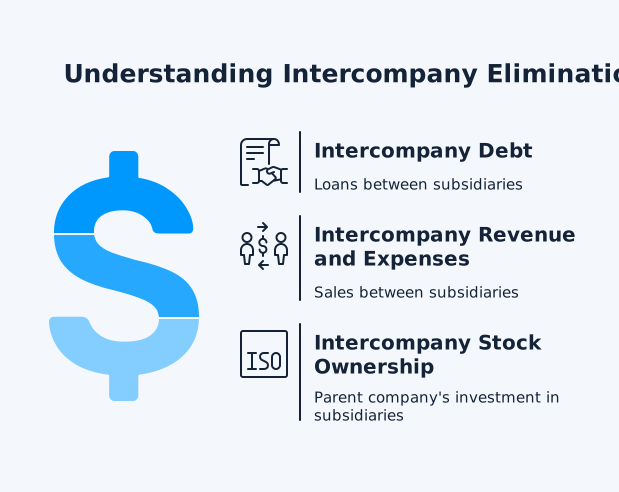
For consolidated statements, eliminate:
- Intercompany debt
- Revenue/expenses (including unrealised profit in inventory/PP&E)
- Parent’s investment vs the subsidiary’s equity at acquisition (recognising goodwill where applicable).
For combined statements, eliminate all intercompany balances and transactions among the entities included, including any cross‑holdings (e.g., where one combined entity holds an interest in another combined entity), consistent with the “as if consolidated” model.
The process begins by identifying all intercompany transactions between entities being consolidated. Each transaction is recorded twice – once by each entity involved – and must be eliminated to present the parent entity’s consolidated results as a single economic unit.
When eliminating intercompany sales, you must reverse both the revenue recorded by the selling entity and the expense recorded by the buyer. On consolidation, eliminate intragroup balances and transactions (including profits embedded in inventory and fixed assets), and offset the parent’s investment against the subsidiary’s equity at acquisition, recognising goodwill where applicable.
Note for Xero users: Xero has no native intercompany module. Eliminations (loans, sales, fees, unrealised profit, etc.) must be managed outside Xero in your consolidation/reporting layer. Keep an audit trail of elimination journals and who posted them.
Control and Ownership Criteria
Under IFRS 10/ASC 810, you consolidate when you control the investee. Interests with significant influence (IAS 28/ASC 323) or joint control (IFRS 11) are not consolidated line‑by‑line; they’re typically accounted for using the equity method.
- ASC 810 (US GAAP): Consolidate under the voting‑interest model (often >50% voting interest) or the VIE model when you are the primary beneficiary
- IFRS 10: Consolidate when you have power, exposure to variable returns, and the ability to affect those returns—including some cases with <50% ownership
Combined statements apply when entities are under common control but lack a parent-subsidiary relationship. Sister entities owned by the same individual or parent company, but not by each other, prepare combined rather than consolidated statements.
When to Use Combined Financial Statements
Use combined reporting when entities share a common control but no parent–subsidiary relationship exists. The next subsections illustrate typical setups and how to present sister companies side by side without implying control.
Common Control Scenarios
Combined statements make sense when multiple businesses operate under common ownership without formal parent-subsidiary structures. Entities under common control may find combined statements more meaningful than consolidated statements of the common parent.
You’ll typically see combined statements when an individual owns multiple companies that operate independently. A restaurant owner with three separate restaurant entities – each with its own legal structure – would prepare combined statements to show overall performance while maintaining individual entity visibility for operational decisions.
Sister Companies Under Same Ownership
When neither Subsidiary A nor Subsidiary B has a controlling financial interest in each other, but the same parent owns both, the financial statements should be labelled as combined. This structure appears frequently in family-owned businesses and private equity portfolios.
Consider a holding company that owns 100% of a manufacturing business and 100% of a distribution business. Neither subsidiary owns the other, so they’re sister companies. Their combined statements show both businesses together without creating the fiction of one entity controlling the other.
When Consolidated Financial Statements Are Required
Once a controlling financial interest exists, consolidation isn’t optional. Below, we outline the ASC 810 and IFRS 10 tests for control and note common statutory exemptions.
ASC 810 Requirements (US GAAP)
Under ASC 810, there’s a presumption that consolidated financial statements are more meaningful than separate statements when one entity has a controlling financial interest in another. US GAAP requires evaluation through two models: the Variable Interest Entity (VIE) model and the Voting Interest Model.
The VIE model applies when control exists through means other than voting rights. A reporting entity with variable interests must assess whether it has both the power to direct activities that most significantly impact the VIE’s economic performance and the obligation to absorb losses or right to receive benefits that could be significant to the VIE. The voting interest model is simpler – consolidation is required when you own more than 50% of voting shares.
IFRS 10 Requirements (International Standards)
IFRS 10 requires consolidation when an entity controls another, regardless of the ownership percentage. Control exists when you have power over the investee, exposure to variable returns, and the ability to use that power to affect returns.
Because IFRS 10 is principles-based, you may consolidate with <50% ownership if you have de facto control (for example, via board rights or contracts). Conversely, you might not consolidate despite majority ownership if legal restrictions prevent you from exercising control.
Jurisdictional Exemptions (Statutory Filing)
- UK: Companies Act 2006 group‑accounts requirements/exemptions (e.g., s399–s401). Check current thresholds and Companies House guidance.
- Australia: AASB 10 includes an intermediate parent exemption (analogue to IFRS 10.4(a)) where a higher‑level parent publishes IFRS‑compliant consolidated financial statements. Corporations Act requirements still apply.
- New Zealand: NZ IFRS 10 (XRB) mirrors IFRS 10; intermediate‑parent exemption also exists— confirm filing obligations under NZ law/XRB.
Even if exempt from statutory consolidation, many groups still prepare management consolidations for boards and investors.
The Consolidation Process: Step-by-Step
Successful consolidation starts long before elimination journals. We’ll move from clean, aligned trial balances through intercompany eliminations and NCI so the group reads as one economic unit.
Trial Balance as Foundation
Every accurate consolidation starts with the Trial Balance. Trial Balance is the definitive report for multi-entity consolidation, ensuring all accounts reconcile before eliminations. You can’t build reliable consolidated statements without first confirming each entity’s Trial Balance balances.
Begin by extracting Trial Balance data from each entity, ensuring consistency in account mappings and period alignment. Any discrepancies at this stage will compound through the consolidation process. Modern consolidation platforms pull Trial Balance data automatically, but manual processes require meticulous verification of every account balance before proceeding.
Elimination Entries and Intercompany Transactions
Intercompany eliminations cancel transactions between entities to present the group as a single economic unit. These eliminations cover three main categories: intercompany debt, intercompany revenue and expenses, and intercompany stock ownership.
When eliminating intercompany sales, you’ll reverse both the revenue recorded by the selling entity and the expense recorded by the buyer. If inventory remains unsold at period-end, you must also eliminate unrealised profit by adjusting inventory values and recognising deferred profit.
Non-Controlling Interest Calculations
Non-controlling interest represents the portion of a subsidiary not owned by the parent company. When you own 75% of a subsidiary, the remaining 25% is non-controlling interest that must be separately presented in consolidated statements.
Under ASC 810, NCI is presented within equity but separate from the parent’s equity. You’ll allocate 25% of the subsidiary’s net income to NCI holders and show their share of equity on the balance sheet. This ensures your consolidated statements accurately reflect both the parent’s and minority shareholders’ interests.
In a pure combined set (sister entities, no parent), NCI typically doesn’t arise. NCI appears only if an entity within the combined perimeter has a consolidated subsidiary with outside shareholders.
Worked Example – Non-Controlling Interest
Parent owns 80% of Sub A. Sub A’s profit = £100,000. In the consolidated income statement, £80,000 is attributable to the parent and £20,000 to NCI; on the balance sheet, NCI appears in equity.
Common Challenges in Multi-Entity Financial Reporting
If your month-end tasks drag on, these are the usual suspects: time-intensive data wrangling, currency translation traps, and weak audit trails. Here’s what to watch for and fix.
Manual Consolidation Time Requirements
Most organisations take 5-10 working days to complete month-end close, with consolidation adding another 4-10 days. For groups with 10+ entities, manual consolidation in Excel often extends beyond 15 days, creating a bottleneck that delays critical management reporting.
The time drain comes from collecting data from disparate systems, mapping different charts of accounts, and manually entering elimination journals. Each additional entity adds exponential complexity – what takes 3 days for 3 entities might take 15 days for 10 entities using manual processes.
Currency Conversion Complexities
Multi-currency consolidation requires converting all foreign subsidiary accounts at appropriate exchange rates. You’ll use current rates for balance sheet items and historical or average rates for income statement items, creating translation adjustments that flow through comprehensive income.
- IFRS (IAS 21): translate foreign operations using the closing rate for assets/liabilities, average rates for income/expenses, and historical rates for equity; the cumulative translation adjustment (CTA) is recognised in OCI.
- US GAAP (ASC 830): distinguish translation (as above) from remeasurement when books ≠ functional currency; monetary items use closing rates and non‑monetary items historical rates, with remeasurement gains/losses recognised in P&L.
Exchange rate fluctuations between reporting periods create additional reconciliation challenges. A UK parent consolidating US and Australian subsidiaries must track three sets of exchange rates, apply them correctly to hundreds of accounts, and document translation adjustments for audit purposes.
Audit Trail and Compliance Issues
Manual consolidation in spreadsheets lacks the audit trail required for regulatory compliance. When auditors ask how you eliminated a specific intercompany transaction from six months ago, Excel offers no systematic way to trace the journal entry back to its source.
Compliance requirements under ASC 810 and IFRS 10 demand extensive documentation of:
- Consolidation procedures
- Elimination entries, and
- Non-controlling interest calculations.
Without proper audit trails, you’re facing extended audit timelines and potential compliance failures.
Automating Your Consolidation Process
Moving off spreadsheets changes the cadence of close. We compare manual vs automated workflows and show how real-time consolidation surfaces issues before they snowball.
Moving from Excel to Automated Systems
Automated consolidation reduces month-end close by up to 70%, from over two weeks to under 5 days. Instead of manually collecting Trial Balances, automated systems pull data directly from each entity’s accounting system in real-time.
Modern platforms automatically identify and eliminate intercompany transactions using pre-configured rules. When Subsidiary A records a sale to Subsidiary B, the system immediately flags it for elimination, maintaining a complete audit trail of what was eliminated and why.
Industry case studies and vendor benchmarks report material close‑time reductions (often 30–70%) when moving from spreadsheets to automated consolidation with audit trails. Real outcomes vary with entity count, data quality, and process maturity. (Representative benchmarks)
Real-Time vs Period-End Consolidation
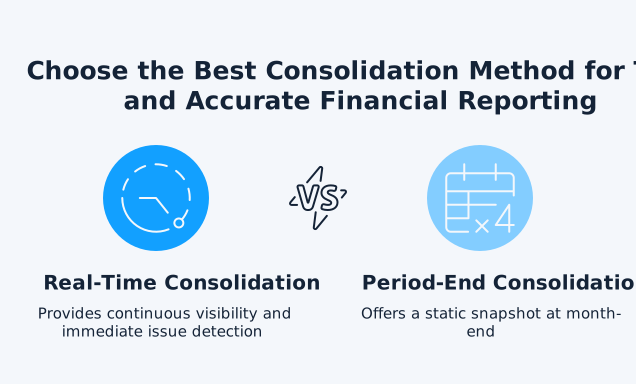
Traditional Excel-based consolidation provides a static snapshot at month-end. Real-time consolidation platforms offer continuous visibility into consolidated positions, surfacing issues daily rather than weeks after the month-end.
With real-time consolidation, you’ll spot intercompany mismatches immediately. If Subsidiary A records a £100,000 receivable but Subsidiary B only shows £95,000 payable, you’re investigating while the context is fresh, not scrambling to explain discrepancies weeks later during the audit.
Important Note: Xero doesn’t provide native consolidation or intercompany eliminations; use a consolidation/ reporting layer (e.g., SQL/Power BI) or a connected app to automate eliminations, multi‑currency, NCI, and audit trails.
Frequently Asked Questions
How Do You Handle Non-Controlling Interests in Combined Statements?
In combined financial statements of sister entities, non-controlling interests only appear when a combined entity itself has subsidiaries with minority shareholders. The parent company’s ownership structure doesn’t create NCI in combined statements since there’s no parent-subsidiary relationship between the combined entities.
What Elimination Entries Are Required for Consolidated Statements?
Consolidated statements require elimination of all intercompany balances and transactions, including intercompany sales, cost of goods sold, loans, interest income/expense, dividends, and unrealised profits on unsold inventory. Each elimination must maintain the balance sheet equation and be fully documented for audit purposes.
Can You Prepare Both Combined and Consolidated Statements?
Yes, companies sometimes prepare both types for different purposes. Consider preparing consolidated statements for regulatory compliance and external reporting while using combined statements internally to evaluate individual entity performance. Always label statements clearly as “Combined” or “Consolidated” in titles/footers and disclose the basis of preparation (which entities are included and the common‑control rationale for combined sets).
How Long Should Consolidation Take for 10+ Entities?
Manual consolidation for 10+ entities typically takes 10-15 days or more. With automated consolidation software, the same process can be completed in 3-5 days. The time savings come from automated data collection, systematic elimination processing, and real-time error detection.
What Happens to Intercompany Loans in Consolidation?
Intercompany loans and related interest must be eliminated in consolidation. The loan receivable on one entity’s books and the loan payable on another’s cancel out, as does any accrued interest. The consolidated balance sheet shows only external debt.
Do Combined Statements Require Elimination of Intercompany Sales?
Combined statements should eliminate intra-entity transactions to avoid double-counting revenue and expenses. However, the process is simpler than consolidation since you’re not dealing with parent-subsidiary eliminations or non-controlling interests.
How Are Foreign Subsidiaries Treated in Consolidation?
Foreign subsidiaries are translated into the parent’s reporting currency before consolidation. Current exchange rates apply to assets and liabilities, while income statement items use average rates for the period. Translation adjustments flow through other comprehensive income rather than affecting net income.
Can I Consolidate If a Subsidiary Has a Different Year-End?
Yes. IFRS 10 permits up to a three-month difference in reporting dates. Make adjustments for significant transactions in the gap so the consolidated figures remain current and comparable.
What's the Difference Between VIE and Voting Interest Models?
The VIE model was written to address fact patterns where not all equity investors bear the typical economic risks and rewards of owning a legal entity. In contrast, the voting interest model follows a general premise that the majority of voting interests dictates control. When assessing consolidation, companies must first determine if the entity is a VIE before applying the voting interest model.
Transform Your Multi-Entity Reporting Today
Whether you’re preparing combined statements for sister companies or consolidated statements for a complex group structure, success depends on accurate Trial Balances, systematic eliminations, and efficient processes. Moving from manual Excel-based consolidation to automated systems isn’t just about saving time – it’s about providing real-time visibility, maintaining complete audit trails, and delivering the management intelligence your stakeholders need.
Streamline Your Financial Consolidation with Xero Automation
Ready to cut your consolidation time from weeks to days? dataSights’ automated Xero consolidation solution handles both small and large entity groups with automatic eliminations and real-time Trial Balance reconciliation. Join 300+ businesses who’ve already transformed their multi-entity reporting – rated 5.0 by over 90 Xero users.
About the Author
Kevin Wiegand
Founder & Client happiness
I’m Kevin Wiegand, and with over 25 years of experience in software development and financial data automation, I’ve honed my skills and knowledge in building enterprise-grade solutions for complex consolidation and reporting challenges. My journey includes developing custom solutions for data teams at Gazprom Marketing & Trading and E.ON, before founding dataSights in 2016. Today, dataSights helps over 300 businesses achieve 100% report automation. I’m passionate about sharing my expertise to help CFOs and Financial Controllers reduce their month-end close time and eliminate the manual Excel exports that drain their teams’ valuable time.