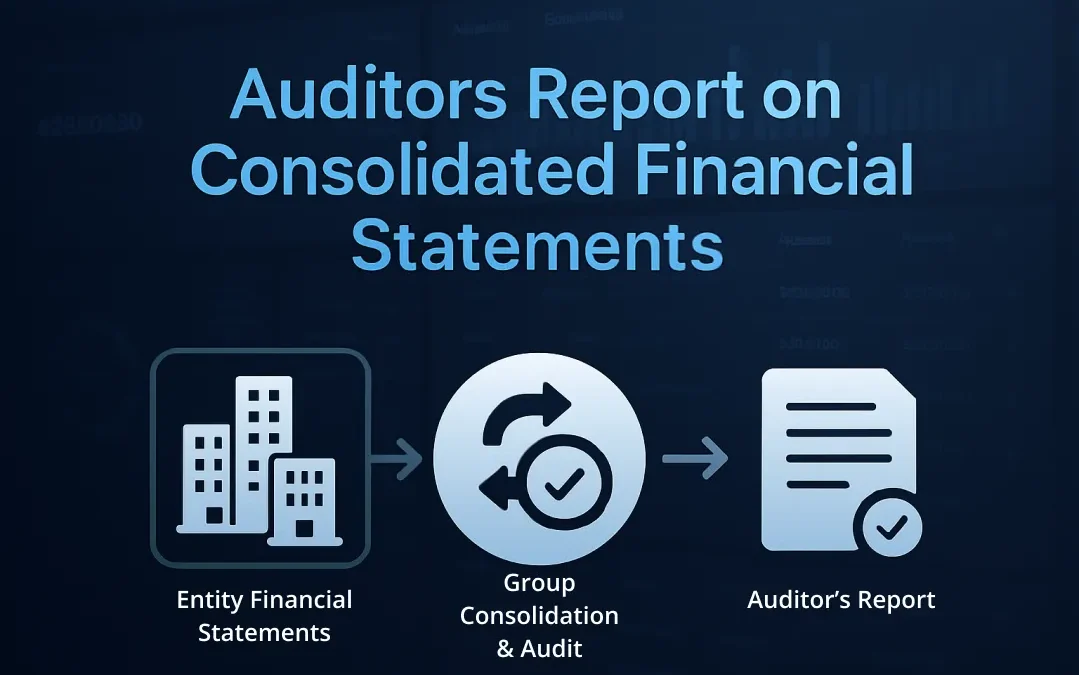
What Auditors Examine in Consolidated Financial Statements
Auditors do not simply verify numbers. They evaluate the entire consolidation process, from how your group identifies its reporting boundary to how it eliminates intercompany balances. The group consolidation process must withstand detailed examination at every stage.
Group Structure and Consolidation Boundary
The first thing an auditor examines is whether you have identified the correct consolidation boundary. Under IFRS 10, control is the sole basis for determining which entities must be consolidated (Note: some structures – such as investment entities – have specific measurement exceptions.). Control exists when the parent has:
- Power over the investee
- Exposure or rights to variable returns
- The ability to use that power to affect those returns
Auditors will test whether your group structure documentation accurately reflects the criteria for consolidated financial statements. This includes reviewing:
- Shareholding agreements and voting rights
- Structured entities that might require consolidation even without majority ownership
- De facto control arrangements where the parent controls without a majority stake
Getting this wrong means the consolidation scope itself is incorrect, which fundamentally undermines the entire set of group accounts.
Uniform Accounting Policies Across Entities
Every entity within the group must apply uniform accounting policies for the preparation of consolidated financial statements. If a subsidiary uses different revenue recognition methods or depreciation approaches, adjustments must be made before consolidation.
Auditors specifically check whether:
- Policy alignment adjustments have been correctly calculated and documented
- Entities operating under different local frameworks have been properly converted
- The accounting standards governing consolidation are applied systematically, not ad hoc
Intercompany Transactions and Eliminations
Intercompany eliminations are consistently one of the highest-risk areas auditors examine. Three primary categories must be fully eliminated:
- Intercompany debt balances: Loans, receivables, and payables between group entities
- Intercompany revenue and expenses: Sales, management fees, and service charges between entities
- Intercompany stock ownership transactions: Investment and equity balances between parent and subsidiaries
Failure to eliminate these transactions inflates the group's reported assets, liabilities, revenue, and expenses. Auditors trace each elimination entry back to source transactions in the individual entity records. They verify that:
- Amounts agree on both sides of the intercompany relationship
- No elimination entries have been missed
- Unrealised profits on intercompany transfers have been removed
For groups preparing consolidations in spreadsheets, this is where problems multiply. Manual elimination journals often lack the systematic controls that strengthen an audit trail. When your elimination entries are managed through automated data pipelines, auditors can evaluate the underlying logic and focus their testing on outputs and exceptions, rather than re-performing checks on every individual manual journal. Auditors will still test the controls themselves and validate that outputs are accurate, but a consistent, repeatable process gives them a stronger evidence base to work from.
Non-Controlling Interests
Where the parent does not own 100% of a subsidiary, auditors examine how non-controlling interests (NCI) have been calculated and presented. Under IFRS 3, NCI can be measured using either of two methods:
- Fair value method: NCI measured at full fair value, including a share of goodwill
- Proportionate share method: NCI measured at the NCI's share of the acquiree's identifiable net assets only
The method chosen affects goodwill calculations and is elected for each business combination. Auditors verify the NCI calculation against the subsidiary's net assets and check that the NCI share of profit or loss is correctly allocated in the consolidated income statement.
Audit Trail and Documentation
Every figure in your consolidated financial statements must be traceable back to source transactions in the individual entity records. Auditors need a clear audit trail from the group balance sheet through consolidation adjustments to each subsidiary's trial balance.
This is where manual spreadsheet-based consolidations create the most friction. Common issues that break audit trails include:
- Broken links between workbooks
- Overwritten formulas without version control
- Undocumented manual adjustments
- Inconsistent cell references across entity sheets
The result is either extended audit timelines, increased audit fees, or qualified opinions.
How ISA 600 (Revised) Changes Group Audit Requirements
ISA 600 (Revised) introduced significant changes to how group audits are conducted. Finance teams preparing for a group audit need to understand these changes because they directly affect what documentation and evidence auditors will request.
Sole Responsibility of the Group Auditor
Under the revised standard, the group engagement partner carries sole responsibility for the audit opinion on the consolidated financial statements. Even when component auditors perform work on individual subsidiaries, the group auditor must:
- Direct the nature, timing, and extent of component auditor work
- Supervise component audit procedures throughout the engagement
- Review component auditor findings and evaluate whether the evidence is sufficient
This means the group auditor will ask more detailed questions about your consolidation process and require more granular evidence than under the previous standard.
Risk-Based Approach to Component Classification
ISA 600 (Revised) requires a risk-based approach to the group audit. Rather than applying uniform procedures across all entities, the group auditor must:
- Identify and assess risks of material misstatement at the group level
- Classify components based on significance and risk profile
- Design audit responses proportionate to each component's risk level
- Evaluate whether combined evidence from all components supports the group opinion
Components classified as significant will receive more extensive audit procedures. For your finance team, this means the auditor will focus more attention on entities with:
- Complex or unusual transactions
- Significant intercompany balances
- Material accounting judgements or estimates
- Higher inherent or control risk
Enhanced Communication Requirements
The revised standard strengthens the two-way communication requirements between group and component auditors. Key changes include:
- Group auditors must communicate instructions to component auditors earlier in the engagement
- Component auditors must report identified risks and findings back to the group auditor
- Both parties must communicate matters relevant to the group auditor's conclusions
For multi-entity groups, this often translates into more detailed information requests earlier in the audit cycle. Finance teams that can provide structured, consistent data packages for each entity significantly reduce audit friction.
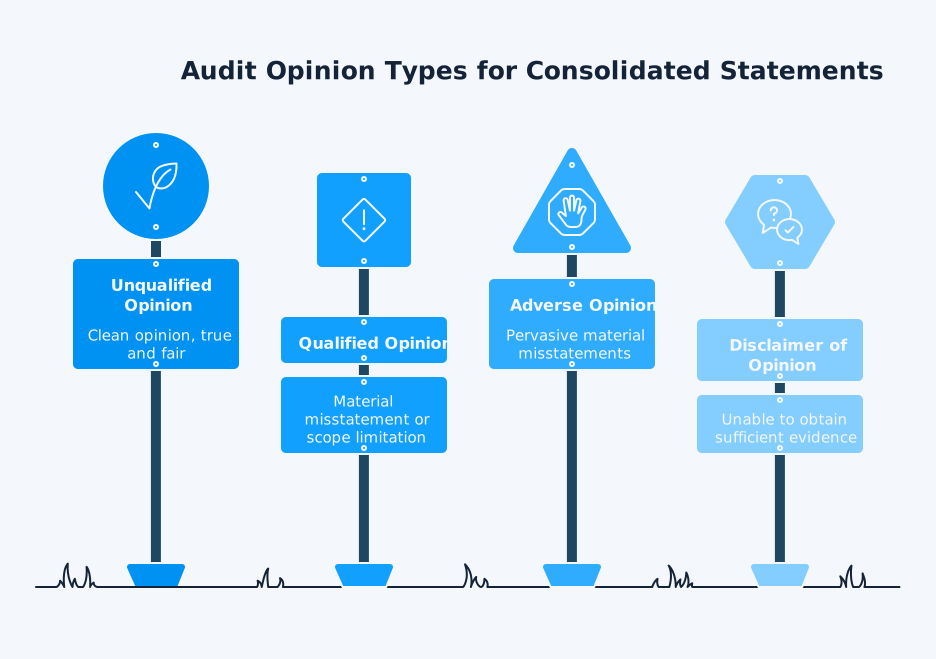
Understanding Audit Opinion Types for Consolidated Statements
The auditor's opinion on your consolidated financial statements falls into one of four categories. Understanding these helps your finance team prioritise the areas that matter most to achieving a clean opinion.
Unqualified (Clean) Opinion
An unqualified opinion means the auditor believes the consolidated financial statements present a true and fair view (under IFRS/UK GAAP) or are fairly presented in all material respects (PCAOB AS 3101 (US issuer auditor's report)). This is the opinion every group targets. It confirms that:
- The consolidation process follows the applicable framework
- Elimination entries are complete and accurate
- Disclosures meet all required standards
- The overall presentation gives a true and fair view
Qualified Opinion
A qualified opinion indicates that the auditor found either:
- A material misstatement that is not pervasive to the financial statements as a whole, or
- A scope limitation preventing the auditor from obtaining sufficient evidence on a specific matter
In consolidation contexts, common triggers include:
- An incomplete or incorrectly processed intercompany elimination
- A subsidiary where records were incomplete or inaccessible
- Disagreements over accounting policy application in a specific entity
Adverse Opinion
An adverse opinion means the auditor found material misstatements that are pervasive to the consolidated financial statements. This is serious and typically indicates fundamental problems with:
- The consolidation methodology itself
- Widespread errors in elimination entries
- Systematic accounting policy failures across entities
Disclaimer of Opinion
A disclaimer means the auditor was unable to obtain sufficient appropriate audit evidence to form an opinion. This typically occurs when:
- Access to subsidiary records was severely restricted
- Consolidation documentation was so inadequate that the auditor could not verify the group's financial position
- Significant uncertainties prevented the auditor from reaching a conclusion
Definitions based on: ISA 700 (Revised) and ISA 705 (Revised).
Common Audit Findings in Group Consolidations
Knowing what triggers audit issues helps you address problems before the auditors arrive. These are the areas where consolidation audits most frequently identify deficiencies.
Incomplete Intercompany Eliminations
The most common finding is that not all intercompany transactions have been identified and eliminated. This happens when:
- Entities do not consistently flag intercompany counterparties in their accounting records
- The consolidation process relies on manual identification of intercompany balances
- Timing differences between entities create unmatched balances
- New intercompany relationships are not captured in the elimination schedule
Automated consolidation tools that systematically identify and match intercompany balances across entities help reduce this risk. When your system pulls data directly from each entity's accounting platform, transactions tagged as intercompany can be matched and scheduled for elimination more consistently than through manual identification. Auditors will still verify that the matching logic is sound and that outputs are complete, but a systematic process provides a more reliable starting point for their testing.
Inconsistent Reporting Periods
Auditors check that all entities report for the same period. Under IFRS 10 Appendix B, paragraphs B87 and B92–B93, the difference between the reporting dates of a subsidiary and the parent cannot exceed three months. If entities have different year-ends, adjustments for significant transactions in the gap period are required.
Inadequate Documentation of Judgements
Consolidation involves judgement calls that auditors expect to be documented with supporting evidence. Key areas include:
- Control assessments for entities near the consolidation boundary
- Fair value measurements at acquisition
- Goodwill impairment testing assumptions and models
- Identification and valuation of intangible assets
Groups that prepare consolidated financial statements after acquisition need particularly robust documentation around purchase price allocation and fair value adjustments.
Foreign Currency Translation Errors
For groups with foreign subsidiaries, translating financial statements into the group's presentation currency is another area auditors examine closely. Common errors include:
- Using incorrect exchange rates for income statement versus balance sheet items
- Failing to recognise translation differences in other comprehensive income
- Inconsistent treatment of monetary versus non-monetary items
- Misclassifying foreign operation gains or losses on disposal
Under IAS 21, consolidations typically translate foreign operations by using the closing rate for assets and liabilities, and transaction-date/average rates for income and expenses, with resulting translation differences recognised in OCI until disposal.
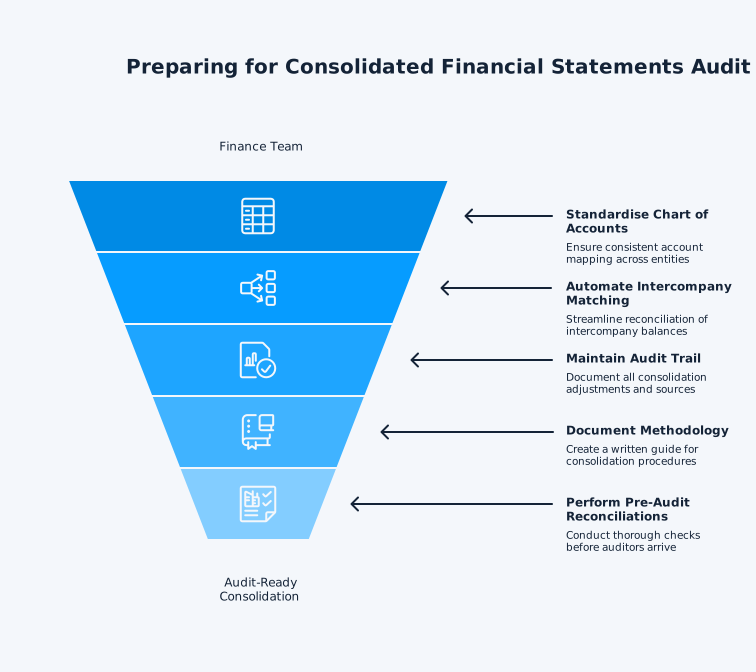
How to Prepare for a Consolidated Financial Statements Audit
Preparation is the most effective way to achieve a clean audit opinion. These practical steps help your finance team build an audit-ready consolidation process.
Standardise Your Chart of Accounts
A unified chart of accounts across all entities in the group makes consolidation cleaner and audit evidence easier to produce. When every entity maps to the same account structure, the consolidation process becomes a structured data aggregation rather than a manual mapping exercise.
dataSights Management Reports connect directly to your Xero entities and apply consistent account mapping across your group. This means your consolidation starts from a standardised data foundation, reducing the mapping errors that auditors frequently identify.
Automate Intercompany Matching
Manual intercompany reconciliation is time-consuming and error-prone. Automating the identification and matching of intercompany balances ensures that elimination entries are:
- Complete: Every intercompany transaction is captured
- Accurate: Amounts agree on both sides of the relationship
- Documented: The matching logic is traceable and repeatable
With dataSights, intercompany data flows directly from each entity's Xero records into your consolidation, where matching is handled systematically rather than through ad hoc spreadsheet checks.
Maintain a Clear Audit Trail
Every consolidation adjustment needs to be traceable. This means documenting:
- The source of each elimination entry
- Exchange rates used for currency translation and their source
- The basis for any consolidation judgements
- Version history for all consolidation workbooks
When you consolidate financial statements through automated pipelines, the system helps maintain this trail consistently. Each data point links back to its source transaction in Xero, giving auditors a clear path to trace consolidation adjustments to their origin – though they will still independently verify that the trail is complete and accurate.
For groups currently managing consolidations in Excel, dataSights' automated data pipelines feed directly into your existing spreadsheet workflows. Your team retains the analytical flexibility of Excel while gaining systematic data controls that support the evidence requirements auditors look for during fieldwork. You can also extend your reporting into Power BI financial reporting for more advanced analytics and visualisation.
Document Your Consolidation Methodology
Auditors expect a written consolidation methodology that describes:
- How the group identifies entities for consolidation
- The accounting policies applied and how uniformity is achieved
- The procedures followed for elimination entries
- How judgements and estimates are documented and approved
- The GAAP principles governing your consolidation, including specific standard references (IFRS 10, FRS 102 Section 9, or ASC 810)
Perform Pre-Audit Reconciliations
Before the auditors begin their fieldwork, complete these checks:
- Reconcile all intercompany balances and resolve discrepancies
- Verify elimination entries balance to zero across all categories
- Confirm the consolidated trial balance agrees with the sum of entity trial balances plus consolidation adjustments
- Review NCI calculations against current subsidiary net asset positions
- Check currency translation reserves for accuracy and completeness
This pre-audit check identifies discrepancies that would otherwise surface during the audit and extend your timeline.
IFRS 10 vs US GAAP Consolidation Audit Considerations
The framework under which your group reports affects what auditors test. While the principles are similar, there are important differences that audit teams will focus on.
| Area | IFRS | US GAAP |
| Consolidation model | Single control model (IFRS 10) | Dual model (ASC 810): voting interest + VIE model |
| Control/consolidation trigger | Power + variable returns + ability to use power (IFRS 10) | Voting entities: controlling financial interest (voting). VIEs: primary beneficiary has power over significant activities and economics that could be potentially significant |
| Goodwill | Impairment testing (no amortisation) | Impairment testing; private company alternative permits amortisation (subject to eligibility) |
| Non-controlling interests | Measurement choice at acquisition (IFRS 3) | Generally measured at fair value (full goodwill model) |
For auditors, this means the assessment of whether an entity should be consolidated can yield different conclusions depending on the framework. Finance teams operating across jurisdictions need to ensure their consolidation boundary analysis addresses the correct framework requirements. The criteria for consolidated financial statements differ in specific technical ways that auditors will test.
Frequently Asked Questions
What Is the Purpose of an Auditor's Report on Consolidated Financial Statements?
The purpose is to provide an independent opinion on whether the group's consolidated financial statements present a true and fair view of the financial position, performance, and cash flows of all entities within the group as a single economic entity. Stakeholders, including investors, lenders and regulators, rely on this opinion to make informed decisions.
Who Is Responsible for the Audit Opinion on Group Financial Statements?
Under ISA 600 (Revised), the group engagement partner is solely responsible for the audit opinion on consolidated financial statements. Even when component auditors perform work on individual subsidiaries, the group auditor must direct, supervise, and review that work before forming the overall opinion.
What Are Critical Audit Matters in Consolidated Financial Statements?
Critical Audit Matters (CAMs) are issues arising from the audit that were communicated to the audit committee and relate to accounts or disclosures that are material to the financial statements. Under PCAOB AS 3101, auditors of public companies must disclose CAMs in the audit report. In consolidation contexts, common CAMs include goodwill impairment assessments, revenue recognition across entities, and complex intercompany arrangements. Under the ISAs, listed-entity reports instead refer to Key Audit Matters (KAMs) under ISA 701.
How Long Does a Group Audit of Consolidated Financial Statements Typically Take?
Group audit timelines vary depending on the number of entities, complexity of intercompany transactions, and quality of consolidation documentation. For multi-entity groups, fieldwork and sign-off often take several weeks or longer, depending on complexity and the quality of the consolidation audit trail. Groups with automated consolidation processes and clean audit trails are generally better positioned to complete the process efficiently, though audit timelines also depend on the auditor's own assessment of controls and risk.
Can an Auditor Give a Qualified Opinion on Only Part of the Consolidated Statements?
Yes. A qualified opinion can relate to a specific matter, such as an incomplete elimination or a scope limitation affecting one subsidiary, provided the issue is material but not pervasive. The auditor will describe the specific qualification in the audit report, allowing users to understand which aspects of the consolidated statements are affected.
What Happens if Intercompany Balances Do Not Agree Between Entities?
Unreconciled intercompany balances indicate a control deficiency in the consolidation process. Auditors will investigate the cause and assess whether the resulting misstatement is material. If material intercompany differences cannot be resolved, this could lead to a qualified opinion. Automated intercompany matching across your Xero entities reduces the likelihood of this scenario by systematically identifying and reconciling balances before the audit begins.
Does Every Subsidiary Need to Be Individually Audited for a Group Audit?
No. Under ISA 600, the group auditor uses a risk-based approach to determine which components require a full audit of financial information, an audit of specific account balances or classes of transactions and specified analytical procedures only. Significant components based on size or risk will typically receive a full audit or audit of specific account balances.
What Is the Difference Between a Group Audit and a Single-Entity Audit?
A group audit covers the consolidated financial statements of a parent and all its subsidiaries, requiring the auditor to evaluate the consolidation process, intercompany eliminations, and component auditor work. A single-entity audit covers only one legal entity's financial statements without consolidation procedures.
How Do Auditors Test Goodwill in Consolidated Financial Statements?
Auditors evaluate the initial measurement of goodwill arising from business combinations, then test the annual impairment assessment (under IFRS) or amortisation calculations (under US GAAP private company alternative). Key inputs auditors scrutinise include management's cash flow projections, discount rates and terminal growth rate assumptions and sensitivity analyses and headroom calculations.
What Documentation Should Finance Teams Prepare Before a Group Audit?
Finance teams should prepare a consolidation package for each entity, including trial balances with consistent chart of accounts mapping, intercompany balance confirmations with matching status, consolidation journals with supporting calculations, a reconciliation of the consolidated trial balance and the documented group consolidation process methodology. Having this ready before fieldwork begins significantly reduces audit duration.
Your Audit-Ready Consolidation Starts With the Process
A clean auditor's report reflects the quality of your consolidation process, not just the accuracy of your final numbers. When your methodology, controls, documentation, and elimination logic are built on automated, traceable data pipelines, the audit is more likely to proceed as a verification exercise rather than a discovery exercise. Auditors still apply professional judgement and test your controls independently, but a well-structured process reduces the volume of issues surfaced during fieldwork. Start by reviewing your current Xero consolidation workflow and identifying where manual processes create audit risk.