
Your group has 15 entities in Xero. Month-end arrives, and you’re staring at 5-10 business days of exports, spreadsheet formulas, and elimination journals that never quite balance. The problem isn’t your team’s skill – it’s that you’re unsure which consolidated financial statements accounting standard actually governs your group and what it requires. IFRS 10, FRS 102, ASC 810 – each framework defines control differently, mandates specific procedures, and carries distinct disclosure rules. This guide breaks down exactly what each standard requires and shows you how to shorten your consolidation cycle from weeks to days.
Consolidated Financial Statements Accounting Standard Explained
A consolidated financial statements accounting standard sets the rules for when a parent must consolidate subsidiaries and how to prepare group accounts (including eliminations, goodwill, and non-controlling interests). In the UK, groups typically apply IFRS 10 (UK-adopted IFRS) or FRS 102, depending on their reporting framework; US groups apply ASC 810. The standard you’re subject to determines your control test, the consolidation steps you must follow, and the disclosures you must make.
Ready to Automate Your Financial Consolidation?
Stop wrestling with manual consolidations and broken formulas. dataSights automates multi-entity reporting, Xero consolidations, and Power BI connections. Join 300+ businesses already transforming their financial reporting with our platform, rated 5.0 out of 5 by 90+ verified Xero users.
Table of Contents
What Are Consolidated Financial Statements?
Consolidated financial statements combine the assets, liabilities, equity, income, and expenses of a parent company and its subsidiaries as if they were a single economic entity. The process eliminates intercompany transactions and balances to prevent double-counting and presents the group’s financial position to external stakeholders.
Under IFRS 10, the objective is to establish principles for presenting and preparing consolidated financial statements when an entity controls one or more other entities. This means a parent that controls subsidiaries must present consolidated accounts showing the aggregate position.
The key components of consolidated financial statements typically include:
- Statement of financial position (balance sheet)
- Statement of profit or loss and other comprehensive income
- Statement of changes in equity
- Statement of cash flows
- Notes including significant accounting policies
For multi-entity groups using Xero, producing these statements manually means exporting data from each organisation, building elimination journals in spreadsheets, and hoping the numbers balance. dataSights’ Xero consolidation solution automates this entire process, pulling data from all your entities and applying intercompany eliminations automatically.
The Three Major Accounting Standards for Consolidation
Three major frameworks commonly govern consolidated financial statements in practice: IFRS 10, FRS 102 and ASC 810. Your reporting jurisdiction and entity type determine which of these, or a local GAAP equivalent, applies. Understanding the differences helps you apply the correct control tests and procedural rules for your group structure.
IFRS 10: The International Framework
IFRS 10 replaced IAS 27’s consolidation guidance (and SIC-12), while IAS 27 continues to cover separate financial statements.
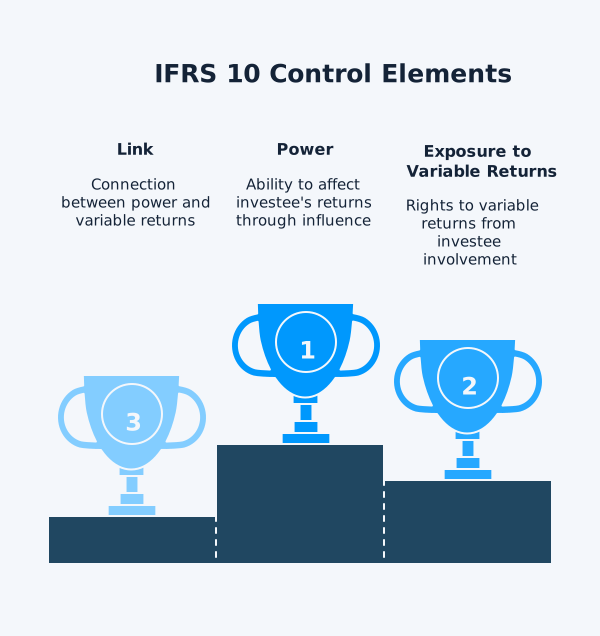
The standard defines control through three elements:
- Power over the investee: The investor has existing rights giving current ability to direct relevant activities
- Exposure to variable returns: The investor has exposure or rights to variable returns from involvement
- Link between power and returns: The investor can use power to affect the amount of returns
Parent and subsidiary must apply uniform accounting policies. If policies differ, appropriate adjustments are required when preparing consolidated financial statements to ensure conformity.
IFRS 10 also establishes when consolidation is not required. A parent need not present consolidated statements if it meets all of the following conditions:
- It is a wholly-owned subsidiary, or owners have been informed and do not object
- Its debt or equity instruments are not publicly traded
- It is not filing financial statements for the purpose of issuing instruments
- Its ultimate or intermediate parent produces consolidated financial statements complying with IFRS
FRS 102: UK GAAP Requirements
For UK entities not applying full IFRS, FRS 102 provides the applicable framework. The Financial Reporting Council maintains this standard, which is based on the IFRS for SMEs with UK-specific amendments.
Under FRS 102 Section 9, a parent that has one or more subsidiaries must prepare consolidated financial statements presenting all subsidiaries. However, small groups may elect exemption from preparing group accounts under the Companies Act 2006 if they qualify as small.
FRS 102 is the principal UK GAAP standard for entities that are not applying adopted IFRS, FRS 101 or FRS 105. It’s widely used by medium and large private entities, and many small entities apply FRS 102 (often using Section 1A) when they are not following the micro-entities regime under FRS 105. The framework requires the same fundamental consolidation procedures:
- Combining line-by-line
- Eliminating intercompany transactions
- Presenting non-controlling interests separately in equity
Important: Amendments to FRS 102 from the 2024 periodic review apply for accounting periods beginning on or after 1 January 2026, including significant updates to revenue recognition, lease accounting, and certain small-entity disclosures. Some disclosure amendments (such as those for supplier finance arrangements) have earlier effective dates. Finance teams should confirm the effective-date wording for their year-end, check FRC or professional firm guidance for specific amendments, and verify whether any transitional reliefs apply.
ASC 810: US GAAP Consolidation
For groups with US operations or reporting requirements, ASC 810 provides the consolidation framework under US GAAP. The standard uses a dual model approach:
- Variable Interest Entity (VIE) model: Consolidate if the reporting entity is the primary beneficiary with power to direct activities and obligation to absorb losses or receive benefits.
- Voting Interest model: For entities that are not VIEs, consolidation generally applies when holding more than 50% of voting interests with control.
As BDO explains, recent amendments to ASC 810 changed consolidation outcomes for limited partnerships, recognising that general partners typically act as service providers without true control.
While IFRS 10 and ASC 810 differ in terminology and specific tests, outcomes are often similar for straightforward voting-control subsidiaries. Differences are most common for structured entities, limited partnerships, and other arrangements analysed under the VIE model.
The Control Principle Explained
Control forms the foundation of consolidation rules across all major standards. Without control, there is no consolidation – the investment would instead be accounted for using the equity method under IAS 28 (for associates with significant influence) or as a financial instrument.
How IFRS 10 Defines Control
Under IFRS 10, an investor controls an investee when it is exposed to, or has rights to, variable returns from involvement with the investee. The investor must also have the ability to affect those returns through power over the investee. This definition moves beyond simple majority ownership.
Power arises from rights, which may include:
- Voting rights from equity instruments
- Rights to appoint or remove key management personnel
- Rights to direct the investee to enter into transactions for the investor’s benefit
- Potential voting rights that are substantive
The standard requires ongoing assessment of control. IFRS Foundation guidance specifies that consolidation begins from the date control is obtained and ceases when control is lost.
Control Without Majority Ownership
Ownership exceeding 50% often indicates control, but the requirement to consolidate is based on control itself – not a percentage threshold. IFRS 10 addresses de facto control scenarios where an investor with less than majority voting rights still controls through:
- Contractual arrangements with other vote holders
- Rights arising from other contractual arrangements
- The investor’s voting rights compared with those of other holders
- Potential voting rights
For example, a 45% shareholder might have control if remaining shares are widely dispersed among many unrelated investors who have not organised their interests collectively.
Framework Comparison: Control Definitions
| Framework | Control Definition / Primary Test | Key Feature / Notes |
| IFRS 10 | Power over relevant activities + exposure to variable returns + ability to use power to affect returns | Single, unified control model for all investees (no separate VIE model). |
| FRS 102 | Power to govern financial and operating policies to obtain benefits | Similar conceptually to IFRS, but defined more simply (focus on governance rights rather than a three-element control test). |
| US GAAP ASC 810 | VIE model or voting interest entity model | Dual model approach: determine first whether it’s a VIE; if not, apply voting interest model. |
Sources: IFRS 10 control model; FRS 102 Section 9 group accounting; US GAAP Topic 810 consolidation models.
Consolidation Procedures Under Accounting Standards
Once control is established, all three frameworks require similar consolidation procedures. Understanding these steps is essential for compliance and accuracy.
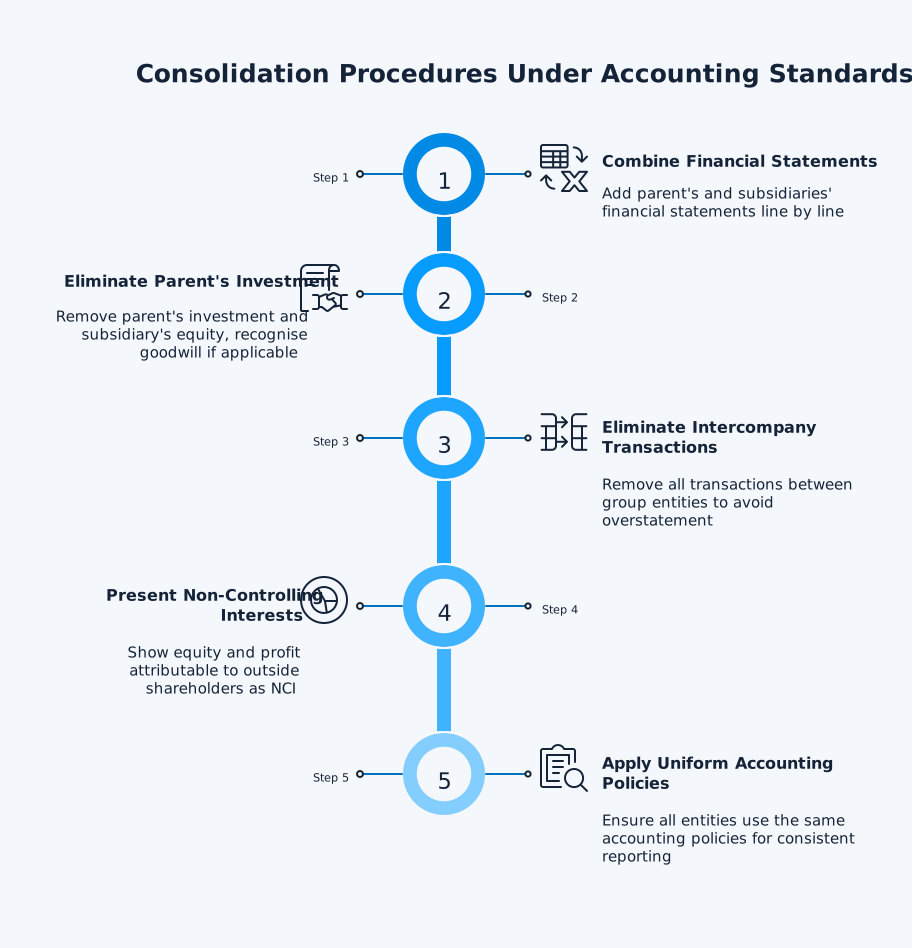
Step 1: Combine Financial Statements Line by Line
Add together the parent’s and subsidiaries’:
- Assets
- Liabilities
- Income
- Expenses
All entities must use the same reporting date – or within three months if alignment proves impracticable under IFRS 10.
Step 2: Eliminate the Parent’s Investment
Remove the parent’s investment in subsidiary from assets and eliminate the corresponding portion of subsidiary’s equity. Under IFRS 3, any difference between consideration paid and fair value of net assets acquired represents goodwill.
Worked example: Parent pays £800,000 for 100% of a subsidiary with net assets fairly valued at £600,000. The £200,000 difference is recognised as goodwill on the consolidated balance sheet.
Step 3: Eliminate Intercompany Transactions
Remove all transactions between group entities to avoid overstating revenue, expenses, assets, and liabilities. Common eliminations include:
- Intercompany sales and purchases
- Intercompany loans and interest
- Dividends from subsidiaries to parent
- Unrealised profits on intercompany transactions
Intercompany revenue example: Entity A sells services to Entity B for £100,000. On consolidation, both the £100,000 revenue in Entity A and the £100,000 expense in Entity B are eliminated – the group has not earned anything from itself.
Unrealised profit example: Entity A sells inventory to Entity B for £50,000 at a £10,000 markup. Entity B has not resold the inventory by year-end. The £10,000 unrealised profit must be eliminated from consolidated inventory and group profit.
Step 4: Present Non-Controlling Interests
When a subsidiary is not wholly owned, the portion of equity and profit attributable to outside shareholders appears as non-controlling interest (NCI). Under IFRS 10, NCI is presented within equity on the consolidated balance sheet, separately from the parent’s equity.
NCI allocation example: Parent owns 80% of Sub A. Sub A reports £100,000 profit after eliminations. The consolidated income statement shows £100,000 profit, but £20,000 (20%) is attributed to non-controlling interests.
Step 5: Apply Uniform Accounting Policies
During consolidation, the group applies a single set of accounting policies across the parent and all subsidiaries. Where a subsidiary’s policies differ, its figures are adjusted so the consolidated accounts reflect the group’s policies consistently.
For finance teams managing this process manually, each step requires significant time and carries error risk. dataSights automates these procedures through consolidated Xero reporting, applying elimination rules you define and maintaining full audit trails for every adjustment.
Foreign Currency Translation in Consolidated Statements
Multi-currency consolidation adds complexity when subsidiaries operate in different functional currencies. IAS 21 requires subsidiaries to measure transactions in their functional currency, then translate to the parent’s presentation currency for consolidation.
Translation rules follow specific rate requirements:
- Assets and liabilities: Closing rate at balance sheet date
- Income and expenses: Average rates for the period
- Equity items: Historical rates
- Translation differences: Recognised in Other Comprehensive Income (OCI) as foreign currency translation reserve until the foreign operation is disposed of
FX translation example: UK parent consolidates a US subsidiary. The subsidiary’s $1m revenue translates at the average rate (£0.79), giving £790,000. Its $500,000 assets translate at the closing rate (£0.81), giving £405,000. The difference flows to the translation reserve in equity.
dataSights handles multi-currency consolidation automatically, applying configured exchange rate tables and tracking cumulative translation adjustments in equity. This eliminates manual rate lookups and calculation errors each period.
Exemptions From Preparing Consolidated Financial Statements
Not all parent companies must prepare consolidated accounts. Both IFRS 10 and FRS 102 provide exemptions for qualifying entities, reducing the reporting burden for certain group structures.
IFRS 10 Exemptions
A parent is exempt from consolidated statements if all conditions are met:
- The parent is itself a wholly-owned subsidiary, or a partially-owned subsidiary, where other owners do not object
- The parent’s debt or equity instruments are not publicly traded
- The parent is not in the process of filing financial statements for public issue
- The ultimate or intermediate parent produces IFRS-compliant consolidated statements available publicly
Investment entities meeting specific criteria under IFRS 10 paragraphs 27-33 measure subsidiaries at fair value through profit or loss rather than consolidating them.
UK Small Group Exemption
Under the Companies Act 2006, small groups may qualify for a legal exemption from preparing consolidated accounts. This is a Companies Act exemption (not purely an accounting standard provision). For financial years beginning on or after 6 April 2025, a company qualifies as small under the Act if, for two consecutive financial years, it meets at least two of the following three thresholds:
- Turnover: £15 million or less
- Balance sheet total: £7.5 million or less
- Average employees: 50 or fewer
Important: Always confirm eligibility rules for your filing context.
Under FRS 102 Section 9, subsidiaries may also be excluded if immaterial to presenting a true and fair view, under severe long-term restrictions preventing control exercise, or in certain ‘held for resale’ cases. FRS 102 can require exclusion where subsidiaries are held exclusively with a view to resale and have not been consolidated previously (see Section 9 guidance for specific criteria).
Section 400 Subsidiary Exemption
Under Section 400 of the Companies Act 2006, a UK subsidiary may be exempt from preparing consolidated accounts if it is included in its parent’s consolidated accounts. Those consolidated accounts must be prepared under UK-adopted IFRS (or an equivalent framework) and be publicly available.
Disclosure Requirements
Accounting standards require extensive disclosures about consolidated entities to help users understand group composition and consolidation decisions. While IFRS 10 establishes consolidation principles, IFRS 12 sets out disclosure requirements.
Required disclosures typically include:
- Significant judgments and assumptions in determining control
- Interests in subsidiaries, including name, principal place of business, and ownership percentage
- Nature and extent of significant restrictions on assets or settling liabilities
- Nature of risks associated with interests in consolidated and unconsolidated structured entities
- Changes in ownership interests that did or did not result in loss of control
These disclosures help financial statement users understand the group’s composition and the basis for consolidation decisions.
Common Challenges in Applying Consolidation Standards
Finance teams regularly encounter practical challenges when applying consolidation standards. Recognising these issues early helps you build processes that address them systematically.
Timing Differences
Subsidiaries with different year-ends require adjustment. IFRS 10 permits up to a three-month difference when alignment is impracticable, with adjustments for significant transactions occurring in the intervening period.
Policy Alignment
Ensuring uniform accounting policies across all group entities requires ongoing monitoring. A subsidiary using different depreciation methods or revenue recognition policies needs adjustment entries before consolidation.
Intercompany Reconciliation
Mismatches between intercompany balances often surface during consolidation. Entity A records £100,000 payable to Entity B, but Entity B shows only £95,000 receivable. These differences must be identified and resolved before elimination.
Audit Trail Documentation
External auditors need to trace every elimination and adjustment to source transactions. Manual processes in spreadsheets rarely provide adequate documentation. dataSights’ consolidation approach maintains timestamped audit trails showing who made what adjustment and when.
How dataSights Automates Consolidation Compliance
For multi-entity groups, manual consolidation can extend month-end close to 10–15 business days or more, especially when intercompany eliminations and currency conversions are handled in spreadsheets. dataSights customers report reducing this to around 5 business days once consolidation, eliminations, and data refresh are automated, depending on group complexity. Finance teams export data from each Xero organisation, build complex spreadsheet models, manually calculate elimination entries, and cross-check every intercompany balance.
dataSights transforms this process. Our Xero consolidation solution connects all your entities via API, syncing data into a dedicated Azure SQL database per customer. From there:
- Management Reports: Our web platform delivers pre-formatted P&L, Balance Sheet, Trial Balance, Budget Variance, and AR/AP reports with automatic eliminations. You can refresh consolidated results on-demand or on a scheduled cadence – no exports and no manual spreadsheets.
- Excel automation via OfficeAddIn and Power Query: Teams preferring spreadsheets are able to refresh consolidated Xero data with one click. Build custom reports, run month-end reconciliations, and create cash flow forecasts without exporting CSVs or manipulating data to get it ready.
- Power BI integration: Our platform provides direct connections for advanced dashboards with drill-through from group totals to individual transactions. Configure elimination rules once, and they apply consistently every period.
dataSights customers commonly report cutting consolidation close time from 10-15 business days to ~5 business days (depending on entity count, complexity, and refresh cadence). In one documented case, a dataSights customer consolidated 72 Xero entities in under 3 seconds, including eliminations, once the model was configured.
Frequently Asked Questions
What Is the Main Accounting Standard for Consolidated Financial Statements?
IFRS 10 Consolidated Financial Statements serves as the primary international standard, issued by the IASB in May 2011. UK entities not using full IFRS apply FRS 102, while US companies follow ASC 810 under US GAAP. All three frameworks share the same fundamental principle: consolidate when control exists.
When Must a Company Prepare Consolidated Financial Statements?
A parent company must prepare consolidated financial statements when it controls one or more subsidiaries, unless specific exemptions apply. Under IFRS 10, control exists when the investor has power over the investee, exposure to variable returns, and the ability to use power to affect those returns.
What Are the Key Differences Between IFRS 10 and ASC 810?
IFRS 10 uses a single control model for all entities, while ASC 810 applies a dual model – the VIE model for variable interest entities and the voting interest model for other entities. Despite these structural differences, both standards usually reach the same consolidation conclusions for straightforward parent-subsidiary relationships.
Can Small Groups Avoid Preparing Consolidated Accounts in the UK?
Yes. Under the Companies Act 2006, small groups meeting two of three size thresholds (turnover not exceeding £15m, balance sheet total not exceeding £7.5m, fewer than 50 employees) may elect exemption from preparing group accounts. Check current thresholds as they are updated periodically.
How Are Intercompany Transactions Eliminated in Consolidation?
Intercompany transactions are eliminated in full during consolidation. This includes intercompany sales and purchases, loans and interest, dividends, and unrealised profits on inventory transfers. The direction of the transaction affects how eliminations are attributed between parent and non-controlling interests.
What Is Non-Controlling Interest in Consolidated Statements?
Non-controlling interest represents the portion of a subsidiary’s equity and profit attributable to shareholders other than the parent. Under IFRS 10, NCI appears as a separate component of equity on the consolidated balance sheet. When a subsidiary earns profit, the portion attributable to outside shareholders is allocated to NCI.
Does Xero Produce Consolidated Financial Statements?
Xero provides entity-level accounting but does not include native consolidation functionality. Multi-entity groups must use third-party solutions or manual processes to combine data, apply eliminations, and produce consolidated statements. dataSights’ Xero consolidation automates this process across all your connected organisations.
How Often Should Consolidation Be Performed?
Many groups perform monthly or quarterly consolidations for management reporting, and at least annually for statutory financial statements, depending on regulatory requirements and stakeholder expectations. Under IFRS 10, consolidated and separate financial statements of the parent and subsidiaries should be prepared as of the same date. Continuous consolidation with automated tools provides near-real-time visibility aligned to your refresh cadence (or query-time visibility where DirectQuery is used).
What Disclosures Are Required for Consolidated Financial Statements?
IFRS 12 specifies disclosure requirements, including significant judgements in determining control, interests in subsidiaries with key details, restrictions on group assets, and risks associated with interests in other entities. Proper disclosure helps users understand the basis for consolidation decisions and group composition.
What Is Goodwill in Consolidated Financial Statements?
Goodwill represents the excess of consideration paid over the fair value of identifiable net assets acquired in a business combination. Under IFRS 3, goodwill is recognised on the consolidated balance sheet and tested annually for impairment rather than amortised. Note that FRS 102 permits goodwill amortisation over useful life with a maximum 10-year presumption.
From Compliance Burden to Competitive Advantage
The right accounting standard framework – whether IFRS 10, FRS 102, or ASC 810 – determines how you consolidate, what you eliminate, and what you disclose. Understanding these requirements transforms consolidation from a compliance burden into a source of reliable group insight. Automation handles the mechanics; your expertise drives the analysis.
Automate Your Multi-Entity Consolidation Today
Ready to transform your month-end close from weeks to days? dataSights delivers automated Xero consolidation with pre-formatted management packs, intercompany eliminations, and full audit trails. Rated 5.0 by 90+ Xero users. Join 300+ businesses already streamlining their consolidated financial reporting.
About the Author
Kevin Wiegand
Founder & Client happiness
I’m Kevin Wiegand, and with over 25 years of experience in software development and financial data automation, I’ve honed my skills and knowledge in building enterprise-grade solutions for complex consolidation and reporting challenges. My journey includes developing custom solutions for data teams at Gazprom Marketing & Trading and E.ON, before founding dataSights in 2016. Today, dataSights helps over 300 businesses achieve 100% report automation. I’m passionate about sharing my expertise to help CFOs and Financial Controllers reduce their month-end close time and eliminate the manual Excel exports that drain their teams’ valuable time.