
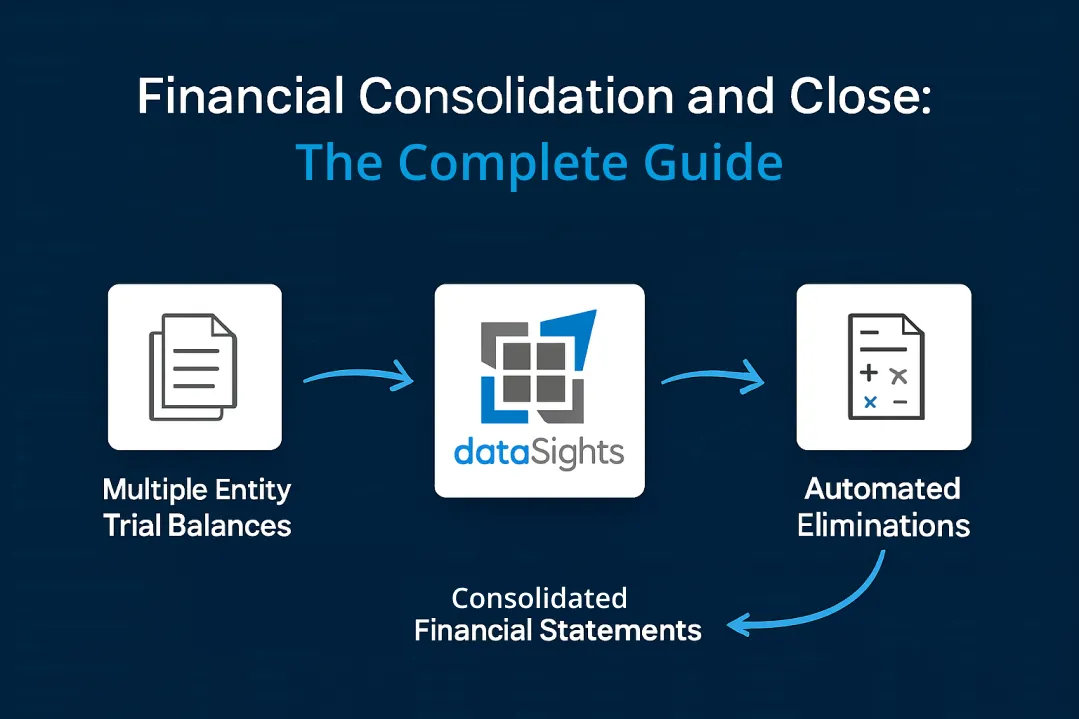
Managing financial consolidation and close across multiple entities shouldn’t mean spending weeks in spreadsheets hunting for elimination entries that won’t balance. The financial consolidation and close process combines data from all your subsidiaries into unified financial statements, finalising those statements for the period. Benchmarking by APQC, cited by CFO.com, shows the median month-end close is 6.4 business days, while top-quartile finance teams close in about 4.8 business days. This guide covers the complete process from Trial Balance collection through elimination entries to final reporting, with specific steps for cutting your close time while improving accuracy.
Understanding Financial Consolidation and Close
Financial consolidation and close is the end-to-end process that turns distributed subsidiary ledgers into finalised, group-level financial statements. It covers entity-level close, Trial Balance collection, chart of accounts mapping, intercompany eliminations, currency translation, and final reporting, ensuring accurate, compliant results across the group. Finance teams that automate key steps in financial consolidation and close routinely complete month-end in under five days, instead of the 10+ days many organisations still experience.
Ready to Automate Your Financial Consolidation?
Stop wrestling with manual consolidations and broken formulas. dataSights automates multi-entity reporting, Xero consolidations, and Power BI connections. Join 300+ businesses already transforming their financial reporting with our platform, rated 5.0 out of 5 by 90+ verified Xero users.
Table of Contents
Why Financial Consolidation and Close Matters
Finance teams face mounting pressure to deliver accurate consolidated statements faster. Research from Ventana indicates that 25% of organisations take more than 10 days to complete their month-end close process, leading to rushed work and team burnout, while only 53% of businesses manage to complete their monthly closing in six days or less.
The consolidation and close process serves multiple critical functions.
- Consolidated financial statements provide stakeholders with accurate insights into group performance, enabling boards and investors to make informed decisions based on the complete economic entity rather than fragmented subsidiary data.
- The process ensures regulatory compliance with IFRS 10 and US GAAP ASC 810 requirements for multi-entity organisations.
- Most importantly, it creates the foundation for strategic analysis, allowing CFOs to identify trends, assess risks, and plan resource allocation across the entire business group.
The Complete Financial Consolidation and Close Process
The financial consolidation and close process follows a systematic sequence that builds accuracy at each step. Understanding this workflow helps identify where delays occur and where automation delivers maximum impact.
Key Stages in Financial Consolidation and Close
Step 1: Collect Trial Balances from All Entities
Every accurate consolidation starts with the Trial Balance. Trial Balances provide the definitive list of all account balances that will flow into your consolidated statements, serving as the backbone of accurate consolidation. Without a properly balanced Trial Balance for each entity, your consolidation will never reconcile, resulting in hours of investigation and manual adjustments.
Modern consolidation platforms automate this collection through API connections, eliminating manual CSV exports. With dataSights’ Xero consolidation solution:
- Data syncs automatically from multiple Xero entities into a centralised database, ensuring your consolidated Trial Balance stays live and ties out to source Xero files.
- From there, pre-formatted management packs are delivered through the dataSights web platform, with additional automation available in Excel and Power BI for teams that prefer those tools
Finance teams should verify that all Trial Balances balance before proceeding. Each subsidiary provides an adjusted Trial Balance showing final balances for the period in each general ledger account. These Trial Balances must reflect all journal entries, reconciliations, and validations completed at the entity level.
Watch how dataSights automates period-end Xero consolidation directly into Excel, eliminating manual CSV exports and delivering balanced Trial Balances ready for elimination entries.
Step 2: Map Charts of Accounts
Before combining data, you need consistent account structures across all entities. Subsidiaries may operate with their own chart of accounts, but at group level, you’ll need standardised reporting structures that map subsidiary accounts to consolidated accounts.
A key part of successful consolidation is the standardisation of the chart of accounts. Without it, consolidating financial data across multiple entities becomes inconsistent and error-prone. Both IFRS 10 (Consolidated Financial Statements) and US GAAP (ASC 810) stress the need for subsidiaries to align their reporting structures with the parent company.
Account mapping ensures that similar accounts across different entities consolidate into the correct group-level account. For example, “Office Supplies” in one subsidiary and “Stationery Expenses” in another might both map to “Administrative Expenses” in the consolidated chart. Modern consolidation software can integrate with multiple ERPs and accounting systems, automatically mapping different charts of accounts to a standard structure.
Step 3: Convert Foreign Currencies
For multinational groups, converting subsidiary balances to the parent company’s reporting currency requires careful attention to exchange rates. Currency conversion follows specific rules under IAS 21 (The Effects of Changes in Foreign Exchange Rates).
Subsidiaries measure transactions in their functional currency (the currency of their primary economic environment), then translate to the parent’s presentation currency for consolidation.
Assets and liabilities translate using the closing rate at balance sheet date. Income and expenses translate using average rates for the period or transaction date rates where practical. Equity items translate at historical rates when initially recognised. Foreign exchange translation adjustments flow through Other Comprehensive Income (OCI) and accumulate in the foreign currency translation reserve within equity. This ensures accurate multi-currency consolidation that separates translation movements from operating performance.
According to Oracle, advanced foreign exchange tools can deliver auto-delivered currency translations with automated settings, simplifying currency management across the entire consolidation.
Step 4: Perform Intercompany Reconciliation and Eliminations
Intercompany eliminations remove the effects of transactions between companies in your group, ensuring consolidated statements only show dealings with outside parties. When a business records an intercompany transaction, it cannot include the transaction as a consolidated profit or loss, as the company is essentially doing business with itself.
Three main types of intercompany eliminations exist:
- Intercompany debt eliminations handle loans between subsidiaries or between parent and subsidiary.
- When goods or services are bought and sold within the parent company and its subsidiaries, intercompany revenue and expense eliminations ensure the parent company’s consolidated net assets remain unchanged.
- Finally, investment elimination entries remove the parent’s investment account against the subsidiary’s equity to avoid inflating consolidated equity accounts.
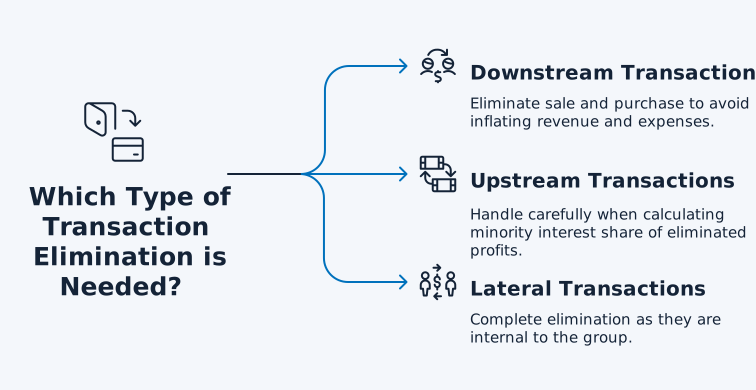
A critical category requiring careful attention is unrealised profit eliminations. When one entity sells inventory or assets to another group member, any profit on that transaction remains unrealised until the goods are sold to an external party. These unrealised profits must be eliminated from consolidated statements, with the adjustment allocated between parent and NCI based on the direction of the transaction.
ASC 810 establishes basic consolidation principles: any intercompany income on assets remaining within the consolidated group of companies should be eliminated, and the amount of intercompany income to be eliminated is not affected by the existence of a non-controlling interest. However, the direction of the transaction matters for attribution:
- Downstream transactions (parent to subsidiary) reduce the parent’s profit without affecting NCI.
- Upstream transactions (subsidiary to parent) reduce the subsidiary’s profit and therefore NCI’s share.
The net effect of eliminations must be zero (debits must equal credits), with data reclassified to net out at the parent entity level.
Common intercompany transactions requiring elimination include:
- Sales of goods or assets between entities
- Internal loans and interest charges
- Management fees charged by parent to subsidiaries
- Dividend payments between group companies
Each must be identified, calculated, and recorded through elimination entries before consolidation can be completed.
Step 5: Apply Top-Side Adjustments
Top-side adjustments apply at the group level to correct items that affect consolidated results but do not belong in individual entity ledgers. These include:
- Goodwill impairment
- Acquisition-related fair value adjustments
- Equity pickup from joint ventures or associates (often handled as a group-level adjustment)
Under IFRS 3, goodwill is recognised at acquisition. Under IAS 36, goodwill is tested annually for impairment rather than amortised.
Top-side adjustments can be applied through manual or automated group-level corrections, allowing finance teams to make necessary adjustments without affecting subsidiary books. This maintains clean entity-level records while ensuring consolidated statements reflect the true group position.
Non-controlling interest (NCI) calculations also occur at this stage. When the parent owns less than 100% of a subsidiary, NCI represents the portion of equity and earnings attributable to external shareholders. Consolidation requires including 100% of the subsidiary’s amounts, then separately showing NCI’s share in both the consolidated balance sheet and income statement.
Step 6: Complete Final Consolidation and Reporting
The final consolidation step aggregates all adjusted entity data into group-level financial statements. This produces the three essential consolidated reports:
- The consolidated income statement (or statement of profit or loss and other comprehensive income) showing group revenues and expenses after eliminations
- The consolidated balance sheet (statement of financial position) presenting total group assets, liabilities, and equity, and
- The consolidated cash flow statement tracking cash movements across all operations.
Financial statements generated from the financial close are used by company management for analysis, comparisons, KPI generation, and other assessments of the business’s financial health. Investors, lenders, and regulatory agencies may also use these statements, depending on the company and reporting requirements.
The goals of the financial close are to enter each new accounting period with temporary account balances at zero and to consolidate and produce the financial statements. How long it takes to complete depends on many variables, including:
- The complexity of finances
- The size and experience of the accounting team
- Whether the company uses accounting automation
Common Challenges in Financial Consolidation and Close
Finance teams encounter recurring obstacles during consolidation and close that extend timelines and increase error risk. Understanding these challenges helps prioritise process improvements and automation investments.
Manual Processes and Data Entry Errors
Research across industries indicates that 88% of spreadsheets contain errors of varying materiality, creating significant risk to financial integrity. Without automation, accountants spend excessive time inputting data and checking calculations multiple times, yet errors persist. Estimates suggest manual data entry costs the U.S. economy over $3 trillion annually across all industries. Businesses may lose up to 25% of revenue due to poor data quality alone.
Manual processes also struggle with high transaction volumes. Finance teams working in Excel can automate transaction matching to a degree through VLOOKUPs or VBA scripts, but those methods cannot scale with businesses processing high volumes of transactions and managing increasingly complex payment flows.
Lack of Process Standardisation
One of the most cumbersome tasks during a month-end close is the reconciliation of transactions and accounts. Without consistent practices for handling enterprise data, discrepancies can accumulate over time, forcing the finance team to deal with them in the midst of the closing effort, creating unnecessary delays and frustration.
Many finance teams operate without a standardised accounting closing process. Instead of structured steps, they rely on institutional memory and ad hoc routines, leading to duplicated tasks, errors, and frequent timeline slippage. The financial reporting close process remains heavily manual, with spreadsheet trackers, email follow-ups, and one-by-one reconciliations dominating.
Complex Intercompany Relationships
Manual consolidation of 30+ entities can extend the month-end close beyond 15 days. Each additional entity multiplies your elimination requirements. The complexity grows exponentially, not linearly. Ten entities might have 45 potential intercompany pairs; twenty entities could have 190 potential pairs.
Intercompany accounting processes were traditionally performed in Excel, and the elimination and consolidation process was highly manual. The problem with manual financial consolidation and elimination is that it’s time-consuming and exposes your data to manual errors.
Late Data Submissions
Key inputs like purchase orders, sub-ledger entries, and expense reports often arrive only at period-end. This backlog compresses the entire financial close process into a tight window, forcing teams to rush and raising the chance of missed entries or late adjustments.
Subsidiaries operating on different reporting schedules create consolidation delays. IFRS 10 permits up to a three-month difference between reporting dates when alignment is impracticable, with adjustments for significant transactions and events in the intervening period. However, this still requires finance teams to manage multiple timelines simultaneously.
How Automation Transforms Financial Consolidation and Close
Automation addresses the core challenges that extend close timelines and increase error risk. Rather than simply working faster, automation changes how consolidation work gets done.
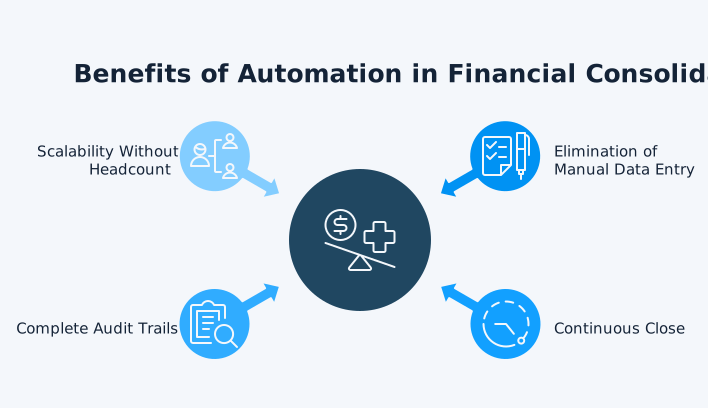
Eliminate Manual Data Entry and Matching
Automated solutions use AI and machine learning models to automatically match settled payments to the corresponding source, whether it’s the:
- Invoice
- Database
- Bank
- PSP
- ERP
This handles high-volume transaction matching even across many different sources and for complex one-to-one, one-to-many, many-to-one, and many-to-many transaction scenarios.
Modern platforms provide automated finance tools that use AI and string-matching algorithms to reconcile invoices and bank statements even when there are missing identifiers. If the system doesn’t identify an exact match, it suggests options to account for scenarios like name mismatches or missing information, making it straightforward to perform investigations and quickly pinpoint the cause of discrepancies.
Enable Continuous Close
Most finance teams know they should perform reconciliation on an ongoing basis, whether daily or weekly, so they don’t face a mountain of unreconciled payments at the end of every month. However, maintaining a state of continuous close requires tremendous investment of time, manpower, and resources when manually managing finance operations.
Automation can connect disparate systems and provide a holistic view of the closing process, breaking down silos and demonstrating how each task contributes to the final outcome. By understanding how Parkinson’s Law influences traditional close processes, strategic automation prevents work from expanding to fill available time, creating a more streamlined and less stressful month-end close.
Provide Complete Audit Trails
Automated processes help ensure that all financial transactions are recorded and reported in compliance with relevant regulations and standards. Every elimination entry, adjustment, and journal entry maintains a complete audit trail showing who made the entry, when it occurred, and what changed.
Without proper audit trails, consolidation errors lead to audit delays or invalidations, resulting in legal and financial consequences for your company. Automated systems document every step of the consolidation process, creating the transparency auditors require.
Scale Without Adding Headcount
Automated consolidation delivers always-balanced consolidated reports regardless of entity count. Trial Balance foundations ensure accuracy. Automated eliminations include complete audit trails. Real-time visibility means issues surface daily, not at month-end.
Companies that automate reconciliations complete their month-end close within a week 72% of the time, nearly three times more than those using manual methods. This scalability allows finance teams to handle growth without proportionally increasing staff.
Best Practices for Faster, More Accurate Close
Implementing these practices alongside automation creates a consolidation process that delivers reliable results on predictable timelines.
Start with Clean Trial Balances
Never proceed with consolidation until all individual Trial Balances balance. The Trial Balance serves as the foundation, ensuring all accounts reconcile before eliminations. Without balanced Trial Balances at the entity level, your consolidation will never balance.
Ensure all subsidiaries follow consistent accounting policies. This uniformity is crucial for seamless consolidation. Before combining any numbers, verify that all entities use the same accounting methods and reporting periods. If subsidiary A uses FIFO for inventory while subsidiary B uses weighted average, you’ll need adjustments to ensure comparability.
Standardise Elimination Rules
Create complete elimination templates covering all intercompany transaction types. Once configured, automated elimination rules apply consistently every period, maintaining accuracy while saving time.
Document who is authorised to make elimination entries and require approvals for material adjustments. This creates accountability while maintaining control over the consolidation process. Having an investor register that automatically feeds into the consolidation elimination is an advantage and can assist in reconciliation.
Establish Clear Deadlines and Ownership
Establishing a clear and reasonable closing date creates clarity and motivates the team to stay focused on the finish line without feeling unnecessarily rushed, which can increase the likelihood of errors or skipped steps. With that end goal in mind, leaders can then work backward to determine deadlines for critical tasks along the way.
- Break the implementation into phases, starting with high-impact processes like reconciliations.
- Define goals, timelines, and ownership for each step.
- Choose KPIs that reflect both operational efficiency (days to close) and strategic value (time reallocated to analysis).
Review and Continuously Improve
After each close, conduct a post-close meeting to discuss what worked well and potential improvements. This continuous feedback loop helps refine the process over time, identifying new bottlenecks and opportunities for automation.
Regular reviews help identify new areas for automation and ensure that existing processes remain efficient. As technology, roles, and best practices change, so should your close cycle. Foster a culture of continuous improvement, encouraging your team to seek out and suggest improvements to the automated month-end close process.
Frequently Asked Questions
How Long Should Financial Consolidation and Close Take?
The average close takes 6.4 business days according to PwC’s 2023 Finance Benchmarking Report. Benchmarking by APQC shows the median month-end close is 6.4 business days. However, 25% of organisations take more than 10 days, while leading finance teams with full automation complete the process in 1-3 business days. Timeline depends on entity count, transaction complexity, and automation level.
What's the Difference Between Financial Consolidation and Closing the Books?
Closing the books is one step within the financial close process. Financial close encompasses the whole accounting cycle, culminating in generating financial statements and closing the books. Closing the books specifically resets temporary accounts to zero and locks in the prior period’s balance, while consolidation combines data from multiple entities into unified statements.
Why Do Consolidated Trial Balances Not Balance?
Unbalanced consolidated Trial Balances typically result from incomplete elimination entries, currency translation errors, or data collection issues. Every accurate consolidation starts with balanced entity-level Trial Balances. Common causes include missed intercompany transactions, incorrect elimination amounts, and subsidiaries using inconsistent accounting policies.
What Causes Delays in the Close Process?
Key inputs like purchase orders, sub-ledger entries, and expense reports often arrive only at period-end, compressing the entire close into a tight window. Other delays stem from manual reconciliation bottlenecks, lack of process standardisation, disconnected systems requiring manual data transfers, and complex intercompany relationships requiring extensive elimination work.
Can Small Businesses Benefit from Consolidation Automation?
Yes. while large enterprises face greater complexity, small businesses with multiple entities still spend disproportionate time on manual consolidation. Automation eliminates manual entry errors, reduces time requirements, and scales as the business grows. Even businesses with 2-3 entities gain significant time savings and accuracy improvements from automated consolidation.
What Is Continuous Close?
Continuous close disperses the work involved in closing the books throughout the accounting period, instead of concentrating it at month-end. AI-enabled accounting software continuously monitors records throughout the month, automatically detecting and flagging potential errors or inconsistencies requiring human attention. This approach reduces end-of-period pressure and enables faster closes.
Which Accounts Require Elimination Entries?
Intercompany transactions requiring elimination include sales and purchases between entities, loans and interest charges between group companies, management fees charged by parent to subsidiaries, dividend payments between group members, and unrealised profits on inventory transfers. All intra-group transactions are eliminated in consolidation, with the net effect of eliminations being zero.
How Does Automation Handle Multi-Currency Consolidation?
Modern platforms deliver automated currency translations using configured exchange rate tables and rules, applying closing rates for assets and liabilities, average rates for income and expenses, and historical rates for equity items, in line with your group policy. Translation adjustments then flow through Other Comprehensive Income according to IAS 21 requirements.
What's the Role of Non-Controlling Interest in Consolidation?
Non-controlling interest represents the portion of equity in a subsidiary not owned by the parent. When ownership is less than 100%, consolidation includes 100% of the subsidiary’s amounts, then separately shows NCI’s share in both consolidated equity and profit allocation. The NCI balance appears as a separate line within consolidated equity, distinct from parent shareholders’ equity.
Should Eliminations Happen in the Source System or Consolidation Layer?
Xero has no native intercompany module. Eliminations and NCI are managed outside Xero, typically in your reporting or consolidation layer. This approach maintains clean entity-level records while ensuring consolidated statements reflect the true group position. Always reconcile back to each entity’s Trial Balance before eliminations.
Cut Your Close Time in Half
Financial consolidation and close transforms from a two-week ordeal into a five-day process when you start with clean Trial Balances, automate elimination entries, and maintain complete audit trails throughout. Leading finance teams prove that accurate, timely consolidation is achievable without sacrificing strategic capacity or team wellbeing. The shift from manual spreadsheets to automated workflows isn’t just about speed – it’s about delivering reliable, audit-ready numbers that give leadership confidence in the data. Stop spending weeks on consolidation that should take days.
Automate Your Xero Consolidation and Close Today
Ready to cut your month-end close from weeks to days? dataSights’ Xero consolidation solution delivers board-ready management packs through our web platform, backed by automated multi-entity reporting, real-time sync, and automatic eliminations. For teams that prefer spreadsheets or dashboards, the same consolidated data flows into Excel and Power BI without manual exports. Join 300+ businesses who have reduced their close from over 15 days to under 5, with our platform rated 5.0 out of 5 by 90+ verified Xero users.
About the Author
Kevin Wiegand
Founder & Client happiness
I’m Kevin Wiegand, and with over 25 years of experience in software development and financial data automation, I’ve honed my skills and knowledge in building enterprise-grade solutions for complex consolidation and reporting challenges. My journey includes developing custom solutions for data teams at Gazprom Marketing & Trading and E.ON, before founding dataSights in 2016. Today, dataSights helps over 300 businesses achieve 100% report automation. I’m passionate about sharing my expertise to help CFOs and Financial Controllers reduce their month-end close time and eliminate the manual Excel exports that drain their teams’ valuable time.