
What GAAP principles govern the consolidation of financial statements is a question finance teams often face when juggling multiple entities, intercompany eliminations, and increasing audit scrutiny. Understanding when a controlling financial interest exists under ASC 810 becomes critical as groups grow more complex. Consolidating financial statements becomes challenging when Trial Balances don’t align or when eliminations fail to clear correctly. For teams using Xero or similar systems, understanding these GAAP principles is essential for producing accurate, compliant reports. ASC 810 provides the control-based framework that determines when entities must be consolidated and how intercompany activity should be treated. This guide explains those requirements in a clear and practical way.
What GAAP Principles Govern the Consolidation of Financial Statements?
What GAAP principles govern the consolidation of financial statements are determined by ASC 810’s control-based framework, which requires a parent to consolidate any entity where it possesses a controlling financial interest. FASB’s Conceptual Framework (Concepts Statement No. 8) establishes the qualitative characteristics that govern all financial reporting, including consolidation: relevance and faithful representation as fundamental characteristics, supported by comparability, verifiability, timeliness, and understandability. Consolidated financial statements must eliminate all intercompany transactions and appropriately attribute net income and comprehensive income between the parent and noncontrolling interests under ASC 810-10-45-20.
Ready to Automate Your Financial Consolidation?
Stop wrestling with manual consolidations and broken formulas. dataSights automates multi-entity reporting, Xero consolidations, and Power BI connections. Join 300+ businesses already transforming their financial reporting with our platform, rated 5.0 out of 5 by 90+ verified Xero users.
Table of Contents
The Foundation: Understanding ASC 810 Consolidation Standards
ASC 810 provides the comprehensive framework for determining when consolidation is required under US GAAP. The standard establishes that consolidated financial statements are presumed to be more meaningful than separate financial statements when one entity has a controlling financial interest in another.
The Core Principle of Control
Control forms the cornerstone of consolidation accounting, unlike older approaches that focused solely on ownership percentages, modern GAAP consolidation recognises that control can be exercised through various means beyond voting rights. FASB issued FIN 46R to address growing variations in multi-entity business structures by shifting consolidation analysis from simple voting percentages to evaluating which party has the power to direct activities that most significantly impact economic performance and who absorbs the entity’s risks and rewards.
A reporting entity has a controlling financial interest when it possesses both the power to direct activities that most significantly impact economic performance and exposure to potentially significant benefits or losses. This definition applies whether control comes from majority voting rights, contractual arrangements, or the absorption of variable returns.
Two Consolidation Models Under ASC 810
ASC 810 establishes two distinct pathways for evaluating consolidation requirements. Reporting entities must first determine whether the Variable Interest Entity model applies. If not, they evaluate using the Voting Interest Model.
- Variable Interest Entity (VIE) Model: This model addresses situations where traditional voting rights don’t adequately represent control or economic interests. A VIE exists when the equity investment at risk is insufficient for the entity to finance activities without additional subordinated financial support, or when equity holders lack typical control characteristics.Under the VIE model, you consolidate when you’re the primary beneficiary. Primary beneficiary status requires having both the power to direct activities that most significantly impact the VIE’s economic performance and the obligation to absorb losses or right to receive benefits that could be significant to the VIE.
- Voting Interest Model: When the VIE model doesn’t apply, entities use the Voting Interest Model. A controlling financial interest generally exists when you own more than 50% of voting rights in another entity. However, control can exist even with less than majority ownership through contractual provisions, agreements between shareholders, or other arrangements that provide power to govern financial and operating policies.
Key Financial Reporting Concepts Applied to Consolidation
While ASC 810 provides consolidation-specific guidance, FASB’s Conceptual Framework (Concepts Statement No. 8) establishes fundamental qualitative characteristics and constraints that govern all financial reporting, including consolidated statements. Chapter 3 identifies relevance and faithful representation as the fundamental qualitative characteristics of useful financial information, supported by enhancing characteristics of comparability, verifiability, timeliness, and understandability. Understanding how these concepts apply to consolidation ensures your consolidated financial statements meet GAAP’s core objectives of providing decision-useful information to investors and creditors.
Relevance and Faithful Representation
Consolidated financial statements must be both relevant (capable of influencing economic decisions) and faithfully represent the economic substance of the group as a single entity. This means:
- Including all controlled entities regardless of industry or geography
- Eliminating all intercompany transactions to prevent double-counting
- Accurately attributing income to noncontrolling interests
For multi-entity businesses using Xero, this means every controlled entity must appear in consolidated statements when control exists under ASC 810.
dataSights delivers consolidated management packs through its web platform, including consolidated Profit & Loss, Balance Sheet, Trial Balance, and elimination-ready reports. Finance teams who prefer Excel can automate refreshes using the OfficeAddIn and Power Query. For advanced analytics, Power BI connects directly to the consolidated dataset for custom dashboards and drill-down analysis.
Comparability and Consistency
Accounting methods must remain consistent throughout the reporting process and across reporting periods. Once you establish how to consolidate a particular entity, you cannot change that approach without disclosure and justification.
This consistency requirement extends to:
- Elimination entries
- Currency translation methods
- Non-controlling interest calculations
When your consolidation produces a consolidated Trial Balance in one period, the methodology must remain identical in subsequent periods unless circumstances change materially. This consistency enables users to identify trends and compare performance across periods.
Materiality
All reported consolidated data must be factual, significant, and sufficient to provide a clear picture of the group’s financial position. Information is material if omitting or misstating it could influence decisions that users make based on the consolidated financial statements.
In practice, this means:
- Immaterial eliminations might not require detailed tracking
- Material intercompany transactions demand complete documentation and elimination
- Disclosure requirements apply when information would influence user decisions
Verifiability and Transparency
Consolidated financial statements must provide sufficient information for knowledgeable users to reach similar conclusions about whether the information faithfully represents economic phenomena. This verifiability requirement affects consolidation in several ways:
Documentation requirements:
- Maintaining audit trails for all elimination entries
- Documenting the basis for control conclusions under ASC 810
- Preserving evidence supporting variable interest assessments
Disclosure obligations:
- Related party relationships that might affect consolidation conclusions
- Accounting policies for consolidation, including intercompany elimination methods
- Significant judgements made in determining control
Going Concern Assumption
Asset valuations in consolidated financial statements assume the business will continue operating. This going-concern assumption affects how you value consolidated assets and whether certain liabilities require recognition. When substantial doubt exists about an entity’s ability to continue as a going concern, specific disclosure requirements apply.
Periodicity and Timeliness
Financial results must be reported in regular, consistent intervals with information available to decision-makers in time to influence their decisions. Consolidated statements follow the same quarterly or annual reporting periods as parent company statements.
Subsidiaries with different year-ends require careful handling:
- Adjustments for significant transactions in any gap period
- Disclosure of the different reporting periods
- Consideration of whether the lag affects comparability
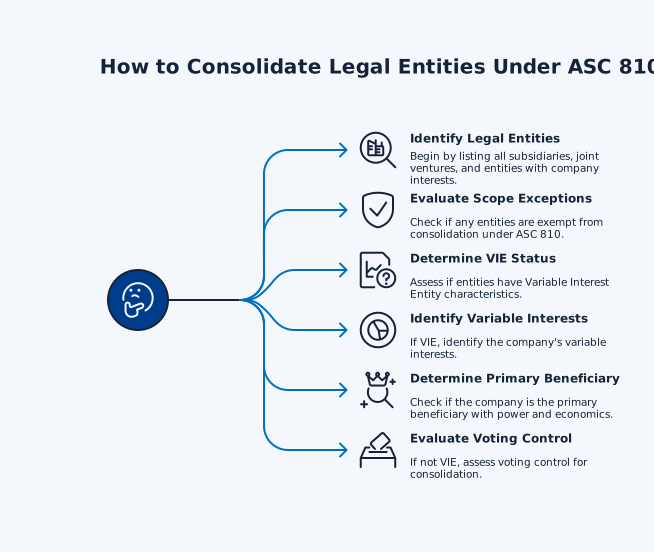
Applying ASC 810: The Consolidation Decision Framework
Determining consolidation requirements under ASC 810 follows a systematic evaluation process. Missing any step can result in incorrect consolidation conclusions and potential audit findings.
Step 1: Identify All Legal Entities
Begin by identifying all subsidiaries, joint ventures, and entities where your company holds interests. Legal entities potentially subject to consolidation include corporations, partnerships, limited liability companies, and trusts. Even divisions or branches can be legal entities if they have sufficient separateness.
For Xero users managing multiple organisations, this means cataloguing every Xero entity in your group structure, including:
- Entities established for separate legal entities
- Different geographies
- Distinct operating divisions
Step 2: Evaluate Scope Exceptions
ASC 810 exempts certain legal entities from consolidation, though exceptions are relatively few. Money market funds complying with Rule 2a-7, registered investment companies in certain circumstances, and employee benefit plans typically fall outside consolidation requirements.
If no scope exceptions apply, proceed to determine whether the VIE model or Voting Interest Model governs the consolidation analysis.
Step 3: Determine if the Entity is a VIE
ASC 810 requires evaluating whether the legal entity has any VIE characteristics. An entity is a VIE if the:
- Equity investment at risk is insufficient
- Equity holders lack decision-making rights
- Equity holders are not exposed to expected losses or residual returns
You don’t need to evaluate VIE characteristics in sequence. If the entity appears to have any VIE characteristic, conduct the full VIE assessment.
Step 4: Identify Your Variable Interests (VIE Path)
If the entity is a VIE, identify whether you hold variable interests. Variable interests are contractual, ownership, or other pecuniary interests that change with changes in the VIE’s net asset fair value. Most equity investments and debt instruments represent variable interests, as do certain fee arrangements and guarantees.
Step 5: Determine Primary Beneficiary Status (VIE Path)
You’re the primary beneficiary and must consolidate the VIE if you have both power and economics. Power means the ability to direct activities that most significantly impact the VIE’s economic performance. Economics means the obligation to absorb potentially significant losses or the right to receive potentially significant benefits.
Step 6: Evaluate Voting Control (Voting Interest Path)
If the VIE model doesn’t apply, use the Voting Interest Model. You have a controlling financial interest when you own more than 50% of voting rights. However, substantive participating rights held by noncontrolling interest holders can preclude consolidation even with majority ownership.
Conversely, control can exist with less than majority ownership through contractual arrangements that provide power to direct financial and operating policies.
GAAP vs IFRS: Key Consolidation Differences
While both frameworks require consolidation based on control, significant differences exist in how control is evaluated and applied.
Consolidation Models
GAAP uses a two-tier approach (VIE model first, then Voting Interest Model), while IFRS 10 applies a single control-based model to all entities regardless of structure. This fundamental difference can lead to different consolidation conclusions for the same group structure.
De Facto Control
IFRS 10 explicitly recognises de facto control situations where a parent company controls another entity despite holding less than 50% voting interest and lacking contractual rights. For instance, when a major shareholder holds a less-than-majority stake but other ownership is widely dispersed, de facto control may exist. GAAP doesn’t explicitly define de facto control the way IFRS does, though similar outcomes may arise through VIE analysis or contractual control arrangements that provide power to direct financial and operating policies.
Potential Voting Rights
Both frameworks consider potential voting rights, but treatment differs significantly. IFRS considers potential voting rights when evaluating control if they’re currently exercisable or convertible. Under GAAP, potential voting rights are considered in the VIE model but generally don’t create control in the Voting Interest Model unless they’re substantively exercisable and convey current power through existing rights or arrangements. This distinction can lead to different consolidation conclusions for entities with complex capital structures involving options, warrants, or convertible instruments.
Related Parties
Under the GAAP VIE model, related parties are presumed to act together, potentially requiring one related party to consolidate even without individual controlling interest. IFRS 10 doesn’t assume related parties act in concert; instead, you evaluate whether another party acts on your behalf as a de facto agent.
Accounting Policies
US GAAP allows flexibility for certain specialised industries to use different accounting policies within consolidated financial statements. IFRS Accounting Standards do not permit exceptions to the requirement for uniform policies across a consolidated group.
Practical Consolidation Challenges Under GAAP
Implementing ASC 810 consolidation requirements presents operational challenges even when you understand the conceptual framework.
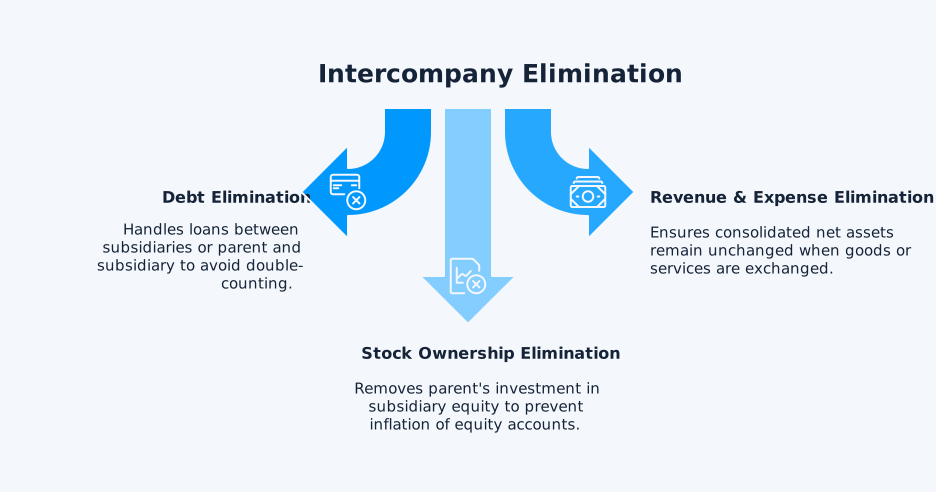
Intercompany Transaction Elimination
All intercompany transactions and balances must be eliminated in consolidated statements. When a parent company sells inventory to a subsidiary, both the sales revenue recorded by the parent and the corresponding expense recognised by the subsidiary are removed. This prevents double-counting and ensures only transactions with external parties appear in consolidated financials.
For businesses using Xero across multiple entities, tracking these intercompany transactions manually creates reconciliation nightmares during month-end close. Every sale between entities, loan transaction, or dividend payment requires identification and elimination.
Non-Controlling Interest Attribution
When you consolidate a less-than-wholly-owned subsidiary, ASC 810-10-45-20 requires attributing net income, other comprehensive income, and changes in equity between the parent and noncontrolling interests. While ASC 810-10 requires this allocation, it does not prescribe a specific attribution method – attribution should be reasonable and appropriate given the circumstances, including any contractual arrangements.
Noncontrolling interests appear as a separate component of equity on the consolidated balance sheet, distinct from parent equity. This separation ensures transparency about which portions of consolidated equity belong to the parent versus minority shareholders in subsidiaries.
Different Reporting Periods
Subsidiaries with different fiscal year-ends require special handling. While IFRS permits up to three months difference between reporting dates (with adjustments for significant transactions), US GAAP is more flexible but requires either consolidating subsidiary results on a lag with disclosure of significant intervening events or adjusting subsidiary results to align with parent reporting dates.
Currency Translation
Foreign subsidiaries introduce currency translation complexities under ASC 830. Assets and liabilities translate using closing rates at the balance sheet date, while income and expenses translate using average rates for the period. Equity is translated at historical rates and the cumulative translation adjustment stays in Other Comprehensive Income until the foreign entity is sold or substantially liquidated. Certain non-monetary items (such as property, plant, and equipment measured at historical cost) also translate at historical rates.
For multi-currency Xero consolidations, you must track which entities operate in which functional currencies, apply appropriate translation rates, maintain translation adjustment histories for audit purposes, and monitor accumulated OCI for each foreign subsidiary.
Automating GAAP-Compliant Consolidation
Manual consolidation processes struggle to maintain GAAP compliance as entity counts increase. Spreadsheet-based eliminations lack audit trails, intercompany mismatches surface weeks after month-end, and reconsolidating for corrections consumes days of the finance team’s time.
Modern consolidation software addresses these challenges by:
- Maintaining centralised elimination rules
- Documenting consolidation logic in transparent database procedures
- Creating historical snapshots for audit reproduction
When elimination rules live in SQL procedures rather than scattered across multiple Excel workbooks, you establish a single source of truth that auditors can review and approve.
For Xero users managing multi-entity businesses, automated consolidation means:
- Pulling full Trial Balance data from each entity
- Applying configured elimination rules automatically
- Producing consolidated financial statements that always tie back to entity-level Trial Balances
This architecture reduces risk of misstatement by enforcing consistent consolidation logic across all reports.
The dataSights Xero consolidation platform delivers pre-formatted management packs through the web interface, with additional automation available in Excel through Power Query and OfficeAddIn for teams preferring spreadsheet workflows. For advanced analytics, Power BI connects directly to consolidated data for custom visualisation and drill-down capabilities.
Bringing Consolidation Principles Into Practical Use
ASC 810 provides a clear framework for assessing control and preparing compliant consolidated statements across multi-entity groups. With structured evaluation and consistent application of GAAP, finance teams can produce accurate results without last-minute surprises. When consolidation is automated and standardised, month-end becomes faster and significantly more reliable.
Frequently Asked Questions
When Is Consolidation Required Under GAAP?
Consolidation is required under ASC 810 when you have a controlling financial interest in another legal entity. This occurs when you’re the primary beneficiary of a Variable Interest Entity (power to direct significant activities plus exposure to significant benefits/losses) or when you hold a majority voting interest in a Voting Interest Entity (generally more than 50% of voting rights).
What Is the Difference Between the VIE Model and Voting Interest Model?
The VIE model applies when equity investors lack typical control rights or when equity investment at risk is insufficient. You consolidate as the primary beneficiary if you have both power and economics. The Voting Interest Model applies when the VIE model doesn’t, with control typically existing at majority voting ownership unless substantive participating rights exist.
Do All GAAP Principles Apply to Consolidated Financial Statements?
Yes, FASB’s Conceptual Framework applies to all financial reporting, including consolidation. Key qualitative characteristics like relevance, faithful representation, comparability, and materiality govern consolidated statements. Specific consolidation guidance in ASC 810 builds on these foundational concepts, ensuring consolidated financial statements present the group as a single economic entity while maintaining consistency, verifiability, and transparency across reporting periods.
How Does GAAP Consolidation Differ From IFRS Consolidation?
GAAP uses a two-tier consolidation model (VIE first, then Voting Interest), while IFRS applies a single control-based model. IFRS recognises de facto control situations that GAAP doesn’t address. GAAP’s VIE model presumes related parties act together, while IFRS requires evaluating whether parties act as de facto agents. GAAP allows some accounting policy variations in specialised industries, while IFRS requires uniform policies.
Can You Have Majority Ownership Without Requiring Consolidation?
Yes, majority ownership doesn’t always trigger consolidation. Under the VIE model, even if you own more than 50%, you only consolidate if you’re the primary beneficiary. Under the Voting Interest Model, substantive participating rights held by noncontrolling interests can preclude consolidation despite majority ownership. Conversely, you might consolidate with less than 50% ownership if you control through other means.
What Happens When Subsidiaries Have Different Year-Ends?
US GAAP permits consolidating subsidiaries with different fiscal year-ends either on a lag (with disclosure of significant intervening events) or by adjusting subsidiary results to align with parent reporting dates. Unlike IFRS, which permits up to three months difference with adjustments for significant transactions, GAAP provides more flexibility but requires careful consideration of materiality and disclosure requirements.
How Do Intercompany Eliminations Work in Consolidated Statements?
All intercompany transactions and balances must be eliminated. When one entity in the group sells to another, the revenue and corresponding expense are removed. Intercompany loans, accounts receivable/payable, and dividends also require elimination. Only transactions with external parties remain in consolidated financials to prevent double-counting and accurately reflect the group’s financial position.
Who Determines GAAP Consolidation Standards?
The Financial Accounting Standards Board (FASB) develops and maintains GAAP consolidation standards through ASC 810. The Securities and Exchange Commission (SEC) enforces compliance for public companies through regulations, including Regulation S-X, which layers additional requirements such as separate financial statements for certain subsidiaries and pro forma disclosures.
Consolidation Compliance Made Systematic
GAAP principles for financial statement consolidation extend far beyond simple ownership thresholds. The ASC 810 framework requires systematic evaluation of control through both the Variable Interest Entity and Voting Interest Models, consistent application of FASB’s Conceptual Framework qualitative characteristics, and rigorous elimination of intercompany transactions. For CFOs managing multi-entity groups, these requirements transform month-end close from a multi-week ordeal into a systematic process when consolidation rules are properly configured and automated.
Transform Your Xero Consolidation Reporting Today
Stop spending weeks manually consolidating multiple Xero entities. dataSights automates multi-entity financial consolidation with full eliminations, Trial Balance reconciliation, and board-ready management packs. Join 300+ businesses who’ve reduced month-end close from 15+ days to under 5 days using automated GAAP-compliant consolidation and rated 5.0 out of 5 by 90+ Xero users.
About the Author
Kevin Wiegand
Founder & Client happiness
I’m Kevin Wiegand, and with over 25 years of experience in software development and financial data automation, I’ve honed my skills and knowledge in building enterprise-grade solutions for complex consolidation and reporting challenges. My journey includes developing custom solutions for data teams at Gazprom Marketing & Trading and E.ON, before founding dataSights in 2016. Today, dataSights helps over 300 businesses achieve 100% report automation. I’m passionate about sharing my expertise to help CFOs and Financial Controllers reduce their month-end close time and eliminate the manual Excel exports that drain their teams’ valuable time.