
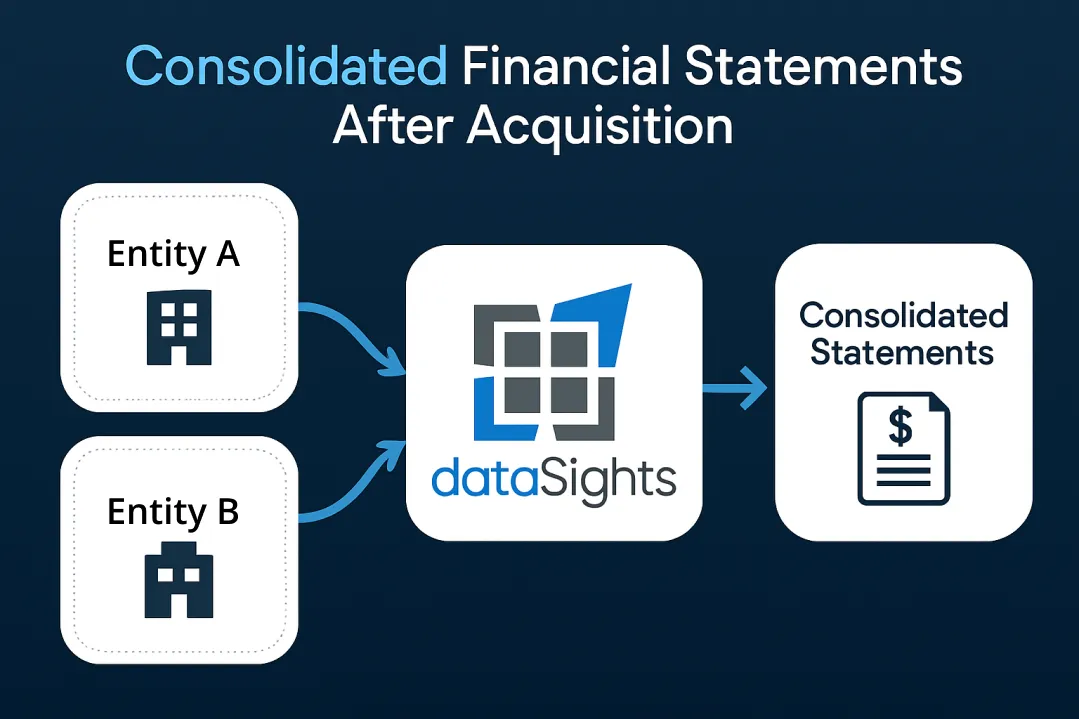
You’ve just completed an acquisition. Now the priority is producing consolidated financial statements after acquisition that present the group as a single economic entity from the date you obtained control. That means eliminating the investment, recognising goodwill (or a bargain purchase gain), and recording acquisition-date fair value adjustments – then carrying the resulting consolidation adjustments forward each reporting period. This guide walks you through the required post-acquisition entries and ongoing adjustments under IFRS 3 and IFRS 10, and under US GAAP (ASC 805 and ASC 810). You’ll learn what to post, when to post it, and the common mistakes that can leave group profit, equity, and non-controlling interest misstated – even when the consolidated balance sheet still “balances.”
What Are Consolidated Financial Statements After Acquisition?
Consolidated financial statements after acquisition combine the parent and acquired entity from the acquisition date (when control is obtained), treating the group as a single economic entity. Under IFRS, the acquisition method requires fair value measurement of identifiable assets and liabilities and recognition of goodwill (or a bargain purchase gain), with ongoing consolidation adjustments each period.
Ready to Automate Your Financial Consolidation?
Stop wrestling with manual consolidations and broken formulas. dataSights automates multi-entity reporting, Xero consolidations, and Power BI connections. Join 300+ businesses already transforming their financial reporting with our platform, rated 5.0 out of 5 by 90+ verified Xero users.
Table of Contents
What Changes After the Acquisition Date?
Both IFRS and US GAAP provide detailed guidance on how to consolidate after an acquisition. The core principle is the same: from the acquisition date, treat the parent and subsidiary as a single economic entity. However, the specific requirements differ in terminology and application. Here is what each framework requires.
The Acquisition Method Under IFRS 3
IFRS 3 Business Combinations requires the acquisition method as the only permitted approach. This requires:
- Identifying the acquirer: The entity that obtains control of another entity. Control is assessed under IFRS 10 based on power over the investee, exposure to variable returns, and the ability to use power to affect returns. Majority voting rights often indicate control, but contractual rights and de facto control can also be decisive.
- Determining the acquisition date: The date when the acquirer obtains control of the acquiree. From this date, you begin consolidating the subsidiary’s assets, liabilities, income and expenses.
- Recognising and measuring identifiable assets and liabilities: At acquisition date, you measure the subsidiary’s identifiable assets and liabilities at fair value. This often creates fair value adjustments compared to the subsidiary’s book values.
- Recognising goodwill or a bargain purchase gain: When consideration paid exceeds the fair value of net identifiable assets, you recognise goodwill. If consideration is less than fair value, you record a bargain purchase gain.
US GAAP Requirements Under ASC 810 and ASC 805
For companies following US GAAP, ASC 810 Consolidation provides guidance on when and how to consolidate. The standard uses two models:
- Voting Interest Model: Applies when a parent holds more than 50% of voting shares, and the entity is not a variable interest entity.
- Variable Interest Entity (VIE) Model: Applies when the legal entity lacks sufficient equity investment at risk to finance its activities, or when equity investors lack characteristics of a controlling financial interest.
According to BDO’s consolidation guidance, after initial measurement, the consolidation principles in ASC 810 apply to both VIEs and voting interest entities. The subsequent measurement of assets, liabilities and non-controlling interest generally follows the same approach regardless of which model determined consolidation.
Four Essential Post-Acquisition Consolidation Entries
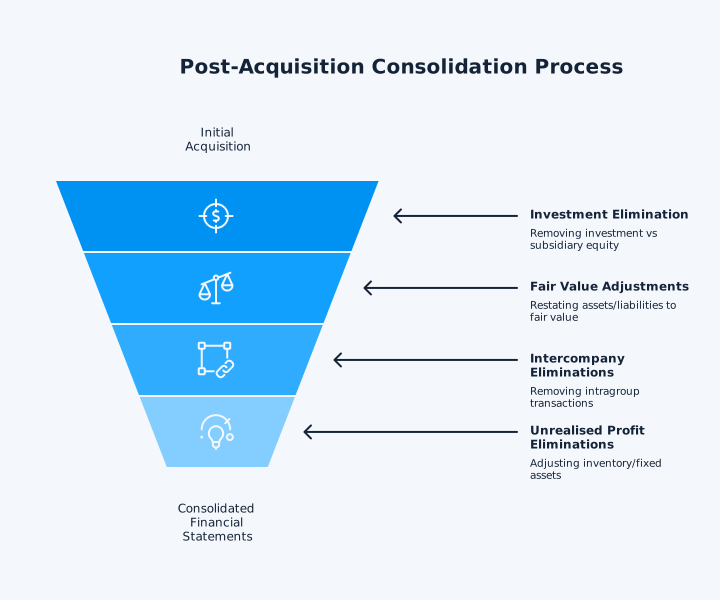
Every post-acquisition consolidation requires four types of entries to produce accurate group accounts. Skipping any one of these can result in material misstatements in profits, equity, goodwill, or NCI.
1. Investment Elimination Entry
The first consolidation entry eliminates the parent’s investment account against the subsidiary’s equity. This prevents double-counting of net assets in the consolidated balance sheet.
At acquisition, you:
- Eliminate the parent’s investment in subsidiary shares
- Eliminate the subsidiary’s share capital and pre-acquisition reserves
- Recognise goodwill for any excess consideration
- Recognise non-controlling interest if ownership is less than 100%
This consolidation entry eliminates the parent’s investment against the subsidiary’s pre-acquisition equity in the consolidation worksheet, with any excess consideration recognised as goodwill and any non-controlling interest recognised based on the acquisition analysis.
2. Fair Value Adjustments
Scenario (used in the examples below): Parent (P) acquires 80% of Subsidiary (S) on 1 Jan 20XX. The group reporting date is 31 Dec 20XX. In Year 1 after acquisition: (1) a fair value uplift is identified on S’s PPE, and (2) S sells inventory to P and some remains unsold at year-end.
When a subsidiary’s assets and liabilities differ from fair value at acquisition, you record fair value adjustments. These adjustments continue in subsequent consolidations.
Common fair value adjustments include:
- Property, plant and equipment revaluations
- Intangible asset recognition (brands, customer relationships, technology)
- Inventory adjustments
- Financial instrument fair values
- Contingent liability recognition
For depreciable FV uplifts, recognise additional depreciation/amortisation in consolidation each period (reducing consolidated profit and retained earnings), and adjust the carrying amount of the related asset accordingly.
Deferred tax reminder: Fair value uplifts, additional depreciation, and unrealised profit eliminations can create temporary differences between consolidated carrying amounts and tax bases. Where applicable, recognise deferred tax and ensure NCI is allocated its share of post-acquisition movements.
Worked Example: Fair value uplift on PPE → extra depreciation
Acquisition-date fair value adjustment
- PPE carrying amount in S’s books at acquisition: $300,000
- PPE fair value at acquisition: $400,000
- Fair value uplift: $400,000 − $300,000 = $100,000
- Remaining useful life: 5 years (straight-line)
Extra depreciation (post-acquisition)
- Additional annual depreciation = $100,000 ÷ 5 = $20,000
Consolidation adjustment (Year ended 31 Dec 20XX)
- Dr Depreciation expense 20,000
- Cr PPE / Accumulated depreciation 20,000
Impact on profit allocation
- This adjustment reduces S’s post-acquisition profit by $20,000.
- NCI share (20%) = 20% × 20,000 = $4,000 (reduces NCI’s share of profit)
- Parent share (80%) = $16,000
3. Intercompany Eliminations
After acquisition, parent and subsidiary often trade with each other. These intercompany transactions must be eliminated to present the group as a single economic entity.
These are the main types of intercompany eliminations processed each period:
- Intercompany debt: Eliminates loans and related interest between group entities.
- Intercompany revenue and expenses: Removes sales of goods or services from one group entity to another, together with the related cost of sales.
- Other intercompany balances and transactions: Eliminates remaining intra-group receivables, payables and related flows so that only balances and transactions with external parties remain in the consolidated statements.
The issue of intercompany eliminations is particularly challenging when an acquisition has just been completed, since the reporting controls are not yet in place at the new acquiree. dataSights’ intercompany eliminations guide explains that investment elimination entries must account for acquisition-date versus post-acquisition equity movements, fair value adjustments, any resulting goodwill, and non-controlling interests.
4. Unrealised Profit Eliminations
When one group entity sells inventory or fixed assets to another at a profit, and those assets remain within the group at period end, you must eliminate the unrealised profit.
According to PwC’s intercompany transactions guidance, intercompany profit should be eliminated from the applicable asset on a before-tax basis. The general objective is to exclude from consolidated shareholders’ equity the profit arising from transactions within the consolidated entity.
For inventory, eliminate unrealised profit based on the difference between the inventory’s intra-group carrying amount and its cost to the group.
Unrealised profit = Ending inventory at transfer price − Ending inventory at group cost.
If the seller used a markup on cost, convert it before calculating the elimination. Also consider whether a deferred tax adjustment is required where tax is paid in the seller but profit is eliminated in consolidation.
Continuing the scenario above: S sells goods to P during 20XX and 60% remains in ending inventory at 31 Dec 20XX.
Worked Example: Intra-group inventory sale → eliminate intercompany profit still in ending inventory
Intra-group transaction (upstream sale: S → P)
- During 20XX, S sells goods to P for $50,000
- Cost to S: $40,000
- Profit recorded by S: $50,000 − $40,000 = $10,000
- At 31 Dec 20XX, 60% of those goods are still in P’s inventory (not yet sold externally)
Unrealised profit in ending inventory
- Unrealised profit = $10,000 × 60% = $6,000
Consolidation eliminations (Year ended 31 Dec 20XX)
(a) Eliminate intercompany sale and purchase (always eliminate the full internal trade):
- Dr Revenue (Sales) 50,000
- Cr Cost of sales (COGS) 50,000
(b) Eliminate unrealised profit remaining in closing inventory (so inventory is at “group cost”):
- Dr Cost of sales (COGS) 6,000
- Cr Inventory 6,000
Impact on profit allocation (because it’s an upstream sale from S)
- The $6,000 unrealised profit was included in S’s profit, so eliminating it reduces S’s post-acquisition profit.
- NCI share (20%) = 20% × 6,000 = $1,200
- Parent share (80%) = $4,800
Note: If the sale were downstream (P → S), the unrealised profit elimination would affect the parent’s profit only (NCI typically not impacted by that specific profit elimination).
Goodwill Accounting After Acquisition
Goodwill is often the largest single asset arising from an acquisition. Getting the initial calculation wrong, or failing to test for impairment correctly, creates material misstatements that auditors will flag. Here is how to handle goodwill from day one and in subsequent periods.
Initial Recognition
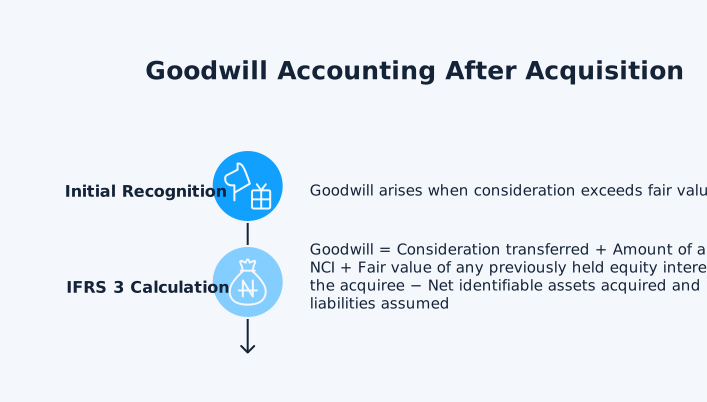
Goodwill arises when the consideration paid exceeds the fair value of identifiable net assets acquired. Under IFRS 3, goodwill is calculated as:
Goodwill = Consideration transferred + Amount of any non-controlling interest (measured in accordance with IFRS 3) + Fair value of any previously held equity interest in the acquiree − Net identifiable assets acquired and liabilities assumed (measured at acquisition-date fair values).
You have a policy choice for measuring non-controlling interest:
- Full goodwill method (fair value): NCI measured at fair value, resulting in higher goodwill that includes NCI’s share.
- Partial goodwill method (proportionate): NCI measured at its share of net assets, resulting in lower goodwill attributable only to the parent.
Subsequent Measurement
Under US GAAP, goodwill is generally not amortised for public business entities and is tested for impairment at least annually (and when triggering events occur). Private companies may elect accounting alternatives that allow amortisation and simplified impairment testing.
Under IAS 36, goodwill is allocated to the CGU (or group of CGUs) expected to benefit from the combination’s synergies, then tested at that level – this may be a single subsidiary or a broader CGU grouping. When conducting the impairment review, compare the carrying amount of net assets plus goodwill against the recoverable amount.
Under UK GAAP (FRS 102), goodwill is always treated as having a finite useful life and must be amortised on a systematic basis over that life. If the useful life cannot be reliably estimated, FRS 102 requires using a finite life not exceeding 10 years (a backstop rather than a default period).
Non-Controlling Interest Treatment
When you acquire less than 100% of a subsidiary, the remaining ownership represents non-controlling interest. NCI appears as a separate component of equity in the consolidated statement of financial position and affects how you allocate profits and process subsequent ownership changes.
Initial Recognition
At acquisition, measure NCI using either:
- Fair value (full goodwill method)
- Proportionate share of the acquiree’s identifiable net assets (partial goodwill method)
Subsequent Measurement
After acquisition, IFRS 10 requires that changes in ownership that do not result in loss of control are accounted for as equity transactions. This means:
- No gain or loss recognised when selling shares in the subsidiary
- Additional share purchases do not create new goodwill
- The carrying amounts of parent equity and NCI adjust to reflect changed ownership percentages
On the consolidated income statement, allocate profit or loss between amounts attributable to the parent and amounts attributable to NCI.
Post-Acquisition Consolidation Timeline
Knowing what to consolidate is only half the challenge. Knowing when to consolidate each element matters equally. Here is the sequence of steps from acquisition date through ongoing reporting periods.
Acquisition Date Procedures
At acquisition date, complete these steps:
- Identify all identifiable assets and liabilities of the acquiree
- Measure identifiable assets and liabilities at fair value
- Calculate goodwill or bargain purchase gain
- Determine NCI at fair value or proportionate share
- Record the acquisition in the parent’s books
- Align the subsidiary’s accounting policies with group policies
First Post-Acquisition Reporting Period
For the first consolidated statements after acquisition:
- Combine like items of assets, liabilities, equity, income, expenses and cash flows
- Eliminate the investment against subsidiary equity
- Recognise goodwill and NCI in consolidated statements
- Include subsidiary results only from acquisition date
- Process fair value adjustments and related depreciation
- Eliminate any intercompany transactions occurring post-acquisition
Subsequent Periods
For ongoing consolidation:
- Update fair value adjustment depreciation
- Process all intercompany eliminations
- Eliminate unrealised profits on intragroup transfers
- Test goodwill for impairment annually
- Adjust NCI for its share of subsidiary profits and dividends
- Track post-acquisition retained earnings separately from pre-acquisition reserves
Common Challenges in Post-Acquisition Consolidation
Post-acquisition consolidation introduces complexity that existing consolidation processes may not handle well. These are the obstacles finance teams encounter most frequently after completing an acquisition.
1. Different Charts of Accounts
Acquired subsidiaries often use different account structures. You need account mapping to align the subsidiary’s chart of accounts with your group structure. This creates significant manual work without automation.
2. Currency Translation
For foreign subsidiaries, IAS 21 requires assets and liabilities to be translated at the closing exchange rate, while income and expenses are translated at exchange rates at the dates of the transactions (often approximated using average rates). Resulting exchange differences are recognised in other comprehensive income. Goodwill arising on the acquisition of a foreign subsidiary is treated as an asset of the foreign operation, measured in the subsidiary’s functional currency and translated at the closing rate.
3. Measurement Period Adjustments
IFRS 3 allows a measurement period of up to 12 months after acquisition to finalise fair values. During this period, you may adjust provisional amounts retrospectively if new information becomes available about facts and circumstances existing at acquisition date.
4. Month-End Close Delays
Manual consolidation processes extend month-end close significantly. Research shows that manual consolidation takes 10 or more business days for bottom-quartile performers versus under 5 business days for automated top performers.
For Xero users managing multiple entities, dataSights’ Xero consolidation solution automates multi-entity reporting with automatic eliminations and near real-time updates. Close timelines vary widely by company size and complexity, but surveys commonly show many teams take more than a week to close. Automation can reduce manual reconciliation effort and improve consistency, especially when consolidation adjustments live outside entity ledgers.
Frequently Asked Questions
When Do You Start Consolidating After an Acquisition?
Consolidation begins on the acquisition date (when control is obtained). In your consolidated statement of financial position at the reporting date, you include the subsidiary’s assets and liabilities from that point onward, measured initially using acquisition-date fair values and then subsequently accounted for under the relevant standards.
How Do You Handle Pre-Acquisition Profits in Consolidation?
Pre-acquisition profits belong to the previous owners and form part of the net assets you acquired. You eliminate pre-acquisition retained earnings as part of the investment elimination entry. Only post-acquisition profits contribute to consolidated retained earnings. This distinction is critical for calculating goodwill correctly and presenting accurate group reserves.
What Intercompany Transactions Require Elimination After Acquisition?
All intercompany transactions require elimination, including intercompany sales and purchases, intercompany loans and interest, management fees between entities, dividends from subsidiary to parent, and intercompany receivables and payables. The objective is to present the group as if it were a single entity transacting only with external parties.
How Often Must You Test Goodwill for Impairment?
Under IFRS, goodwill must be tested for impairment at least annually and whenever there are indicators of impairment. The annual test can be performed at any point during the year, as long as it’s performed at the same time each year. If goodwill is recognised during the year, the related cash-generating unit must be tested before the end of that annual period.
Can You Change the Measurement of Non-Controlling Interest After Acquisition?
The choice between fair value and proportionate share methods applies only at acquisition date. You cannot change this election retrospectively. For subsequent ownership changes that do not result in a loss of control, adjust NCI based on its proportionate share of subsidiary equity, rather than by applying a new fair value measurement.
What Happens to Goodwill If You Sell the Subsidiary?
When disposing of a subsidiary, include the carrying amount of goodwill in the calculation of gain or loss on disposal. Allocate goodwill to the disposal group based on relative fair values if you sell part of a cash-generating unit. The disposed goodwill reduces your remaining goodwill balance and affects the gain or loss recognised in profit or loss.
Stop Chasing Balance Sheet Differences
Post-acquisition consolidation is complex. Investment eliminations, fair value adjustments, goodwill calculations, NCI allocations. Miss a step and your consolidated statements may still ‘balance’ – but profits, equity, goodwill, or NCI can be materially misstated. With the technical requirements under IFRS 3, IFRS 10, ASC 810 and ASC 805 clearly mapped out, your finance team can now approach each acquisition with a repeatable consolidation framework that auditors will approve.
Automate Your Post-Acquisition Xero Consolidation
Ready to consolidate your newly acquired entities without the spreadsheet headaches? If you’re consolidating multiple entities and need a repeatable way to track goodwill, FV uplifts, NCI and eliminations outside entity ledgers, dataSights centralises those adjustments and keeps an audit trail. Rated 5.0 by 90+ Xero users, the platform helps 300+ businesses reduce month-end close from over 15 business days to under 5 business days.
About the Author
Kevin Wiegand
Founder & Client happiness
I’m Kevin Wiegand, and with over 25 years of experience in software development and financial data automation, I’ve honed my skills and knowledge in building enterprise-grade solutions for complex consolidation and reporting challenges. My journey includes developing custom solutions for data teams at Gazprom Marketing & Trading and E.ON, before founding dataSights in 2016. Today, dataSights helps over 300 businesses achieve 100% report automation. I’m passionate about sharing my expertise to help CFOs and Financial Controllers reduce their month-end close time and eliminate the manual Excel exports that drain their teams’ valuable time.