
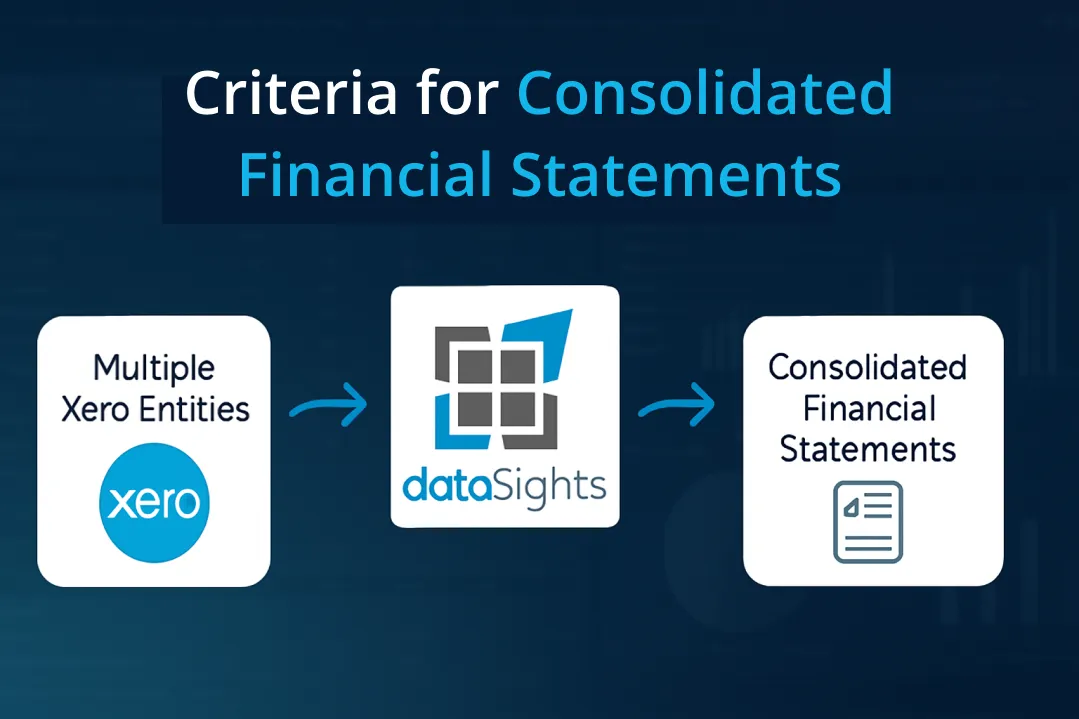
Which subsidiaries must appear in your consolidated financial statements? If the consolidation scope is wrong, finance teams often face audit queries, rework, and delayed reporting. The criteria for consolidated financial statements centre on control tests under IFRS 10, exemption rules in the UK Companies Act 2006, and VIE assessments under US GAAP. This guide breaks down the exact tests finance teams must apply to determine which entities require consolidation and which qualify for exemption.
What Are the Criteria for Consolidated Financial Statements?
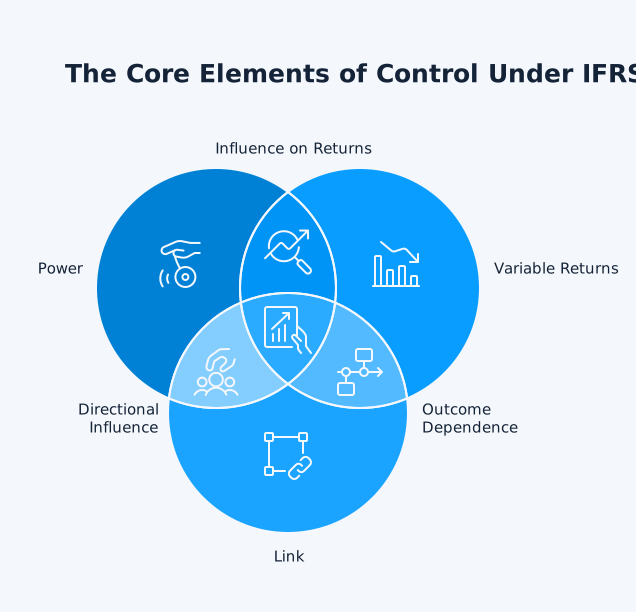
The criteria for consolidated financial statements determine whether a parent must include a subsidiary in group accounts based on control. Under IFRS 10, control requires three elements: power over the investee, exposure to variable returns, and ability to affect those returns. Because consolidation depends on control assessments and consistent eliminations, many groups standardise these steps (and often automate them) to reduce rework and improve audit trail quality.
Ready to Automate Your Financial Consolidation?
Stop wrestling with manual consolidations and broken formulas. dataSights automates multi-entity reporting, Xero consolidations, and Power BI connections. Join 300+ businesses already transforming their financial reporting with our platform, rated 5.0 out of 5 by 90+ verified Xero users.
Table of Contents
The Three Elements of Control Under IFRS 10
IFRS 10 establishes a single control model applicable to all investees, regardless of their structure. An investor controls an investee when it possesses all three elements simultaneously.
1. Power Over the Investee
Power represents the current ability to direct relevant activities. Relevant activities are those operations that most significantly affect the investee’s returns. According to ICAEW, power arises from rights, which may be straightforward, such as voting rights or complex, such as contractual arrangements.
Examples of relevant activities include:
- Operating and capital decisions
- Appointing key management
- Establishing policies that significantly affect returns
Holding majority voting rights typically provides power, but de facto control can exist with less than 50% ownership when other shareholders are dispersed.
2. Exposure to Variable Returns
The second element requires exposure or rights to variable returns from involvement with the investee. BDO explains that returns can be positive only, negative only, or both positive and negative. The variability depends on the substance of the arrangement, not its legal form.
Variable returns include:
- Dividends
- Changes in investment value
- Remuneration for servicing assets
- Fee income
- Exposure to losses from credit support or liquidity arrangements
3. Link Between Power and Returns
The third element requires the investor to have the ability to use its power to affect its returns. This element distinguishes principals from agents. Grant Thornton notes that an investor acting as an agent exercises delegated decision-making authority and does not control the investee.
When assessing this link, consider whether the investor can use its power unilaterally or requires cooperation from others. Decision-makers must determine whether they act primarily for their own benefit or on behalf of other parties.
UK Companies Act 2006 Consolidation Requirements
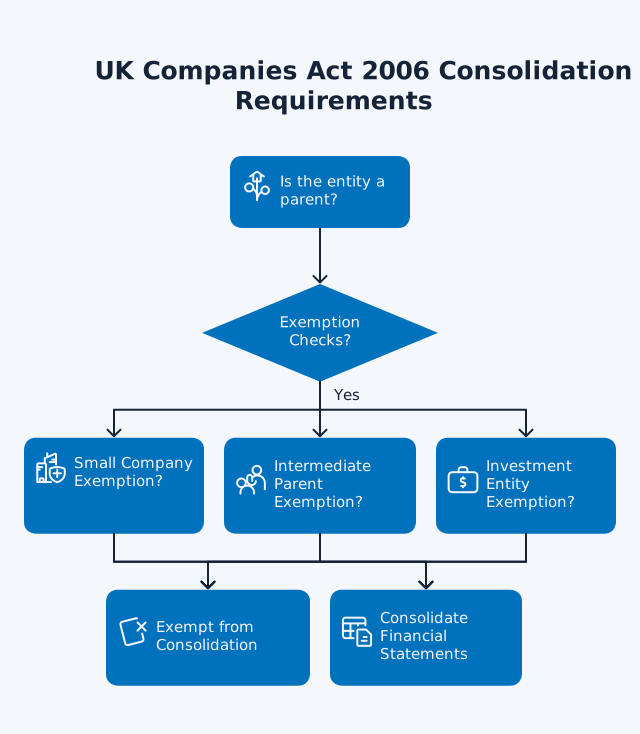
UK parent companies are subject to statutory requirements to prepare consolidated financial statements under the Companies Act 2006, subject to specific exemptions.
Duty to Prepare Group Accounts
Section 399 establishes that a parent company must prepare group accounts in addition to individual accounts, unless an exemption applies. The ACCA factsheet confirms that this duty applies to any entity that is a parent at the end of its financial year.
Small Company Exemption
Under s399(2A), a parent company is exempt from preparing consolidated financial statements if it is subject to the small companies regime and is not a member of an ineligible group. For a parent to qualify, both the individual company and the group it heads must meet the small company thresholds defined in s383.
The small company thresholds (for periods starting on or after 6 April 2025) are:
- Turnover: not more than £15 million (gross) or £12.6 million (net)
- Balance sheet total: not more than £7.5 million (gross) or £6.3 million (net)
- Average employees: not more than 50
A group is ineligible if any member is a traded company, an authorised insurance company, a banking company, or carries on regulated activities under the Financial Services and Markets Act 2000.
Intermediate Parent Exemption
Sections 400 and 401 provide exemptions for intermediate parent companies included in larger group consolidations. ICAEW guidance explains that following Brexit, s400 applies where the parent of the intermediate company is established under UK law, while s401 applies where the parent is established outside the UK. Availability and inclusion conditions apply – check the statutory wording before relying on an exemption.
To claim the exemption, the intermediate parent must be included in consolidated accounts prepared by a higher-level parent, and those accounts must be filed with the UK registrar.
Subsidiary Exclusion Criteria (UK Companies Act vs FRS 102)
Section 405 of the Companies Act 2006 permits exclusion of subsidiary undertakings from consolidation in limited circumstances. However, FRS 102 paragraph 9.9 narrows these exclusions beyond the Companies Act requirements:
- Severe long-term restrictions substantially hinder the parent’s ability to exercise rights over the subsidiary’s assets or management.
- The interest is held exclusively with a view to subsequent resale and the subsidiary has not previously been consolidated in FRS 102 financial statements.
The second criterion is particularly restrictive. Under the Companies Act alone, the held-for-resale exclusion does not require prior consolidation. FRS 102 adds the condition that the subsidiary must never have been consolidated previously, making this exclusion unavailable for subsidiaries that were consolidated before the decision to sell.
US GAAP Consolidation Under ASC 810
US GAAP provides two consolidation models under ASC 810: the Variable Interest Entity model and the Voting Interest model.
Variable Interest Entity Model
BDO explains that the VIE model applies when a legal entity lacks sufficient equity investment at risk to finance its activities without additional subordinated financial support. A legal entity is a VIE if:
- Total equity at risk is insufficient to finance operations without additional support
- Equity investors lack one or more characteristics of a controlling financial interest
- The entity’s activities are conducted primarily on behalf of an investor with disproportionately few voting rights
Primary Beneficiary Determination
The reporting entity that consolidates a VIE is called the primary beneficiary. According to EY, a reporting entity is the primary beneficiary if it has both:
- Power to direct the activities that most significantly impact the VIE’s economic performance
- Obligation to absorb losses or right to receive benefits that could potentially be significant to the VIE
Voting Interest Model
When an entity is not a VIE, the Voting Interest model applies. Under this model, the entity owning more than 50% of voting rights typically has a controlling financial interest and must consolidate. Consolidated financial statements present a parent and its subsidiaries as though they were a single entity.
Consolidation Procedures Required by All Frameworks
Once consolidation is required, specific procedures apply regardless of the accounting framework used.
Uniform Accounting Policies
The parent must prepare consolidated financial statements using uniform accounting policies for like transactions and events. Where subsidiary financial statements use different policies, adjustments must be made during consolidation.
Intercompany Eliminations
All intercompany transactions must be eliminated, including:
- Intercompany receivables and payables
- Intercompany sales and purchases
- Intercompany dividends
- Unrealised profits on intercompany transactions
- Intercompany loans and interest
Non-controlling Interest Presentation
Non-controlling interests represent equity in a subsidiary not attributable to the parent. These must be presented within equity, separately from the parent’s equity. Profit or loss attributable to non-controlling interests is allocated even if this results in a deficit balance.
Reporting Date Alignment
Parent and subsidiary financial statements should have the same reporting date. Where different dates are used, IFRS 10 requires that the difference is no more than three months, with adjustments for significant intervening transactions.
Practical Challenges in Applying Consolidation Criteria
Finance teams face several practical challenges when applying consolidation criteria across multi-entity groups.
1. Control Assessment Complexity
Control assessment requires significant judgement, particularly when:
- Ownership is below 50% but de facto control may exist
- Voting patterns at previous shareholder meetings suggest control
- Special relationships exist between the investor and the investee
- Potential voting rights could affect the assessment
2. Multi-currency Consolidation
Groups with entities in different countries must translate foreign currency financial statements. This involves applying appropriate exchange rates to assets, liabilities, income, and expenses, then recognising exchange differences in other comprehensive income.
3. Different Accounting Frameworks
Subsidiaries may prepare individual accounts under different frameworks. A UK parent using UK-adopted IFRS must ensure subsidiary accounts are adjusted to align with group policies, requiring detailed reconciliation processes.
4. Month-end Processing Time
Manual consolidation processes often extend month-end close periods significantly. Finance teams report spending 15 or more days each period on manual consolidation tasks, including eliminations, currency translation, and reconciliation.
Automating Consolidation Compliance
Modern consolidation software addresses these practical challenges through automation. dataSights connects directly to Xero and other accounting platforms, automatically pulling trial balances and applying consolidation rules.
Key automation capabilities include:
- Automatic intercompany eliminations without manual journal entries
- Multi-currency translation using configurable exchange rate sources
- Real-time consolidation that updates as source data changes
- Audit trails showing exactly how consolidated figures are derived
For groups using Xero across multiple entities, automated consolidation reduces month-end close from weeks to days. The system handles eliminations, minority interest calculations, and currency translation automatically, allowing finance teams to focus on analysis rather than data processing.
Frequently Asked Questions
What Are the Main Criteria for Preparing Consolidated Financial Statements?
The main criteria centre on control. Under IFRS 10, control exists when an investor has power over the investee, exposure to variable returns, and the ability to use that power to affect returns. Under US GAAP ASC 810, control is assessed through the VIE model or Voting Interest model depending on the entity’s characteristics. UK Companies Act 2006 requires all parent companies to consolidate unless they qualify for small company or intermediate parent exemptions.
When Is a Parent Company Exempt from Preparing Consolidated Accounts?
A UK parent company is exempt from preparing consolidated accounts if it qualifies as a small company under s383 and heads a small group per s384 and s399(2A). Alternatively, intermediate parents can claim exemption under s400 or s401 if included in consolidated accounts prepared by a higher-level parent. Under IFRS 10, investment entities measuring all subsidiaries at fair value through profit or loss are exempt from consolidation.
How Does Control Differ from Ownership in Consolidation Requirements?
Control and ownership are distinct concepts. An investor can have control with less than 50% ownership if voting rights of other shareholders are dispersed, contractual arrangements provide decision-making authority, or potential voting rights are substantive. Conversely, majority ownership does not guarantee control if protective rights limit the majority owner’s ability to direct relevant activities.
What Entities Must Be Excluded from Consolidation?
Under FRS 102, subsidiaries must be excluded from consolidation when severe long-term restrictions substantially hinder the parent’s ability to exercise rights over assets or management, or when the interest is held exclusively with a view to subsequent resale and the subsidiary has not previously been consolidated. Exclusion for immateriality is permitted only when individual and combined exclusions are genuinely immaterial.
What Is a Variable Interest Entity Under US GAAP?
A Variable Interest Entity is a legal entity that either lacks sufficient equity at risk to finance its activities without additional subordinated financial support, has equity investors lacking characteristics of a controlling financial interest, or conducts activities primarily on behalf of an investor with disproportionately few voting rights. The primary beneficiary of a VIE must consolidate it, determined by which party has both power over significant activities and exposure to significant economics.
How Often Must Control Be Reassessed?
Control must be reassessed whenever facts and circumstances indicate changes to any of the three elements of control: power, returns, or the link between them. Specific triggering events include changes in ownership structure, amendments to governing documents, changes in contractual arrangements, and any circumstance that could affect the investor’s ability to direct relevant activities.
Building a Foundation for Accurate Group Reporting
Getting consolidation criteria right determines whether your group accounts present a true picture of financial performance. The core principle across IFRS 10, UK GAAP, and US GAAP remains consistent: identify control, apply uniform policies, eliminate intercompany transactions. Manual processes extend month-end close and introduce reconciliation errors that automated consolidation eliminates. A clear understanding of which entities to include protects against audit findings and ensures stakeholders receive accurate group-level information.
Automate Your Consolidation Criteria Assessment Today
Stop spending weeks determining which entities require consolidation and manually processing eliminations. dataSights delivers automated Xero consolidation that handles control assessments, intercompany eliminations, and multi-currency translation without manual intervention. Rated 5.0 out of 5 by 90+ Xero users. Join 300+ businesses who’ve reduced month-end close from over 15 days to under 5 days.
About the Author
Kevin Wiegand
Founder & Client happiness
I’m Kevin Wiegand, and with over 25 years of experience in software development and financial data automation, I’ve honed my skills and knowledge in building enterprise-grade solutions for complex consolidation and reporting challenges. My journey includes developing custom solutions for data teams at Gazprom Marketing & Trading and E.ON, before founding dataSights in 2016. Today, dataSights helps over 300 businesses achieve 100% report automation. I’m passionate about sharing my expertise to help CFOs and Financial Controllers reduce their month-end close time and eliminate the manual Excel exports that drain their teams’ valuable time.