
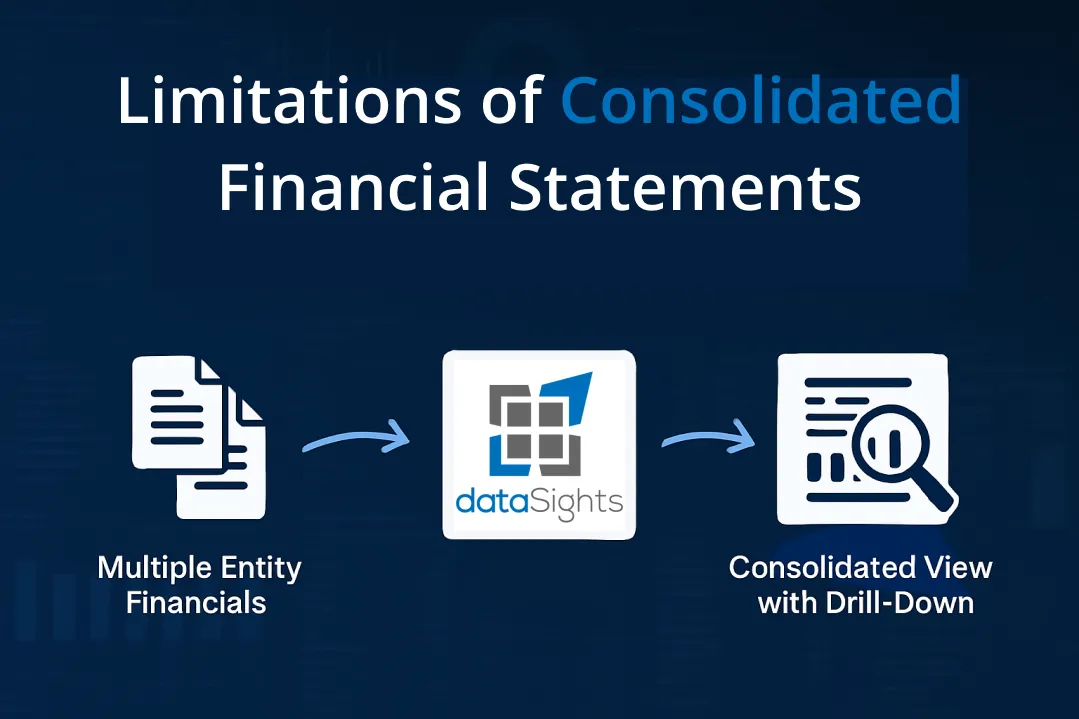
Your month-end consolidation took 15 days, everything balanced, and you presented the results to the board. Then someone asked which subsidiary drove the profit decline – and your consolidated statements couldn’t answer. This scenario plays out in finance teams regularly because the limitations of consolidated financial statements can obscure as much as they reveal. They mask individual entity performance, distort financial ratios, and hide the detail stakeholders need for decisions. This guide examines each limitation and shows you practical ways to overcome them.
Understanding the Limitations of Consolidated Financial Statements
Limitations of consolidated financial statements include five primary constraints that CFOs and Financial Controllers must understand. These are: masking of poor subsidiary performance, unrepresentative combined financial ratios, lack of uniformity across entities, limited availability of entity-specific resources, and insufficient detailed disclosures. These constraints affect decision-making for investors, creditors, and stakeholders who need accurate visibility into individual business unit performance.
Ready to Automate Your Financial Consolidation?
Stop wrestling with manual consolidations and broken formulas. dataSights automates multi-entity reporting, Xero consolidations, and Power BI connections. Join 300+ businesses already transforming their financial reporting with our platform, rated 5.0 out of 5 by 90+ verified Xero users.
Table of Contents
How Consolidated Statements Can Mask Poor Subsidiary Performance
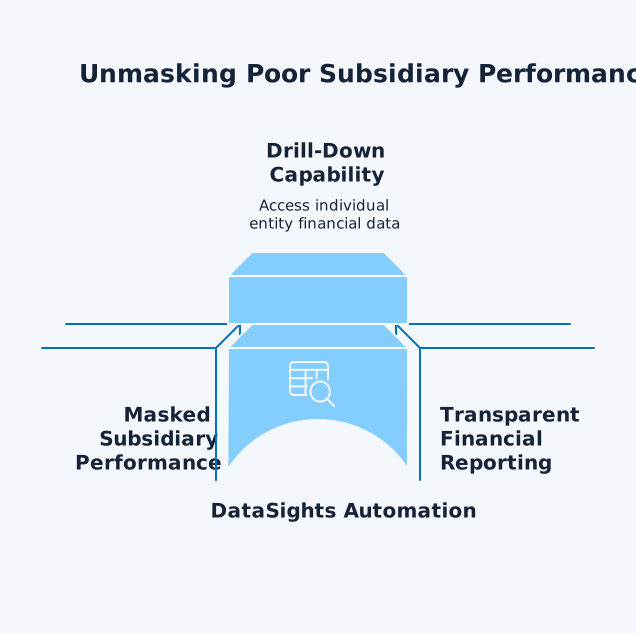
One of the most significant drawbacks of consolidated reporting is its ability to hide underperforming subsidiaries within the group results. When you consolidate revenues, expenses, and net profit into a single set of statements, the individual profitability problems of any company within the group become invisible.
Consider a parent company with five subsidiaries where four are highly profitable but one is generating substantial losses. The consolidated income statement shows combined results that may still appear healthy, yet the struggling subsidiary could be draining cash and requiring capital injections that stakeholders cannot identify from the consolidated view alone.
According to consolidation experts, while consolidated statements can help identify areas of strength and weakness, they require supplementary analysis of standalone financials to assess individual entity performance properly. For minority shareholders who have invested in a specific subsidiary rather than the parent, consolidated statements provide little visibility into their actual investment performance.
The masking effect becomes particularly problematic when:
- A high-performing parent compensates for struggling subsidiaries
- Seasonal variations affect entities differently
- One business unit requires significant turnaround investment
- Management wants to obscure operational problems from investors
To address this limitation, finance teams should maintain parallel reporting that tracks individual entity performance alongside consolidated results. dataSights’ consolidated financial reporting automation enables drill-down from group totals to individual entity transactions, providing visibility that traditional consolidated statements cannot offer.
Why Consolidated Financial Ratios May Not Reflect Reality
Financial ratios are essential tools for investors and creditors to evaluate company’s viability. However, when consolidated financial statements combine every company’s assets, liabilities, and income as one, the derived ratios become skewed and do not accurately reflect each company’s individual performance.
This creates several analytical problems:
- Debt-to-equity distortions: A subsidiary with high leverage may be masked by a parent with strong equity reserves, leading creditors to underestimate default risk for specific entities within the group.
- Profitability ratio confusion: Return on assets and return on equity calculations blend the performance of efficient and inefficient operations, making it impossible to identify which business units generate acceptable returns.
- Liquidity ratio misrepresentation: Current ratio and quick ratio calculations may show healthy group liquidity while specific subsidiaries face working capital constraints that require parent company support.
- Asset turnover aggregation: Different business models within a group naturally have different asset utilisation patterns, and combining them produces ratios that represent no actual business unit.
For CFOs evaluating acquisition targets or creditors assessing lending risk, these ratio distortions can lead to poor decisions. The solution requires segment reporting and entity-level analysis alongside consolidated ratios. Understanding the difference between combined and consolidated financial statements helps stakeholders choose the appropriate reporting format for their analytical needs.
The Intercompany Elimination Challenge
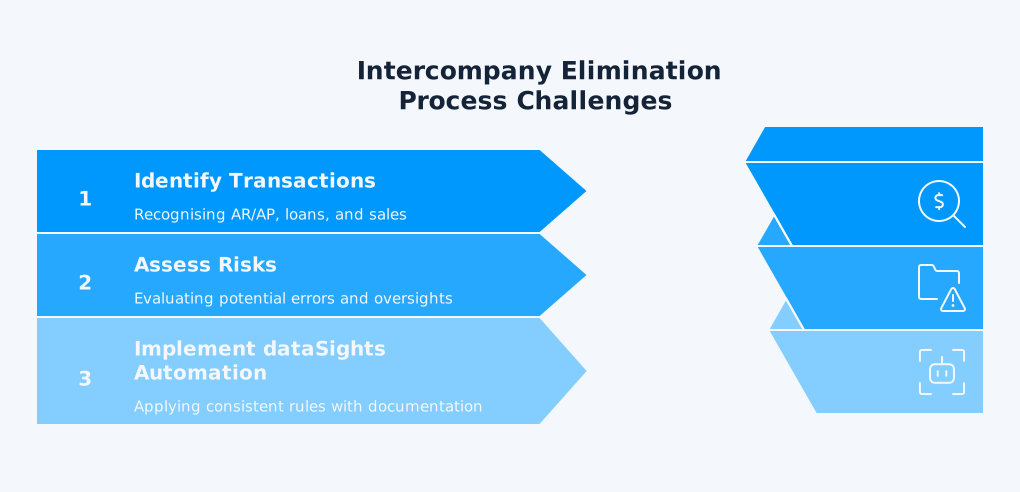
When preparing consolidated financial statements, all intercompany transactions and balances must be eliminated to reflect only third-party activity and avoid double-counting. While this elimination is conceptually straightforward, it remains a significant challenge for many groups.
The practical difficulties include:
- Matching complexity: Intercompany receivables and payables must match exactly across entities, but timing differences, currency conversions, and posting errors frequently create mismatches that require investigation.
- Unrealised profit in inventory: When one entity sells goods to another at a markup, the profit recognised by the seller must be eliminated if the goods remain in the buyer’s inventory at period end.
- Fixed asset transfers: Intercompany sales of property, plant, and equipment require elimination of gains and ongoing adjustment of depreciation calculations.
- Intercompany loans and interest: Principal amounts and interest income/expense must be eliminated, but different recognition timing can create reconciliation issues.
Accounting and finance teams spend significant time reconciling intercompany transactions, comparing financial data from different entities to ensure they match and are accurately accounted for. Without automation, manual eliminations lack audit trails and repeatability, introducing error risk that compounds with each reporting period.
The absence of proper elimination documentation also creates audit challenges. External auditors need to trace each elimination back to its source transactions, and manual processes rarely provide the transparency required for efficient audit support.
Non-Controlling Interest Presentation Limitations
One of the limitations of consolidated financial statements is the exclusion of non-controlling interests from full incorporation into the consolidated view. Non-controlling interests represent the ownership stake held by minority shareholders in subsidiaries, and while accounting standards require their separate disclosure, the treatment can still create interpretation difficulties.
Under IFRS 10 and comparable standards, consolidated statements include 100% of a subsidiary’s assets, liabilities, revenues, and expenses, with the NCI share separated on the balance sheet equity section and in profit attribution. This approach means:
- Total consolidated revenue includes sales by entities the parent does not fully own
- Consolidated assets include property and equipment controlled but not fully owned
- Profit figures require careful allocation between controlling and non-controlling portions
For stakeholders evaluating the parent company specifically, this creates analysis challenges. As noted by financial experts, minority interest treatment in consolidated statements requires trusting accountants to estimate holding values correctly, which may not always reflect economic reality.
The NCI limitation becomes particularly relevant in partial acquisitions where the parent owns between 50% and 100% of a subsidiary. Understanding non-controlling interest treatment helps CFOs properly interpret consolidated results and communicate them to boards and investors.
Multi-Currency Translation Distortions
For multinational groups, currency translation poses challenges in accurately reflecting the financial performance and position of the group. Exchange rate fluctuations between reporting periods can create gains or losses unrelated to operational performance.
Translation risk emerges when consolidating financial statements of foreign subsidiaries, as fluctuations in exchange rates can cause discrepancies between reported earnings and the actual financial positions of subsidiaries. This creates several reporting challenges:
- Balance sheet versus income statement rates: IAS 21 requires translating assets and liabilities at the closing rate at the reporting date, and income and expense items at rates at the dates of the transactions (often approximated by an average rate), with exchange differences recognised in equity where appropriate.
- Foreign currency translation reserve volatility: The reserve can swing significantly based on exchange rate movements, creating equity fluctuations that do not reflect business performance.
- Comparability problems: Year-over-year comparisons become difficult when currency movements mask or exaggerate underlying operational changes.
- Cash flow complexity: Preparing consolidated cash flow statements requires converting each entity’s statement to the reporting currency using appropriate rates, with exchange rate effects presented separately.
For groups operating across multiple currency zones, understanding how currency fluctuations affect financial position and performance is critical. Foreign currency exchange rate fluctuations can cause profits or losses on the income statement and can affect loan covenants, creating real business consequences from translation mechanics.
Different Accounting Policies Across Subsidiaries
Entities within a group may adopt different accounting policies and practices, leading to discrepancies and challenges in the consolidation process. These differences in recognition, measurement, and disclosure practices affect the comparability and accuracy of consolidated statements.
Common policy differences that create consolidation challenges include:
- Revenue recognition timing and methods
- Inventory valuation approaches (FIFO versus weighted average)
- Depreciation methods and useful life estimates
- Lease classification and measurement
- Provisions and contingent liability recognition
- Fair value measurement techniques
IFRS 10 requires uniform accounting policies across group entities, meaning adjustments must be made to align subsidiary policies with the parent’s approach before consolidation. However, this alignment process takes time and introduces adjustment risk.
For groups that have grown through acquisition, inherited accounting policies may differ significantly from the parent’s practices. The cost and effort to fully harmonise policies across all entities can be substantial, and some differences may persist for practical reasons.
Finance teams should establish consistent accounting policies across subsidiaries wherever possible, minimising differences that arise from different frameworks or interpretations. Automation tools that apply standardised treatments can help ensure consistency without manual policy alignment for each reporting period.
Reporting Timing and Lag Issues
The timing of financial reporting among subsidiaries can pose a limitation in preparing consolidated financial statements. Different fiscal year-ends, varying closing timetables, and communication delays all affect the timeliness and relevance of consolidated reporting.
IFRS permits a reporting date difference of up to 3 months between parent and subsidiary, with adjustments required for significant transactions occurring in the intervening period. While this flexibility accommodates practical constraints, it creates challenges:
- Stale data: When subsidiaries report weeks before the parent’s close, their numbers may not reflect the most current business conditions.
- Adjustment complexity: Significant transactions occurring between subsidiary and parent reporting dates require careful identification and adjustment.
- Consolidation bottlenecks: If one subsidiary’s close is delayed, the entire consolidated close waits, extending the overall reporting timeline.
- Audit coordination: Different close dates complicate the timing of external audit procedures across the group.
Many jurisdictions have shortened the timeframes for filing consolidated financial statements, putting additional pressure on groups to accelerate their consolidation processes. This time pressure exacerbates the challenges of gathering, reconciling, and validating data from multiple entities.
Implementing standardised reporting timelines and ensuring timely submission of financial information can minimise reporting lags. dataSights clients who automate their Xero multi-company consolidation report reducing month-end close from over 15 days to under 5, addressing timing limitations through continuous rather than period-end consolidation.
Limited Segment and Entity-Level Disclosure
Consolidated financial statements provide a single view of the group’s financials, so IFRS 8 requires additional operating-segment and entity-wide disclosures about products, services and geographies. Without sufficient segment detail, stakeholders may struggle to see where value is created and where risks concentrate within the group.
The disclosure limitations affect:
- Geographic analysis: While some segment reporting is required, the level of detail may not satisfy investors wanting to understand regional performance drivers.
- Business unit visibility: Groups with diverse operations may combine very different businesses in ways that obscure individual unit contributions.
- Trend identification: Without entity-level detail, identifying which parts of the business are improving or declining becomes difficult.
- Risk assessment: Concentration of risk in specific subsidiaries may not be apparent from consolidated disclosures alone.
For CFOs presenting to boards, the limitation of consolidated statements often requires supplementary materials that break down group results by entity, region, or business line. This additional reporting burden exists precisely because consolidated statements alone provide insufficient decision-making detail.
Understanding the difference between consolidated and consolidating financial statements helps finance teams determine when to use working schedules that preserve entity-level visibility versus final consolidated presentations for external reporting.
The Complexity and Cost Burden
The process of preparing consolidated financial statements can become more costly and time-consuming as group structures become more complex. This cost burden falls directly on finance teams who must balance accuracy requirements against resource constraints.
The complexity drivers include:
- Multiple ERP systems: Group companies often use different ERP systems and accounting software across entities, making data aggregation difficult and requiring manual extraction and transformation.
- Manual processes: Financial consolidation is notoriously laborious, and not having automations in place leads to errors, inconsistencies, and delays.
- Changing group structures: Mergers, acquisitions, divestitures, and internal restructuring frequently alter the group structure, requiring ongoing adjustments to consolidation processes.
- Regulatory requirements: Many industries face additional regulatory requirements that impact financial reporting, adding layers of compliance complexity.
For finance teams already stretched thin, the consolidation burden often means month-end becomes a period of intense pressure with limited time for analysis and strategic work. The cost of errors – whether in restated financials, audit adjustments, or poor decisions based on inaccurate data – compounds the direct cost of preparation.
Automation provides the path to managing complexity without proportionally increasing cost. By eliminating manual data gathering and standardising elimination processes, finance teams can handle increasing group complexity while actually reducing close time.
How to Overcome Consolidated Financial Statement Limitations
Understanding these limitations is the first step toward addressing them. Finance teams can take several practical approaches to ensure consolidated statements support rather than hinder decision-making:
- Maintain parallel entity-level reporting: Keep individual entity financials readily accessible alongside consolidated statements, enabling stakeholders to drill down when questions arise.
- Automate intercompany eliminations: Replace manual elimination journals with automated rules that apply consistently, document completely, and update in real time.
- Implement continuous consolidation: Move from period-end batch consolidation to ongoing consolidation that surfaces issues daily rather than at month-end.
- Standardise chart of accounts: Align account structures across entities to simplify aggregation and reduce mapping complexity.
- Use management reporting alongside statutory: Create management views that preserve the segment and entity detail that statutory consolidated statements obscure.
dataSights addresses these limitations through automated Xero consolidation that maintains full audit trails, applies consistent elimination rules, and enables real-time drill-down from group totals to individual transactions. This approach transforms consolidated reporting from a limitation-prone process into a strength that provides both statutory compliance and management insight.
Frequently Asked Questions
What Are the Five Main Limitations of Consolidated Financial Statements?
The five main limitations are masking of poor subsidiary performance, unrepresentative combined financial ratios, lack of uniformity in accounting policies, limited availability of entity-specific detail, and insufficient granular disclosures. Each affects how stakeholders can interpret and use consolidated information for decision-making.
Why Do Consolidated Financial Statements Hide Individual Company Problems?
Consolidated statements combine all revenues, expenses, assets, and liabilities into single line items, which means strong performance from profitable entities can offset weak performance from struggling ones. Without separate entity reporting, stakeholders cannot identify which business units need attention or investment.
How Do Intercompany Eliminations Create Audit Trail Problems?
Manual elimination processes typically lack documentation showing why each adjustment was made, who authorised it, and how it connects to underlying transactions. This creates audit challenges and makes it difficult to recreate prior period consolidations or verify elimination accuracy.
Can Consolidated Financial Ratios Be Trusted for Investment Decisions?
Consolidated ratios should be used with caution because they blend different business models, risk profiles, and operational characteristics into single metrics. Investors should supplement consolidated ratio analysis with segment reporting and standalone financial review where available.
What Is the Maximum Reporting Date Difference Allowed Between Parent and Subsidiary Under IFRS?
IFRS permits a maximum three-month difference between parent and subsidiary reporting dates, with adjustments required for significant transactions occurring in the intervening period. Closer alignment is generally preferable for consolidated statement accuracy.
How Do Currency Translation Differences Affect Consolidated Equity?
Currency translation differences arise from using different exchange rates for balance sheet items, which use closing rates, versus income statement items, which use average rates. These differences accumulate in the foreign currency translation reserve within equity, creating volatility unrelated to operational performance.
Are Small Groups Exempt From Preparing Consolidated Financial Statements?
Under UK law, small groups may qualify for exemption from preparing consolidated financial statements under the Companies Act 2006, subject to specific size and eligibility criteria. However, many exempt groups still prepare management consolidations for internal decision-making.
How Does Automation Help Address Consolidated Financial Statement Limitations?
Automation addresses limitations by maintaining entity-level visibility alongside consolidated views, applying consistent elimination rules with full audit trails, enabling real-time consolidation rather than period-end processing, and reducing the manual effort that introduces errors and delays.
Making Consolidated Reporting Work for Your Business
Consolidated financial statements will always have limitations, but they remain essential for statutory reporting and group-level insight. The finance team’s job is to preserve the benefits of a single group view while giving stakeholders the drill-down and explanations they need for decisions. By combining sound consolidation processes with automation, CFOs can turn consolidation from a compliance obligation into a reliable foundation for planning, analysis, and performance management.
Automate Your Multi-Entity Consolidation Today
Ready to overcome the limitations of manual consolidated reporting? dataSights delivers pre-formatted management packs with automated eliminations, real-time drill-down capability, and full audit trails. Rated 5.0 by 90+ Xero users. Join 300+ businesses who have transformed their consolidation process.
About the Author
Kevin Wiegand
Founder & Client happiness
I’m Kevin Wiegand, and with over 25 years of experience in software development and financial data automation, I’ve honed my skills and knowledge in building enterprise-grade solutions for complex consolidation and reporting challenges. My journey includes developing custom solutions for data teams at Gazprom Marketing & Trading and E.ON, before founding dataSights in 2016. Today, dataSights helps over 300 businesses achieve 100% report automation. I’m passionate about sharing my expertise to help CFOs and Financial Controllers reduce their month-end close time and eliminate the manual Excel exports that drain their teams’ valuable time.