
Getting confused between consolidated vs consolidating financial statements? You’re not alone. These terms sound similar but represent fundamentally different aspects of financial reporting. One is the finished product you present to investors; the other is the complex process of getting there.
What Is Consolidated vs Consolidating?
Consolidated financial statements present the combined financial position of a parent company and its subsidiaries as a single economic entity. Consolidating, meanwhile, refers to the actual process of combining, adjusting, and eliminating transactions to create those consolidated statements. The key difference: consolidated is the final result, while consolidating is the journey to get there.
Ready to Automate Your Financial Consolidation?
Stop wrestling with manual consolidations and broken formulas. dataSights automates multi-entity reporting, Xero consolidations, and Power BI connections. Join 300+ businesses already transforming their financial reporting with our platform, rated 5.0 out of 5 by 90+ verified Xero users.
Table of Contents
Understanding the Core Difference Between Consolidated and Consolidating
Think of it this way: consolidated financial statements are what you read; consolidating financial statements is what you do.
Consolidated statements are the polished, board-ready reports that show your entire group’s financial position. They’re the documents investors analyse, auditors review, and regulators require. According to accounting standards, these statements must present assets, liabilities, equity, income, and expenses as if the parent and subsidiaries were one entity.
Consolidating, however, describes the actual work:
- Gathering data from multiple entities
- Eliminating intercompany transactions
- Converting currencies
- Adjusting for non-controlling interests.
It’s the process finance teams wrestle with every month – often manually in spreadsheets.
The confusion often stems from how we use these terms interchangeably in everyday conversation. You might hear someone say “we’re consolidating our accounts” when they mean “we’re preparing consolidated accounts.” But in technical accounting terms, the distinction matters.
What Are Consolidated Financial Statements?
Consolidated financial statements combine the financial information of a parent company and its subsidiaries into a single set of reports. Under standards such as IFRS 10 and ASC 810, a parent must consolidate when it controls an investee – that is, it has power over the relevant activities, exposure or rights to variable returns, and the ability to use that power to affect those returns. Ownership of more than 50% of the voting rights is a common indicator of control, but it is not the test on its own.
These statements typically include:
- A consolidated statement of financial position (balance sheet)
- A consolidated statement of profit or loss and other comprehensive income (income statement/OCI)
- A consolidated statement of changes in equity
- A consolidated statement of cash flows
- Supporting notes, including significant accounting policies
For many readers, the consolidated balance sheet, income statement, and cash flow statement are the primary focus, because they show the group’s assets, profitability, and cash movements at a glance.
When Consolidation Becomes Mandatory
In the UK, whether a group must prepare consolidated accounts depends both on control and on whether it qualifies as a small group under the Companies Act 2006 and related regulations. For accounting periods beginning between 1 January 2016 and 5 April 2025, small companies and small groups generally met the size criteria if they did not exceed at least two of the following:
- Annual turnover of £10.2 million
- Balance sheet total of £5.1 million
- An average of 50 employees
From 6 April 2025, these thresholds increase for small companies and groups (for example, the turnover limit rises to £15 million and the balance sheet total to £7.5 million). The exact limits and eligibility rules change over time, so finance teams should always check current Companies House or professional guidance before relying on specific figures.
For everyone else, consolidated statements aren’t optional – they’re a legal requirement under the Companies Act 2006.
The Consolidating Process: How Financial Consolidation Actually Works
Consolidating financial statements involves several critical steps that transform separate entity data into unified group reports. Here’s what actually happens during the consolidation process:
Step 1: Identify All Entities
First, determine which subsidiaries need consolidating. This includes any entity where the parent holds majority ownership or significant control. Control typically means owning more than 50% of voting stock, but can also exist through board representation or contractual arrangements.
Step 2: Gather Financial Data
Collect financial statements from all subsidiaries for the same reporting period. This sounds simple, but becomes complex when subsidiaries use different accounting systems, reporting currencies, or fiscal year-ends.
Step 3: Standardise and Adjust
Align all accounting policies across entities. If one subsidiary uses different depreciation methods or revenue recognition policies, you must adjust their figures to match the parent’s approach.
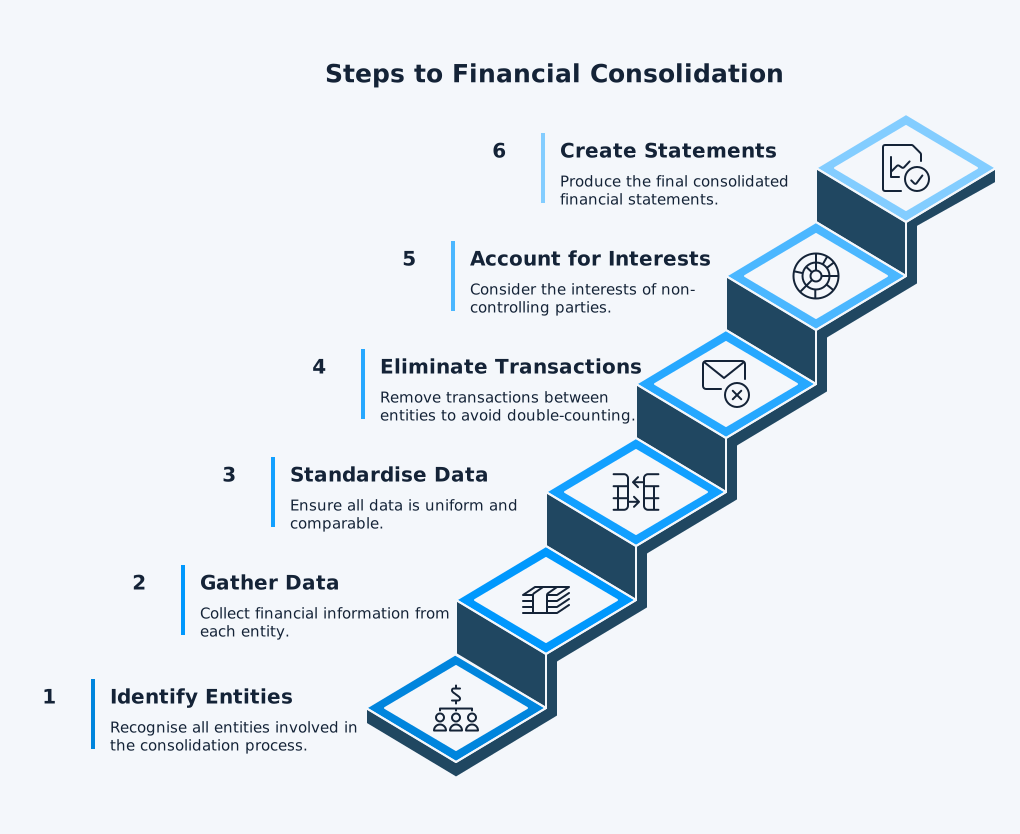
Step 4: Eliminate Intercompany Transactions
This is where consolidating gets tricky. Any transactions between group entities must be eliminated to avoid double-counting. This includes:
- Intercompany sales and purchases
- Loans between entities
- Dividends paid from subsidiary to parent
- Management fees and service charges
Step 5: Account for Non-Controlling Interests
When you don’t own 100% of a subsidiary, you must separately report the portion owned by external shareholders. This appears as “non-controlling interest” on consolidated statements.
Step 6: Create Final Consolidated Statements
Combine all adjusted figures into the three core financial statements, ensuring everything balances and ties back to individual entity Trial Balances.
Consolidated vs Combined Financial Statements: Another Critical Distinction
While we’re clarifying terminology, here’s another common confusion: consolidated versus combined financial statements.
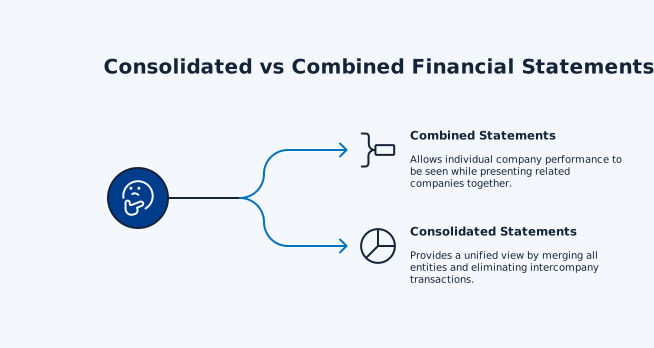
Combined financial statements show the finances of related companies in a single document, but keep each entity visible rather than presenting one merged set of numbers. Think of it as presenting several entities side-by-side in one pack so you can still see each company’s individual performance. In practice, even combined presentations often eliminate intra-group transactions and balances to avoid overstating revenue, assets, or profits, but the entities themselves remain separately identifiable.
‘Combined’ financial statements are not defined in IFRS, so practice is jurisdiction-specific and should always be disclosed in the accounting policies.
When would you use each?
- Combined statements: Often used when companies are under common control but there is no single parent that controls all entities, or when investors and lenders want to see individual entity performance in one place.
- Consolidated statements: Used when a parent controls its subsidiaries and reporting frameworks such as IFRS 10 or local GAAP require the group to be presented as a single economic entity.
Common Mistakes in the Consolidating Process
Research shows 64% of finance teams say manual consolidation work leaves no time for proper analysis. Here are the biggest pitfalls to avoid:
Incomplete Elimination of Intercompany Transactions
Missing even one intercompany transaction can throw off your entire consolidation. Common oversights include:
- Forgetting management fees charged between entities
- Missing inventory transfers at year-end
- Overlooking intercompany loan interest
Inconsistent Accounting Policies
When subsidiaries use different accounting methods, you must adjust everything to the parent’s policies before consolidating. Failing to standardise leads to comparing apples with oranges.
Currency Conversion Errors
For international groups, converting foreign subsidiary figures at incorrect exchange rates can significantly distort consolidated results. According to IAS 21, you need different rates for:
- Balance sheet assets and liabilities (closing rate at reporting date)
- Income and expenses (exchange rates at transaction dates, or average rate as approximation)
- Share capital and pre-acquisition reserves (historical rate at acquisition date)
Manual Process Overload
Consolidating complex multi-entity structures in Excel often results in errors. With 37% of CFOs not fully trusting their financial data, manual consolidation clearly isn’t working.
Legal and Regulatory Requirements for Consolidation
The regulatory framework for consolidated statements varies by jurisdiction, but key principles remain consistent:
IFRS and UK GAAP Requirements
IFRS 10 and FRS 102 mandate consolidation when control exists. Control means:
- Power over the investee
- Exposure to variable returns
- Ability to use power to affect returns
Quarterly Reporting Obligations
Public companies must file Form 10-K annually and Form 10-Q quarterly with the SEC. These reports include consolidated financial statements when the company has subsidiaries. Your company’s CEO and CFO must certify the financial and certain other information contained in these reports, ensuring accuracy and accountability in financial reporting.
Documentation and Audit Trails
Consolidated statements require extensive documentation showing:
- How eliminations were calculated
- Currency conversion methodologies
- Adjustments for accounting policy differences
- Non-controlling interest calculations
Without proper documentation, auditors can’t verify your consolidation process – potentially delaying sign-off on annual accounts.
Technology’s Role in Modern Financial Consolidation
The complexity of consolidating financial statements explains why finance teams are investing heavily in automation. Modern consolidation involves:
Moving Beyond Spreadsheets
Manual Excel-based consolidation creates vulnerabilities, including:
- No real-time visibility across entities
- Version control nightmares
- Broken formulas and links
- Hours spent on repetitive tasks
Automated Consolidation Benefits
Purpose-built consolidation software transforms the process by:
- Automatically eliminating intercompany transactions
- Handling currency conversions in real-time
- Maintaining full audit trails
- Reducing month-end close from weeks to days
dataSights clients typically reduce their month-end close from over 15 days to under 5 days through automation. Those results come from a complete consolidation platform: pre-formatted Management Reports delivered through the dataSights web portal, Excel automation for teams that live in spreadsheets, and optional Power BI integration for advanced analytics. That’s not incremental improvement – it’s transformation.
Integration Requirements
Effective consolidation requires connecting multiple data sources. Your consolidation solution needs to:
- Pull data directly from each entity’s accounting system
- Standardise different chart of accounts structures
- Handle various reporting currencies
- Maintain transaction-level detail for drill-down analysis
Making Sense of Consolidation for Your Business
Understanding consolidated versus consolidating isn’t just academic – it directly impacts how you approach financial reporting. Here’s what matters for your business:
For Growing Multi-Entity Businesses
Once your group no longer qualifies for small-group exemptions and you have subsidiaries that you control, consolidated financial statements are typically required under IFRS or local GAAP. Start preparing early by:
- Standardising accounting policies across entities
- Implementing consistent charts of accounts
- Documenting intercompany transactions clearly
- Considering consolidation software before it becomes critical
For Established Groups
If you’re already consolidating, focus on efficiency:
- Evaluate whether manual processes are sustainable
- Calculate the true cost of delayed month-end closes
- Consider how real-time consolidation could improve decision-making
- Assess whether your current approach provides adequate audit trails
The Cost of Getting It Wrong
Poor consolidation doesn’t just mean late reports. It means:
- Investor confidence issues from delayed filings
- Audit qualifications from inadequate documentation
- Management decisions based on incomplete data
- Finance teams burning out from manual work
Frequently Asked Questions
What's the Simple Difference Between Consolidated and Consolidating?
Consolidated refers to the final financial statements that present multiple entities as one. Consolidating is the process of creating those statements – the actual work of combining, adjusting, and eliminating transactions.
Do All Companies Need Consolidated Financial Statements?
No. In the UK, small groups meeting specific thresholds (under £10.2m turnover, £5.1m assets, or 50 employees) are exempt. However, any parent company with controlling interest in subsidiaries above these thresholds must prepare consolidated statements.
What's the Difference Between Consolidation and Aggregation?
Aggregation simply adds numbers together. Consolidation requires eliminating intercompany transactions, adjusting for accounting policy differences, and presenting entities as a single economic unit. It’s far more complex than simple addition.
How Long Should Financial Consolidation Take?
Manual consolidation often takes 15+ days after month-end. With proper automation, the same process typically completes in under 5 days. The complexity depends on the number of entities, intercompany transactions, and reporting requirements.
Can You Partially Consolidate Financial Statements?
Where you have significant influence over, but not control of, another entity – often presumed when you hold 20% or more of the voting rights – you generally use the equity method under IAS 28 rather than full consolidation. Arrangements with joint control are addressed by IFRS 11 and also typically use the equity method. Under this approach, your investment appears as a single line in the balance sheet, and your share of the investee’s profit or loss appears as a single line in the income statement, instead of combining all of the investee’s assets and liabilities line-by-line.
What Happens If You Don't Eliminate Intercompany Transactions?
Failing to eliminate intercompany transactions inflates your consolidated figures. You’d double-count revenues, overstate assets, and present misleading financial information to stakeholders. This can lead to audit qualifications and regulatory issues.
Is Consolidating Different from Preparing Combined Financial Statements?
Yes. Consolidating creates unified statements showing multiple entities as one. Preparing combined statements keeps entities separate within the same document. The processes and end results are fundamentally different.
Transform Complex Consolidation Into Clear Financial Insight
Consolidated versus consolidating – now you understand the distinction. One represents your destination (clear, accurate group financial statements), while the other describes the journey to get there. For finance teams struggling with manual consolidation processes that stretch beyond two weeks, the path forward is clear: automate the consolidating process to deliver better consolidated statements faster. That’s exactly what dataSights does for over 300 businesses worldwide.
Streamline Your Financial Consolidation Journey Today
Stop wrestling with the consolidating process every month. dataSights’ automated Xero consolidation solution – with board-ready Management Reports, Excel automation, and Power BI integration – is rated 5.0 by 90+ users and transforms weeks of manual work into days of automated accuracy. Join 300+ businesses who’ve already eliminated the confusion between consolidated and consolidating by making the entire process seamless.
About the Author
Kevin Wiegand
Founder & Client happiness
I’m Kevin Wiegand, and with over 25 years of experience in software development and financial data automation, I’ve honed my skills and knowledge in building enterprise-grade solutions for complex consolidation and reporting challenges. My journey includes developing custom solutions for data teams at Gazprom Marketing & Trading and E.ON, before founding dataSights in 2016. Today, dataSights helps over 300 businesses achieve 100% report automation. I’m passionate about sharing my expertise to help CFOs and Financial Controllers reduce their month-end close time and eliminate the manual Excel exports that drain their teams’ valuable time.