
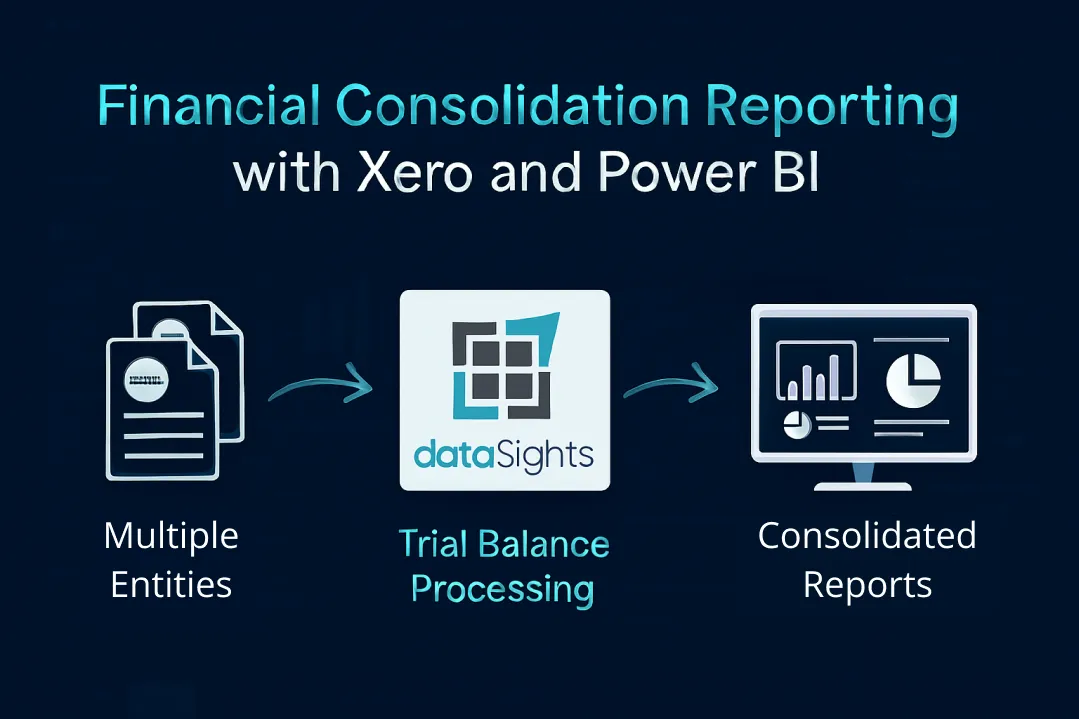
Managing financial data across multiple entities is complex, especially when your month-end close drags on for weeks, intercompany eliminations don’t balance, and Excel formulas keep breaking. That’s where financial consolidation reporting with Xero and Power BI changes the game. By connecting Xero directly into Power BI through dataSights, you can automate Trial Balance imports, handle eliminations seamlessly, and deliver consolidated reports in real time. Whether you’re consolidating three entities or thirty, this guide shows you how to create accurate, compliant, and interactive consolidated financial statements that satisfy regulators, inform stakeholders, and reduce close time from weeks to days.
What Is Financial Consolidation Reporting?
Financial consolidation reporting combines financial data from parent companies and subsidiaries into single, unified statements that present the entire group as one economic entity. This process requires eliminating internal transactions and following specific accounting standards to ensure accurate representation of the group’s financial position. According to IFRS 10, companies must consolidate when they control other entities – typically through majority ownership or the ability to direct financial decisions.
Ready to Automate Your Financial Consolidation?
Stop wrestling with manual consolidations and broken formulas. dataSights automates multi-entity reporting, Xero consolidations, and Power BI connections. Join 300+ businesses already transforming their financial reporting with our platform, rated 5.0 out of 5 by 90+ verified Xero users.
Table of Contents
Why Financial Consolidation Reporting Matters
Financial consolidation reporting isn’t just a compliance exercise – it’s basic to understanding your group’s true financial position. Without proper consolidation, you can’t see the complete picture of your organisation’s performance, cash flow, or financial health.
Regulatory Compliance Requirements
Both GAAP and IFRS require consolidated financial statements when a parent company controls subsidiaries. In the UK, Companies House requires group accounts for companies meeting specific thresholds. Non-compliance can result in penalties, delayed filings, and damaged stakeholder trust.
Strategic Decision-Making Benefits
Consolidated reports provide the complete financial picture needed for strategic decisions. You can identify profitable segments, allocate resources effectively, and spot trends across entities. According to Sage’s research, automating the financial close saves 24 working days annually, freeing up 3x more time for strategic activities. Finance teams currently spend an average of 300 hours per year on unproductive manual reporting tasks.
Stakeholder Transparency
Investors, lenders, and board members need consolidated views to assess group performance. According to PwC, efficient consolidation systems enable companies to produce consolidated results quickly and accurately, which enhances transparency and reliability in financial reporting. These qualities are well-recognised as essential drivers of investor confidence. Individual entity statements don’t reveal intercompany dependencies, group cash position, or elimination adjustments that affect overall financial health.
The Financial Consolidation Process: Step-by-Step Guide
Financial consolidation follows a structured process that starts with individual entity closes and ends with unified group statements. Each step builds on the previous one, and shortcuts create compounding errors.
Step 1: Collect Trial Balances from All Entities
Your Trial Balance forms the foundation of accurate consolidation. Every account must reconcile at the entity level before you begin consolidation. Pull Trial Balances for the same reporting period from each entity, ensuring all transactions are posted and accounts balanced.
Common Trial Balance issues include:
- Unreconciled suspense accounts
- Missing accruals or deferrals
- Unposted journal entries
- Timing differences between entities
Watch how automated consolidation transforms the entire process from Trial Balance import through to final consolidated reports with automatic eliminations:
Step 2: Standardise Chart of Accounts
Map each entity’s accounts to your group chart of accounts. Different subsidiaries often use varying account structures, especially after acquisitions. Create a standardised mapping that translates local accounts to group-level categories while maintaining audit trails.
Step 3: Convert Foreign Currencies
For international groups, translate foreign subsidiary statements using appropriate exchange rates:
- Balance sheet items at period-end rates
- Income statement items at average period rates
- Equity items at historical rates
- Record translation differences in other comprehensive income
Step 4: Eliminate Intercompany Transactions
Remove all internal transactions to prevent double-counting. According to PwC guidance, eliminations must include:
- Intercompany sales and purchases
- Internal loans and interest
- Dividend payments between group entities
- Unrealised profits on internal inventory transfers
- Management fees and service charges
Step 5: Calculate Non-Controlling Interests
When you don’t own 100% of a subsidiary, calculate the minority interest portion. This appears separately in equity and requires proportional allocation of subsidiary profits and losses to external shareholders.
Step 6: Prepare Consolidated Statements
Combine adjusted figures into three core statements:
- Consolidated Income Statement: Group revenues and expenses after eliminations
- Consolidated Balance Sheet: Combined assets, liabilities, and equity
- Consolidated Cash Flow Statement: Group-wide cash movements
Core Components of Consolidated Financial Statements
Consolidated financial statements comprise specific elements that work together to present your group’s complete financial picture. Understanding each component ensures accurate preparation and meaningful analysis.
Consolidated Balance Sheet Requirements
Your consolidated balance sheet shows the group’s financial position as a single entity. Assets and liabilities combine at 100% regardless of ownership percentage, with minority interests shown separately in equity. Key adjustments include:
- Elimination of parent’s investment in subsidiaries
- Recognition of goodwill from acquisitions
- Fair value adjustments on acquisition date
- Removal of intercompany receivables and payables
Consolidated Income Statement Structure
The consolidated income statement presents group-wide performance after eliminating internal revenues and expenses. Focus on external transactions only – no intercompany sales, management fees, or internal dividends appear. Include:
- Combined revenues from external customers
- Consolidated operating expenses
- Group-wide tax provisions
- Non-controlling interest allocation
Consolidated Cash Flow Presentation
Cash flow consolidation tracks actual money movements across the group. Eliminate internal cash transfers while maintaining visibility of:
- Operating cash flows from external activities
- Investment activities, including acquisitions
- Financing activities with external parties
- Foreign exchange impacts on cash
Statement of Changes in Equity
Track movements in group equity, including:
- Share capital changes
- Retained earnings movements
- Reserve transfers
- Non-controlling interest changes
- Other comprehensive income items
Multi-Entity Consolidation and Elimination Challenges
Multi-entity consolidation complexity grows exponentially, not linearly. Ten entities create 45 potential intercompany relationships; twenty entities have 190. Manual processes force compromises between speed and accuracy.
Managing Complex Intercompany Transactions
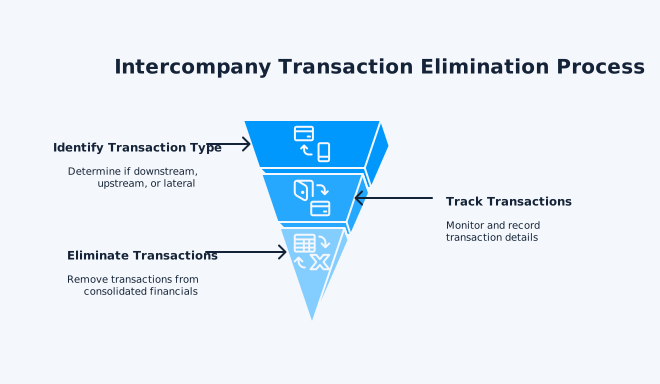
Intercompany transactions require systematic tracking and elimination. Common elimination types include:
- Downstream transactions: Parent selling to subsidiary
- Upstream transactions: Subsidiary selling to parent
- Lateral transactions: Between sister subsidiaries
Each transaction type needs specific elimination entries to avoid inflating group results. Document elimination rules and apply them consistently across all periods.
Trial Balance as Your Foundation
Your Trial Balance isn’t just another report – it’s the cornerstone of consolidation accuracy. Without balanced Trial Balances at entity level, your consolidated statements will never reconcile. Modern consolidation starts with automated Trial Balance imports that:
- Validate account balances before consolidation
- Flag discrepancies immediately
- Maintain drill-down to transaction detail
- Provide audit trails for every adjustment
Currency Translation Complexities
According to PwC’s IAS 21 guidance, multi-currency consolidation requires different exchange rates for each component:
- Closing rates for balance sheet items
- Average period rates for income statements (when rates don’t fluctuate significantly), and
- Historical rates for equity.
The complexity increases because exchange differences between closing and average rates must be tracked in cumulative translation adjustments, requiring detailed documentation of rate sources and calculation methods for audit purposes.
IFRS 10 and GAAP Consolidation Requirements
Understanding the regulatory framework ensures compliance and accurate reporting. While IFRS 10 and US GAAP share similar principles, significant differences affect consolidation approach.
IFRS 10 Control Model
IFRS 10 uses a single control model requiring three elements:
- Power over the investee
- Exposure to variable returns
- Ability to use power to affect returns
Control can exist without majority ownership through potential voting rights, contractual arrangements, or de facto control situations.
US GAAP Two-Tier Approach
- Voting Interest Model: Based on majority voting rights
- Variable Interest Entity (VIE) Model: Focused on economics and risk
The VIE model captures special-purpose entities and structured arrangements that IFRS might handle differently.
Key Reporting Differences
Significant differences affecting consolidation include:
- Potential voting rights: Considered under IFRS, generally not under US GAAP
- De facto control: Recognised in IFRS, not in US GAAP voting model
- Investment entities: Different scope exceptions apply
- Accounting policies: IFRS requires uniform policies; US GAAP allows industry exceptions
Financial Consolidation Automation and Software Solutions
Manual consolidation using Excel reaches breaking point with multiple entities. Modern consolidation software reduces close time from weeks to days while eliminating errors and improving audit trails. Using dataSights’ Xero to Power BI connector, financial consolidation reporting moves beyond static Excel into automated dashboards. Finance teams can drill down into entity-level data in real time, giving CFOs visibility daily instead of waiting until period-end.
Limitations of Manual Processes
Excel-based consolidation creates significant risks:
- No automatic elimination rules
- Broken formulas with structural changes
- Limited audit trail functionality
- Version control challenges
- Time-intensive data gathering
Research indicates manual consolidation takes 10+ days for bottom-quartile performers versus 4.8 days for automated top performers.
Benefits of Consolidation Software
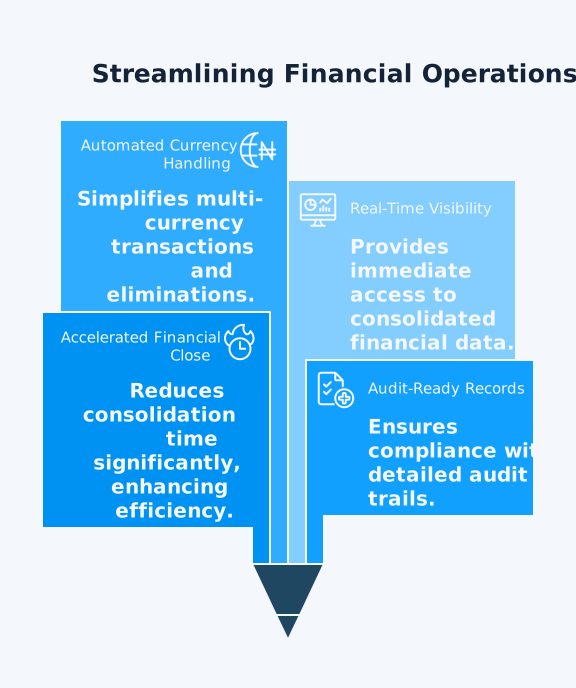
Automated consolidation platforms deliver:
- Financial close accelerated: Customers reduce consolidation from 15+ days to under 5 days, cutting weeks off the close cycle
- Audit-ready records: All eliminations, adjustments, and mappings are tracked with full audit trails and version control
- Automated currency handling: The platform supports automatic multi-currency conversions and eliminations across entities
- Real-time visibility: Finance teams access real-time consolidated dashboards and reports, enabling daily insights instead of waiting for period-end
Integration with Existing Systems
dataSights’ Xero to Power BI connector eliminates CSV exports and manual manipulation. Trial Balances flow directly from Xero into Power BI, Excel, or Google Sheets, enabling faster and more accurate financial consolidation reporting with interactive dashboards.
Key benefits include:
- Direct API connections to Xero, QuickBooks, and other accounting platforms
- Automated data synchronisation
- Standardised mapping across different charts of accounts
- Preserved transaction-level detail
For Xero users specifically, consolidation apps eliminate CSV exports and manual data manipulation, pulling Trial Balances directly for immediate consolidation.
Here’s a webinar, part four of CFO Techstack’s Scaling on Xero: How Far Can You Go? Series, where experts from The Bean Counters, dataSights, and Mayday share practical strategies for automating consolidations and reporting on Xero. The discussion explores how to maintain accuracy, streamline intercompany processes, and deliver timely insights without the high cost and risk of ERP systems.
Watch the full session below to see how leading finance teams are tackling financial consolidation and building scalable reporting systems on Xero.
Management Reporting vs Statutory Consolidation
Financial consolidation serves two distinct purposes: statutory compliance and management insight. Understanding the differences ensures you deliver the right information to each audience.
Statutory Consolidation Requirements
Statutory consolidation follows strict rules defined by accounting standards. These statements must comply with GAAP or IFRS, include specific disclosures, and undergo external audit. Focus areas include:
- Technical compliance with standards
- Detailed note disclosures
- Audit trail documentation
- Prescribed statement formats
Statutory consolidation follows strict rules defined by accounting standards. These statements must comply with GAAP (ASC 810) or IFRS (IFRS 10 and IFRS 12), include specific disclosures, and undergo external audit. Focus areas include:
- Technical compliance with standards such as IFRS 10’s requirement to consolidate all subsidiaries and ASC 810’s rules for voting interest and variable interest entities.
- Detailed note disclosures under IAS 1 and IFRS 12, which mandate transparency regarding interests in other entities and significant accounting policies.
- Audit trail documentation that supports external auditors in verifying elimination entries, consistency of accounting policies, and compliance with standards.
- Prescribed statement formats required by IAS 1 (for IFRS) and SEC/ASC regulations (for US GAAP), including a balance sheet, income statement, statement of equity changes, and cash flow statement with comparatives.
Management Reporting Flexibility
Management reports provide operational insights beyond statutory requirements:
- KPI dashboards and trending analysis
- Segment performance breakdowns
- Budget versus actual comparisons
- Profitability by product or region
- Cash flow forecasts
- Non-financial metrics integration
CFOs increasingly demand management packs that combine statutory accuracy with operational intelligence.
Bridging Both Requirements
Leading organisations produce both from the same data source. Start with statutory consolidation for accuracy, then layer management analytics on top. This approach ensures:
- Single source of truth
- Consistent base numbers
- Reduced reconciliation efforts
- Faster report production
Common Consolidation Pitfalls and Solutions
Even experienced finance teams encounter consolidation challenges. Recognising common issues helps you implement preventive measures and quick resolutions.
Elimination Imbalances
Eliminations often don’t balance due to:
- Timing differences between entity bookings
- Exchange rate mismatches on intercompany balances
- Unrecorded transactions in one entity
- Incorrect elimination mapping
Solution: Implement intercompany reconciliation processes before consolidation. Match and clear differences at source rather than forcing adjustments during consolidation.
Version Control Chaos
Multiple versions of consolidation files create confusion and errors:
- Which version is final?
- Who made which adjustments?
- What changed between versions?
Solution: Use consolidation software with built-in version control, or establish strict file naming conventions and check-in/check-out procedures.
Missing Audit Trails
According to the PCAOB Auditing Standard No. 1215: Audit Documentation, auditors must maintain records that clearly describe:
- The procedures performed, the evidence obtained, and the conclusions reached
- Who performed the work, who reviewed it, and the dates involved
- Significant findings or issues, including how inconsistencies were resolved
In practice, this means that for financial consolidation reporting, auditors expect documentation covering:
- Elimination entries and the rationale behind them
- Manual adjustments along with evidence of approval
- Currency rate sources used for translations
- The chosen consolidation methodology, including key assumptions
Solution: Document all consolidation steps, maintain supporting schedules, and use systems that automatically log all changes and adjustments.
Frequently Asked Questions
How Long Should Financial Consolidation Reporting Take?
Top-performing companies complete consolidation in under 5 days, while manual processes often extend beyond 15 days. Automation and standardised processes are the key differentiators in consolidation speed.
What's the Difference Between Combined and Consolidated Financial Statements?
Combined financial statements present the results of two or more entities under common control in a single report, but the entities remain distinct and are labeled as “combined” rather than “consolidated.” Consolidated statements merge all entities into one, eliminating intercompany transactions and delivering a single economic unit.
Do Small Businesses Need Consolidated Financial Statements?
If you control other entities through majority ownership or financial control, consolidation is required. Even small groups benefit from the complete financial picture consolidation provides.
Can Excel Handle Multi-Entity Consolidation Effectively?
While Excel can technically perform consolidation, it becomes error-prone and time-consuming with multiple entities. Most finance teams find Excel inadequate beyond 3-4 entities due to elimination complexity and audit trail requirements.
How Often Should We Prepare Consolidated Reports?
Most companies consolidate monthly for management reporting and quarterly for external reporting. Real-time consolidation through automation allows continuous monitoring versus period-end only.
What Happens When Consolidation Doesn't Balance?
Imbalanced consolidation typically stems from incorrect eliminations, unmatched intercompany transactions, or errors in the underlying Trial Balances. Systematic reconciliation before consolidation prevents most imbalances.
Which Accounting Standards Govern Consolidation?
IFRS 10 governs international consolidation, while US companies follow ASC 810 under GAAP. Both require control-based consolidation but differ in specific applications.
How Do Currency Conversions Affect Consolidated Reports?
Currency translation creates gains or losses recorded in other comprehensive income. Different rates apply to different statement items, and rate selection significantly impacts reported results.
What Audit Evidence Do Consolidation Reports Require?
Auditors need elimination schedules, intercompany reconciliations, currency rate documentation, and clear audit trails showing all consolidation adjustments and their business rationale.
Should We Consolidate Joint Ventures and Associates?
Joint ventures and associates typically use equity accounting rather than full consolidation, unless you have control. The equity method recognises your share of profits without line-by-line consolidation.
Can I Use Power BI for Financial Consolidation Reporting From Xero?
Yes. With dataSights’ Xero to Power BI connector, you can automate Trial Balance imports, eliminations, and multi-entity financial consolidation reporting directly in Power BI dashboards, without manual exports.
Transform Your Financial Consolidation Reporting with Xero and Power BI
Financial consolidation reporting doesn’t need to be slow, error-prone, or reliant on fragile Excel spreadsheets. With dataSights’ Xero to Power BI connector, you can automate Trial Balance imports, streamline eliminations, and consolidate multiple entities in minutes. The result? Real-time dashboards in Power BI that provide your finance team and stakeholders with complete visibility, accuracy, and control.
Ready To Cut Your Close Time By 70% and Deliver Smarter, Faster Insights?
About the Author
Kevin Wiegand
Founder & Client happiness
I’m Kevin Wiegand, and with over 25 years of experience in software development and financial data automation, I’ve honed my skills and knowledge in building enterprise-grade solutions for complex consolidation and reporting challenges. My journey includes developing custom solutions for data teams at Gazprom Marketing & Trading and E.ON, before founding dataSights in 2016. Today, dataSights helps over 300 businesses achieve 100% report automation. I’m passionate about sharing my expertise to help CFOs and Financial Controllers reduce their month-end close time and eliminate the manual Excel exports that drain their teams’ valuable time.