
Consolidation Accounting: Methods, Examples and Journal
Entries for Multi-Entity Groups
by Kevin Wiegand
| Apr 23, 2026
| Xero
by Kevin Wiegand
|Apr 23, 2026
|Xero
Xero
|Consolidation Accounting: Methods, Examples and Journal Entries for Multi-Entity Groups
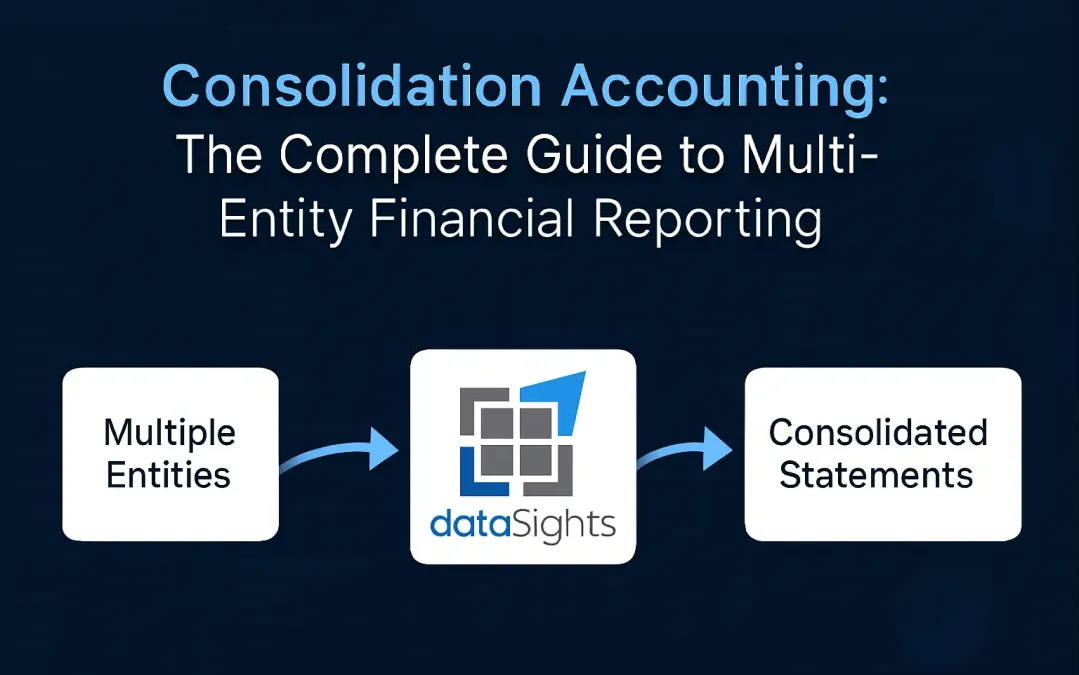
Your subsidiaries’ numbers refuse to reconcile. Intercompany transactions create a maze of elimination entries, and month-end stretches past day 15. If you are managing consolidation accounting across multiple entities, you already know where the delays show up. Many finance teams find that multi-entity spreadsheet consolidation stretches their close well beyond target, with consolidated reporting often causing the biggest delays. This guide walks you through the full consolidation accounting process step by step, explains each method with worked journal entries, and shows you where automation can cut your close time. Read on to see exactly how the seven-step process works, what each elimination entry looks like, and how to avoid the errors that trip up most finance teams.
What Is Consolidation Accounting?
Consolidation accounting combines the financial statements of a parent company and its subsidiaries into a single set of consolidated financial statements, presenting the group as one economic entity. Under IFRS 10, the parent must control the investee; under US GAAP, two models apply: the voting interest entity model and the variable interest entity (VIE) model. The process requires gathering trial balances, aligning accounting policies, eliminating intercompany transactions, translating foreign currencies, and calculating non-controlling interests before producing consolidated statements of financial position, profit or loss, changes in equity, and cash flows.
Ready to Automate Your Financial Consolidation?
Stop wrestling with manual consolidations and broken formulas. dataSights automates multi-entity reporting, Xero consolidations, and Power BI connections. Join 300+ businesses already transforming their financial reporting with our platform, rated 5.0 out of 5 by 90+ verified Xero users.
Start Your Free 14-Day TrialWhen Consolidation Accounting Becomes Mandatory
Framework note: This guide mainly references UK-adopted IFRS, including IFRS 10, IFRS 3 and IAS 21, because these standards apply to many listed and larger groups. UK groups using FRS 102 follow similar consolidation principles, but there are important differences around exemptions, goodwill and non-controlling interests. The Companies Act 2006 legal requirements still apply regardless of framework.
You cannot avoid consolidation when you control other entities. The principle is control, not ownership percentage alone. Under IFRS 10, consolidation is required when the parent has power over the investee, exposure to variable returns, and the ability to use its power to affect those returns. Ownership above 50% is a common indicator, but control determines the outcome.
You might consolidate with 40% ownership if you effectively control the board. A majority voting interest generally indicates control under IFRS 10, but narrow exceptions exist – for example, where substantive rights held by other parties prevent the majority holder from directing the investee's relevant activities. Under US GAAP, there are two primary consolidation models:
- The voting interest entity model
- The VIE model
The VIE model catches structures where control exists without majority voting rights. Special purpose entities and structured finance vehicles often trigger VIE consolidation requirements regardless of ownership percentage. In January 2025, the FASB issued an invitation to comment on whether stakeholders support moving to a single consolidation model, signalling potential future simplification of the US GAAP framework.
The Step-by-Step Consolidation Accounting Process
Here is a practical, seven-step consolidation accounting workflow you can apply every reporting period. You will start with entity trial balances, align reporting periods and charts of accounts, handle foreign currency translation, eliminate intercompany activity, attribute NCI, and produce your consolidated statements.
Step 1: Gather Trial Balances
Begin with trial balances for each entity. Gather trial balance data – assets, liabilities, equity, revenue, and expenses – from each subsidiary's general ledger. Each subsidiary's trial balance must balance individually before consolidation begins.
Step 2: Align Accounting Periods
All subsidiaries must report their financials for the same period, whether monthly, quarterly, or annually. Different year-ends create timing differences that distort results. If aligning reporting dates is impracticable, IFRS 10.22 permits a difference of up to three months. You must still adjust for significant transactions and events that occur between the subsidiary's reporting date and the parent's reporting date.
Step 3: Standardise Charts of Accounts
Map every subsidiary account to your consolidated chart. Standardise revenue recognition methods, depreciation policies, and inventory valuation across the group. IFRS 10 requires consolidated financial statements to be prepared applying uniform accounting policies across the group.
Create mapping tables showing how each subsidiary account rolls into consolidated accounts. Document exceptions and manual adjustments. Your auditors will review these mappings, so clarity now saves time later.
Step 4: Convert Foreign Currencies
International operations add complexity. Each subsidiary first records its own transactions in its functional currency under IAS 21. At consolidation, the group then translates each foreign operation's results and financial position into the group's presentation currency.
Each subsidiary first measures transactions in its functional currency, then translates into the group's presentation currency for consolidation. Translation differences are recognised in OCI and accumulated in the foreign currency translation reserve until disposal of the foreign operation.
Under the current rate method:
- Translate assets and liabilities at the closing rate
- Translate income and expenses at transaction-date rates (or a weighted average if rates do not fluctuate significantly)
- Recognise translation differences in other comprehensive income (OCI)
For subsidiaries operating in hyperinflationary economies, apply IAS 29 before translation.
Step 5: Eliminate Intercompany Transactions
This is where consolidation accounting gets complex. There are three types of intercompany eliminations:
- Intercompany debt: Eliminates loans made between group entities
- Intercompany revenue and expenses: Eliminates sales between group entities
- Investment elimination entries: Eliminate the parent's investment against the subsidiary's pre-acquisition equity
Add an acquisition-date elimination for the parent's 'Investment in Subsidiary' account against the subsidiary's pre-acquisition equity. Recognise fair-value adjustments to identifiable net assets and record goodwill (or a bargain purchase gain if negative).
Goodwill (IFRS 3) = consideration transferred + fair value of any NCI + fair value of any previously held interest – fair value of identifiable net assets acquired.
For a simple 100% acquisition with no previously held interest:
Goodwill = consideration transferred – fair value of identifiable net assets.
Goodwill is recognised in the consolidation layer only, not in the individual entity ledgers. For Xero users, this is important: Xero does not calculate or track goodwill natively, so the adjustment must be made in your consolidation or reporting layer.
Start with straightforward eliminations: intercompany sales, purchases, and loans. Then tackle complex items: unrealised profit in inventory, capitalised interest on intercompany loans, and dividend distributions between entities. For a detailed guide, see our article on consolidation elimination entries.
See how dataSights handles the full consolidation workflow, from connecting multiple Xero entities through to automated eliminations and Management Report generation.
Step 6: Calculate Non-Controlling Interests
When you own 80% of a subsidiary, the other 20% appears as non-controlling interest (NCI). Under the full consolidation method, you record 100% of the subsidiary's assets and liabilities on the consolidated balance sheet, even though you may not own 100% of the subsidiary's equity.
Calculate the minority interest share of net assets. Allocate the appropriate portion of subsidiary profits. Present NCI separately in equity and the consolidated income statement.
Example: Parent owns 80% of Sub A. Sub A's post-elimination profit is GBP 100,000. The consolidated income statement includes the full GBP 100,000, with GBP 20,000 attributed to non-controlling interests. On the consolidated statement of financial position, NCI is presented as a separate line within equity.
Note: If NCI is measured at fair value at acquisition (one option under IFRS 3), the goodwill recognised includes an NCI component. If NCI is measured at its proportionate share of the acquiree's net assets, goodwill recognised is the parent-only amount.
Step 7: Generate Consolidated Statements
After all adjustments and eliminations, produce your consolidated financial statements:
- Statement of financial position (balance sheet)
- Statement of profit or loss and other comprehensive income
- Statement of changes in equity
- Statement of cash flows
- Notes to the consolidated financial statements
Review everything. Does your balance sheet balance? Do eliminations net to zero? Are NCI properly presented? Run analytical reviews comparing current figures to prior periods. For a worked example of this full process, see our consolidation accounting example.
Consolidation Accounting Journal Entries: Worked Examples
Consolidation journal entries are made at the group level – they do not appear in any individual entity's ledger. Below are three common consolidation entries that appear in every multi-entity reporting cycle.
Investment Elimination Entry
When Parent acquires 80% of Subsidiary for GBP 800,000 and Subsidiary's net assets at acquisition are GBP 900,000 at fair value:
- Dr Share capital (Subsidiary): GBP 200,000
- Dr Retained earnings (Subsidiary): GBP 700,000
- Dr Goodwill: GBP 80,000
- Cr Investment in Subsidiary (Parent): GBP 800,000
- Cr Non-controlling interest (20% x GBP 900,000): GBP 180,000
This example uses the proportionate-share method for NCI. NCI is measured at 20% of the subsidiary's fair-valued net assets, or GBP 180,000. Goodwill is therefore the consideration transferred of GBP 800,000 less the parent's 80% share of fair-valued net assets of GBP 720,000, giving GBP 80,000.
Intercompany Revenue Elimination
Parent sells GBP 500,000 of goods to Subsidiary during the period. All goods are sold externally by year-end:
- Dr Revenue (Parent): GBP 500,000
- Cr Cost of sales (Subsidiary): GBP 500,000
This prevents double-counting of the intercompany portion of group revenue and cost of sales, so the consolidated statements reflect only external trading. If GBP 100,000 of inventory remains unsold at year-end with a 20% margin, add an unrealised profit elimination:
- Dr Cost of sales: GBP 20,000
- Cr Inventory: GBP 20,000
Intercompany Loan Elimination
Subsidiary lends GBP 300,000 to Parent at 5% interest. At year-end:
- Dr Loan payable (Parent): GBP 300,000
- Cr Loan receivable (Subsidiary): GBP 300,000
- Dr Interest income (Subsidiary): GBP 15,000
- Cr Interest expense (Parent): GBP 15,000
These entries remove intra-group financing from the consolidated statements, so only external transactions remain. For more elimination examples, see our guide on intercompany transactions in consolidated financial statements.
Three Consolidation Methods Explained
Consolidation accounting uses different methods depending on your relationship with the investee. The method is not a choice – accounting standards mandate the approach based on your level of control or influence.
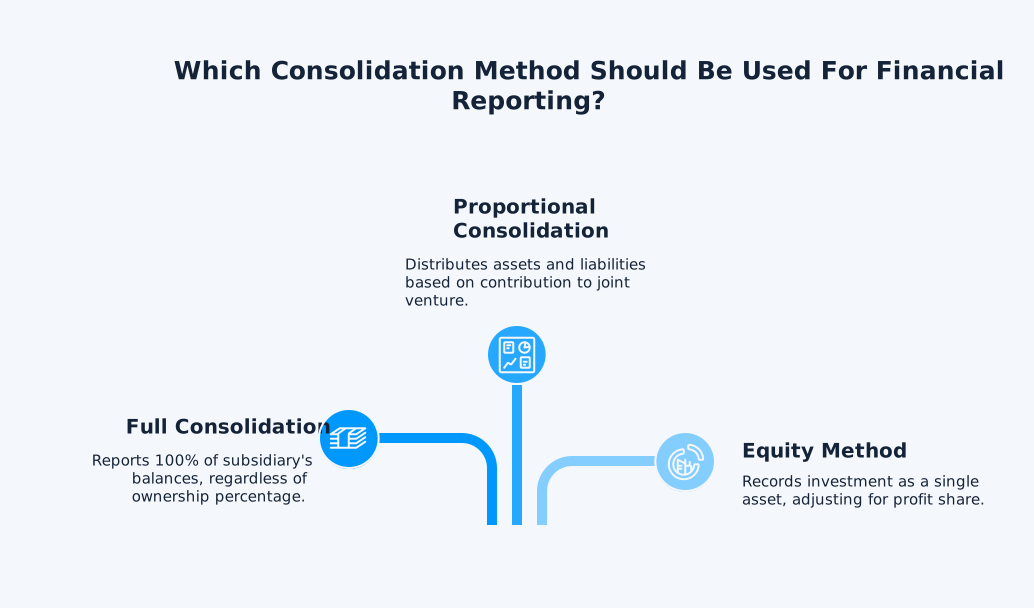
1. Full Consolidation Method
When you control a subsidiary (typically over 50% ownership or effective control), you use full consolidation. You report 100% of subsidiary assets, liabilities, revenues, and expenses regardless of actual ownership percentage. Own 51% or 99% – full consolidation includes everything, with NCI shown separately.
2. Equity Method
Significant influence without control triggers the equity method. This typically applies with 20-50% ownership. You do not consolidate individual accounts. Instead, show the investment as a single line item on the balance sheet, adjusting for your share of the investee's profit or loss.
Example: You own 30% of Associate B. Associate B reports GBP 100,000 net income. You increase your investment carrying amount by GBP 30,000 and recognise GBP 30,000 in your income statement as share of profit from associate.
3. Proportionate Consolidation (Historical)
Proportionate consolidation, as it existed under the former IAS 31, was eliminated when IFRS 11 became effective in 2013. Joint ventures are now accounted for using the equity method. For joint operations, IFRS 11 requires each operator to recognise its own assets, liabilities, revenue, and expenses relating to the arrangement rather than applying proportionate consolidation.
For further detail on how these methods compare, see our guide on consolidated vs consolidating financial statements.
Mastering Intercompany Eliminations
Intercompany eliminations are where otherwise clean consolidations go wrong – double-counted revenue, overstated assets, and misstated profit. Without eliminations, you count the same revenue twice, inflate assets, and misrepresent your group's position.
Why Eliminations Matter
Intercompany transactions can artificially inflate profits and liabilities within a group, resulting in inaccurate financial statements. Manual eliminations cause problems: no audit trail, version control issues, and formula errors that cascade through the entire consolidation.
Common Elimination Scenarios
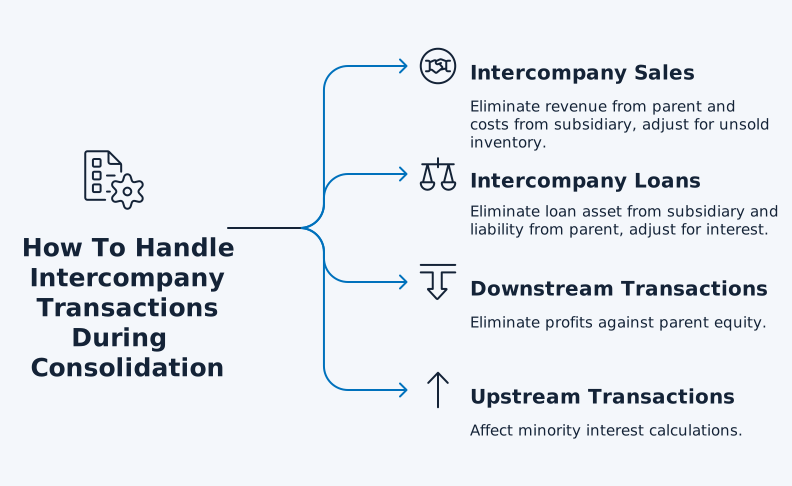
- Intercompany sales: Parent sells GBP 1 million of inventory to its subsidiary. Eliminate GBP 1 million in revenue from the parent and GBP 1 million in costs from the subsidiary. If inventory remains unsold, eliminate unrealised profit too.
- Intercompany loans: Subsidiary lends GBP 500,000 to parent. Eliminate the loan asset from the subsidiary, the loan liability from the parent, plus all related interest income and expense.
- Downstream vs upstream: Downstream (parent to subsidiary) eliminations reduce the parent's profit and do not affect NCI. Upstream (subsidiary to parent) eliminations reduce the subsidiary's profit and reduce NCI's share proportionally.
Building Reliable Elimination Processes
Document every elimination with clear reconciliations. Use standardised templates showing debit and credit entries, supporting calculations, and ownership schedules. Maintain a complete audit trail so each adjustment can be traced back to the underlying intercompany transaction.
Track intercompany transactions from inception. Tag them in source systems. Reconcile monthly, not just at year-end. Build elimination rules that repeat automatically. For a complete guide, see our dedicated article on consolidation elimination entries.
GAAP vs IFRS: Critical Differences in Consolidation Accounting
At a high level, both IFRS 10 and ASC 810 require consolidation when control exists. The practical differences sit in how each framework assesses control, handles special structures and applies group accounting policy requirements.
Consolidation Models
The frameworks diverge at a structural level. IFRS uses a single control model to determine consolidation. US GAAP employs a two-tier consolidation model: the VIE model and the voting interest entity model.
This matters in practice. The same ownership structure might trigger consolidation under one framework but not the other. In January 2025, the FASB asked for stakeholder feedback on whether to adopt a single consolidation model, which could align US GAAP more closely with IFRS in the future.
De Facto Control
De facto control is considered when evaluating control under IFRS, while US GAAP does not recognise the concept. Under IFRS, owning 48% might require consolidation if you effectively control decisions through dispersed ownership or other arrangements. US GAAP typically requires majority voting rights unless VIE criteria apply.
Accounting Policy Alignment
Under US GAAP, applying different accounting policies within a consolidation group is acceptable to address issues relevant to certain specialised industries. Under IFRS, no exceptions exist to the requirement to apply uniform accounting policies throughout a consolidated group. This distinction affects groups with subsidiaries operating in specialised sectors like financial services or insurance.
Common Consolidation Accounting Challenges
From misaligned year-ends and inconsistent charts of accounts to FX translation and missed eliminations, small gaps create large errors in group results. Use this section as a diagnostic guide to spot the usual problems early.
1. The Month-End Close Bottleneck
Month-end close timelines vary widely, but multi-entity groups relying on manual processes typically find consolidation adds days to their close cycle. Manual processes, disparate systems, and currency conversions compound the delay. Heavy reliance on spreadsheets adds time, inconsistency, and risk. One formula error can cascade through the entire consolidation. For strategies to reduce your close time, see our guide on the financial consolidation and close process.
2. System Integration and Data Quality
Subsidiaries often use different accounting systems. Extracting, mapping, and consolidating data from multiple platforms becomes a multi-week exercise when done manually. Inconsistent charts of accounts, different fiscal year-ends, and varied revenue recognition policies create reconciliation headaches. Standardising data before consolidation is half the battle.
3. Currency and Compliance Complexity
Multi-currency consolidations require tracking historical rates, closing rates, and average rates. Translation adjustments must flow through OCI correctly. Evolving regulations under both IFRS and GAAP add compliance overhead. For groups with international subsidiaries, see our guide on consolidating foreign subsidiary financial statements.
4. Materiality Judgements
Materiality still matters in consolidation, but the framework matters too. Under IFRS, there is no broad exemption that lets you ignore a controlled subsidiary simply because it is small. Under FRS 102, exclusions can be wider in limited circumstances. In practice, finance teams should document their materiality judgements carefully and apply them consistently.
How dataSights Automates Consolidation Accounting
dataSights delivers board-ready Management Reports through the web platform as the primary output, including consolidated P&L, Balance Sheet and Trial Balance with audit trails. For teams that prefer spreadsheets, Excel automation through the OfficeAddIn and Power Query refreshes consolidated Xero data directly into custom models without CSV exports. For advanced analytics and drill-downs, Power BI connects to the same dedicated Azure SQL database for dashboards and deeper analysis, using either Import or DirectQuery mode depending on your configuration.
Automation That Reduces Your Close
Stop wrestling with spreadsheets. By automating repetitive consolidation tasks, your finance team can focus on analysis rather than data wrangling. dataSights handles multi-entity trial balance imports, intercompany eliminations, and currency conversions with full audit trails. Many finance teams reduce month-end close from over 15 days to under 5 once data collection, eliminations and reporting are automated. Actual results vary based on group complexity, data quality and existing close processes.
Built for Compliance
dataSights maintains complete audit trails for every adjustment. dataSights supports IFRS and GAAP consolidation workflows through configurable automation and full audit trails. Once your accounting policies, mappings and elimination logic are set, the platform documents NCI calculations, currency translations and elimination entries consistently for review and audit. To see how this works for Xero users, visit our Xero consolidation solution page – rated 5.0 out of 5 by 90+ verified Xero users.
Frequently Asked Questions
Coming soon.
Coming soon.
Coming soon.
Coming soon.
Coming soon.
Coming soon.
Coming soon.
Coming soon.
Coming soon.
Coming soon.
Coming soon.
Coming soon.
Coming soon.
Your Path to Faster, Accurate Consolidation
Consolidation accounting follows the same seven-step logic whether you manage two entities or twenty. Standardise your charts of accounts, automate repetitive elimination entries, and document every adjustment with clear audit trails. The real shift comes when consolidation stops being a month-end fire drill and becomes a controlled, repeatable process. When Trial Balances reconcile, eliminations are documented and management packs refresh automatically, finance teams spend less time fixing numbers and more time explaining them. With the right approach, you turn consolidation from a monthly burden into a reliable, repeatable workflow that gives your board the numbers they need on time, every time.
Automate Your Consolidation Accounting With Xero
Rated 5.0 by 90+ verified users, dataSights' Xero consolidation solution delivers board-ready Management Reports with full eliminations, audit trails and multi-currency support. For teams working in Excel or Power BI, the same consolidated data refresh automatically on your configured schedule, too. Join 300+ businesses already streamlining multi-entity reporting.
Start Your Free 14-Day TrialAbout the Author

Kevin Wiegand
Founder & Client happiness
I'm Kevin Wiegand, and with over 25 years of experience in software development and financial data automation, I've honed my skills and knowledge in building enterprise-grade solutions for complex consolidation and reporting challenges. My journey includes developing custom solutions for data teams at Gazprom Marketing & Trading and E.ON, before founding dataSights in 2016. Today, dataSights helps over 300 businesses achieve 100% report automation. I'm passionate about sharing my expertise to help CFOs and Financial Controllers reduce their month-end close time and eliminate the manual Excel exports that drain their teams' valuable time.