
You’re managing multiple entities and need to produce group financial statements. The reporting requirements are clear, but what is the difference between consolidation and combination accounting? Choose wrong and you’ll either waste weeks on unnecessary eliminations or fail compliance requirements entirely. Here’s the reality: consolidation creates one unified entity view with complex eliminations, while combination accounting can mean either combined statements (keeping entities visible) or business combination accounting (acquisition method). We’ll show you exactly when to use each method and which automation solutions actually work for multi-entity reporting.
What Is the Difference Between Consolidation and Combination Accounting?
Consolidation accounting combines a parent company and its subsidiaries into one single economic entity, eliminating all intercompany transactions and presenting unified financial statements – typically required when ownership exceeds 50%. Combination accounting can mean either combined financial statements (keeping entities separate but in one report for common control situations) or business combination accounting (the acquisition method under ASC 805 when one company buys another).
The key difference lies in how consolidation and combined statements approach entity visibility: consolidation creates a single entity view with eliminations, whereas combined statements preserve individual entity visibility. Additionally, business combinations involve purchase accounting with fair value adjustments.
Ready to Automate Your Financial Consolidation?
Stop wrestling with manual consolidations and broken formulas. dataSights automates multi-entity reporting, Xero consolidations, and Power BI connections. Join 300+ businesses already transforming their financial reporting with our platform, rated 5.0 out of 5 by 90+ verified Xero users.
Table of Contents
Understanding Consolidation Accounting
Consolidation accounting transforms multiple legal entities into a single economic unit for reporting purposes. When you own a controlling interest in subsidiaries – typically more than 50% of voting shares – you’re required to present consolidated financial statements under both IFRS 10 and US GAAP ASC 810.
The process involves three critical steps that finance teams often underestimate.
- First, you combine all assets, liabilities, revenues, and expenses from the parent and subsidiaries.
- Second, you eliminate every intercompany transaction – sales between entities, intercompany loans, and dividends paid upstream.
- Third, you account for non-controlling interests when you own less than 100% of a subsidiary.
What makes consolidation particularly complex? The elimination entries. If Subsidiary A sells £1 million of products to Subsidiary B, that transaction appears twice in your raw data – as revenue for one entity and as expense for another. Without proper elimination, you’re double-counting and overstating group performance. Manual consolidation involves tracking hundreds of transactions across multiple entities, a process that often takes finance teams 15+ days to complete month-end close.
The Consolidation Process in Practice
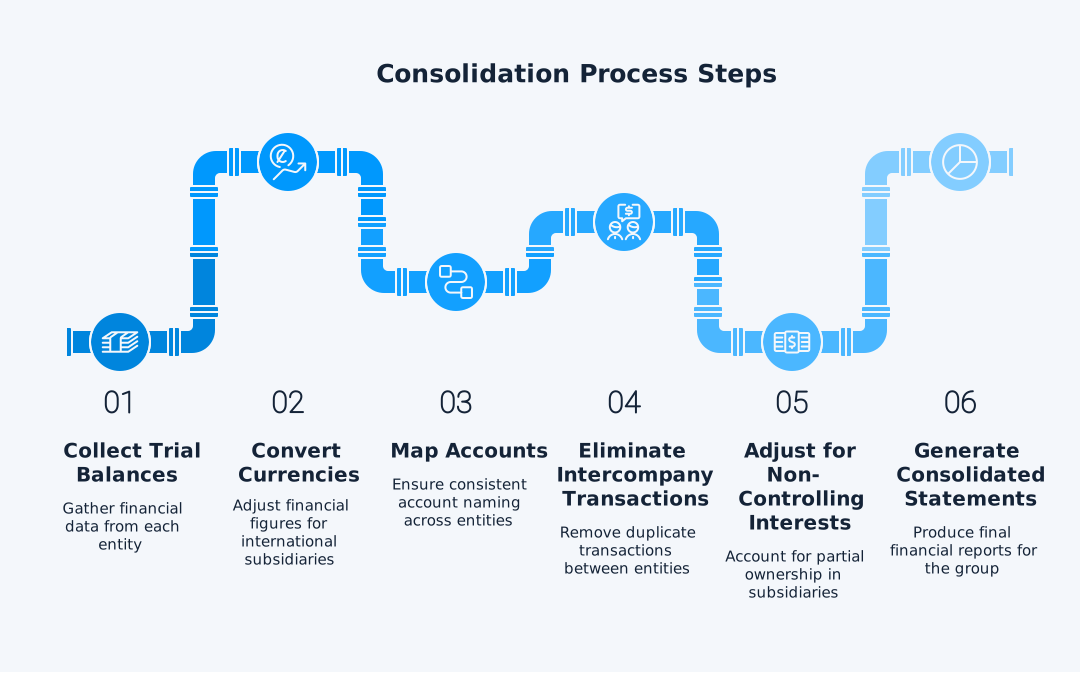
Your consolidation process follows these critical steps:
- Collect Trial Balances from each entity: Not random reports. The Trial Balance ensures everything balances before you begin eliminations.
- Convert currencies for international subsidiaries: A UK parent consolidating a US subsidiary must convert everything to pounds sterling using appropriate exchange rates.
- Map accounts across entities: Your “Marketing Expense” in Entity A might be “Advertising Costs” in Entity B. Without consistent mapping, your consolidated P&L becomes meaningless
- Identify and eliminate all intercompany transactions: Remove double-counting from sales, loans, and transfers between entities
- Adjust for non-controlling interests: Account for ownership percentages less than 100% in subsidiaries.
- Generate consolidated statements: Produce final reports showing the group as a single economic entity.
Understanding Combination Accounting
Here’s where confusion typically starts. “Combination accounting” actually refers to two completely different concepts that finance professionals constantly mix up.
Combined Financial Statements
Combined financial statements present multiple entities together in one document while keeping each entity’s financials distinct and visible. You’ll use these when entities are under common control but lack a parent-subsidiary relationship – think multiple companies owned by the same individual or family.
Key distinctions from consolidation:
- Each entity remains visible side-by-side: Not merged into one economic unit
- Intercompany transactions still eliminated: Removes double-counting without losing entity identity
- Individual performance stays identifiable: See exactly which entity drives profitability
- Better for mixed stakeholder interests: Different investors can track their specific entity holdings
- Simpler than full consolidation: No complex non-controlling interest calculations
According to ASC 810-55-1b, combined statements are often more meaningful than consolidated statements for entities under common control. Why? Forcing a consolidation without an actual parent company creates a misleading presentation with artificial non-controlling interests.
Business Combination Accounting
Business combination accounting applies when one company acquires control of another business. This falls under ASC 805 in US GAAP and follows the acquisition method, which is distinct from both consolidation and combined statements.
Key elements of business combination accounting:
- Record at fair value on acquisition date: Not historical cost or book value
- Revalue all acquired assets: Adjust to current market values, affecting future depreciation
- Mark liabilities to market rates: Update debt and obligations to current terms
- Calculate goodwill: Excess purchase price over net asset fair value goes on balance sheet
- One-time accounting event: Not ongoing like consolidation, just at acquisition point
- Step-up in basis created: Affects tax, depreciation, and impairment for years
The complexity comes from determining what constitutes a “business” versus just buying assets. Recent FASB guidance clarified that a business must include inputs and substantive processes that together significantly contribute to creating outputs. Miss this distinction and you’ll apply the wrong accounting treatment entirely.
Key Differences Between Methods
Control and Ownership Requirements
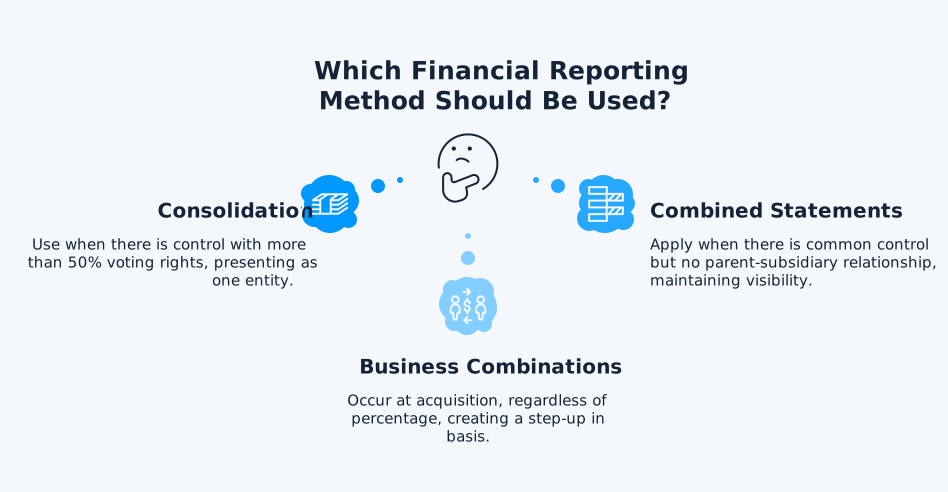
Consolidation kicks in when you have control, generally more than 50% of voting rights, though contractual arrangements can also establish control. Combined statements apply when there’s common control but no parent-subsidiary relationship. Business combinations occur at the point of acquiring control, regardless of percentage.
The Variable Interest Entity (VIE) rules add another layer. Consider consolidating with less than 50% ownership if you’re the primary beneficiary absorbing the majority of gains or losses. This trips up companies with complex joint venture or special purpose entity structures.
Financial Statement Presentation
- Consolidated statements present everything as one entity. Your £10 million parent company revenue and £5 million subsidiary revenue become £15 million group revenue (minus eliminations). The subsidiary’s individual performance disappears into the consolidated whole.
- Combined statements maintain visibility. That same scenario shows both the £10 million and £5 million separately within one document. Investors can see exactly which entity drives performance. Banks and smaller groups often prefer this transparency.
- Business combination accounting creates a step-up in basis at acquisition. If you paid £20 million for a company with £15 million book value, you’re recording £5 million in goodwill and revaluing all assets to fair value. This affects depreciation, amortisation, and future impairment testing for years.
Elimination Requirements
All three methods require eliminating intercompany transactions, but the complexity varies dramatically:
- Consolidation demands complete elimination with detailed tracking of non-controlling interests. Every penny flowing between entities needs documentation and reversal.
- Combined statements also eliminate intercompany transactions, but without the non-controlling interest complexity. You’re removing double-counting while preserving individual entity equity sections. The process is generally more straightforward than full consolidation.
- Business combinations focus on eliminating the investment account against acquired equity, not ongoing intercompany transactions. Once you’ve recorded the acquisition, future eliminations follow standard consolidation rules.
Regulatory Requirements and Standards
IFRS 10 and ASC 810 mandate consolidation when you control another entity. Control typically means >50% voting rights, but professional judgement applies. Board control, management contracts, or economic dependence can trigger consolidation requirements even with minority ownership.
The SEC requires specific disclosures for consolidated entities:
- Form 8-K filing: Within 4 business days for acquisitions exceeding 20% significance
- Rule 3-05 requirements: Separate audited statements for significant acquisitions, reduced from 3 years to 2
- Subsidiary financials: Amended Rule 3-10 permits omission if consolidated in parent statements with supplemental disclosures
- Significance testing: Use pre-acquisition consolidated statements from most recent fiscal year
- Scope changes: Disclose material effects on financial statements
- Policy departures: Justify any non-standard consolidation approaches in footnotes
For combined statements, regulatory guidance is surprisingly limited. The AICPA notes this lack of authoritative guidance creates practitioner confusion. Generally accepted practice follows consolidation procedures minus the parent-subsidiary requirements.
Business combinations follow ASC 805’s detailed acquisition accounting rules. The standard requires extensive disclosures about purchase price allocation, pro forma results, and acquisition-related costs. Miss these requirements and your auditors will have serious concerns.
Choosing the Right Method
- Start with the ownership and control test. Do you own more than 50% of voting shares? You’re consolidating. Are multiple entities under common control without a parent-subsidiary relationship? Combined statements likely make more sense. Just acquired a business? That’s ASC 805 business combination accounting.
- Consider your audience next. Lenders and investors often prefer consolidated statements for overall group strength assessment. However, if stakeholders need to evaluate individual entity performance – common with joint ventures or family-owned groups – combined statements provide better transparency.
- Automation capabilities matter too. Manual consolidation across multiple entities is a month-end nightmare. dataSights automates multi-entity consolidation, handling eliminations and currency conversions that typically consume weeks of finance team time. For Xero users managing multiple entities, the platform reduces consolidation time from 15+ days to under 5.
Practical Decision Framework
Ask these questions in order:
- Do you have legal control (>50% voting)? → Consolidate
- Are entities under common control without parent-subsidiary relationship? → Combine
- Did you just acquire a business? → Apply ASC 805
- Do stakeholders need individual entity visibility? → Consider combined even if consolidation is allowed
- Can your current systems handle the complexity? → Factor in automation requirements
Automating Multi-Entity Accounting
Manual consolidation breaks down quickly as you scale. Three entities might be manageable in Excel. Ten entities with multiple currencies and hundreds of intercompany transactions? You’re looking at weeks of work with high error risk.
Modern automation handles the complexity that overwhelms spreadsheets. dataSights connects directly to accounting systems like Xero, pulling data from multiple entities automatically. Elimination rules run consistently every period. Currency conversions update with current rates. What took 15 days now happens in hours.
The key automation requirements:
- Direct API connections to avoid manual exports
- Automated elimination rule engines
- Multi-currency handling with live exchange rates
- Drill-down capability from consolidated to transaction level
- Audit trails for every elimination and adjustment
For groups managing both consolidated and combined reporting requirements, automation becomes essential. You need systems that can toggle between presentation methods without rebuilding everything from scratch.
Frequently Asked Questions
What Percentage of Ownership Requires Consolidation?
Generally, owning more than 50% of voting shares requires consolidation under both IFRS and US GAAP. However, control can exist with less ownership through board representation, management agreements, or VIE structures.
Can a Company Prepare Both Consolidated and Combined Financial Statements?
No, you cannot label statements as both consolidated and combined. You must choose based on the relationship between entities – consolidated for parent-subsidiary structures, combined for common control without a parent company.
How Long Does Manual Consolidation Typically Take?
Manual consolidation often extends beyond 15 days for multi-entity groups, especially with intercompany eliminations and currency conversions. Automated solutions can reduce this to under 5 days.
Do Combined Financial Statements Require Eliminating Intercompany Transactions?
Yes, combined statements eliminate intercompany transactions to avoid double-counting, similar to consolidation. The difference is presentation – entities remain distinct rather than merged into one.
What Triggers Business Combination Accounting?
Business combination accounting applies when you obtain control of another business through purchasing equity interests, net assets, or even through contractual arrangements without ownership transfer.
Are Consolidation Requirements the Same Under IFRS and US GAAP?
While broadly similar, differences exist. IFRS 10 uses a single control model while US GAAP has separate voting interest and VIE models. The practical outcome is usually the same – control triggers consolidation.
Which Method Is More Complex to Prepare?
Consolidation is typically most complex due to elimination entries, non-controlling interest calculations, and single entity presentation requirements. Combined statements are simpler, while business combinations involve one-time purchase accounting complexity.
How Do You Handle Different Year-Ends in Consolidation?
Subsidiary financial statements should align within three months of the parent’s year-end. If gaps exist, you’ll need to prepare additional interim statements or make adjusting entries for significant transactions.
What If Control Exists Without Majority Ownership?
Variable Interest Entity (VIE) rules may require consolidation even with minority ownership if you’re the primary beneficiary absorbing the entity’s gains and losses.
Do Private Companies Have Different Consolidation Requirements?
Private companies follow the same consolidation principles but may have simplified disclosure requirements and specific accounting alternatives available under private company guidance.
Making Multi-Entity Accounting Actually Work
The difference between consolidation and combination accounting fundamentally changes how you present your group’s financial story – consolidation creates one unified entity with complex eliminations, while combination preserves individual entity visibility. Choose wrong and you’ll either waste weeks on unnecessary work or fail compliance requirements. The key is matching your method to your actual control relationships and stakeholder needs. With modern automation, even complex multi-entity structures become manageable, transforming what was once a month-end marathon into a streamlined process.
Transform Your Multi-Entity Financial Reporting Today
Turn complex multi-entity accounting from a month-end nightmare into an automated workflow. dataSights’ Xero consolidation platform handles eliminations, currency conversions, and both consolidated and combined reporting requirements automatically. Rated 5.0 by 90+ finance teams who’ve already cut their month-end close from weeks to days. Join 300+ businesses who’ve transformed their multi-entity financial reporting.
About the Author
Kevin Wiegand
Founder & Client happiness
I’m Kevin Wiegand, and with over 25 years of experience in software development and financial data automation, I’ve honed my skills and knowledge in building enterprise-grade solutions for complex consolidation and reporting challenges. My journey includes developing custom solutions for data teams at Gazprom Marketing & Trading and E.ON, before founding dataSights in 2016. Today, dataSights helps over 300 businesses achieve 100% report automation. I’m passionate about sharing my expertise to help CFOs and Financial Controllers reduce their month-end close time and eliminate the manual Excel exports that drain their teams’ valuable time.