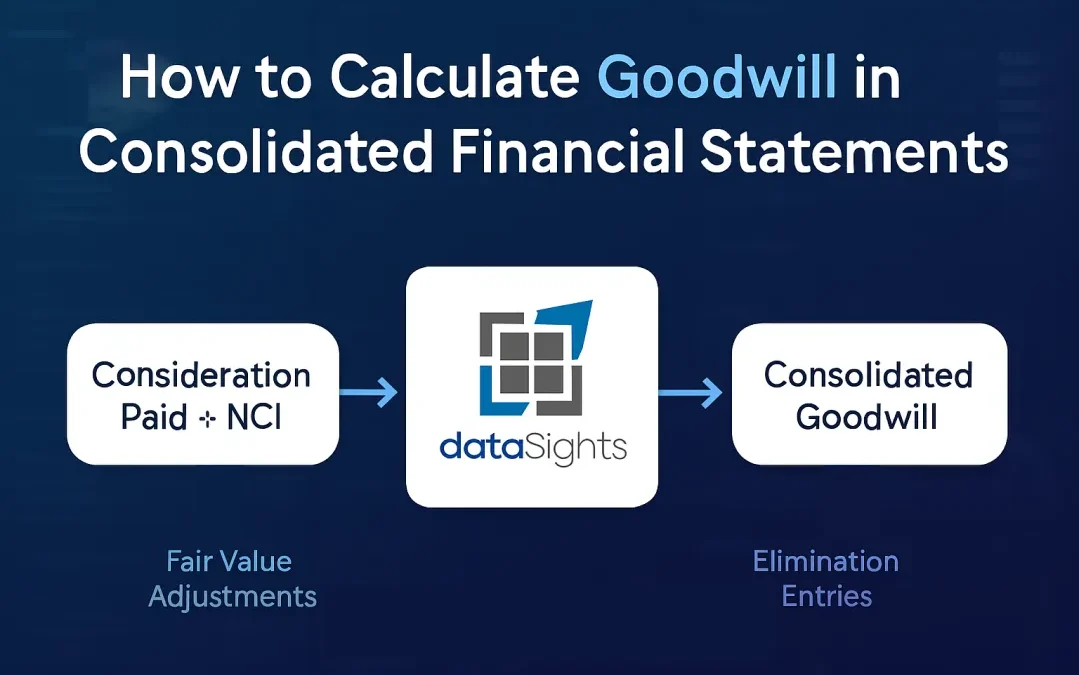
Goodwill is one of those numbers that looks simple, then breaks your consolidation when one input is off by £1. If you’re searching for how to calculate goodwill in consolidated financial statements, you need the acquisition-date fair values, the right treatment of non-controlling interests, and a clean audit trail for every adjustment. This guide shows the step-by-step calculation under IFRS 3, then highlights the key FRS 102 differences for UK groups. You’ll also see a worked example and the common errors that cause consolidations to fall out of balance.
How to calculate goodwill in consolidated financial statements comes down to one IFRS 3 formula: Goodwill = (consideration transferred + fair value of NCI + fair value of any previously held interest) – fair value of identifiable net assets acquired. In simple terms, it’s the excess of the purchase price over the fair value of the net identifiable assets at the acquisition date – for example, paying £800,000 for a subsidiary with £600,000 of fair value net identifiable assets results in £200,000 of goodwill. Goodwill is recognised only in the consolidated statement of financial position because it arises on consolidation when the parent’s investment is eliminated against the subsidiary’s equity.
Goodwill is calculated once at acquisition, but it can create errors for years if the inputs, fair value adjustments and audit trail are messy. Use a consistent consolidation layer to track goodwill movements, document every adjustment, and keep impairment testing current. If you do this well, your group accounts stay balanced and your disclosures stay defensible.
What Is Goodwill and Why Does It Matter in Consolidation?
Goodwill represents the future economic benefits arising from assets acquired in a business combination that cannot be individually identified and separately recognised. In plain terms, it captures the premium a buyer pays above the value of tangible and identifiable intangible assets for things like:
- Brand reputation
- Customer loyalty
- Skilled workforce
- Market position
Goodwill is exclusively a consolidation accounting concept. It does not appear on any individual entity’s trial balance. When you prepare consolidated financial statements, the parent’s “investment in subsidiary” account must be eliminated against the subsidiary’s equity. The residual difference, after fair value adjustments, becomes goodwill.
This distinction matters for Xero users in particular. Xero does not calculate or track goodwill automatically, because goodwill arises at the consolidation layer rather than in operational ledgers. You need a separate consolidation process, either manual in Excel or automated through consolidation software, to recognise and monitor goodwill correctly.
The Goodwill Calculation Formula Under IFRS 3
This guide references UK-adopted IFRS (IFRS 3 and IAS 36) for acquisition accounting and impairment. Where FRS 102 (UK GAAP) differs – mainly goodwill amortisation and certain measurement rules – the UK GAAP treatment is highlighted in the “Goodwill Treatment After Initial Recognition” section and FAQs.
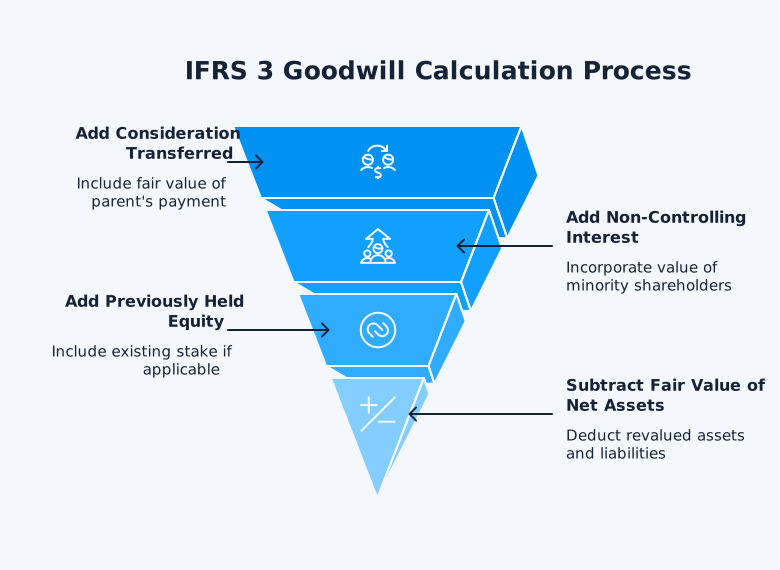
IFRS 3 Business Combinations provides the standard framework for calculating goodwill. The formula has four components:
Goodwill = (A + B + C) – D
Where:
- A = Consideration transferred: The fair value of what the parent pays (cash, shares, deferred payments, contingent consideration)
- B = Non-controlling interest (NCI): The value of the ownership stake held by minority shareholders
- C = Previously held equity interest: The fair value of any existing stake in step acquisitions
- D = Fair value of net identifiable assets acquired: All assets and liabilities of the subsidiary, revalued to fair value at the acquisition date
If the result is positive, you recognise goodwill as an intangible asset. If the result is negative, you have a bargain purchase, and the gain is recognised immediately in profit or loss after reassessing your valuations.
Step 1: Determine the Consideration Transferred
The consideration transferred includes everything the acquirer gives up to obtain control. The most common forms are:
- Cash consideration: The amount paid immediately at acquisition
- Share consideration: Equity instruments issued by the parent, measured at fair value on the acquisition date
- Deferred consideration: Future cash payments, recognised at present value using an appropriate discount rate
- Contingent consideration: Payments dependent on future events (such as hitting revenue targets), recognised at fair value at the acquisition date per IFRS 3
Acquisition costs such as legal fees, due diligence costs, and advisory fees are not part of the consideration. Under IFRS 3, these must be expensed in the income statement.
Step 2: Measure the Non-Controlling Interest
When the parent acquires less than 100% of a subsidiary, there is a non-controlling interest. IFRS 3 gives you two measurement options at the acquisition date:
- Fair value method (full goodwill): Measure NCI at its fair value, which means goodwill includes both the parent’s portion and the NCI’s share of goodwill
- Proportionate share method (partial goodwill): Measure NCI at its proportionate share of the subsidiary’s identifiable net assets, meaning goodwill reflects only the parent’s portion
The choice between methods is made on a transaction-by-transaction basis, and it directly affects the amount of goodwill recognised. The fair value method produces a higher goodwill figure because it includes an element attributable to the minority shareholders.
For example, if Parent acquires 80% of Subsidiary for £400,000, and Subsidiary’s identifiable net assets are worth £450,000:
- Proportionate method: NCI = 20% x £450,000 = £90,000. Goodwill = £400,000 + £90,000 – £450,000 = £40,000
- Fair value method: If the implied fair value of 100% of the subsidiary is £550,000, the 20% NCI is £110,000 (20% × £550,000). Goodwill = £400,000 + £110,000 − £450,000 = £60,000
The difference of £20,000 represents goodwill attributable to the non-controlling interest.
Step 3: Account for Previously Held Equity Interests
In a step acquisition, the parent may already hold shares in the subsidiary before gaining control. Under IFRS 3, you must remeasure the previously held equity interest at fair value on the acquisition date. Any gain or loss on this remeasurement goes to profit or loss (or other comprehensive income, depending on the original classification).
The fair value of the previously held interest then forms part of the goodwill calculation, as if it were additional consideration.
Step 4: Calculate Fair Value of Net Identifiable Assets
This is typically the most complex step. You need to identify and fair-value all of the subsidiary’s assets and liabilities at the acquisition date, including:
- Tangible assets (property, plant, equipment) revalued to market value
- Identifiable intangible assets (patents, customer lists, brand names) that meet recognition criteria
- Financial assets and liabilities at fair value
- Contingent liabilities that represent present obligations with reliable estimates
- Deferred tax adjustments arising from fair value uplifts
Any existing goodwill in the subsidiary’s own books must be excluded because you are replacing it with the group’s goodwill figure. The acquirer has 12 months from the acquisition date to finalise the fair value exercise, during which provisional amounts can be adjusted retrospectively.
Step 5: Calculate Goodwill
Apply the formula with all four components to arrive at the goodwill figure. Record goodwill as an intangible asset on the consolidated statement of financial position. Goodwill is not amortised under IFRS. Instead, it must be tested for impairment at least annually under IAS 36 Impairment of Assets.
Worked Example: Goodwill Calculation
The following example applies the IFRS 3 formula to a partial acquisition with deferred consideration, showing how each component feeds into the final goodwill figure and where common adjustments apply.
Parent Co acquires 75% of Subsidiary Co on 1 January 2025. The details are:
- Cash paid: £600,000
- Deferred consideration (due in one year, discount rate 5%): £105,000 (present value = £100,000)
- Fair value of Subsidiary’s identifiable net assets: £750,000
- Fair value of NCI (25%): £210,000
- Acquisition costs (legal fees): £15,000
Calculation:
Consideration transferred = £600,000 + £100,000 = £700,000
NCI at fair value = £210,000
Goodwill = £700,000 + £210,000 – £750,000 = £160,000
The £15,000 acquisition costs are expensed in the parent’s income statement. They are not included in the goodwill figure.
The £100,000 deferred consideration appears as a current liability on the consolidated balance sheet. Over the year, the discount of £5,000 (£100,000 x 5%) unwinds as a finance cost, bringing the liability to its settlement amount of £105,000.
Goodwill Treatment After Initial Recognition
Once you have calculated and recognised goodwill at the acquisition date, the next question is how to account for it in subsequent reporting periods. The answer depends on whether your group reports under IFRS or UK GAAP, because the two frameworks take fundamentally different approaches.
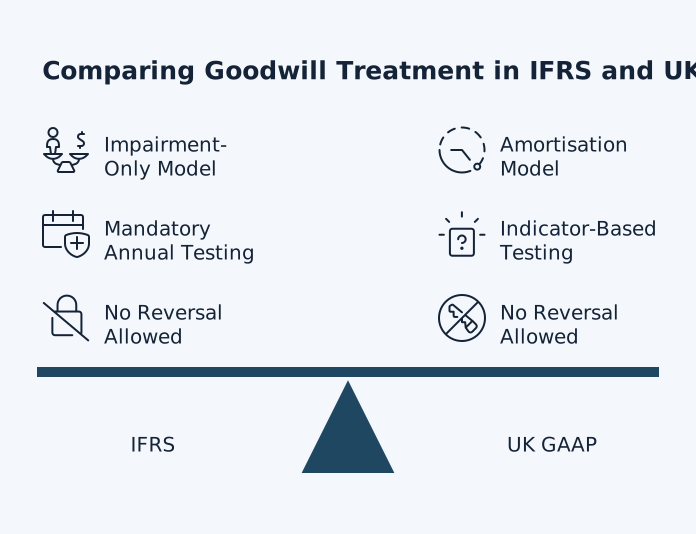
IFRS: Impairment-Only Model
Under IFRS, goodwill is not amortised. Instead, it is tested for impairment at least annually, regardless of whether there are indicators of impairment. The impairment testing process requires you to:
- Allocate goodwill to CGUs: Assign goodwill to one or more cash-generating units (CGUs) that benefit from the synergies of the acquisition (typically the subsidiary itself, unless the group can demonstrate a more appropriate allocation)
- Compare carrying amount to recoverable amount: The recoverable amount is the higher of fair value less costs of disposal and value in use
- Recognise any impairment loss: If the carrying amount of the CGU (including goodwill) exceeds its recoverable amount, allocate the impairment loss first to goodwill, then pro rata to other assets in the CGU
Once recognised, a goodwill impairment loss can never be reversed, even if conditions improve.
UK GAAP (FRS 102): Amortisation Model
Under FRS 102, goodwill is treated as having a finite useful life and is amortised on a systematic basis over that life. If, in exceptional cases, you cannot make a reliable estimate of the useful life, FRS 102 uses a 10-year backstop – it is not a default minimum or “standard” period. Goodwill is also reviewed for impairment when indicators exist, and impairment losses are not reversed.
In addition to amortisation, goodwill under FRS 102 must still be reviewed for impairment if indicators suggest the carrying amount may not be recoverable. Impairment losses on goodwill cannot be reversed.
This distinction is one of the most visible differences between IFRS and UK GAAP. If your group includes entities reporting under both frameworks, you need to reconcile the different goodwill treatments at the consolidated level.
NCI Measurement Choice and Its Effect on Impairment
If you used the proportionate method (NCI at share of net assets) for the initial calculation, the goodwill on your consolidated balance sheet reflects only the parent’s share. When testing for impairment, you must notionally gross up the goodwill to include the NCI’s share for comparison purposes. Any impairment written off against the notional NCI goodwill does not affect the consolidated financial statements. This is a technical but important point that directly affects the impairment loss allocated to the parent.
What Happens When Goodwill Is Negative?
If the formula produces a negative result, the subsidiary’s identifiable net assets exceed the total of consideration plus NCI. This is called a bargain purchase. Before recognising a bargain purchase gain, IFRS 3 requires you to:
- Reassess whether all assets acquired and liabilities assumed have been correctly identified
- Review the measurement of assets, liabilities, NCI, and consideration
- Confirm that liabilities are not understated and assets are not overstated
Only after confirming the accuracy of all measurements can the gain be recognised immediately as profit or loss. Bargain purchases are rare and typically arise from forced sales or distressed sellers. For example, UBS reported provisional negative goodwill of USD 27.7bn from its acquisition of Credit Suisse (recognised as a separate income statement line item).
Under FRS 102, negative goodwill is treated differently. It is recognised on the balance sheet and released to profit over the period the non-monetary assets acquired are recovered, with any excess recognised in the periods expected to benefit.
Common Mistakes in Goodwill Calculations
Even experienced finance teams make errors when calculating goodwill, particularly during complex acquisitions with multiple consideration types and fair value adjustments. The following five mistakes appear most frequently in consolidation reviews and audit findings.
1. Including Acquisition Costs in Consideration
Legal fees, due diligence costs, and advisory fees are frequently added to the investment balance by mistake. Under IFRS 3, these must be expensed, not capitalised. If your parent entity’s trial balance includes these costs within “investment in subsidiary,” you need to make a correcting adjustment before calculating goodwill.
2. Ignoring Fair Value Adjustments
Using book values instead of fair values for the subsidiary’s assets and liabilities leads to an incorrect goodwill figure. Property, plant and equipment, identifiable intangibles, and contingent liabilities all need reassessment at the acquisition date. Missing a fair value uplift on property, for instance, inflates your goodwill figure.
3. Forgetting Deferred Tax on Fair Value Adjustments
When the carrying amount of an asset is increased to its fair value in a business combination, a deferred tax liability (DTL) typically arises because the tax base of the asset remains at its original cost. Failing to recognise this DTL overstates the net identifiable assets, which in turn understates goodwill, since goodwill is calculated as the excess of consideration over the fair value of net assets. Correctly recognising deferred tax ensures that the net assets reflect all liabilities and that goodwill is measured accurately.
4. Incorrectly Treating Pre-Acquisition Reserves
Only the subsidiary’s reserves at the acquisition date form part of the net assets calculation. Post-acquisition profits belong to the group. Mixing up pre-acquisition and post-acquisition reserves is a common source of consolidation errors, particularly when the steps in preparation of consolidated financial statements are not followed systematically.
5. Failing to Impair Goodwill When Required
Annual impairment testing is mandatory under IFRS. Skipping the test or using stale assumptions in your discounted cash flow model can leave goodwill overstated. IAS 36 requires sensitivity analysis disclosures for CGUs with significant goodwill allocations, so auditors and regulators actively scrutinise this area.
How Consolidation Software Handles Goodwill
Calculating goodwill manually in Excel involves:
- Pulling Trial Balance data from each entity
- Applying fair value adjustments to subsidiary assets and liabilities
- Running the IFRS 3 formula
- Recording the result as a consolidation journal entry
- Repeating the process each reporting period for impairment testing
For groups with multiple acquisitions at different dates, this process becomes increasingly complex and error-prone. Research across industries indicates that 94% of spreadsheets contain errors of varying materiality, making manual goodwill tracking a risk to your consolidated reporting.
Automated consolidation software can reduce this risk by pulling full Trial Balance data from each entity and maintaining a consistent consolidation layer where the following are tracked separately from operational ledgers:
- Goodwill
- Intercompany eliminations
- Other adjustments
dataSights, for example, syncs Trial Balance data from multiple Xero entities into a dedicated consolidation layer, so goodwill, NCI allocations and elimination entries sit outside operational ledgers and stay auditable. It delivers web-based Management Reports first (board-ready packs in the platform), then supports Excel automation (Office Add-In and Power Query refresh for spreadsheet workflows), with Power BI connectivity as an advanced option for drill-down dashboards. Teams we work with often cut month-end close from 15+ days to under 5 days, because issues surface earlier and consolidation rules stay consistent period to period.
Because consolidations must reconcile back to entity-level Trial Balances, every goodwill and elimination entry can be traced from the consolidated output back to the underlying source balances, which makes review, audit support and issue resolution faster, especially as the number of entities grows.
Goodwill Disclosure Requirements
Both IFRS and UK GAAP require detailed disclosures about goodwill in the notes to the consolidated financial statements. Key disclosures include:
- The gross carrying amount and accumulated impairment losses at the beginning and end of the period
- Reconciliation of changes during the period (additions from business combinations, impairment losses, disposals)
- For each CGU with significant goodwill allocation: the recoverable amount, the basis for determining it (fair value less costs of disposal or value in use), key assumptions, and sensitivity analysis
- The discount rate and growth rate used in value-in-use calculations
- A description of any impairment losses recognised, including the facts and circumstances that led to impairment
These disclosures are heavily scrutinised by auditors, regulators, and investors. Preparing them accurately requires a clear audit trail from the original acquisition through to the current carrying value, which is where a solid consolidated financial reporting system adds measurable value.
For IFRS reporters, these requirements sit primarily in IAS 36 (impairment disclosures) and IFRS 3 (business combination disclosures).