
Your finance team spends weeks consolidating financial data from multiple entities. The process involves countless spreadsheets, manual eliminations, and late nights, ensuring everything balances. Who prepares consolidated financial statements when you have multiple subsidiaries and complex entity structures? This guide explains the roles, responsibilities, and regulatory requirements for consolidated statement preparation, as well as how businesses cut consolidation time from over 15 days to under 5.
Who Prepares Consolidated Financial Statements?
A parent company prepares consolidated financial statements when it controls one or more subsidiaries. A dedicated finance and accounting team typically handles the consolidation process, led by the CFO and coordinated by the Financial Controller. External auditors review the statements but don’t prepare them. Under IFRS 10, any entity controlling subsidiaries must present consolidated financial statements.
Ready to Automate Your Financial Consolidation?
Stop wrestling with manual consolidations and broken formulas. dataSights automates multi-entity reporting, Xero consolidations, and Power BI connections. Join 300+ businesses already transforming their financial reporting with our platform, rated 5.0 out of 5 by 90+ verified Xero users.
Table of Contents
The Parent Company Finance and Accounting Team
The responsibility for preparing consolidated financials belongs to the parent company’s finance and accounting team. This isn’t a task for your bookkeeper or junior accountant. Consolidation requires advanced technical expertise in:
- Elimination entries
- Non-controlling interest calculations
- Multi-currency translation
Consolidated financial statements should be prepared by a dedicated team or point person who takes ownership and accountability. When you assign consolidation to specific team members, they step up and standardise the process. This ensures your final consolidated statements are consistent and accurate month after month.
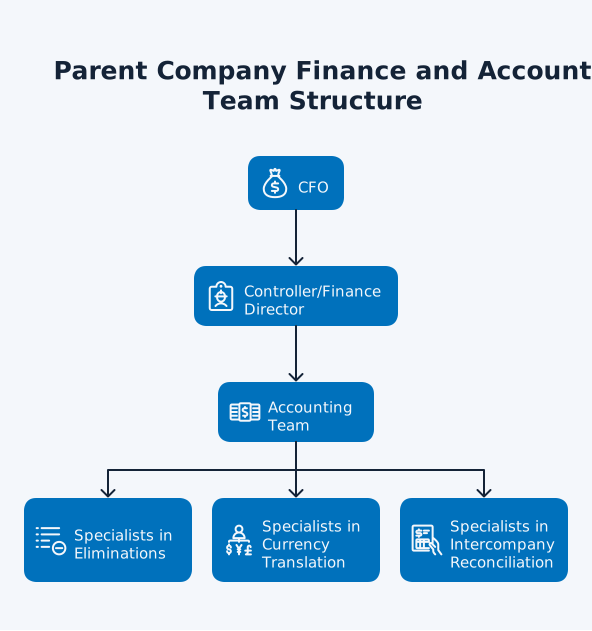
The size of your consolidation team depends on your entity structure. A business with three subsidiaries might assign consolidation to the Financial Controller and one senior accountant. Organisations with 30+ entities need a full consolidation team with specialists in eliminations, currency translation, and intercompany reconciliation.
Your finance team must understand both IFRS 10 and US GAAP ASC 810 requirements if operating across multiple jurisdictions. Each framework has specific consolidation procedures, though both use control as the consolidation basis.
Chief Financial Officer (CFO) Oversight Responsibilities
The CFO oversees the entire reporting process of the parent company, including consolidated financial statement preparation. They provide strategic guidance and ensure compliance with accounting standards and regulatory requirements.
For publicly traded companies, the CFO holds ultimate responsibility for ensuring quarterly and annual financial statements are produced accurately and in accordance with GAAP or IFRS. The Sarbanes-Oxley Act section 302 requires both the CEO and CFO to certify the appropriateness of consolidated financial statements.
The CFO doesn’t personally prepare journal entries or run elimination reports. Instead, they:
- Establish consolidation policies and procedures
- Review and approve consolidated financial statements
- Present consolidated results to the board and stakeholders
- Ensure the finance team has adequate resources and systems
- Oversee relationships with external auditors
CFOs are responsible for making financial decisions that affect the company’s success. They must comprehend and analyse consolidated financial statements to forecast future financial outcomes. This requires understanding how subsidiary performance impacts group results.
Financial Controller Coordination Role
The controller or finance director coordinates the consolidation process. While the CFO provides strategic oversight, the Financial Controller handles day-to-day consolidation management and technical accounting.
Financial Controllers ensure the accuracy of financial information that goes into consolidated financial statements. They verify compliance with accounting standards and legislation. Controllers oversee the preparation and publishing of monthly financial statements, coordinate budget preparation, and manage report preparation.
For consolidated group reporting, the Financial Controller:
- Collects Trial Balances from all entities
- Validates data accuracy and completeness
- Prepares elimination entries for intercompany transactions
- Calculates non-controlling interest allocations
- Reconciles consolidated statements to entity-level Trial Balances
- Documents all consolidation adjustments for audit trails
Trial Balance reconciliation is critical. Your consolidated statements must tie back to entity-level Trial Balances. Without this foundation, your consolidation will never balance. dataSights automates Trial Balance consolidation across small and large entities, ensuring everything reconciles before you even start eliminations.
Controllers prepare consolidated financial statements using uniform accounting policies. They combine assets, liabilities, equity, income and expenses from the parent and subsidiaries, then eliminate intra-group transactions in full.
When Are Consolidated Financial Statements Required?
IFRS 10 requires an entity that controls one or more other entities to present consolidated financial statements. Control is the sole basis for consolidation under IFRS 10. The structure of the investee is not relevant.
Control exists when the investor has all three elements:
- Power over the investee through existing rights
- Exposure or rights to variable returns from involvement with the investee
- Ability to use power to affect those returns
Ownership of more than 50% often indicates control, but the requirement to consolidate is based on control, not a percentage threshold. You might control an entity with less than 50% ownership through contractual arrangements or significant influence.
US GAAP ASC 810 requires consolidation based on controlling financial interest. The requirements are similar to IFRS 10, though specific application rules differ.
Limited exemptions exist under IFRS 10.4. A parent need not present consolidated financial statements if all of these apply:
- It is a wholly-owned or partially-owned subsidiary and all other owners have been informed and do not object
- Its debt or equity instruments are not publicly traded
- It did not file, and is not in the process of filing, financial statements for the purpose of issuing instruments in a public market
- Its ultimate or any intermediate parent produces IFRS-compliant consolidated financial statements that are available for public use.
If the parent is an investment entity, it does not consolidate relevant subsidiaries; it measures them at fair value through profit or loss (see IFRS 10 and the 2014 ‘Investment Entities’ amendments).
External Auditors Review Consolidated Statements – They Don’t Prepare Them
Per auditing standards, management is responsible for preparing the financial statements; the auditor’s role is to opine on them.
- External auditors don’t prepare consolidated financial statements. They examine the statements that management has prepared and provide an independent opinion.
- Company management has responsibility for preparing financial statements and related disclosures. The external auditor then subjects those statements to an audit. During the audit, the auditor obtains an understanding of internal controls and applies auditing procedures including inspection, observation, inquiries, and confirmations.
- External auditors provide assurance beyond management’s own assertions that consolidated financial statements can be relied upon. They express an opinion on whether the statements are fairly presented in accordance with GAAP or IFRS.
- The preparation vs audit distinction is critical. Your finance team prepares the consolidated statements. External auditors verify that those statements are accurate and compliant. Auditors might suggest adjustments during their review, but they don’t do the initial consolidation work.
- Management provides a representation letter to auditors confirming the accuracy of financial statements. For consolidated statements, this letter comes from the parent company’s CFO and CEO.
The Multi-Entity Consolidation Process
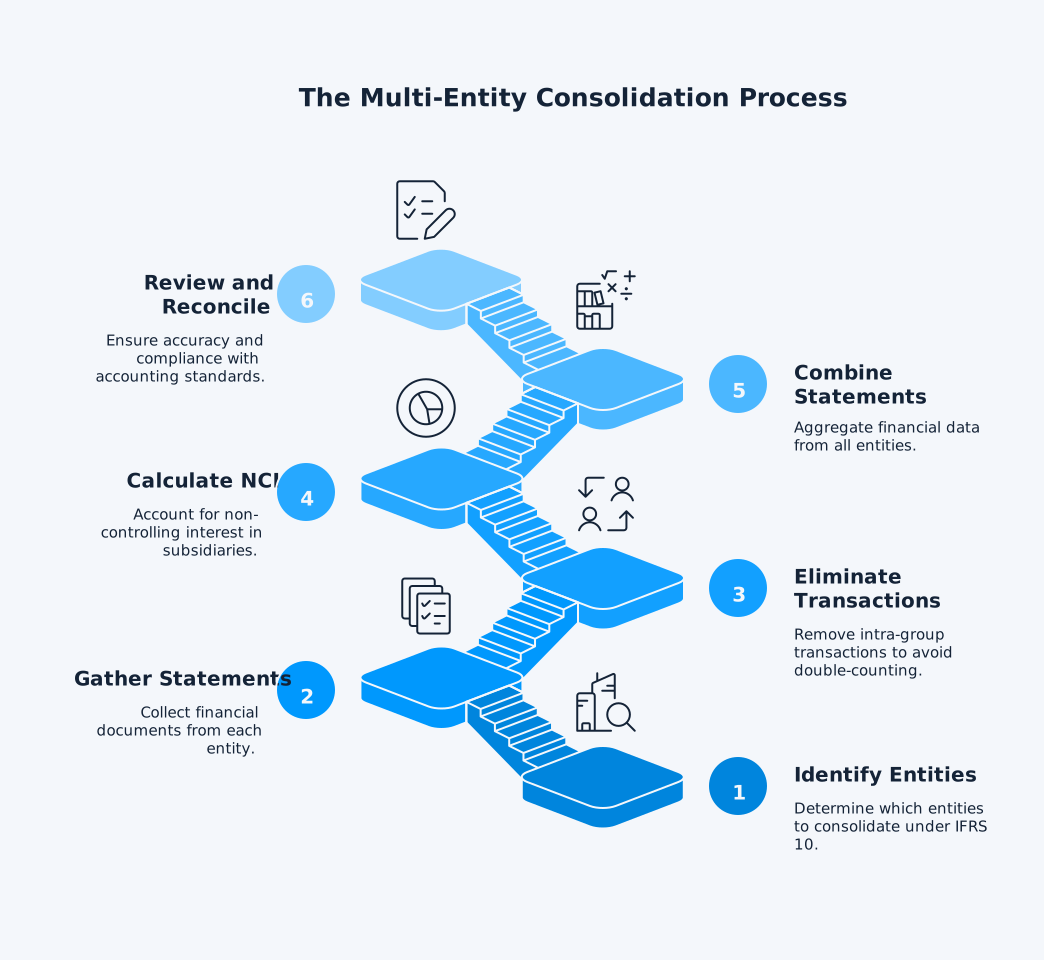
Preparing consolidated financial statements follows a structured process. Here’s how finance teams handle multi-entity consolidation:
Step 1: Identify Entities for Consolidation
Determine which entities you control under IFRS 10 (power, exposure to variable returns, and the ability to affect those returns). Ownership >50% often indicates control, but it is control, not a percentage, that triggers consolidation; control can exist below 50% through rights or contracts.
Step 2: Gather Financial Statements
Collect Trial Balances, general ledgers, and supporting documentation from each entity. Ensure all entities follow consistent accounting policies. If subsidiaries use different policies, adjust them to align with the parent company’s policies.
Step 3: Eliminate Intercompany Transactions
Eliminating intra-group transactions is critical. These transactions create artificial profits or losses that don’t reflect the actual financial position. Common eliminations include intercompany sales, purchases, loans, dividends, and interest.
Per IFRS 10 consolidation procedures (B86–B93), eliminate in full:
- Intragroup balances
- Transactions
- Income and expenses, including unrealised profits on inventory and non-current assets.
Profit is recognised only when the goods or services are sold outside the group.
Step 4: Calculate Non-Controlling Interest
When you own less than 100% of a subsidiary, you must account for non-controlling interest (NCI). NCI represents the portion of subsidiary equity not owned by the parent. At acquisition, IFRS 3 allows NCI to be measured at fair value or at the proportionate share of the acquiree’s identifiable net assets.
Full consolidation combines 100% of the subsidiary’s assets, liabilities, revenues and expenses. Then you separately account for the NCI share. If you own 80% of a subsidiary with £8 million equity, NCI is £1.6 million (20% × £8 million).
Non-controlling interests (NCI) are presented within equity, separately from the parent’s equity, and profit or loss and total comprehensive income are attributed to owners of the parent and to NCI.
Step 5: Combine and Present
Combine the financial statements of the parent and subsidiaries by aggregating assets, liabilities, equity, revenues, expenses, and cash flows. Prepare the following:
- Consolidated statement of financial position
- Profit or loss and other comprehensive income
- Changes in equity
- Cash flows
- Notes.
Step 6: Review and Reconcile
Review consolidated statements for accuracy and compliance with accounting standards. Your consolidated accounts must reconcile to entity-level Trial Balances. Without balanced Trial Balances, your consolidation will never balance.
This manual process takes over 15 days for businesses with multiple entities. dataSights automates the complete workflow from Trial Balance import to final consolidated statements with automated eliminations. Join 300+ businesses who’ve already transformed their financial reporting.
Common Challenges in Consolidated Statement Preparation
Finance teams face significant challenges preparing consolidated financial statements manually:
Manual Excel Consolidation Risks
Spreadsheet-based consolidation is inherently prone to formula errors, data entry mistakes, and version control issues. When multiple team members update different versions, you lose track of which file contains accurate data.
Excel-based consolidation lacks audit trails. You can’t trace who made which adjustments or when eliminations were entered. This creates problems during external audits when you need to explain consolidation journals.
Intercompany Elimination Complexity
Intercompany reconciliation is a primary bottleneck in multi-entity groups; manual, spreadsheet-based eliminations increase error risk and delay. Identifying and eliminating every intercompany transaction grows more difficult as transaction volume increases.
Discrepancies in timing, exchange rates, and transaction recording between entities lead to reconciliation challenges. Manual eliminations take days to complete and often contain errors that delay the close process.
Multi-Currency Translation
Converting financial data from various local currencies into a single reporting currency creates significant complexity. Exchange rate fluctuations dramatically impact consolidated results, especially for organisations with entities in volatile currency regions.
Translation differences arising on translating a foreign operation are recognised in other comprehensive income and accumulated in a separate component of equity until disposal. Without proper systems, currency translation becomes one of the most time-consuming consolidation aspects of consolidation.
Timing and Reporting Period Alignment
IFRS 10 permits a reporting date difference of up to three months between parent and subsidiary, with adjustments for significant transactions in the intervening period. Managing this lag requires careful documentation of material events occurring between reporting dates. Most businesses prefer aligned reporting periods to avoid this complexity.
Frequently Asked Questions
Can External Auditors Prepare Consolidated Financial Statements?
No. External auditors examine statements that management has prepared; they don’t prepare them. Company management holds responsibility for preparing financial statements. Auditors provide independent verification that statements are accurate and compliant with accounting standards.
What Qualifications Are Needed for the Consolidation Team?
Consolidation team members typically hold professional accounting qualifications such as CPA, CA, CMA, or CIMA, along with relevant bachelor’s or master’s degrees in accounting. They need advanced technical expertise in elimination entries, NCI calculations, and multi-currency translation beyond basic bookkeeping skills.
How Long Does Consolidated Statement Preparation Take?
Manual consolidation of small and large entities can extend month-end close beyond 15 days. The time required depends on entity count, transaction volume, and system sophistication. Automated consolidation solutions can reduce this to under 5 days by eliminating manual data gathering and Excel reconciliation.
What Software Do Teams Use for Consolidated Statements?
Finance teams use specialised consolidation accounting software that automates data collection, elimination entries, and currency translation. dataSights provides automated Xero consolidation with direct connections to Power BI and Excel, eliminating manual CSV exports and broken formulas.
Are Consolidated Statements Required for Private Companies?
Requirements vary by jurisdiction. If a private parent controls one or more subsidiaries, IFRS 10 requires consolidated financial statements unless an IFRS 10.4 exemption applies (e.g., wholly/partly owned subsidiary of a higher-level parent that publishes IFRS consolidated FS). Local laws may add further requirements. In the UK, Companies Act 2006 s.399 places a duty on parent companies to prepare group accounts, subject to specified exemptions for small groups and other cases. Many private companies prepare consolidated statements even when not legally required, particularly when seeking funding or for management reporting.
Who Signs Off on Consolidated Financial Statements?
The CFO and CEO of publicly traded companies must certify consolidated financial statements under Sarbanes-Oxley Act section 302. They certify that the statements fairly present the company’s financial condition and operations. For private companies, typically the CFO or Financial Controller signs management representation letters.
What Happens if No One Is Qualified to Prepare a Consolidation?
Businesses without qualified internal staff have three options: hire experienced consolidation accountants, engage external consultants to handle consolidation, or implement automation solutions that simplify the technical requirements. Many organisations invest in training to build internal team capabilities.
Do Small Businesses Need Someone to Prepare Consolidated Statements?
If you control subsidiaries, IFRS 10 requires consolidated statements regardless of business size. Small groups may qualify for exemptions in some jurisdictions. Even when exemptions apply, banks and investors often request consolidated financials to assess overall business performance.
Can You Outsource Consolidated Statement Preparation?
Yes. Many businesses outsource consolidation to accounting firms or use fractional CFO services. However, senior management still retains ultimate responsibility for the accuracy of consolidated statements. The CFO must review and certify outsourced work before filing.
What’s the Difference Between Preparing and Auditing Consolidated Statements?
Preparation means creating the consolidated financial statements, including data gathering, elimination entries, NCI calculations, and final presentation. Auditing means independently examining those prepared statements to verify accuracy and compliance. Your finance team prepares, and external auditors audit.
How Do You Handle Subsidiaries on Different Accounting Software?
Many organisations operate with different accounting systems across entities, creating significant mapping challenges during consolidation. Finance teams must create complex mapping tables to align different account structures. Automated consolidation software can connect to multiple systems simultaneously, standardising data formats during import.
What if Subsidiary Accounting Policies Differ From Parent?
IFRS 10 requires uniform accounting policies across group entities. If subsidiaries use different policies, adjust their financial statements to align with parent company policies before consolidation. Document all policy adjustments in consolidation working papers.
Cut Your Consolidation Time by 70%
Your finance team shouldn’t spend weeks in Excel consolidating entities. Preparation responsibility stays with your finance team – the CFO oversees, the Financial Controller coordinates, and dedicated accountants handle technical consolidation. External auditors review the final product. This structure works brilliantly when supported by automation that eliminates manual data entry, with businesses cutting month-end close from over 15 days to under 5 days.
Streamline Your Xero Consolidation with dataSights
Ready to transform how your finance team prepares consolidated statements? dataSights automates Xero consolidation from the Trial Balance import to final consolidated reports. Eliminate manual CSV exports, automated elimination entries, and complete audit trails across small and large entities. Reduce month-end close from weeks to days. Join 300+ businesses already using dataSights, rated 5.0 by 90+ Xero users. Your finance team retains full control and responsibility while automation handles the heavy lifting.
About the Author
Kevin Wiegand
Founder & Client happiness
I’m Kevin Wiegand, and with over 25 years of experience in software development and financial data automation, I’ve honed my skills and knowledge in building enterprise-grade solutions for complex consolidation and reporting challenges. My journey includes developing custom solutions for data teams at Gazprom Marketing & Trading and E.ON, before founding dataSights in 2016. Today, dataSights helps over 300 businesses achieve 100% report automation. I’m passionate about sharing my expertise to help CFOs and Financial Controllers reduce their month-end close time and eliminate the manual Excel exports that drain their teams’ valuable time.