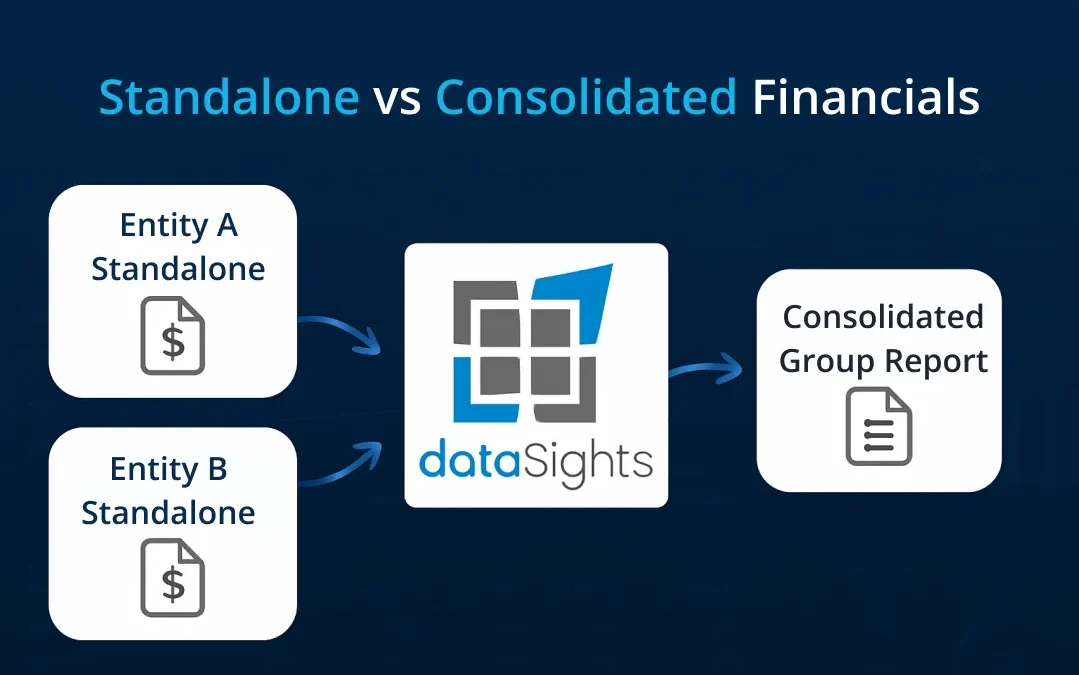
Are you running month-end close across multiple entities and still relying on standalone reports to tell the full story? If your business has grown beyond a single company, understanding standalone vs consolidated financials is not optional – it determines whether your board, investors, and auditors see accurate numbers or a fragmented picture. This guide breaks down exactly what each type of financial statement covers, when consolidated reporting becomes a legal requirement, and how to manage the transition without adding weeks to your close cycle. Whether you report under IFRS or UK GAAP, you will find practical guidance for your specific situation here.
Standalone financial statements report the financial position, performance, and cash flows of a single legal entity, excluding subsidiaries. Consolidated financial statements combine the financial data of a parent company and all controlled subsidiaries into a single set of accounts, eliminating intercompany transactions. Under IFRS 10, any parent that controls one or more subsidiaries must present consolidated financial statements, and the UK Companies Act 2006 Section 399 requires group accounts unless a specific exemption applies. For UK companies, group accounts are generally required for parent companies, with limited exemptions (for example, small groups).
Understanding standalone vs consolidated financials comes down to perspective. Standalone statements show how each entity performs in isolation. Consolidated statements show how the group performs as a single economic unit. Both are necessary, but for multi-entity businesses, consolidated reporting delivers the complete picture that boards, investors, and regulators need. The challenge is not knowing the difference – it is managing the consolidation process without it consuming your month-end close. With the right automation in place, your Xero consolidation can move from a multi-week manual exercise to a continuous, verified workflow that produces accurate group financials every time.
What Standalone Financial Statements Show
A standalone financial statement presents the financial data of one legal entity in isolation. It covers that entity’s assets, liabilities, equity, revenue, expenses, and cash flows without factoring in any subsidiaries, joint ventures, or associates.
For parent companies that also hold investments in subsidiaries, the standalone statement records those investments as a single line item on the balance sheet – typically at cost, in accordance with IFRS 9, or using the equity method (as described in IAS 28) in line with IAS 27. You do not see the subsidiary’s individual revenue, expenses, or debts broken out in the parent’s standalone accounts.
Standalone statements are useful for several purposes:
- Tax filings: Tax authorities assess each legal entity individually, making standalone accounts the basis for tax compliance in most jurisdictions
- Dividend distribution: Directors use entity-level accounts to determine distributable reserves and declare dividends
- Capital maintenance and insolvency assessments: Standalone accounts establish each entity’s financial position for solvency testing and capital adequacy
For entities without subsidiaries, standalone financial statements are the only set of accounts they produce.
Where a company operates as a single entity with no controlled subsidiaries, its financial statements are technically called “individual” financial statements rather than “separate” financial statements. IFRS uses the term “separate financial statements” in IAS 27.
What Consolidated Financial Statements Include
Consolidated financial statements present the assets, liabilities, equity, income, expenses, and cash flows of a parent and its subsidiaries as those of a single economic entity. The group’s results are aggregated, and intercompany transactions are eliminated so that the statements reflect only the group’s dealings with external parties. This elimination principle is required by IFRS 10.
Under IFRS, a complete set of consolidated financial statements typically includes:
- Statement of financial position (balance sheet)
- Statement of profit or loss and other comprehensive income (income statement/OCI)
- Statement of changes in equity
- Statement of cash flows
- Notes including significant accounting policies
The consolidation process involves three core steps:
- Combine like items of the parent’s and subsidiaries’ assets, liabilities, equity, income, and expenses
- Eliminate intra-group balances, transactions, income, and expenses in full
- Recognise and present non-controlling interests (NCI) separately within equity, and attribute profit or loss between the parent and NCI
The parent’s investment in each subsidiary is offset against the parent’s share of each subsidiary’s equity, with any resulting difference accounted for as goodwill under IFRS 3. Changes in ownership that do not result in loss of control are treated as equity transactions.
Key Differences Between Standalone and Consolidated Financials
The core distinction is scope. Standalone statements show one entity’s performance. Consolidated statements show the entire group’s performance as if it were a single business.
- Scope of reporting: Standalone statements capture the financial position of one legal entity. Consolidated statements aggregate the financial data of the parent and all entities it controls, providing a group-wide view. If you manage multiple Xero entities, each entity’s Xero organisation produces standalone data. You need a consolidation layer to combine them.
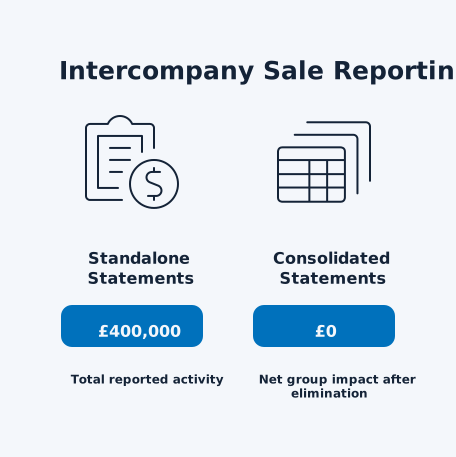
- Intercompany treatment: In standalone statements, transactions with other group entities appear as normal revenue, expenses, receivables, or payables. In consolidated statements, these intercompany items are eliminated. If Subsidiary A sells £200,000 of services to Subsidiary B, both entities record the transaction in their standalone accounts. On consolidation, you eliminate the £200,000 revenue from A, the £200,000 expense from B, and any related receivable/payable balance. Without this elimination, group revenue and expenses would be overstated.
- Investment presentation: In the parent’s standalone accounts, investments in subsidiaries appear as a single line item. In consolidated accounts, the investment line disappears entirely – replaced by the subsidiary’s individual assets, liabilities, income, and expenses combined line-by-line with the parent’s.
- Non-controlling interests: Standalone statements have no concept of NCI. Consolidated statements must separately identify the portion of equity and profit or loss attributable to non-controlling shareholders. If you own 80% of a subsidiary, the remaining 20% of that subsidiary’s net assets and profit is presented as NCI in the consolidated accounts.
- Regulatory purpose: Standalone accounts often serve as the legal basis for tax compliance and dividend decisions at the entity level. Consolidated accounts serve investors, lenders, and regulators who need to assess the group’s aggregate financial health. Both sets fulfil distinct reporting obligations, which is why consolidated financial statements are prepared alongside entity-level accounts.
| Aspect | Standalone financials | Consolidated financials |
| Scope | Single legal entity | Parent + all controlled subsidiaries |
| Intercompany items | Included as normal transactions | Eliminated in full |
| Subsidiary investment | Single line item (cost, FVTPL, or equity method) | Replaced by subsidiary’s line-by-line assets and liabilities |
| NCI | Not applicable | Presented separately in equity and profit/loss |
| Primary users | Tax authorities, entity management | Investors, lenders, group boards |
| Regulatory basis | Local tax law, Companies Act, individual accounts | IFRS 10, Companies Act group accounts |
When Your Business Needs Consolidated Financial Statements
The requirement to consolidate depends on control, not just ownership.
IFRS 10 requires any parent that controls one or more subsidiaries to prepare consolidated financial statements. Control exists when an investor has all three of the following:
- Power over the investee
- Exposure or rights to variable returns from involvement with the investee
- The ability to use that power to affect those returns
Ownership above 50% is an indicator, not the test itself. A parent can control an entity with less than majority ownership if other shareholders’ voting rights are dispersed or if contractual arrangements provide decision-making authority.
In the UK, Section 399 of the Companies Act 2006 requires parent companies to prepare group accounts in addition to individual accounts, subject to specific exemptions. Understanding the criteria for consolidated financial statements helps you determine whether your group must consolidate or qualify for an exemption.
Small Group Exemptions
Under the UK Companies Act, a parent company is exempt from preparing consolidated financial statements if it heads a small group. A group qualifies as small where it meets two of three criteria for two consecutive financial years:
- Aggregate turnover not exceeding £15 million net (or £18 million gross)
- Aggregate balance sheet total not exceeding £7.5 million net (or £9 million gross)
- Aggregate average number of employees not exceeding 50.
(For financial years beginning on or after 6 April 2025.)
Groups containing traded companies, banking companies, authorised insurance companies, or entities carrying on regulated activities under the Financial Services and Markets Act 2000 cannot use the small group exemption from consolidation.
Intermediate Parent Exemptions
Sections 400 and 401 of the Companies Act 2006 provide exemptions for certain intermediate parent companies included in a larger group’s consolidated accounts. To qualify, the intermediate parent must be included in consolidated accounts prepared by a higher-level parent, and those accounts must be filed with the UK registrar.
Even where exemptions apply, many groups still prepare consolidated management reports for internal decision-making. The statutory exemption only removes the legal filing obligation – it does not reduce the need for group-wide visibility.
How Intercompany Eliminations Shape Your Consolidated Results
One of the most time-consuming aspects of consolidation is eliminating intercompany activity. These eliminations remove internal transactions so that your consolidated statements reflect only business conducted with external parties.
IFRS 10 requires entities to eliminate intragroup balances, transactions, income, and expenses in full when preparing consolidated financial statements. In practice, eliminations usually fall into three buckets:
- Intercompany revenue and expenses: When one group entity sells goods or services to another, you eliminate the associated revenue, cost of goods sold, and any unrealised profit on inventory still held within the group at the reporting date.
- Intercompany debt: Loans between subsidiaries create offsetting receivables and payables. You eliminate these balances, plus any associated interest income and interest expense.
- Intercompany equity: The parent’s investment in each subsidiary is offset against the parent’s portion of that subsidiary’s equity. Any difference is recognised as goodwill or a bargain purchase gain.
Intercompany eliminations do not affect the standalone financial statements of each entity. Each entity continues to record and report transactions in accordance with applicable accounting standards on an individual basis. Eliminations are performed only during the consolidation process.
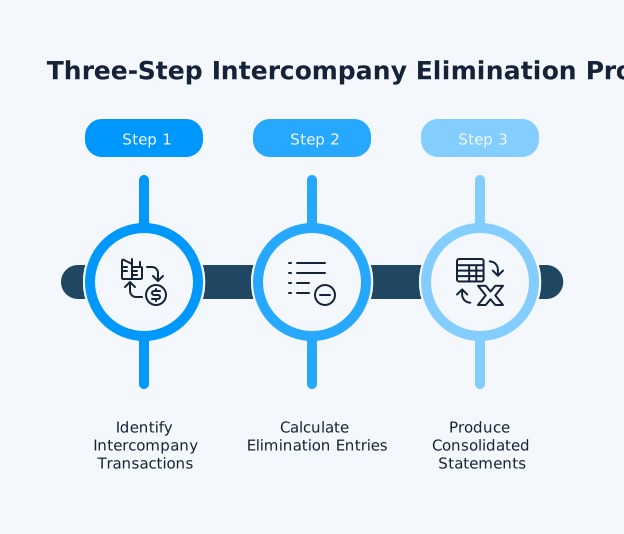
Getting eliminations wrong leads to misstated group revenue, inflated assets, and audit queries. When your group grows beyond a handful of entities, manual elimination tracking in spreadsheets becomes a reliability risk. This is exactly where automated Xero consolidation reduces rework and improves audit trail quality. dataSights automates intercompany eliminations with full audit trails, turning a multi-day manual process into a verified, repeatable workflow.
Moving From Standalone to Consolidated Reporting in Xero
Xero reporting is organisation-based; if you need group consolidated statements, you typically export entity data or connect a dedicated group reporting tool. Each Xero organisation operates independently, producing standalone financial data for that entity. When your group structure requires consolidated financial statements, you need a consolidation layer that sits above your individual Xero entities.
The manual approach involves several steps:
- Export trial balances from each Xero entity
- Map chart of accounts across entities to ensure consistency
- Perform elimination entries in spreadsheets
- Manually reconcile to verify the consolidated balance sheet balances
For groups with more than a few entities, this process typically takes over 15 days at month-end.
dataSights connects directly to your Xero entities and automates the entire consolidation workflow. The platform:
- Pulls transactional data from each entity
- Applies configurable elimination rules
- Handles foreign currency translation where needed
- Produces board-ready management reports through its web platform
For teams who prefer spreadsheets, dataSights also feeds consolidated data directly into Excel through automated pipelines. dataSights customers reduce their month-end close from over 15 days to under 5 days, with everything reconciled across the group.
The practical difference is visibility. With standalone Xero reports, you see each entity in isolation. With automated consolidation, you see the group as a single economic unit – continuously, not just at period-end. Issues like mismatched intercompany balances surface daily rather than becoming discoveries during the month-end close.