
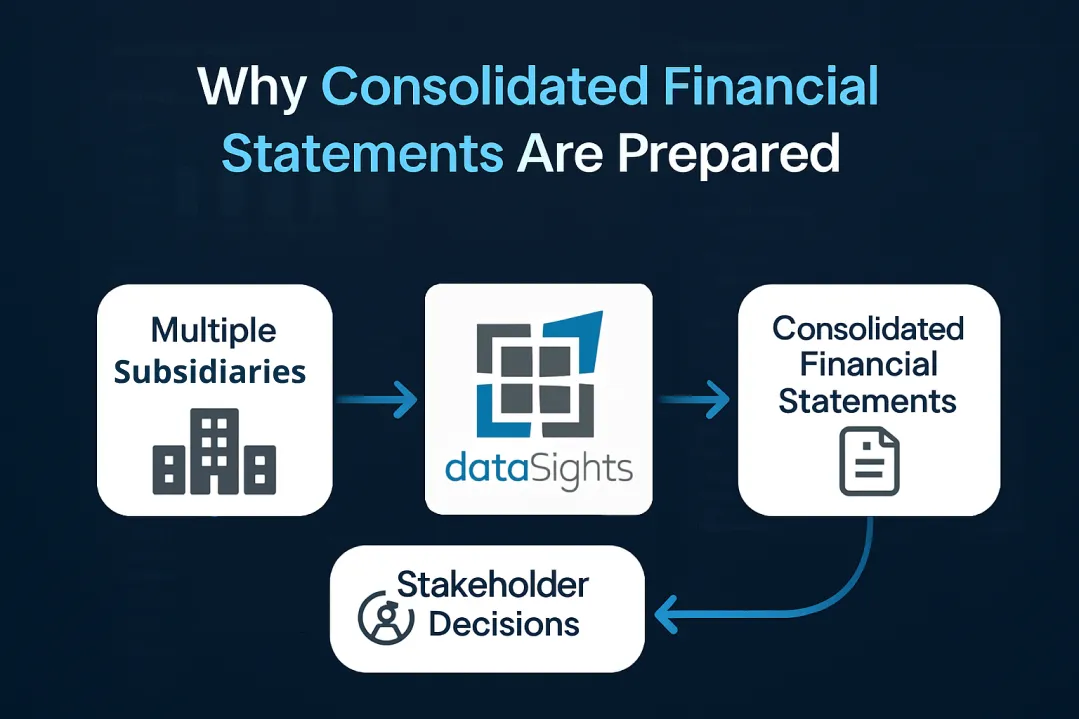
Consolidating results across multiple entities is one of the toughest parts of group reporting, especially when month-end already feels overloaded. If you are responsible for group accounts, understanding why consolidated financial statements are prepared is essential to meet IFRS 10 requirements, keep stakeholders informed, and avoid misstatements caused by intercompany activity. These statements show how the group performs as a single economic unit, not just a list of separate companies. This guide walks through the regulatory drivers, the technical reasons behind consolidation, and how accurate group reporting supports better decisions for boards and investors.
Understanding Why Consolidated Financial Statements Are Prepared
The reason why consolidated financial statements are prepared is that IFRS 10 and generally accepted accounting principles require parent companies to present the assets, liabilities, equity, income, expenses, and cash flows of the group as a single economic entity. Under IFRS 10, a parent must consolidate an investee when it controls it. Control requires power over relevant activities, exposure to variable returns, and the ability to use power to affect those returns. They eliminate intercompany transactions, provide stakeholders with complete financial transparency, and enable informed decision-making about the group’s overall financial health.
Ready to Automate Your Financial Consolidation?
Stop wrestling with manual consolidations and broken formulas. dataSights automates multi-entity reporting, Xero consolidations, and Power BI connections. Join 300+ businesses already transforming their financial reporting with our platform, rated 5.0 out of 5 by 90+ verified Xero users.
Table of Contents
The Regulatory Foundation: IFRS 10 and Control
Consolidated financial statements exist primarily because accounting standards require them. IFRS 10 establishes that when a parent controls one or more subsidiaries, it must present consolidated financial statements.
Control means having power over the investee, exposure to variable returns from involvement with the investee, and the ability to use that power to affect those returns. Ownership above 50% is only an indicator; consolidation is required when the parent has control as defined by IFRS 10, even if ownership is lower.
The UK Companies Act 2006 requires parent companies to prepare group accounts unless they qualify for a statutory exemption. Small groups may qualify for exemption, subject to turnover, asset, and employee thresholds, which change periodically.
Why Stakeholders Demand Consolidated Financial Statements
Investors, lenders, regulators, and management teams need to see the complete financial picture. When shareholders invest in a parent company, they invest in the entire group. They want to know how the group performs, which can differ dramatically from the parent’s standalone results.
Consolidated statements deliver this clarity by:
- Presenting the Group as One Economic Entity: Rather than reviewing separate statements for each subsidiary, stakeholders see combined financial data showing total assets, liabilities, revenue, and expenses across the entire group.
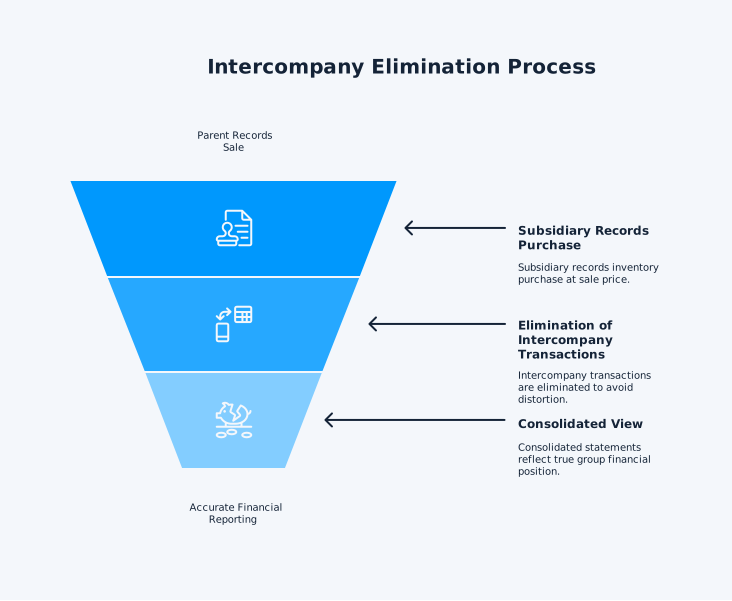
- Eliminating Internal Transactions: When one subsidiary sells goods to another, both the sale and the purchase disappear from consolidated statements. This elimination prevents double-counting and shows only the group’s external economic activity.
- Revealing True Group Performance: Individual statements might show strong profits in one subsidiary offset by losses in another. Consolidated statements surface these patterns, helping boards and investors identify best and worst-performing business units.
- Supporting Evidence-Based Decisions: Management teams need consolidated data to assess whether business activities align with strategic goals, whether entities follow standard accounting policies, and where to allocate resources for maximum group benefit.
The Technical Purpose: Accuracy Through Elimination
One of the most critical reasons for preparing consolidated financial statements is to prevent financial distortion. Without consolidation, group finances would be materially misstated.
Consider a parent company that sells inventory costing £60,000 to its subsidiary for £100,000. In standalone statements, the parent records £100,000 revenue and £40,000 profit. The subsidiary records £100,000 in inventory. From the group’s perspective, no external sale occurred. That inventory still belongs to the group at cost.
Consolidation eliminates this intercompany revenue, adjusts the subsidiary’s inventory value to reflect the actual cost to the group, and defers recognition of profit until the subsidiary sells the goods externally. This process ensures consolidated statements reflect genuine economic performance, not internal shuffling of value.
The same principle applies to:
- Intercompany Loans: Balances that appear as receivables for the parent and payables for the subsidiary cancel out in consolidation, showing only external debt.
- Dividend Payments: Dividends paid from subsidiary to parent represent internal transfers of equity, not genuine income distribution.
- Shared Services: Management fees, IT costs, or other services provided between group entities are eliminated to prevent inflated revenue.
Simplifying Complex Group Structures
As groups grow through acquisitions or organic expansion, tracking financial performance becomes increasingly complex. A parent with nine subsidiaries would generate 40 separate standalone financial statements (four basic statements for each of ten entities).
Consolidated financial statements reduce this pile to four consolidated reports. This simplification saves time, reduces paperwork, and makes it easier for stakeholders to assess overall financial health without reviewing dozens of individual documents.
For multi-entity groups using Xero, manual consolidation means:
- exporting trial balances,
- reconciling intercompany balances in spreadsheets, and
- hoping all eliminations are accurate.
dataSights automates this process, pulling trial balance data from each Xero entity, applying elimination rules automatically, and delivering consolidated statements that always reconcile.
This video demonstrates the step-by-step Xero consolidation process that automates what would otherwise require manual trial balance exports, spreadsheet reconciliation, and error-prone elimination entries.
Compliance and Transparency Requirements
Regulators mandate consolidated statements because consolidation reduces the risk that obligations or exposures sit outside the group statements due to structuring. Historical accounting failures involved companies creating special-purpose entities to keep debts off consolidated balance sheets.
Modern accounting standards require transparency. IFRS 10 closes these loopholes by focusing on control rather than legal ownership structures. If you control an entity, you consolidate it, regardless of how that control is achieved.
For UK businesses, Companies Act 2006 sets size criteria for group exemptions. Small group exemptions apply where the group meets the Companies Act size criteria (thresholds are periodically updated – check current Companies House guidance for the latest figures). Medium and large groups must prepare consolidated accounts using uniform accounting policies.

The Strategic Value: Insights Beyond Compliance
While regulatory compliance drives consolidation requirements, the strategic insights these statements provide often matter more to finance teams.
Consolidated statements reveal:
- Subsidiary Contribution Analysis: Which business units drive group profitability? Which drag performance down? Consolidated data with drill-down capabilities shows each subsidiary’s impact on group results.
- Capital Allocation Decisions: Where should the group invest next? Consolidated statements show which entities generate strongest returns, helping boards allocate capital efficiently.
- Risk Identification: Are certain subsidiaries over-leveraged? Do foreign currency exposures threaten group stability? Consolidated statements surface financial risks that individual statements might obscure.
- Non-Controlling Interest Treatment: When the parent owns less than 100% of a subsidiary, consolidated statements show the portion of equity and earnings attributable to external shareholders separately, ensuring accurate attribution.
Non-controlling interest (NCI) is presented within equity and can be measured at fair value or at the proportionate share of net assets at acquisition. Consolidated profit is allocated between parent and NCI after intercompany eliminations.
For groups using dataSights with Xero consolidation, these insights update on your configured schedule. Rather than discovering consolidation issues two weeks after month-end, finance teams see balancing problems daily, fixing issues while context is fresh.
Frequently Asked Questions
Who Is Required to Prepare Consolidated Financial Statements?
IFRS 10 requires any parent company that controls one or more subsidiaries to prepare consolidated financial statements. Control is often associated with a majority of voting rights, but IFRS 10 requires assessment of power over relevant activities, exposure to variable returns, and ability to use that power to affect those returns. Ownership above 50% is an indicator, not the test itself.
When Are Companies Exempt from Preparing Consolidated Statements?
Small group exemptions under Companies Act 2006 apply where the group meets the statutory size criteria, which are periodically updated. Check current Companies House guidance for the latest thresholds covering turnover, total assets, and employee count. Intermediate parent companies may also be exempt if their ultimate parent prepares IFRS-compliant consolidated statements that are publicly available and certain other conditions are met.
What Is the Difference Between Consolidated and Separate Financial Statements?
Separate financial statements report each entity’s financial position independently, showing the parent’s investment in subsidiaries as a line item. Consolidated financial statements combine the parent and all subsidiaries into one set of accounts, eliminating intercompany transactions and presenting the group as a single economic entity.
Do Investment Entities Have to Prepare Consolidated Financial Statements?
IFRS 10 provides an exception for investment entities that obtain funds from investors to provide investment management services. These entities measure subsidiaries at fair value through profit or loss rather than consolidating them, except for subsidiaries providing investment-related services.
How Often Must Consolidated Financial Statements Be Prepared?
Consolidated financial statements are prepared for each financial year. The parent’s reporting date determines the consolidation period. IFRS 10 permits a reporting date difference of up to three months only when alignment is impracticable, with adjustments required for significant transactions in the intervening period.
Can Subsidiaries Be Excluded from Consolidation?
Very limited circumstances permit exclusion. Under FRS 102, subsidiaries may be excluded only if severe long-term restrictions substantially hinder the parent’s ability to exercise rights over assets or management. Holding a subsidiary exclusively for resale qualifies if sale is highly probable within one year.
What Accounting Standards Govern Consolidated Financial Statements?
IFRS 10 Consolidated Financial Statements is the primary international standard. US entities follow ASC 810. UK companies may use UK-adopted International Accounting Standards or FRS 102 depending on size and listing status. All frameworks require similar consolidation procedures despite some technical differences.
Why Do Consolidated Statements Eliminate Intercompany Transactions?
Eliminating intercompany transactions prevents double-counting of revenue, expenses, assets, and liabilities. When one group entity transacts with another, the consolidated group hasn’t engaged in genuine economic activity with external parties. Eliminations ensure consolidated statements reflect only external transactions and the group’s true financial position.
How Does Goodwill Arise in Consolidated Financial Statements?
Goodwill appears when the parent’s acquisition cost exceeds the fair value of the subsidiary’s identifiable net assets. This difference represents intangible value like brand reputation, customer relationships, or synergies. Goodwill is recognised at acquisition under IFRS 3 as the excess of consideration over the fair value of identifiable net assets. Goodwill is not amortised but is tested annually for impairment under IAS 36.
Do Consolidated Statements Replace Individual Entity Statements?
No. Subsidiaries still prepare separate financial statements for their own management, local statutory requirements, and tax compliance. Consolidated statements supplement, rather than replace, individual entity reporting. Both serve different purposes for different stakeholders.
Bringing Your Consolidation Process Together
Consolidated financial statements give finance teams a complete, accurate view of group performance. When eliminations, reconciliations, and reporting flow automatically, month-end closes become faster and more reliable. With the right tools in place, finance teams move from manual checking to confident decision-making. For multi-entity groups, automation turns consolidation from a bottleneck into a routine process.
Transform Your Xero Consolidation Reporting Today
Ready to cut your month-end close from weeks to days? dataSights delivers automated consolidated management reports with eliminations, multi-entity Trial Balances, and reconciled group insights. Rated 5.0 by 90+ Xero users. Join 300+ businesses improving accuracy and reducing manual work.
About the Author
Kevin Wiegand
Founder & Client happiness
I’m Kevin Wiegand, and with over 25 years of experience in software development and financial data automation, I’ve honed my skills and knowledge in building enterprise-grade solutions for complex consolidation and reporting challenges. My journey includes developing custom solutions for data teams at Gazprom Marketing & Trading and E.ON, before founding dataSights in 2016. Today, dataSights helps over 300 businesses achieve 100% report automation. I’m passionate about sharing my expertise to help CFOs and Financial Controllers reduce their month-end close time and eliminate the manual Excel exports that drain their teams’ valuable time.