
Does your group qualify for an exemption from consolidation of financial statements? For many UK parent companies, this question determines whether finance teams spend days each month on group reporting or avoid it entirely. Getting the answer wrong means either unnecessary compliance work or regulatory penalties. This guide walks you through every exemption available under UK law and international standards, with practical tests you can apply to your own group structure.
Exemption from Consolidation of Financial Statements
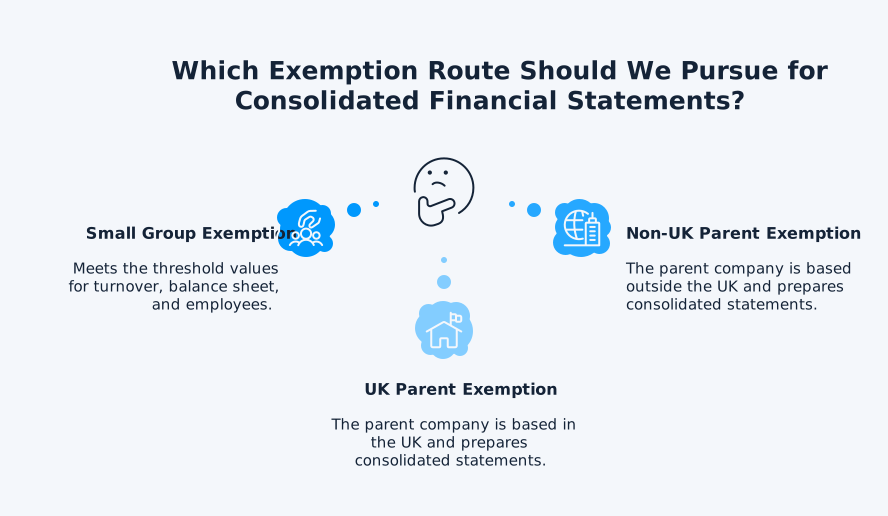
An exemption from consolidation of financial statements allows certain parent companies to avoid preparing group accounts that combine all subsidiaries into a single set of statements. Under UK law, the main exemptions include the small group exemption (Companies Act 2006 Section 399), the intermediate parent exemption with a UK parent (Section 400), and the intermediate parent exemption with a non-UK parent (Section 401). For financial years beginning on or after 6 April 2025, small groups must meet two of the following three thresholds: turnover not exceeding £15 million, balance sheet total not exceeding £7.5 million, and average employees not exceeding 50.
Ready to Automate Your Financial Consolidation?
Stop wrestling with manual consolidations and broken formulas. dataSights automates multi-entity reporting, Xero consolidations, and Power BI connections. Join 300+ businesses already transforming their financial reporting with our platform, rated 5.0 out of 5 by 90+ verified Xero users.
Table of Contents
Why Consolidation Exemptions Matter for Finance Teams
Consolidated financial statements present a group of companies as if they were a single economic entity. This process requires eliminating intercompany transactions, translating foreign currency balances, calculating non-controlling interests, and reconciling every line item across multiple ledgers.
For groups that qualify for an exemption, avoiding this process saves significant time and cost. For groups that don’t qualify, understanding exactly why you must consolidate helps you plan resources and timelines for month-end close.
The IFRS Foundation notes that consolidation requirements exist because individual entity accounts can obscure the true financial position of a group. A parent might appear profitable while its subsidiaries accumulate losses, or intercompany loans might inflate total group assets.
The Three Main Exemption Routes Under UK Law
UK companies can claim exemption from preparing consolidated financial statements through three main routes. Each has specific conditions that must all be satisfied.
1. Small Group Exemption (Section 399)
The most common exemption applies to groups that qualify as small. Under the Companies Act 2006 Section 399, a parent company need not prepare group accounts if the group headed by it qualifies as a small group.
New thresholds effective 6 April 2025:
For accounting periods commencing on or after 6 April 2025, a group qualifies as small if it meets at least two of these three conditions:
| Criterion | Net Figure | Gross Figure |
| Aggregate turnover | £15 million or less | £18 million or less |
| Aggregate balance sheet total | £7.5 million or less | £9 million or less |
| Average number of employees | 50 or fewer | 50 or fewer |
The “net” figures apply after making consolidation adjustments to eliminate group transactions. The “gross” figures apply before such adjustments. The “gross” figures apply before such adjustments. Section 383(5) of the Companies Act 2006 confirms a company may satisfy any relevant requirement on the basis of either the net or the gross figure.
Always confirm the current thresholds on GOV.UK or via the latest Companies Act guidance, as these figures are subject to legislative updates.
Previous thresholds (before 6 April 2025):
| Criterion | Net Figure | Gross Figure |
| Aggregate turnover | £10.2 million or less | £12.2 million or less |
| Aggregate balance sheet total | £5.1 million or less | £6.1 million or less |
| Average number of employees | 50 or fewer | 50 or fewer |
Transitional relief:
Groups can assume the new thresholds applied in the previous year when determining eligibility. This allows immediate benefit from the increased limits without waiting for two consecutive years.
Ineligible Groups
Even if a group meets the size thresholds, certain types of entities cannot claim the small group exemption. Section 384 of the Companies Act 2006 excludes:
- Public companies (PLC)
- Companies (or other bodies corporate) with transferable securities admitted to trading on a UK-regulated market
- Authorised insurance companies
- Banking companies
- E-money issuers
- MiFID investment firms
- UCITS management companies
If any group member falls into these categories, the entire group becomes ineligible for the small company exemption from consolidation.
2. Intermediate Parent Exemption with a UK Parent (Section 400)
A UK subsidiary that is itself a parent company can claim exemption from preparing consolidated accounts if it’s included in the consolidated accounts of a larger UK group. Section 400 of the Companies Act 2006 requires all of the following:
- The company is a subsidiary undertaking of a parent established under UK law
- The company is included in consolidated accounts drawn up by that parent
- Those consolidated accounts are prepared using UK-adopted international accounting standards or give a true and fair view under Companies Act requirements
- Those consolidated accounts and auditor’s report are delivered to the registrar
For wholly-owned subsidiaries, no shareholder consent is required. Where ownership is less than 100%, the exemption may require shareholder consent depending on the ownership percentage. Minority shareholders may have rights to object if notice is served within the statutory period under the Companies Act. The exemption is not available to a traded company.
3. Intermediate Parent Exemption with a Non-UK Parent (Section 401)
Similar provisions apply when the ultimate parent is established outside the UK. Section 401 allows exemption if:
- The company is included in consolidated accounts of a larger group
- Those accounts are prepared in accordance with UK-adopted international accounting standards, EU-adopted IAS, or give a true and fair view under relevant accounting framework
- The consolidated accounts and auditor’s report are filed with the registrar
- The company discloses the exemption and the name of the parent undertaking drawing up the consolidated accounts
The same shareholder consent requirements apply as under Section 400.
IFRS 10 Exemption for Intermediate Parents
Groups applying IFRS 10 Consolidated Financial Statements have access to a parallel exemption framework that operates independently of UK Companies Act provisions.
Paragraph 4(a) permits a parent not to present consolidated financial statements if all four conditions are met:
- Ownership condition: The parent is a wholly-owned subsidiary, or is a partially-owned subsidiary of another entity and all other owners have been informed about, and do not object to, the parent not presenting consolidated financial statements
- Non-traded requirement: The parent’s debt or equity instruments are not traded in a public market
- No filing for public market: The parent did not file, and is not in the process of filing, its financial statements with a securities commission or other regulatory organisation for the purpose of issuing any class of instruments in a public market
- Higher-level consolidation: The ultimate or any intermediate parent produces consolidated financial statements available for public use that comply with IFRS Accounting Standards
IFRS 10 requires that other owners are informed and do not object; in practice, document this with explicit written non-objection rather than assuming silence equals consent.
Historical Exemptions No Longer Available
Several exemptions that existed under previous standards were removed when IFRS 10 replaced IAS 27. While factors such as temporary control or severe restrictions no longer provide standalone exemptions, they may still influence the assessment of control in rare cases.
FRS 102 Exemptions and Subsidiary Exclusions
UK groups applying FRS 102 The Financial Reporting Standard follow Section 9 for consolidation requirements. The standard provides both exemptions from preparing consolidated accounts and grounds for excluding specific subsidiaries.
Exemptions from Preparing Consolidated Accounts
FRS 102 paragraph 9.3 outlines exemptions for accounting periods commencing on or after 1 January 2021:
- The parent and group qualify as small under Companies Act Section 383 and are eligible per Sections 384 and 399(2A)
- The parent is included in consolidated accounts of a UK parent meeting Section 400 conditions
- The parent is included in consolidated accounts of a non-UK parent meeting Section 401 conditions
- All subsidiaries must be excluded from consolidation under FRS 102 paragraph 9.9
- The parent is not subject to the Companies Act and the relevant statutory framework does not require consolidation
None of these exemptions is available if the parent has transferable securities admitted to trading on a UK regulated market.
Subsidiary Exclusions from Consolidation
Even when a parent must prepare consolidated accounts, certain subsidiaries can be excluded. FRS 102 paragraph 9.9 permits exclusion in limited circumstances:
- Immateriality: A subsidiary may be excluded if its inclusion is not material to giving a true and fair view. Two or more subsidiaries may only be excluded if they are not material taken together.
- Severe long-term restrictions: A subsidiary can be excluded if severe long-term restrictions substantially hinder the parent’s exercise of rights over the subsidiary’s assets or management. The restriction must genuinely prevent effective control.
- Held exclusively for subsequent resale: A subsidiary acquired and held exclusively with a view to subsequent resale may be excluded. If held as part of an investment portfolio, measure at fair value through profit or loss. Otherwise, account according to paragraph 9.26.
Accounting for Excluded Subsidiaries
A subsidiary excluded from consolidation on any ground must still be accounted for in the parent’s consolidated accounts. Where a subsidiary is excluded from consolidation, the investment is accounted for as a financial instrument in accordance with FRS 102 Sections 11 and 12. Depending on classification, measurement may result in recognition at cost or fair value through profit or loss. The chosen accounting policy must be applied consistently across all excluded subsidiaries. The same accounting policy must apply consistently to all excluded subsidiaries.
Practical Steps to Determine Your Exemption Status
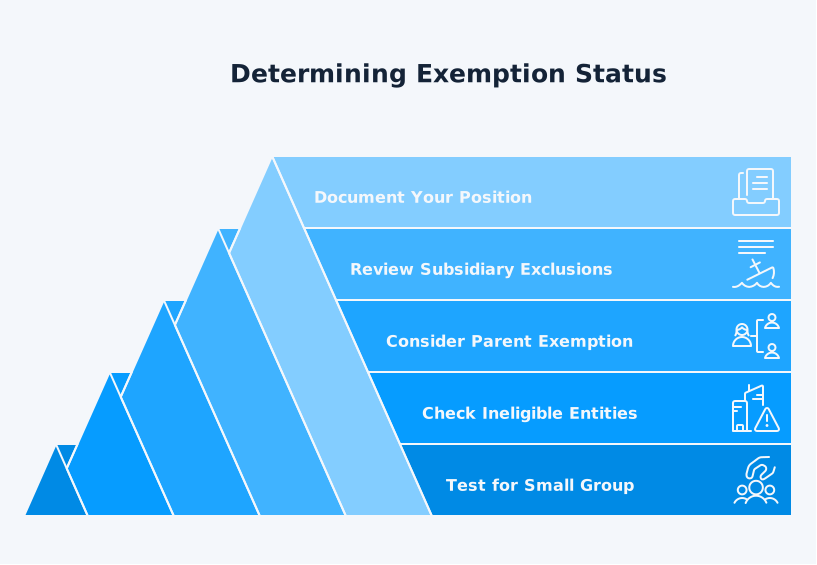
Determining whether your group qualifies for an exemption from consolidation requires a systematic assessment of size, entity type, and group structure. Follow these five steps to reach a defensible conclusion.
Step 1: Test for Small Group Status
Calculate your group’s aggregate turnover, balance sheet total, and employee count. Use either net figures (after consolidation adjustments) or gross figures (before adjustments) for turnover and balance sheet. If you meet two of three thresholds, proceed to eligibility testing.
Step 2: Check for Ineligible Entities
Review whether any group member is a public company, traded company, authorised financial services firm, or other ineligible entity. One ineligible member disqualifies the entire group.
Step 3: Consider Intermediate Parent Exemption
If you’re a subsidiary of a larger group, check whether your parent’s consolidated accounts meet the requirements of Section 400 (UK parent) or Section 401 (non-UK parent). Ensure shareholder consent requirements are satisfied.
Step 4: Review Subsidiary Exclusions
If you must consolidate, assess whether any subsidiaries qualify for exclusion under your framework (for example, FRS 102 paragraph 9.9 allows limited exclusions; IFRS is more restrictive).
Step 5: Document Your Position
Whatever your conclusion, document the analysis and retain evidence supporting the exemption claim or consolidation requirement. This documentation supports auditor review and regulatory enquiry.
When Exemptions Don’t Apply: Managing Consolidation Requirements
Many groups exceed the small group thresholds or contain ineligible entities. For these groups, consolidated financial statements are mandatory and the focus shifts to efficient execution.
The consolidation process requires:
- Combining all subsidiary Trial Balances into a single group Trial Balance
- Eliminating intercompany transactions and balances
- Translating foreign currency subsidiaries per IAS 21 requirements
- Calculating and presenting non-controlling interests
- Recognising and testing goodwill from acquisitions
- Maintaining audit trails for every adjustment
Example (simple intercompany elimination):
If Subsidiary A shows a £200k intercompany receivable from Subsidiary B and B shows a £200k payable, the consolidated group eliminates both balances so the group balance sheet isn’t overstated by internal amounts. The same principle applies to intercompany interest income/expense and internal sales – eliminate internal results so only external performance remains.
Manual consolidation often pushes month-end close beyond 15 business days. Groups with complex structures, multiple currencies, or significant intercompany activity face particular challenges.
Automating Consolidation When Exemptions Don’t Apply
dataSights delivers pre-formatted management packs with consolidated P&L, Balance Sheet, and Trial Balance directly through our web platform. For groups using Xero across multiple entities, this means:
- Automated intercompany elimination with full audit trail
- Multi-currency translation aligned with accounting standards
- Automated consolidation refreshes as source data updates (based on your sync/refresh schedule)
- Drill-down capability from group totals to individual transactions
Teams we work with often reduce month-end close from over 15 business days to under 5 business days. The platform handles both small and large groups of entities without performance degradation.
For finance teams who prefer Excel, dataSights automates data import with scheduled refreshes through the OfficeAddIn and Power Query. This approach lets teams focus on analysis rather than data gathering – no CSV exports, no manual data manipulation.
For teams requiring advanced visualisation and drill-down capabilities, Power BI integration supports scheduled refresh connections and interactive dashboards for drill-down reporting.
Disclosure Requirements When Claiming Exemption
Companies claiming exemption must make specific disclosures in their individual accounts. The required disclosures vary depending on which exemption route applies.
Small Group Exemption Disclosures
State that the company is entitled to the exemption from preparing group accounts under Section 399 of the Companies Act 2006.
Intermediate Parent Exemption Disclosures
When claiming exemption under Section 400 or 401, disclose:
- The name and registered office of the parent undertaking that draws up group accounts
- That the company is included in those consolidated accounts
- The country of incorporation of that parent (if outside the UK)
- Where copies of the group accounts can be obtained
Filing Requirements
Even when exempt from preparing consolidated accounts, the parent company must file the group accounts of the higher-level parent with Companies House if claiming the intermediate parent exemption.
Impact of Threshold Changes from April 2025
The UK Government announced increased thresholds effective for accounting periods commencing on or after 6 April 2025. These changes represent approximately 50% increase in turnover and balance sheet limits, bringing more groups within the small group exemption.
Groups that previously exceeded the old thresholds may now qualify as small. The transitional provision allowing groups to assume new thresholds applied in the previous year means groups can benefit immediately without waiting two years.
The employee threshold remains unchanged at 50. Groups with higher headcounts cannot benefit from the increased financial thresholds.
Periodic Review 2024 Implications
The FRC’s Periodic Review 2024 introduces changes to FRS 102 effective 1 January 2026. Enhanced lease accounting requirements will bring operating leases onto balance sheets, potentially increasing balance sheet totals and affecting small group qualification for some entities.
Frequently Asked Questions
What Are the Main Grounds for Exemption from Preparing Consolidated Financial Statements?
The main grounds include qualifying as a small group under Companies Act 2006 Section 399, being included in consolidated accounts of a UK parent under Section 400, being included in consolidated accounts of a non-UK parent under Section 401, or all subsidiaries being excluded from consolidation under FRS 102 paragraph 9.9.
How Do I Calculate Whether My Group Qualifies as Small?
Add together turnover, balance sheet totals, and employee numbers across all group members. You can use “net” figures (after eliminating intercompany transactions) or “gross” figures (before such adjustments) for turnover and balance sheet. Meet two of three thresholds: turnover £15m net or £18m gross, balance sheet £7.5m net or £9m gross, employees 50 or fewer.
Can a Group with a Public Company Member Claim the Small Group Exemption?
No. If any group member is a public company, traded company, authorised insurance company, banking company, e-money issuer, MiFID investment firm, or UCITS management company, the entire group is ineligible for the small company exemption regardless of size.
What Happens if Non-Controlling Shareholders Object to the Exemption?
If non‑controlling shareholders object to the exemption within the statutory notice period, their objection may prevent the exemption from applying, particularly where the subsidiary is not wholly owned and shareholder approval is required based on the ownership stake and the Companies Act provisions.
Does the Intermediate Parent Exemption Apply to IFRS Reporters?
Yes. IFRS 10 paragraph 4(a) provides a parallel exemption for intermediate parents. All four conditions must be met: ownership condition satisfied, securities not publicly traded, not filing for public market purposes, and ultimate or intermediate parent produces IFRS-compliant consolidated accounts available publicly.
When Can a Subsidiary Be Excluded from Consolidation?
Under FRS 102 paragraph 9.9, a subsidiary may be excluded if it’s immaterial to the true and fair view (but multiple subsidiaries cannot be excluded if material in aggregate), if severe long-term restrictions prevent effective control, or if held exclusively for subsequent resale.
What Are the Disclosure Requirements When Claiming Exemption?
Disclose that you’re claiming exemption and under which provision. For intermediate parent exemption, state the name and registered office of the parent preparing group accounts, the country of incorporation if outside UK, and where copies of those accounts can be obtained.
How Do the April 2025 Threshold Changes Affect My Group?
Thresholds increased by approximately 50% for accounting periods starting on or after 6 April 2025. Groups that previously exceeded limits may now qualify as small. The transitional provision allows assuming new thresholds applied in the prior year, enabling immediate benefit without waiting two consecutive years. Always check the latest thresholds on GOV.UK or in up-to-date Companies Act guidance, as these amounts can change through legislative updates
What Accounting Treatment Applies to Excluded Subsidiaries?
Subsidiaries excluded from consolidation must still be accounted for. Under FRS 102, equity method is not permitted for subsidiaries – only for associates and joint ventures. Excluded subsidiaries are treated as financial instruments under Sections 11/12. Apply the chosen policy consistently across all excluded subsidiaries.
Does Temporary Control Allow Exemption from Consolidation?
No. Under current standards, temporary control is not a valid ground for avoiding consolidation. If control exists under IFRS 10 or FRS 102 criteria, consolidation is required regardless of whether the control is expected to be temporary.
Navigating Consolidation Requirements with Confidence
Understanding exemption from consolidation of financial statements requires careful analysis of your group structure, size, and regulatory status. The small group exemption offers relief for qualifying groups, while intermediate parent exemptions serve subsidiaries within larger corporate structures. For groups that must consolidate, proper automation transforms month-end from a burden into a routine process that completes in days rather than weeks.
Streamline Your Multi-Entity Financial Reporting
Ready to reduce your month-end close from weeks to days? dataSights’ Xero consolidation solution automates multi-entity reporting with full eliminations and board-ready management packs – rated 5.0 by 90+ Xero users. Join 300+ businesses already transforming their group financial reporting.
About the Author
Kevin Wiegand
Founder & Client happiness
I’m Kevin Wiegand, and with over 25 years of experience in software development and financial data automation, I’ve honed my skills and knowledge in building enterprise-grade solutions for complex consolidation and reporting challenges. My journey includes developing custom solutions for data teams at Gazprom Marketing & Trading and E.ON, before founding dataSights in 2016. Today, dataSights helps over 300 businesses achieve 100% report automation. I’m passionate about sharing my expertise to help CFOs and Financial Controllers reduce their month-end close time and eliminate the manual Excel exports that drain their teams’ valuable time.