Your subsidiary declares a £200,000 dividend to the parent company, retained earnings drop on one side, and dividend income appears on the other. Simple enough on each entity’s books, but what happens when you consolidate? The treatment of dividend in consolidated financial statements requires eliminating that intercompany dividend entirely, because the group cannot earn income from itself. Elimination entries are posted in the consolidation workings (or consolidation software), and typically do not change the legal-entity ledgers of the parent or subsidiary. This guide walks you through the elimination mechanics, pre-acquisition versus post-acquisition splits, NCI allocation, and how automation removes the manual risk.
Treatment of dividend in consolidated financial statements centres on one rule: intercompany dividends must be eliminated in full. Under IFRS consolidation requirements, intragroup income and balances are removed so the consolidated statements reflect only external activity. In practice, the parent’s dividend income is reversed against the subsidiary’s equity distribution entry (often retained earnings or a ‘dividends declared’ account), the NCI portion reduces the NCI equity balance, and any unpaid intercompany dividend receivable/payable is eliminated from the consolidated balance sheet.
The treatment of dividend in consolidated financial statements follows one clear rule: intercompany dividends are internal movements and must be eliminated so the group reports only external activity. The practical challenge lies in tracking pre-acquisition versus post-acquisition sources, correctly allocating NCI shares, and processing eliminations accurately across complex group structures. Automation removes the manual risk from this process, giving your finance team time to analyse results rather than reconcile workpapers. Explore how Xero consolidation with dataSights can streamline your group reporting.
Why Intercompany Dividends Must Be Eliminated on Consolidation
Consolidated financial statements present the parent and its subsidiaries as a single economic entity. A dividend paid from a subsidiary to its parent is an internal transfer of cash within that entity. If you left the dividend income on the consolidated income statement, the group would be reporting income it earned from itself, inflating consolidated profit and retained earnings.
Consider a simple example:
- Parent Co owns 100% of Subsidiary A.
- Subsidiary A declares a dividend of £200,000 to Parent Co.
- In Subsidiary A’s books, retained earnings decrease by £200,000.
- In Parent Co’s separate financial statements, dividend income of £200,000 is recognised.
If these figures were simply added together without elimination, the group’s consolidated income statement would include £200,000 of income that never came from an external customer. The group’s total cash position has not changed.
IFRS 10 requires consolidation when the parent controls an investee, meaning it has:
- Power over relevant activities
- Exposure to variable returns
- Ability to use that power to affect those returns
Ownership of more than 50% is a common indicator of control, but not the test itself. Once control is established, all intra-group transactions, including dividends, must be eliminated in full.
The same principle applies under US GAAP: intercompany transactions and balances (including dividends between consolidated entities) are eliminated so the consolidated statements reflect only third-party activity.
Pre-Acquisition Versus Post-Acquisition Dividends
The timing of a dividend relative to the acquisition date determines how it affects the consolidation. This distinction is one of the more common areas where errors occur during the close process.
Pre-Acquisition Dividends
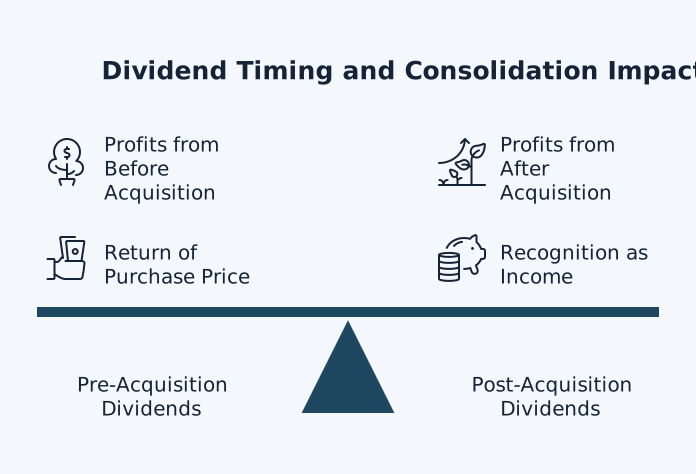
When a subsidiary pays a dividend from profits that existed before the parent acquired its shares, those profits were already reflected in the price the parent paid for the investment. Conceptually, receiving them back is a return of part of the purchase price rather than new income.
How this is treated depends on the measurement basis the parent applies in its separate financial statements:
If the parent measures the investment at cost or fair value (under IAS 27), dividends are generally recognised as income when the right to receive is established. However, where a dividend clearly represents a recovery of part of the cost of the investment – for example, when the dividend exceeds the subsidiary’s total comprehensive income since acquisition – the parent should assess whether the investment’s carrying amount is impaired. IAS 27 does not mandate a mechanical split of dividends into pre-acquisition and post-acquisition components, but the substance of the distribution matters for impairment purposes.
If the parent elects the equity method in its separate financial statements, dividends received are recognised as a reduction of the investment carrying amount rather than new income.
For example:
- Parent Co acquires 100% of Subsidiary B for £800,000
- At acquisition, Subsidiary B has accumulated profits of £100,000
If Subsidiary B then pays a £100,000 dividend from those pre-acquisition profits, Parent Co’s investment effectively recovers £100,000 of the original cost. Under the cost method, the dividend is recognised as income, but Parent Co should consider whether the distribution triggers an impairment assessment of the investment’s carrying amount.
On consolidation, the dividend itself is still eliminated as an intragroup distribution and does not appear as group income.
Post-Acquisition Dividends
Dividends paid from profits earned after the parent gained control are post-acquisition dividends. In the parent’s separate financial statements, these are recognised as income under IAS 27. On consolidation, they are still eliminated because the subsidiary’s post-acquisition retained earnings are already included in the group’s consolidated retained earnings through the line-by-line consolidation of income and expenses.
The key point is this: whether a dividend is pre-acquisition or post-acquisition changes where it hits the consolidation workings, but the end result on the consolidated income statement is the same. Intercompany dividends do not appear as income in the consolidated financial statements.
How to Determine the Source of a Dividend
In practice, determining whether a dividend comes from pre-acquisition or post-acquisition profits can be challenging, particularly when the subsidiary has traded for several years since acquisition. The general approach involves:
- Identifying the subsidiary’s retained earnings at the date of acquisition
- Comparing the dividend amount against profits accumulated before and after that date
- Allocating the dividend proportionally if it spans both periods
Where capital profits are involved, the distinction becomes even more important. A capital gain realised by a subsidiary after acquisition may have accrued before the parent’s purchase, meaning the acquisition price already reflected that value.
The Elimination Journal Entry
The mechanics of eliminating an intercompany dividend on consolidation are direct. The entry reverses the dividend income recorded by the parent and adjusts the subsidiary’s retained earnings distribution.
Example: wholly owned subsidiary dividend elimination
Subsidiary A declares a £150,000 dividend to Parent Co (100% ownership).
In Parent Co’s books:
Dr Cash/Dividend Receivable £150,000
Cr Dividend Income £150,000
In Subsidiary A’s books:
Dr Retained Earnings £150,000
Cr Dividend Payable/Cash £150,000
Consolidation elimination entry:
Dr Dividend Income (Parent) £150,000
Cr Dividends declared / equity distribution £150,000
Note: The credit entry targets whichever account the subsidiary used to record the distribution. Many subsidiaries use a “Dividends declared” or “Distributions” account that is then closed to retained earnings at period end, rather than debiting retained earnings directly. If the subsidiary booked the dividend straight to retained earnings, the credit is to retained earnings.
This removes the dividend income from the consolidated income statement and ensures that consolidated retained earnings are not inflated by intercompany distributions. Consolidated retained earnings reflect the parent’s own retained earnings plus the parent’s share of each subsidiary’s post-acquisition retained earnings, less dividends paid by the parent to its own shareholders.
If the dividend has not yet been paid at the reporting date, any dividend payable in Subsidiary A’s balance sheet and the corresponding dividend receivable in Parent Co’s balance sheet must also be eliminated as intercompany balances.
How Dividends Affect Non-Controlling Interests
When a subsidiary is partly owned, the dividend treatment becomes more nuanced. The NCI shareholders are entitled to their proportionate share of the subsidiary’s dividends, and this distribution reduces the NCI balance in consolidated equity.
NCI Dividend Mechanics
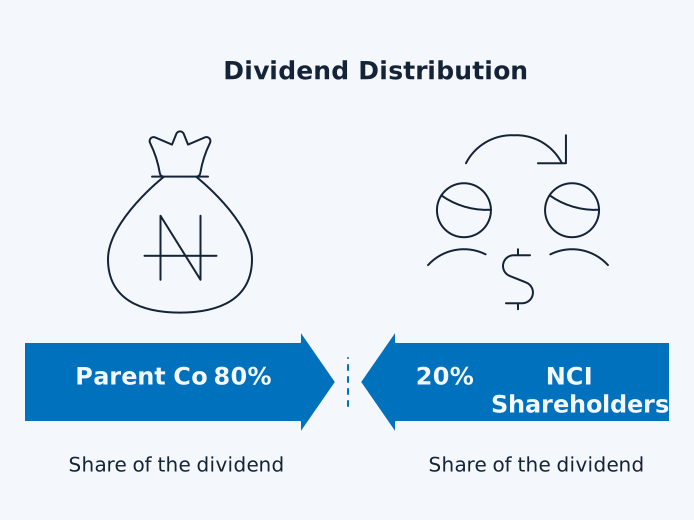
Suppose Parent Co owns 80% of Subsidiary C, with 20% held by external NCI shareholders. Subsidiary C declares a total dividend of £100,000.
The parent’s share is £80,000 (80%), and the NCI’s share is £20,000 (20%).
On consolidation:
- The £80,000 intercompany dividend (parent’s share) is eliminated using the standard elimination entry described above (debiting the parent’s dividend income and crediting the subsidiary’s dividends declared / equity distribution account)
- The £20,000 paid to NCI shareholders is a genuine cash outflow from the group and is not eliminated
At acquisition, IFRS 3 permits NCI to be measured either at fair value or at the non-controlling interest’s proportionate share of the acquiree’s identifiable net assets. The choice affects goodwill, but dividends after acquisition still reduce subsidiary equity and must be eliminated on consolidation.
The NCI balance in consolidated equity decreases by £20,000 because the NCI shareholders received their share of profits. Each period, NCI increases with its share of profit and decreases with distributions such as dividends paid to NCI shareholders. If the subsidiary has outstanding cumulative preference shares classified as equity that are held by non-controlling interests, the group computes the controlling interest’s share of profit or loss after adjusting for dividends on those shares, whether or not the dividends have been declared.
This movement appears in the consolidated statement of changes in equity, where dividends paid to NCI are shown as a separate line reducing the NCI balance. The consolidated income statement itself is unaffected by the dividend distribution, as dividends are not an expense but a distribution of already-recognised profits.
Dividend Treatment in the Parent’s Separate Financial Statements
It’s important to distinguish between the group’s consolidated financial statements and the parent’s separate financial statements, because dividends are treated differently.
In the Parent’s Separate Financial Statements (IAS 27)
How dividends are treated depends on how the investment is measured:
- Investment measured at cost or fair value
- Dividend income is recognised in profit or loss when the parent’s right to receive the dividend is established.
- IAS 27 does not require a mechanical split between pre-acquisition and post-acquisition profits in the parent’s separate financial statements – dividends are recognised as income. However, where a dividend clearly represents a return of part of the cost of the investment (for example, dividends paid from pre-acquisition reserves that exceed post-acquisition earnings), the parent should assess whether the investment’s carrying amount requires impairment testing under IAS 36.
- Investment measured using the equity method (permitted under IAS 27 amendments since 2014)
- Dividends received reduce the carrying amount of the investment, rather than being recognised as income.
- This mirrors IAS 28 treatment for associates and joint ventures.
Practical Implications for Finance Teams
A CFO reviewing results will often see two different “truths,” depending on the view.
- Standalone (parent-only) view: Dividend income from subsidiaries may appear (depending on the measurement basis).
- Consolidated group view: The same dividend disappears, because it is an intragroup distribution.
Why the Dividend Disappears in Consolidation
That’s by design. Consolidation replaces the single-line “investment in subsidiary” with:
- Line-by-line consolidation of the subsidiary’s assets and liabilities, and
- Line-by-line consolidation of the subsidiary’s income and expenses,
followed by elimination of intragroup income and distributions (including dividends).
Dividends From Associates and Joint Ventures
For entities accounted for using the equity method (typically 20% or more ownership with significant influence, but not control), the dividend treatment differs from subsidiary consolidation.
Under the equity method, the investor records its share of the investee’s profit or loss each period, increasing the investment’s carrying amount. When a dividend is received, it reduces the carrying amount of the investment. The dividend is not recognised as income because the investor has already picked up its share of the underlying profit.
For example, if Investor Co holds 30% of Associate D and receives a £15,000 dividend, the journal entry is:
Dr Cash £15,000
Cr Investment in Associate £15,000
Under the equity method, dividends received from an associate reduce the carrying amount of the investment rather than being recognised as income, because the investor has already recognised its share of the associate’s profit through the equity pick-up.
Upstream Versus Downstream Dividends and NCI Impact
In standard group structures, dividends flow in one direction: from subsidiary to parent (upstream). The subsidiary distributes profits upward, and on consolidation, the parent’s share is eliminated while the NCI’s share (if any) reduces the NCI equity balance.
Cross-holdings – where a subsidiary holds shares in the parent – can create situations where dividends flow in the opposite direction. These arrangements are uncommon in practice and involve additional consolidation complexities beyond dividend treatment. If a cross-holding does exist and the subsidiary recognises dividend income from the parent, that income is eliminated on consolidation so group profit reflects only external activity.
Unlike intercompany sales of goods or services, dividends do not create ‘unrealised profit’ requiring deferral. The core consolidation rule remains the same: all intragroup dividends are eliminated regardless of direction.
Common Mistakes With Dividend Treatment in Consolidation
Finance teams frequently encounter these issues when processing dividends through consolidation:
- Failing to eliminate dividend income on consolidation: This is the most basic error and results in overstated consolidated profit. The parent’s dividend income from a subsidiary should never appear on the consolidated income statement.
- Not distinguishing separate vs consolidated treatment (pre- vs post-acquisition): In consolidation, intragroup dividends are eliminated and do not affect group profit or goodwill. In the parent’s separate financial statements, dividends are recognised when the right to receive is established (unless the equity method is elected, in which case they reduce the investment carrying amount), and unusually large dividends can be an impairment indicator.
- Leaving intercompany balances unreconciled: If a dividend is declared but not paid by the reporting date, the subsidiary’s dividend payable and the parent’s dividend receivable must both be eliminated. Mismatches here signal timing differences or recording errors that delay the consolidation close.
- Incorrect NCI allocation: When a partly-owned subsidiary pays a dividend, only the parent’s share is eliminated as an intercompany transaction. The NCI’s share is a real distribution to external shareholders and must reduce the NCI equity balance, not be eliminated.
- Double-counting in the equity method: If the parent uses the equity method in its separate books and also consolidates, there is a risk of counting the subsidiary’s profits twice. The consolidation process replaces the equity method entries with full line-by-line consolidation.
How to Automate Dividend Elimination in Consolidation
Manual consolidation workbooks are prone to errors, particularly when tracking intercompany dividends across multiple entities. With ten entities, you might have 45 potential intercompany pairs; with twenty entities, that number rises to 190.
Automated consolidation systems address this by:
- Applying pre-configured elimination rules to all intercompany transactions, including dividends
- Maintaining full audit trails of every elimination entry
- Reconciling intercompany balances automatically before processing eliminations
- Tracking pre-acquisition and post-acquisition profit splits by entity and acquisition date
- Calculating NCI allocations based on ownership percentages and transaction direction
dataSights pulls full Trial Balance data from each Xero entity through secure API connections, ensuring consolidations tie back to source systems with consistent source-to-report mapping. Automated elimination entries process intercompany sales, loans, dividends, and management fees with full audit trails, and – depending on data quality and group complexity – can materially reduce the time spent on manual eliminations and tie-outs. With 300+ businesses using the platform and 80+ five-star reviews on the Xero Marketplace, the approach is proven across small and large groups of entities.