You closed the deal, recorded the fair values, and prepared your first consolidated accounts. Now you have to do it again next month – and every month after. Preparing consolidated financial statements subsequent to date of acquisition means repeating the same consolidation adjustments each period, but updating them for new Trial Balances, fair value uplifts, goodwill, and intercompany activity. This guide shows the recurring entries, the standards behind them, and a workflow you can reuse every close.
Consolidated financial statements subsequent to date of acquisition combine the parent’s and subsidiary’s financial data for each reporting period after the parent obtains control, following IFRS 10. Each period you repeat four consolidation-layer adjustments: investment elimination, amortisation of finite-life fair value uplifts (from acquisition accounting under IFRS 3), goodwill impairment testing under IAS 36, and elimination of intercompany balances (including unrealised profits). APQC’s 2018 benchmark found the median month-end close takes 6.4 calendar days, so many teams automate these repeat adjustments into board-ready management packs – dataSights delivers them through the platform, with Excel and Power BI automation available where your workflow needs it.
Getting consolidated financial statements right in subsequent periods requires discipline across four recurring entry types, accurate NCI allocation, and reliable intercompany elimination. The standards are clear, but the execution is where most finance teams lose time, with each additional entity multiplying your elimination requirements. Manual processes compound period after period, turning what should be a structured workflow into a monthly scramble. Automating the recurring mechanics with a platform like dataSights’ Xero consolidation frees your team to focus on analysis and decision-making instead of rebuilding worksheets.
How Post-Acquisition Consolidation Differs from the Acquisition Date
Framework note: This guide references IFRS requirements (IFRS 10, IFRS 3, IAS 21, IAS 36, IAS 12), which apply to UK-adopted IFRS and are widely used in Australia and New Zealand. If you report under FRS 102, the consolidation mechanics are similar, but goodwill is generally amortised (with a 10-year backstop when you cannot estimate a reliable useful life).
On the acquisition date, you measure the subsidiary’s identifiable assets and liabilities at fair value, calculate goodwill, and establish the NCI balance. In subsequent periods, the mechanics shift in several important ways:
- You eliminate pre-acquisition retained earnings against the investment account every period, not just once
- You include the subsidiary’s full-year revenues and expenses (not partial-year as at acquisition)
- You amortise finite-life fair value uplifts over their remaining useful lives
- You test goodwill for impairment annually (IFRS/US GAAP) or amortise it (FRS 102)
- You allocate each period’s post-acquisition profit between the parent and NCI
Pre-Acquisition vs Post-Acquisition Retained Earnings
Pre-acquisition retained earnings belong to the previous owners and form part of the net assets you acquired. You eliminate these as part of the investment elimination entry every period. Only profits earned after the acquisition date flow into consolidated retained earnings. This distinction is critical for calculating goodwill correctly and presenting accurate group reserves.
For example, if you acquired a subsidiary on 1 July with retained earnings of £200,000 at that date, the £200,000 is eliminated against your investment account on every subsequent consolidation. Only profits from 1 July onward contribute to the group’s retained earnings.
Subsidiary Revenues and Expenses in Subsequent Periods
In the first consolidation, you include the subsidiary’s revenues and expenses only from the acquisition date to the reporting date. In all subsequent full periods, you include the subsidiary’s full-period results, then allocate post-acquisition profit between the parent and any non-controlling interests.
The Four Recurring Consolidation Entries
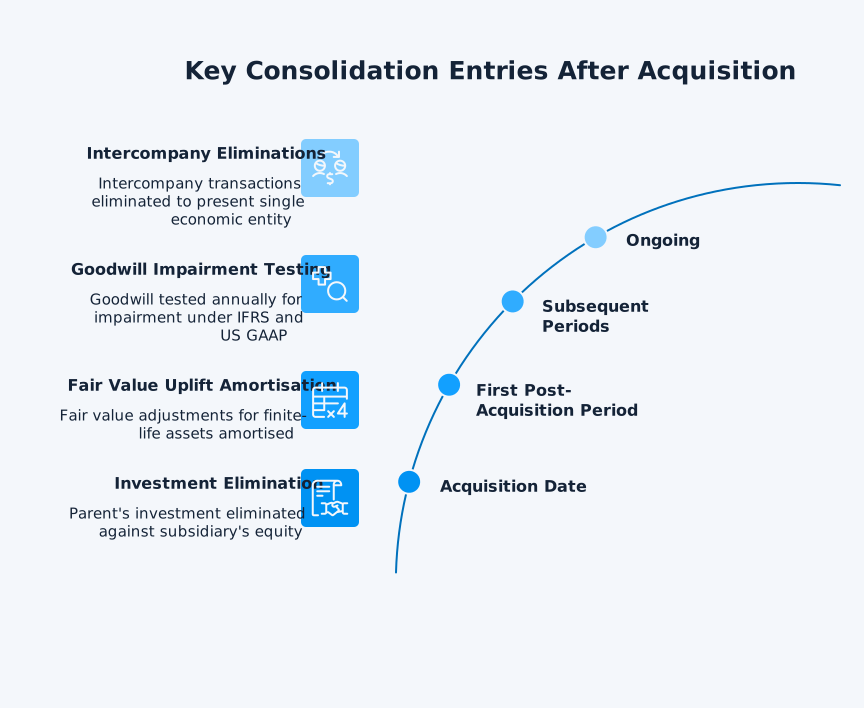
Every post-acquisition consolidation requires four types of entries to produce accurate group accounts. Skipping any one of these can result in material misstatements in profits, equity, goodwill, or NCI.
1. Investment Elimination Entry
This entry eliminates the parent’s investment in the subsidiary against the subsidiary’s equity at the acquisition date. In consolidation workings, pre- and post-acquisition equity movements are analysed so that post-acquisition profits and reserves are recognised in consolidated retained earnings, and only the pre-acquisition equity is removed in the elimination entry at each reporting date.
These are consolidation-only adjustments (typically done in a consolidation worksheet or platform), not journals posted into the subsidiary’s ledger.
The basic elimination entry:
- Debits the subsidiary’s common stock, additional paid-in capital, and beginning retained earnings
- Credits the parent’s investment account
- Reclassifies any difference between the investment balance and the subsidiary’s book value equity to specific assets and goodwill
2. Fair Value Adjustment Amortisation
At acquisition, you measured the subsidiary’s identifiable assets and liabilities at fair value. Where those fair values exceeded book values and the related assets have finite useful lives, you must amortise the excess over those remaining useful lives in every subsequent period.
For example, if a subsidiary’s building had a book value of £300,000 but a fair value of £600,000 at acquisition with a remaining useful life of 20 years, you record an additional £15,000 depreciation expense each year in the consolidation workings. This adjustment reduces the subsidiary’s post-acquisition profit and, where NCI exists, affects the NCI profit allocation.
Key rules for specific asset types:
- Inventory: Charge the fair value uplift to cost of goods sold in the first period after acquisition (as the inventory is sold)
- Land (indefinite life): No amortisation required – the uplift remains on the consolidated balance sheet until disposal
- Buildings, equipment, patents (finite life): Amortise the uplift over the remaining useful life from the acquisition date
3. Goodwill Treatment in Subsequent Periods
Goodwill is the excess of purchase consideration over the fair value of identifiable net assets acquired. Its treatment differs between frameworks:
- IFRS (UK-adopted IFRS): Recognise goodwill at acquisition under IFRS 3 and test it for impairment at least annually under IAS 36 – you do not amortise it. In November 2022, the IASB voted to retain this impairment-only approach.
- US GAAP: Under ASC Topic 350, goodwill is tested for impairment at least annually; public companies do not amortise goodwill. The FASB also permits an accounting alternative for eligible private companies to amortise goodwill (typically over 10 years).
- FRS 102 (UK GAAP): Goodwill is amortised over its useful life. If you cannot reliably estimate that life, amortise it over no more than 10 years.
When preparing consolidated financial statements across mixed-framework groups, confirm which standard applies to each entity’s reporting requirements. Goodwill always lives at the consolidation layer, not in entity-level ledgers. Xero, for instance, does not calculate or track goodwill automatically, so this adjustment must be managed either manually in spreadsheets or through a dedicated consolidation accounting platform.
4. Intercompany Elimination Entries
After acquisition, the parent and subsidiary frequently trade with each other. You must eliminate all intercompany transactions to present the group as a single economic entity. The main categories are:
- Intercompany revenue and cost of sales: Entity A sells services to Entity B for £100,000. On consolidation, both the £100,000 revenue in Entity A and the £100,000 expense in Entity B are eliminated. The group has not earned anything from itself.
- Intercompany loans and interest: Parent lends £500,000 to Subsidiary at 5% interest. Both the £500,000 loan balance and the £25,000 interest income/expense eliminate on consolidation. No cash has entered or left the group.
- Unrealised profit on inventory: Entity A sells £50,000 of inventory to Entity B at a £10,000 markup. Entity B has not resold it by year-end. The £10,000 unrealised profit must be eliminated from consolidated inventory and group profit.
- Intercompany dividends: Dividends paid from subsidiary to parent are internal transfers. Only dividends paid to external shareholders appear in consolidated financial statements.
Eliminate intra-group balances and transactions in full, but remember the direction matters for attribution when you have non-controlling interests:
- Downstream eliminations (parent → subsidiary) reduce the parent’s profit
- Upstream eliminations (subsidiary → parent) reduce the subsidiary’s profit and therefore reduce NCI’s share
For a detailed walkthrough of elimination mechanics, see our guide to intercompany transactions in consolidated financial statements.
Non-Controlling Interest in Subsequent Periods
When you own less than 100% of a subsidiary, you must allocate profits, losses, and equity movements between the parent and the non-controlling interest. NCI is presented as a separate component of equity on the consolidated balance sheet.
In each subsequent period, NCI’s share of the subsidiary’s post-acquisition profit or loss is calculated based on ownership percentages. For example, if parent owns 80% of Sub A and Sub A reports £100,000 profit after eliminations, the full £100,000 appears on the consolidated income statement, but £20,000 (20%) is attributed to NCI.
Changes in Ownership Without Loss of Control
Under IFRS 10, if you buy additional shares in a subsidiary (reducing NCI) or sell shares without losing control (increasing NCI), these are equity transactions. The key rules are:
- No additional goodwill is recognised
- No gain or loss is recorded in profit or loss
- You simply adjust the carrying amounts of the parent’s equity and NCI to reflect the new ownership split
The NCI measurement choice (fair value or proportionate share of identifiable net assets) applies only at the acquisition date. You cannot change this election retrospectively for subsequent ownership changes.
Practical Consolidation Workflow for Subsequent Periods
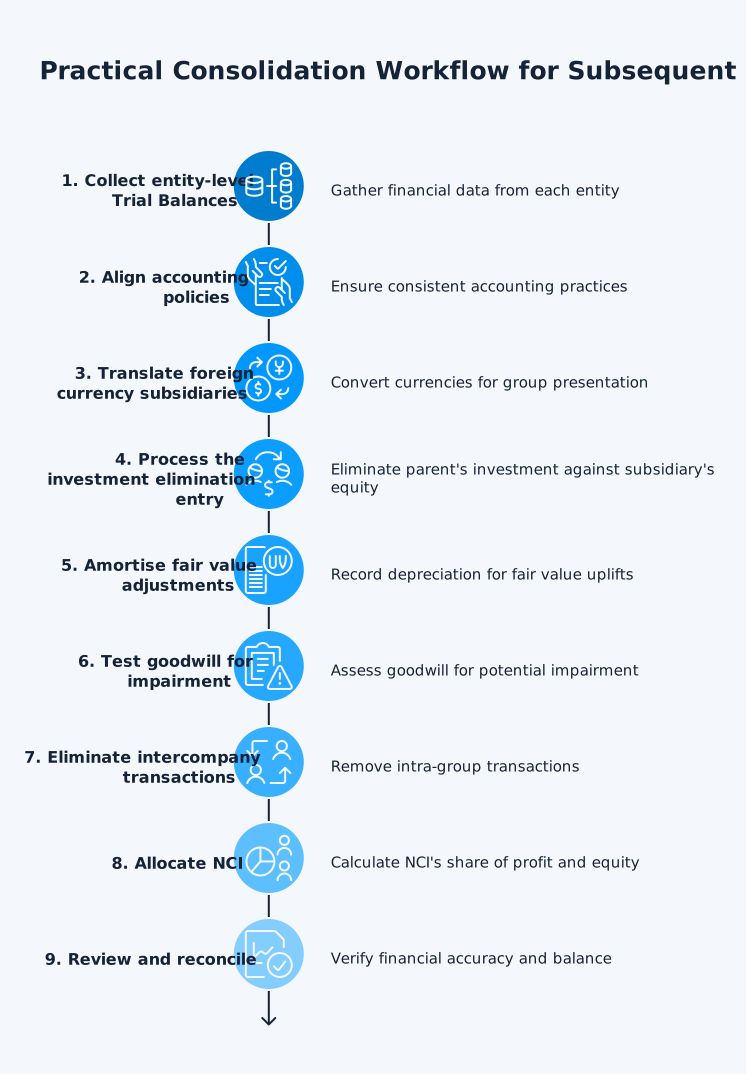
Running a post-acquisition consolidation each period follows a structured sequence. Here is a step-by-step process:
- Collect entity-level Trial Balances: Every consolidation starts with the Trial Balance from each entity. dataSights pulls full Trial Balance data from each Xero entity, ensuring consolidations always tie back to source systems.
- Align accounting policies: Confirm all subsidiaries follow the parent’s accounting policies for depreciation methods, revenue recognition, and inventory valuation. Adjust where differences exist.
- Translate foreign currency subsidiaries: Translate from each entity’s functional currency into the group presentation currency under IAS 21. Use closing rates for assets and liabilities, average rates for income and expenses, and historical rates for equity. Record translation differences in OCI as a foreign currency translation reserve until disposal.
- Process the investment elimination entry: Eliminate the parent’s investment account against the subsidiary’s beginning-of-period equity, then bring forward the remaining acquisition-date fair value adjustments and goodwill in your consolidation workings.
- Amortise fair value adjustments: Record additional depreciation or amortisation for any finite-life fair value uplifts established at acquisition.
- Test goodwill for impairment: At least annually under IFRS and US GAAP, or amortise under FRS 102.
- Eliminate intercompany transactions: Remove all intra-group revenues, expenses, balances, loans, interest, dividends, and unrealised profits.
- Allocate NCI: Calculate and record NCI’s share of post-acquisition profit and equity movements.
- Review and reconcile: Verify that eliminations net to zero, the balance sheet balances, and consolidated retained earnings reconcile to the expected total.
For an overview of how this fits within your month-end close, see our financial consolidation process guide.
Deferred Tax Considerations in Post-Acquisition Consolidation
Fair value uplifts, additional depreciation, and unrealised profit eliminations can create temporary differences between consolidated carrying amounts and tax bases. Under IAS 12, recognise deferred tax on these temporary differences (subject to the standard’s exceptions) and allocate NCI its share of post-acquisition deferred tax movements where relevant.
Common deferred tax triggers in post-acquisition consolidation include:
- Fair value uplift on PPE: When PPE is revalued to fair value on acquisition under IFRS 3, the carrying amount typically exceeds its tax base. This creates a taxable temporary difference and requires recognition of a deferred tax liability. The DTL unwinds over time as the additional depreciation from the uplift is recognised.
- Unrealised profit on intercompany inventory: Eliminating unrealised profit lowers the consolidated inventory carrying amount below the amount in the seller’s tax return, requiring a deferred tax adjustment.
- Intangible asset amortisation: Fair value uplifts on patents, customer lists, or brands generate additional amortisation that creates temporary differences at the consolidation level.
Reporting Date Misalignment Between Parent and Subsidiary
IFRS 10 allows a parent to use a subsidiary’s financial statements prepared at a different reporting date when aligning reporting dates is impracticable. The gap must be no more than three months and should remain consistent from period to period, with adjustments for significant transactions and events in the intervening period. When using misaligned reporting dates, you must:
- Adjust for significant transactions and events occurring in the intervening period
- Apply the reporting lag consistently from period to period
- Disclose the reporting date difference in the notes to the consolidated financial statements
- Account for any material intervening events between the subsidiary’s and parent’s reporting dates
In practice, reporting lags are common straight after an acquisition, before reporting systems and close calendars are fully aligned. Document the policy and keep a clear schedule of intervening adjustments to support audit queries.
Automating Subsequent Consolidation in Xero
Manual Excel-based consolidation for subsequent periods is error-prone and time-consuming. Research across industries indicates that 94% of spreadsheets contain errors of varying materiality. Each period, your team rebuilds elimination worksheets, recalculates fair value amortisation, and manually checks intercompany balances.
dataSights’ Xero consolidation solution Generates web-based Management Reports and management packs from consolidated Trial Balances:
- Pulls Trial Balance data directly from each Xero entity, so group numbers reconcile back to source systems
- Processes elimination entries and consolidation journals based on your configured rules, with a full audit trail
- Supports multi-currency translation aligned with IAS 21
- Automates Excel refresh for teams who prefer spreadsheet workflows
- Connects to Power BI for advanced analytics and drill-downs
The platform handles multi-currency conversions aligned with IAS 21 and maintains a complete audit trail that ties every consolidated figure back to entity-level source data.