
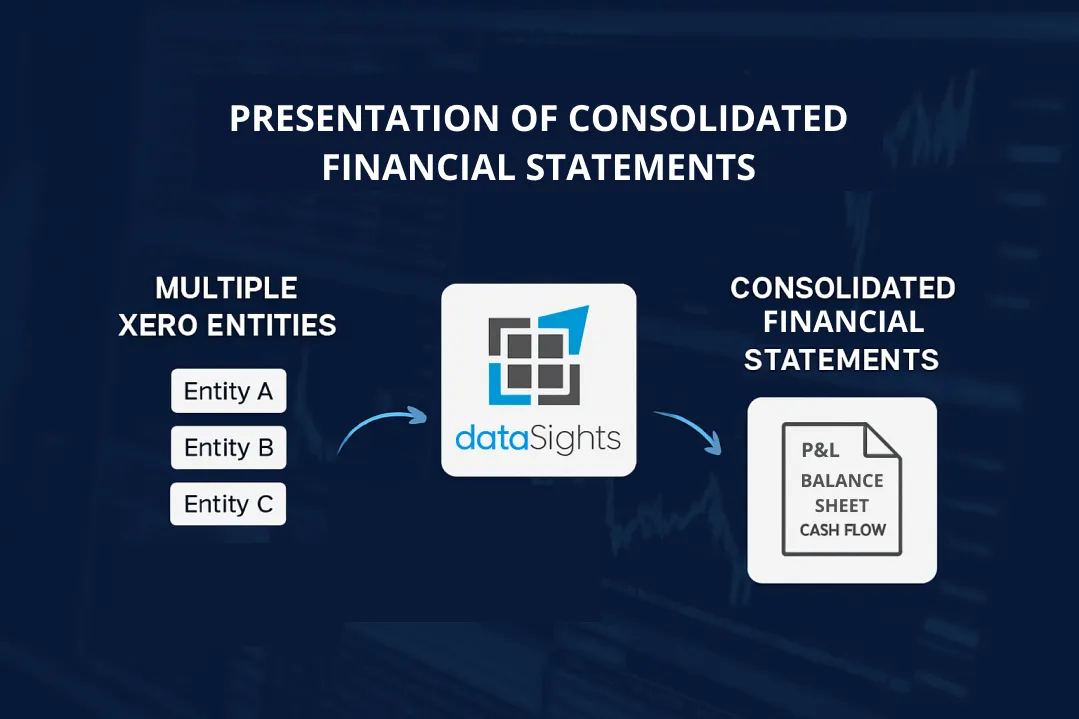
Tomorrow’s board meeting depends on one thing – accurate, reconciled consolidated financial statements. Yet intercompany eliminations, non-controlling interest mismatches, and version-chaos Excel files often derail accuracy. This guide explains the presentation of consolidated financial statements under IFRS 10 and ASC 810 – showing exactly how to deliver board-ready statements that reconcile automatically through automation.
Presentation of Consolidated Financial Statements
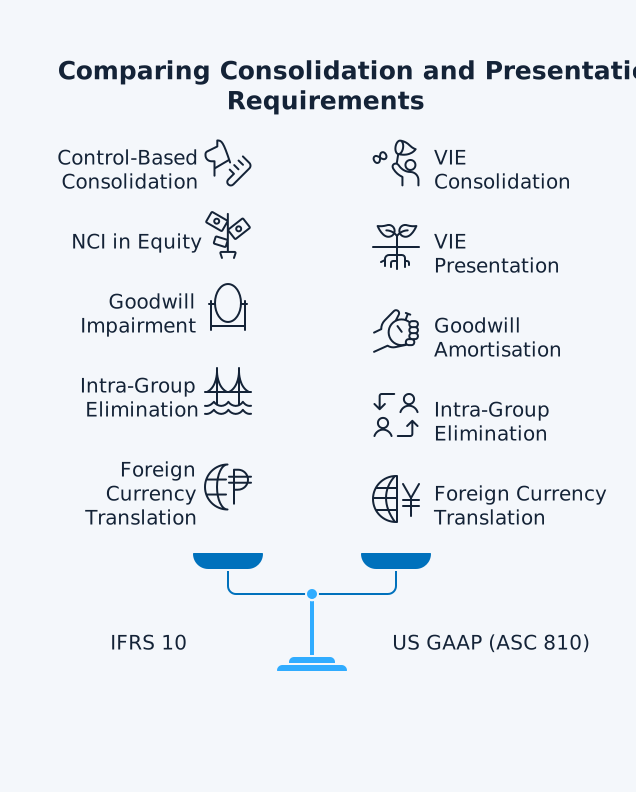
The presentation of consolidated financial statements combines financial data from a parent company and all subsidiaries it controls into a single set of financial statements that present the group as one economic entity. Under IFRS 10, consolidated financial statements must include a consolidated statement of financial position, statement of profit or loss and other comprehensive income, statement of changes in equity, statement of cash flows, and notes. ASC 810 under US GAAP requires similar components with specific additional requirements for Variable Interest Entities (VIEs). Both frameworks require elimination of all intra-group transactions and balances before presenting consolidated results.
Ready to Automate Your Financial Consolidation?
Stop wrestling with manual consolidations and broken formulas. dataSights automates multi-entity reporting, Xero consolidations, and Power BI connections. Join 300+ businesses already transforming their financial reporting with our platform, rated 5.0 out of 5 by 90+ verified Xero users.
Table of Contents
What Must Be Included in Consolidated Financial Statements
Consolidated financial statements must present a complete picture of the group’s financial position, performance, and cash flows. Each component serves a distinct purpose in showing how the group operates as a single economic entity.
1. Consolidated Statement of Financial Position (Balance Sheet)
The consolidated balance sheet presents all assets, liabilities, and equity of the parent and subsidiaries after eliminating intra-group balances. IFRS 10 requires that non-controlling interests appear as a separate component within equity, distinct from equity attributable to owners of the parent. Assets and liabilities cannot be offset unless a right of offset exists and the entity intends to settle on a net basis.
For Xero users managing multi-entity groups, the challenge is that Xero provides entity-level balance sheets only. dataSights consolidates balance sheets across small and large groups of entities automatically, eliminating intercompany balances and presenting non-controlling interests correctly.
2. Consolidated Statement of Profit or Loss and Other Comprehensive Income
This statement shows the group’s:
- Income
- Expenses
- Profit or loss
- Other comprehensive income
Under IFRS, you can present this as a single statement or two separate statements (profit or loss, then other comprehensive income). The critical requirement is attributing profit or loss and other comprehensive income between amounts attributable to owners of the parent and non-controlling interests.
All intercompany revenue and expenses must be eliminated before presentation. For example, if Entity A sells £100,000 of services to Entity B, both the revenue (in A) and expense (in B) must be removed from the consolidated income statement. The group hasn’t earned anything from itself.
3. Consolidated Statement of Cash Flows
The consolidated cash flow statement presents cash flows from operating, investing, and financing activities for the group as a whole. Intra-group cash flows must be eliminated. If the parent lends £500,000 to a subsidiary, this doesn’t represent cash entering or leaving the group and must be eliminated from the consolidated cash flow statement.
4. Consolidated Statement of Changes in Equity
This statement reconciles the opening and closing balances of each component of equity, including share capital, retained earnings, other reserves, and non-controlling interests. Each movement must be separately disclosed, including profit or loss, other comprehensive income, transactions with owners, and changes in ownership interests.
5. Notes to Consolidated Financial Statements
Notes provide essential context, including:
- Accounting policies
- Judgements
- Estimates
- Detailed breakdowns of financial statement line items
Consolidation-specific disclosures must explain the following:
- Basis of consolidation
- Composition of the group
- Non-controlling interest details
- Restrictions on access to or use of group assets
Watch how dataSights automates the entire consolidation process from multiple Xero entities through to board-ready consolidated financial statements. This demonstration shows elimination processing, NCI calculations, and automated balance sheet reconciliation in action.
Framework Note: This guide references International Financial Reporting Standards (IFRS 10, IAS 21, IFRS 3, IAS 36). UK groups using FRS 102 (UK GAAP) follow similar consolidation principles under Section 9, with key differences such as goodwill amortisation and immaterial-subsidiary exclusions.
Presentation Requirements Under IFRS 10
IFRS 10 Consolidated Financial Statements establishes presentation requirements based on the principle that an investor controls an investee when it has power over the investee, exposure to variable returns, and the ability to use its power to affect those returns.
Control as the Basis for Consolidation
Consolidation is required when control exists, regardless of ownership percentage. While ownership of over 50% of voting rights typically indicates control, IFRS 10 recognises that control can exist with less than 50% ownership through contractual arrangements, the ability to direct relevant activities, or de facto control. Once control is established, full consolidation applies, meaning 100% of the subsidiary’s assets, liabilities, income, and expenses appear in the consolidated statements.
Non-Controlling Interest Presentation
Non-controlling interests (NCI) represent the equity in subsidiaries not attributable to the parent. IFRS 10 requires NCI to be presented within equity in the consolidated balance sheet, separately from equity attributable to owners of the parent. In the consolidated income statement, profit or loss and each component of other comprehensive income must be attributed to the owners of the parent and to non-controlling interests, even if this results in a deficit balance in NCI.
For example, if the parent owns 80% of a subsidiary that reports £100,000 profit after eliminations, the consolidated income statement shows the full £100,000 profit, with £80,000 attributed to parent shareholders and £20,000 to non-controlling interests.
Goodwill Recognition and Impairment
When a parent acquires control, goodwill = consideration transferred + NCI (at fair value or proportionate share of net assets) – fair value of net identifiable assets acquired. Recognise goodwill under IFRS 3 Business Combinations and test annually (or if indicators exist) for impairment under IAS 36 Impairment of Assets. FRS 10 (old UK GAAP) presumed goodwill amortisation over no more than 20 years unless rebutted; FRS 102 requires amortisation over its estimated useful life, with a maximum of 10 years only in exceptional cases where no reliable estimate can be made.
Elimination of Intra-Group Transactions
All intra-group transactions must be eliminated in full:
The direction of the transaction matters for NCI attribution. Downstream transactions (parent to subsidiary) reduce the parent’s profit without affecting NCI, while upstream transactions (subsidiary to parent) reduce the subsidiary’s profit and therefore decrease NCI’s share proportionately.
Manual Excel consolidation makes elimination tracking increasingly cumbersome and error-prone at scale, especially as the number of entities and intercompany relationships grows. dataSights automates elimination entries with full audit trails, ensuring repeatable, documented adjustments every period.
Foreign Currency Translation
Under IAS 21 The Effects of Changes in Foreign Exchange Rates, assets and liabilities translate at the closing rate, income and expenses at average rates, and equity at historical rates. Translation differences are recognised in Other Comprehensive Income as a foreign currency translation reserve.
Presentation Requirements Under US GAAP (ASC 810)
ASC 810 Consolidation under US GAAP establishes similar fundamental presentation requirements to IFRS 10 but includes specific additional requirements for Variable Interest Entities (VIEs).
Variable Interest Entity (VIE) Presentation
ASC 810-10-45-25 requires that assets and liabilities of consolidated VIEs be presented separately on the face of the balance sheet if creditors or beneficial interest holders of the VIE have recourse only to the VIE’s assets, not to the general credit of the primary beneficiary. This separate presentation helps financial statement users understand which assets are ring-fenced and which liabilities are limited to specific asset pools.
After applying normal consolidation procedures and eliminating intra-entity balances, the reporting entity must identify which remaining assets and liabilities meet the separate presentation criteria. You’re not required to gross up assets and liabilities just to apply this presentation requirement.
Separate Presentation Requirements
When VIE assets and liabilities meet the separate presentation criteria, you have several acceptable presentation alternatives. You can present them as one line item with a parenthetical note stating the VIE amounts, or as one line item followed by a table showing VIE assets and liabilities included in the consolidated balance sheet. The key requirement is that assets and liabilities meeting the criteria appear separately on the balance sheet face.
The separate presentation criteria for assets differ from those for liabilities, meaning you might separately present only assets or only liabilities for certain entities. ASC 810-10-45-25 doesn’t require separate presentation in the cash flow statement or income statement unless other GAAP requires it, though you’re permitted to do so as an accounting policy choice.
Common Presentation Challenges in Multi-Entity Groups
Finance teams managing multi-entity groups face recurring presentation challenges when consolidating manually or using systems not designed for group reporting.
1. Manual Excel Consolidation Presentation Issues
Manual consolidation in Excel creates several presentation problems. First, there’s no systematic way to ensure elimination entries are complete and accurate. Second, Excel formulas break when entity structures change. Third, you’re producing static snapshots rather than dynamic consolidated views that update as underlying data changes.
When you export Trial Balances from each Xero entity and merge them in Excel, you’re missing the audit trail that shows who made which eliminations, when, and why. Manual eliminations lack system-level documentation that external auditors expect during year-end reviews.
2. Reconciliation and Balancing Problems
Consolidated balance sheets must balance. Consolidated equity must reconcile to the sum of parent equity plus non-controlling interests. When these don’t tie out, you’re stuck investigating dozens of potential causes:
- Missed eliminations
- Incorrect NCI calculations
- FX translation errors
- Broken formulas
Research indicates that 94% of spreadsheets contain errors of varying materiality. The more complex your consolidation, the higher the risk that presentation errors creep into board packs and regulatory filings.
3. Audit Trail Documentation
IFRS 12 and ASC 810 both require disclosures about the consolidation basis, significant judgements, and composition of the group. Manual spreadsheet-based processes rarely provide the same level of consistent, system-generated audit trail as dedicated consolidation platforms, unless teams invest significant additional effort in documentation and version control.
When auditors ask, “How did you determine this elimination?” you need more than “It’s in the spreadsheet somewhere.”
How dataSights Automates Consolidated Statement Presentation
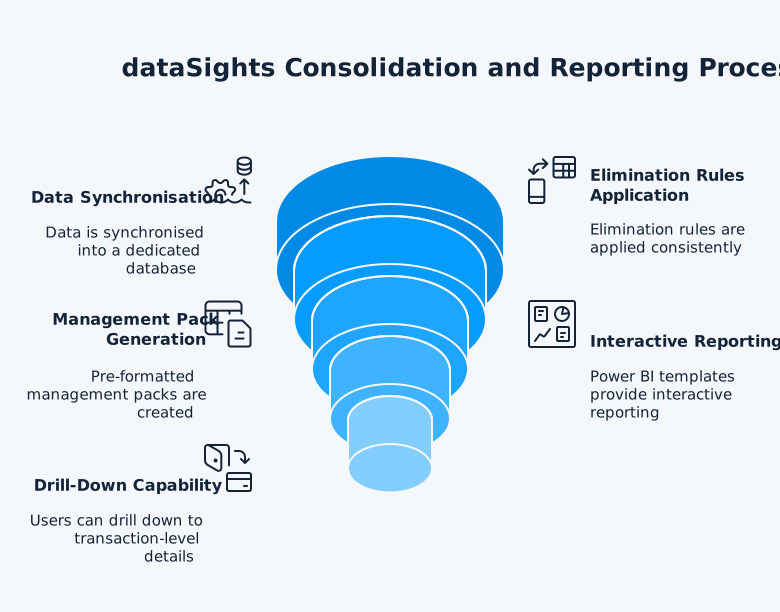
dataSights delivers pre-formatted consolidated financial statements that meet IFRS and GAAP presentation requirements, with automated data flows from Xero entities directly into reporting outputs.
Pre-Formatted Management Packs with Consolidated Statements
dataSights provides consolidated management packs through the web platform, including:
- Consolidated Profit & Loss
- Balance Sheet
- Trial Balance
- Budget & Budget Variance
- AR & AP Summary
- Detailed reports
- Cash Flow Statements
These packs update automatically as Xero data changes, eliminating the manual month-end scramble to compile and format consolidated statements.
Each customer receives a dedicated Azure SQL database where all Xero entity data synchronises. Elimination rules are configured once in the database layer, then applied consistently every period with full audit trails showing timestamp, user, and rationale for each adjustment.
Power BI Templates for Interactive Consolidated Reporting
For finance teams requiring more than standard management reports, dataSights connects Power BI directly to the consolidated database. Pre-built Power BI templates deliver consolidated views with drill-down capabilities from group-level summaries to transaction detail. You’re not limited to static PDF statements – you can filter by entity, department, product line, or any other dimension.
The platform handles consolidated KPI calculations automatically. Margin percentages, return on equity, debt ratios, and other metrics reflect the consolidated group position, not just individual entities. Power BI dashboards update on your configured schedule, giving you near real-time visibility into consolidated financial position rather than waiting for month-end.
Drill-Down from Consolidated to Transaction Level
One critical limitation of manually prepared consolidated statements is that when numbers look wrong, you can’t easily trace back to source transactions. dataSights maintains the connection from consolidated line items through eliminations back to individual entity transactions. Click a consolidated revenue figure in Power BI and drill into which entities contributed, what eliminations were applied, and view individual invoices if needed.
This drill-down capability transforms the audit season. External auditors can trace consolidated balances directly to source systems, review elimination rules in transparent SQL procedures, and verify that group-level adjustments follow documented, consistent logic. Manual spreadsheet consolidations simply can’t provide this level of transparency.
Frequently Asked Questions
What Is the Difference Between Consolidated and Unconsolidated Financial Statements?
Consolidated financial statements present a parent company and all subsidiaries it controls as a single economic entity, eliminating all intra-group transactions and balances. Unconsolidated financial statements present only the parent company’s own accounts, showing investments in subsidiaries as single line items rather than consolidating their full assets, liabilities, income, and expenses.
What Are the Main Components of Consolidated Financial Statements?
The main components are a consolidated balance sheet (statement of financial position), consolidated income statement (statement of profit or loss and other comprehensive income), consolidated statement of changes in equity, consolidated cash flow statement, and comprehensive notes explaining accounting policies, consolidation basis, and significant judgements.
How Are Non-Controlling Interests Presented in Consolidated Statements?
Non-controlling interests appear within equity on the consolidated balance sheet, separately from equity attributable to owners of the parent. In the consolidated income statement, profit or loss and other comprehensive income are attributed between parent shareholders and non-controlling interests based on ownership percentages.
What Consolidation Procedures Must Be Completed Before Presentation?
Before presenting consolidated statements, you must eliminate all intercompany balances (receivables/payables, loans), intercompany transactions (revenue/expenses, sales/purchases), unrealised profits in inventory or assets, and dividend income/expense between group entities. Investment elimination entries must remove the parent’s investment against the subsidiary’s equity to avoid double-counting.
Can Consolidated Financial Statements Be Prepared in Excel?
Technically, yes, but Excel consolidation becomes unmanageable beyond a few simple entities. Manual Excel consolidation lacks systematic audit trails, creates version control problems, breaks when structures change, and offers no way to verify elimination completeness. Most multi-entity groups using Excel for consolidation face recurring balancing issues and extensive month-end rework.
What Are the Disclosure Requirements for Consolidated Financial Statements?
IFRS 12 requires disclosing the basis of consolidation, nature of restrictions on accessing group assets or settling liabilities, composition of the group (subsidiaries acquired or disposed during the period), non-controlling interest details including summarised financial information, and significant judgements made in determining control. ASC 810 includes similar requirements plus specific VIE disclosures.
How Often Must Consolidated Financial Statements Be Prepared?
Listed companies typically prepare consolidated statements quarterly and annually. Private companies may prepare them annually for statutory purposes or more frequently for management reporting and board packs. The frequency depends on regulatory requirements, stakeholder needs, and internal management information requirements.
What Is the Difference Between IFRS 10 and ASC 810 Presentation Requirements?
Both require similar core components (balance sheet, income statement, equity changes, cash flows, notes), but ASC 810 includes specific additional requirements for Variable Interest Entities (VIEs). When a VIE’s creditors have recourse only to the VIE’s assets, those assets and liabilities must be separately presented on the consolidated balance sheet face. IFRS 10 has no direct equivalent to this requirement.
What Are the Key Differences Between IFRS and FRS 102 Consolidation Requirements?
IFRS offers a choice between NCI measurement (fair value or proportionate share) and requires impairment-only testing of goodwill. In contrast, FRS 102 requires proportionate share NCI and permits goodwill amortisation over its useful life (maximum 20 years).
Transform Your Consolidated Statement Presentation
Accurate consolidated financial statements should demonstrate control, not complexity. With dataSights Management Reports, Excel automation, and Power BI integration, finance teams deliver board-ready statements that balance every time. Teams often cut month-end close from over 15 days to under 5 while maintaining full audit visibility.
Automate Your Consolidated Financial Statement Production Today
Turn consolidation presentation challenges into automated workflows that deliver compliant, audit-ready statements every period. With dataSights’ Xero consolidation solution – rated 5.0 by 90+ users – you can reduce month-end close from weeks to days while maintaining full control through Power BI dashboards and Excel automation. Join 300+ businesses already transforming their multi-entity reporting with pre-formatted consolidated statements that update automatically.
About the Author
Kevin Wiegand
Founder & Client happiness
I’m Kevin Wiegand, and with over 25 years of experience in software development and financial data automation, I’ve honed my skills and knowledge in building enterprise-grade solutions for complex consolidation and reporting challenges. My journey includes developing custom solutions for data teams at Gazprom Marketing & Trading and E.ON, before founding dataSights in 2016. Today, dataSights helps over 300 businesses achieve 100% report automation. I’m passionate about sharing my expertise to help CFOs and Financial Controllers reduce their month-end close time and eliminate the manual Excel exports that drain their teams’ valuable time.