
Your month-end close stretches beyond two weeks. Balance sheets don’t reconcile. Elimination entries consume days of manual work. Understanding how to prepare consolidation of financial statements with examples transforms this complex process into systematic, repeatable steps. If you’re consolidating financial statements across multiple entities, these challenges feel familiar. The preparation process requires systematic Trial Balance foundations, precise elimination entries, and rigorous audit trails that manual spreadsheets simply cannot deliver consistently. The consolidation process involves identifying subsidiaries, gathering financial statements, eliminating intra-entity transactions, adjusting for non-controlling interests, and then preparing and reviewing consolidated financial statements.
How to Prepare Consolidation of Financial Statements with Examples Explained
How to prepare a consolidation of financial statements with examples means combining parent and subsidiary financials through systematic Trial Balance verification, elimination entries, and non-controlling interest calculations. You gather Trial Balances from each entity, remove all intercompany transactions, calculate non-controlling interests based on ownership percentages, then produce consolidated balance sheets, income statements, and cash flow statements. Manual consolidation across multiple entities often takes more than 15 days, while automated workflows commonly cut month-end close to under 5 days for dataSights clients.
Ready to Automate Your Financial Consolidation?
Stop wrestling with manual consolidations and broken formulas. dataSights automates multi-entity reporting, Xero consolidations, and Power BI connections. Join 300+ businesses already transforming their financial reporting with our platform, rated 5.0 out of 5 by 90+ verified Xero users.
Table of Contents
Understanding Consolidation Requirements Under IFRS 10
Before preparing consolidated financial statements, you need to determine which entities require consolidation. IFRS 10 establishes control as the single basis for consolidation, requiring all three elements:
- Power over the investee
- Exposure to variable returns
- Ability to use power to affect returns
While owning more than 50% of voting shares is a common indicator, IFRS 10 requires consolidation based on control, not a fixed ownership threshold. Control exists when the investor has power over the investee’s relevant activities, exposure or rights to variable returns, and the ability to use that power to affect those returns. Where there is significant influence but not control (often presumed at around 20% or more), the investment is generally accounted for using the equity method under IAS 28 rather than full consolidation. Some investees are structured so that control arises mainly through contractual arrangements rather than voting rights, but the same control test still applies.
Control Assessment Checklist:
- Ownership exceeds 50% of voting shares
- Ability to appoint or remove key management
- Power to direct relevant activities affecting returns
- Exposure to variable returns from involvement with investee
- Ability to use power to influence return amounts
Once control is established, IFRS 10 requires presenting consolidated financial statements that combine the parent and subsidiaries as a single economic entity.
Trial Balance: The Foundation of Accurate Consolidation
Every successful consolidation begins with balanced Trial Balances from each entity. Controllers use Consolidating Trial Balance Reports as essential control tools to ensure subsidiary financial transactions are in balance before continuing the consolidation process.
Your Trial Balance lists all accounts with debit and credit balances that must equal zero when totalled. Without balanced Trial Balances at the entity level, your consolidation will never balance at the group level.
Why Trial Balance Verification Matters:
- Catches unbalanced transactions before consolidation
- Provides drill-down capability to underlying transactions
- Ensures accuracy before applying elimination entries
- Reduces time spent troubleshooting consolidated mismatches
- Creates audit trail from entity to group level
Best practice requires each subsidiary to provide an adjusted trial balance showing final balances for all general ledger accounts, along with three primary financial statements.
Step-by-Step Consolidation Preparation Process
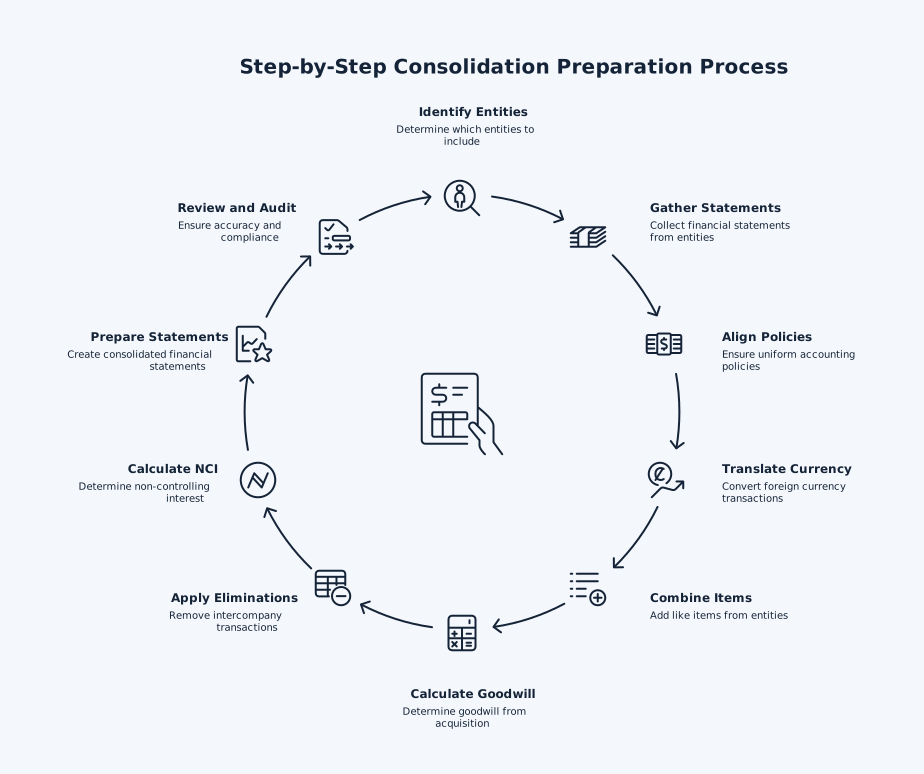
The consolidation process combines financial results of multiple entities within a group into a single set of financial statements. Follow this systematic approach to ensure accuracy and compliance:
Step 1: Identify All Reporting Entities
Begin by determining which entities require inclusion in consolidated financial statements. This involves identifying all companies over which the parent company has control or significant influence.
Document each entity’s:
- Legal name and registration number
- Ownership percentage
- Date control was obtained
- Functional currency
- Reporting period end date
Step 2: Gather Financial Statements
Collect financial statements from the parent company and its subsidiaries, ensuring they are prepared using consistent accounting policies and reporting periods.
Required documents from each entity:
- Trial Balance (adjusted and final)
- Balance Sheet (Statement of Financial Position)
- Income Statement (Statement of Profit or Loss)
- Cash Flow Statement
- Statement of Changes in Equity
- Notes detailing accounting policies
If reporting dates differ by more than three months, subsidiaries should prepare statements corresponding to the parent’s fiscal period. IFRS 10 permits a difference of up to three months between reporting dates when alignment is impracticable, with adjustments for significant transactions and events in the intervening period.
Step 3: Align Accounting Policies
Ensure all entities use uniform accounting policies. IFRS 10 requires uniform accounting policies across group entities, with adjustments made to align subsidiaries’ policies with the parent’s if needed before consolidation.
Common policy alignment areas:
- Revenue recognition methods
- Depreciation rates and methods
- Inventory valuation (FIFO vs weighted average)
- Foreign currency translation
- Lease accounting treatment
Step 4: Translate Foreign Currency
For subsidiaries operating in different currencies, translation is essential. Under IAS 21, transactions are initially recorded in the entity’s functional currency at the transaction date’s exchange rate. For consolidation, you translate each subsidiary into the group’s presentation currency.
Translation Requirements:
- Assets and liabilities: Closing rate at reporting date
- Income and expenses: Transaction-date rates (or average rates)
- Equity: Historical rates at transaction dates
- Translation adjustments: Recognise in Other Comprehensive Income under IAS 21
Step 5: Combine Like Items
Add together like items of assets, liabilities, equity, income, expenses and cash flows from the parent with those of its subsidiaries on a line-by-line basis.
This step aggregates:
- All cash and cash equivalents
- All receivables and payables
- All revenue streams
- All expense categories
- All asset classes
- All liability types
Combine 100% of subsidiary balances regardless of ownership percentage. Full consolidation requires including 100% of all subsidiary accounts, then separately accounting for non-controlling interest.
Step 6: Calculate and Record Goodwill
When the parent acquired control, goodwill may have arisen. Calculate goodwill as:
Goodwill Formula: Consideration Transferred + Fair Value of NCI − Fair Value of Identifiable Net Assets = Goodwill
Example Calculation:
- Consideration paid: £90,000 for 80% ownership
- Fair value of NCI (20%): £20,000
- Fair value of net assets at acquisition: £100,000
- Goodwill: £90,000 + £20,000 − £100,000 = £10,000
Record goodwill as a non-current asset in the consolidated balance sheet. Under IFRS 3, goodwill is recognised at the acquisition date, and IAS 36 requires goodwill to be tested annually for impairment rather than amortised.
Step 7: Apply Elimination Entries
Eliminations remove transactions between group entities so consolidated statements reflect only external activity. Without eliminations, consolidated reports double-count revenues, expenses, assets, or liabilities.
Common Elimination Types:
Intercompany Sales Elimination: If Parent sells £100,000 of goods to Subsidiary (cost £60,000), eliminate both revenue and cost:
Dr. Revenue £100,000 Cr. Cost of Goods Sold £60,000 Cr. Inventory £40,000 (unrealised profit)
Intercompany Debt Elimination: If Parent loans £500,000 to Subsidiary at 5% interest annually, eliminate both loan and interest:
Dr. Loan Payable £500,000 Cr. Loan Receivable £500,000
Dr. Interest Income £25,000 Cr. Interest Expense £25,000
Intercompany Receivables/Payables: When preparing consolidated accounts, intercompany balances must be eliminated as the group should only report amounts owed to external parties.
Unrealised Profit in Inventory: Calculate unrealised profit by multiplying the profit margin on intercompany sales by the value of goods remaining unsold at period-end. If goods are sold at 20% margin and £60,000 remains unsold, unrealised profit equals £10,000.
Watch how dataSights automates the complete consolidation preparation process, from importing multiple Xero entities to generating consolidated reports with automated elimination entries:
Step 8: Calculate Non-Controlling Interest
Non-controlling interest represents the portion of a subsidiary’s equity and earnings attributable to shareholders other than the parent.
Balance Sheet Treatment: NCI appears as a separate line within consolidated equity, distinct from parent shareholders’ equity. Calculate as:
NCI = Fair Value at Acquisition + Share of Post-Acquisition Retained Earnings
Income Statement Treatment: The subsidiary’s profit after eliminations is allocated between parent shareholders and NCI based on ownership percentages.
Example:
- Parent owns 80% of subsidiary
- Subsidiary profit: £100,000 post-elimination
- NCI share: £20,000 (20% × £100,000)
- Parent share: £80,000 (80% × £100,000)
Under IFRS 3, NCI at acquisition can be measured at fair value or at proportionate share of identifiable net assets.
Step 9: Prepare Consolidated Financial Statements
Once all adjustments are made, prepare consolidated statements including balance sheet, income statement, and cash flow statement.
Required Statements:
- Statement of Financial Position (consolidated balance sheet)
- Statement of Profit or Loss and Other Comprehensive Income
- Statement of Changes in Equity
- Statement of Cash Flows
- Notes including significant accounting policies
These statements present the parent and its subsidiaries as a single economic entity, providing stakeholders with a comprehensive view of the group’s financial performance, position, and cash flows.
Step 10: Review and Audit
Review consolidated financials for accuracy, completeness, and compliance with accounting standards. Consider engaging external auditors to perform an audit for additional assurance.
Review Checklist:
- Trial Balances balanced at entity level
- All elimination entries properly recorded
- NCI calculations verified
- Goodwill impairment tested
- Foreign currency translations accurate
- Disclosure requirements met
- Audit trails complete and documented
Worked Example: Complete Consolidation Preparation
Theory only gets you halfway. Let’s work through actual numbers showing exactly how consolidation preparation flows from individual entity balances to final consolidated statements. This example demonstrates goodwill calculation, elimination entries, NCI attribution, and consolidated retained earnings using the systematic approach outlined above.
Let’s walk through a practical example showing the complete consolidation process with specific numbers.
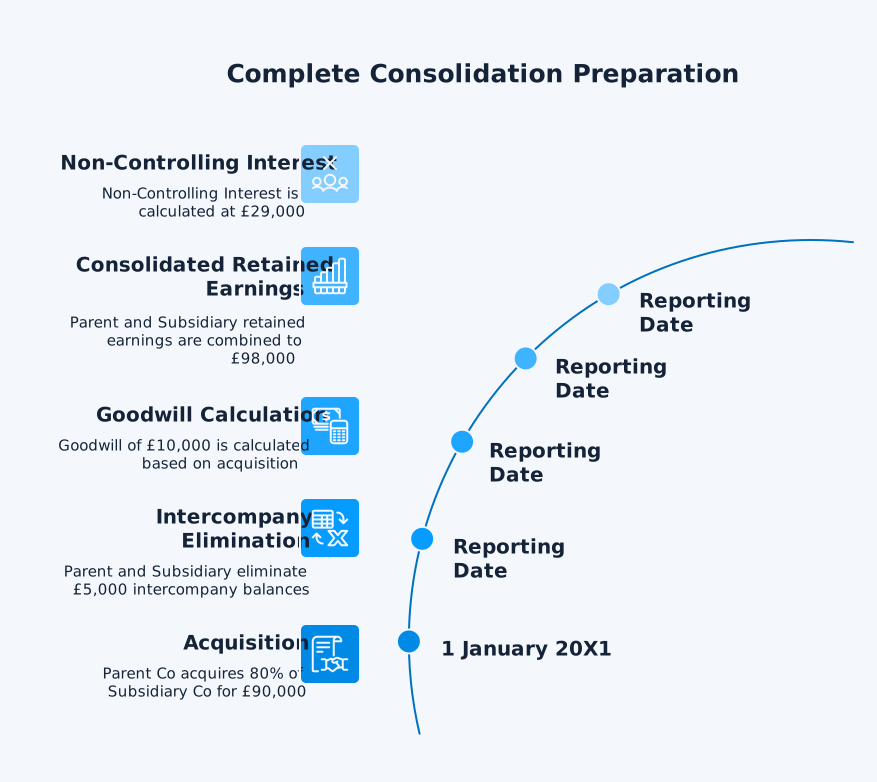
Scenario: On 1 January 20X1, Parent Co paid £90,000 for 80% controlling interest in Subsidiary Co when Subsidiary’s retained earnings were £25,000.
Step 1: Calculate Goodwill
- Consideration transferred: £90,000
- Fair value of NCI: £20,000
- Fair value of net assets at acquisition: £100,000
- Goodwill: £90,000 + £20,000 − £100,000 = £10,000
Step 2: Eliminate Intercompany Balances
Parent owes Subsidiary £5,000 at reporting date. Eliminate: Dr. Payables £5,000 Cr. Receivables £5,000
Step 3: Calculate Consolidated Retained Earnings
- Parent retained earnings: £62,000
- Parent share of Subsidiary post-acquisition retained earnings: 80% × £45,000 = £36,000
- Consolidated retained earnings: £62,000 + £36,000 = £98,000
Step 4: Calculate Non-Controlling Interest
- Fair value at acquisition: £20,000
- NCI share of post-acquisition profits: 20% × £45,000 = £9,000
- Total NCI: £20,000 + £9,000 = £29,000
Final Consolidated Balance Sheet:
- Total Assets: Combined parent and subsidiary assets
- Less: Eliminated receivable £5,000
- Plus: Goodwill £10,000
- Total Liabilities: Combined less eliminated payable £5,000
- Share Capital: Parent only (£50,000)
- Retained Earnings: £98,000
- Non-Controlling Interest: £29,000
Common Consolidation Challenges and Solutions
Even with systematic processes, specific technical issues create bottlenecks during consolidation preparation. Intercompany mismatches delay close. Foreign currency translations multiply complexity. Manual elimination entries introduce errors that take days to trace. Here’s how to address the four most common roadblocks that extend your consolidation timeline.
Challenge 1: Intercompany Mismatches
When subsidiary receivable doesn’t match parent payable, investigate timing differences or transaction recording errors. Automating eliminations with documented audit trails prevents these mismatches from delaying close.
Challenge 2: Multiple Currency Translations
Foreign currency translations require converting each transaction at historical rates, creating complexity. Establish standard monthly average rates and document exceptions requiring transaction-date rates.
Challenge 3: Different Reporting Periods
IFRS permits reporting date differences up to three months, with adjustments for significant intervening events. Align fiscal periods where feasible to avoid manual adjustments.
Challenge 4: Manual Elimination Entry Errors
Manual consolidation extends month-end close and increases error risk. Automated elimination entries with system-level documentation reduce errors and provide complete audit trails.
Frequently Asked Questions
How Long Does Consolidation Preparation Take?
Manual consolidation typically takes 15+ days for month-end close. Automated consolidation reduces this to under 5 days by eliminating manual elimination entries and providing real-time Trial Balance consolidation.
Do I Need to Consolidate if I Own Less Than 100% of a Subsidiary?
Yes. Full consolidation requires combining 100% of subsidiary accounts regardless of ownership percentage, then separately accounting for the non-controlling interest portion.
What's the Difference Between Upstream and Downstream Eliminations?
Downstream eliminations involve the parent selling to subsidiaries, typically impacting only the controlling interest. Upstream eliminations involve subsidiaries selling to the parent, affecting NCI proportionally.
Can Consolidated Statements Use Different Fiscal Year Ends?
IFRS 10 permits a difference of up to three months between parent and subsidiary reporting dates when aligning them is impracticable, provided you adjust for significant transactions and events in the intervening period and disclose the approach.
What if Subsidiary Accounting Policies Differ From Parent?
IFRS 10 requires uniform accounting policies across group entities. Adjust subsidiary policies to align with parent policies before combining financial statements.
How Do I Handle Unrealised Profit in Intercompany Inventory?
Eliminate unrealised profit by adjusting inventory to cost to the group, deferring profit recognition until external sale occurs. Calculate as profit margin multiplied by unsold inventory value.
What Elimination Entries Are Mandatory?
All intercompany transactions require elimination, including sales, purchases, loans, dividends, interest, and receivables/payables between group entities.
Where Does Goodwill Appear in Consolidated Statements?
Goodwill appears as a non-current asset in the consolidated balance sheet. Under IFRS 3, goodwill is recognised when control is obtained, and IAS 36 requires it to be tested annually for impairment instead of being amortised.
Transform Manual Consolidation Into Automated Efficiency
Consolidation preparation does not have to consume weeks of manual work and countless reconciliations. The 10-step approach in this guide shows how Trial Balance discipline, consistent accounting policies, rigorous eliminations, and clear non-controlling interest calculations create accurate, audit-ready group results. When those steps are automated, finance teams move from chasing errors at month-end to confirming results in days, with transparent audit trails that external auditors can follow.
Streamline Your Xero Consolidation with Automated Workflows
Stop spending weeks on manual consolidations and Excel eliminations. dataSights delivers consolidated management packs via our web platform with full eliminations, audit trails, and the key reports your board cares about, while your existing Excel and Power BI files refresh automatically from the same data model. dataSights clients routinely cut month-end from more than 15 days to under 5 and join 300+ businesses rated 5.0 out of 5 by 90+ verified Xero users.
About the Author
Kevin Wiegand
Founder & Client happiness
I’m Kevin Wiegand, and with over 25 years of experience in software development and financial data automation, I’ve honed my skills and knowledge in building enterprise-grade solutions for complex consolidation and reporting challenges. My journey includes developing custom solutions for data teams at Gazprom Marketing & Trading and E.ON, before founding dataSights in 2016. Today, dataSights helps over 300 businesses achieve 100% report automation. I’m passionate about sharing my expertise to help CFOs and Financial Controllers reduce their month-end close time and eliminate the manual Excel exports that drain their teams’ valuable time.