Financial Consolidation Example: Complete Worked Guide with Real Numbers
by Kevin Wiegand
|
Mar 31, 2026
|
Xero
Home
|
Xero
|
Financial Consolidation Example: Complete Worked Guide with Real Numbers
Ever reach month-end and your group balance sheet still will not reconcile after combining multiple entities? This financial consolidation example walks through the practical steps finance teams use to produce accurate group statements: combining entity balances, removing intercompany activity, and handling goodwill, NCI, and FX where needed. You will see worked numbers and elimination journals you can reuse, plus a realistic consolidation workflow from source balances through to consolidated statements. Use it as a template the next time your consolidation pack needs to tie out quickly and cleanly.
Financial Consolidation Example
A financial consolidation example shows how a group combines parent and subsidiary results line by line, then removes internal balances and transactions (investment in a subsidiary, intercompany sales, loans, dividends, and unrealised profit). Under IFRS 10, consolidation is required when the parent controls the investee (power, exposure to variable returns, and the ability to use power to affect returns).
Ready to Automate Your Financial Consolidation?
Stop wrestling with manual consolidations and broken formulas. dataSights automates multi-entity reporting, Xero consolidations, and Power BI connections. Join 300+ businesses already transforming their financial reporting with our platform, rated 5.0 out of 5 by 90+ verified Xero users.
Let’s start with a straightforward example: Parent Ltd acquires 100% of Sub Ltd for £500,000 cash. At acquisition, Sub Ltd’s net assets (total assets minus liabilities) equal £500,000.
Sub Ltd Balance Sheet at Acquisition:
Assets: £700,000
Liabilities: £200,000
Net Assets (Equity): £500,000
Parent Ltd’s Investment Entry:
Dr Investment in Sub Ltd £500,000 Cr Cash £500,000
Consolidation Elimination Entry:
Dr Net Assets of Sub Ltd £500,000 Cr Investment in Sub Ltd £500,000
This elimination removes Parent’s investment account against Sub’s equity to avoid double-counting. The consolidated balance sheet now shows:
All of Parent’s assets (including its operating assets, but excluding the £500,000 investment)
All of Sub’s assets (£700,000)
All of Parent’s liabilities
All of Sub’s liabilities (£200,000)
Parent’s equity only (Sub’s equity is eliminated)
No goodwill arises because consideration equals fair value of net assets acquired. Starting from reconciled entity balances reduces downstream reconciliation issues before you post eliminations and consolidation adjustments.
Multi-Entity Consolidation Example with Eliminations
Real consolidations involve multiple entities with intercompany transactions. Here’s a three-entity group demonstrating practical elimination mechanics.
Group Structure:
Parent Ltd (UK holding company)
Sub A Ltd (100% owned trading subsidiary)
Sub B Ltd (100% owned manufacturing subsidiary)
Intercompany Transactions During the Year:
Sub B manufactures goods at cost of £60,000 and sells to Sub A for £100,000 (£40,000 markup)
Sub A holds all inventory at year-end (hasn’t resold to external customers)
Parent lends £500,000 to Sub A at 5% interest (£25,000 annual interest)
Intercompany Sale Elimination: The £100,000 sale from Sub B to Sub A inflates group revenue and inventory. Sub A holds goods that cost the group £60,000 but are recorded at £100,000. The £40,000 unrealised profit must be eliminated:
Step 1: Eliminate the intercompany sale
Dr Revenue (Sub B) £100,000 Cr Cost of Goods Sold (Sub A) £100,000
Step 2: Eliminate the unrealised profit in closing inventory
Dr Cost of Goods Sold £40,000 Cr Inventory £40,000
After these eliminations, consolidated inventory is stated at £60,000 (cost to the group), and the £40,000 unrealised profit is deferred until Sub A sells the goods to external customers.
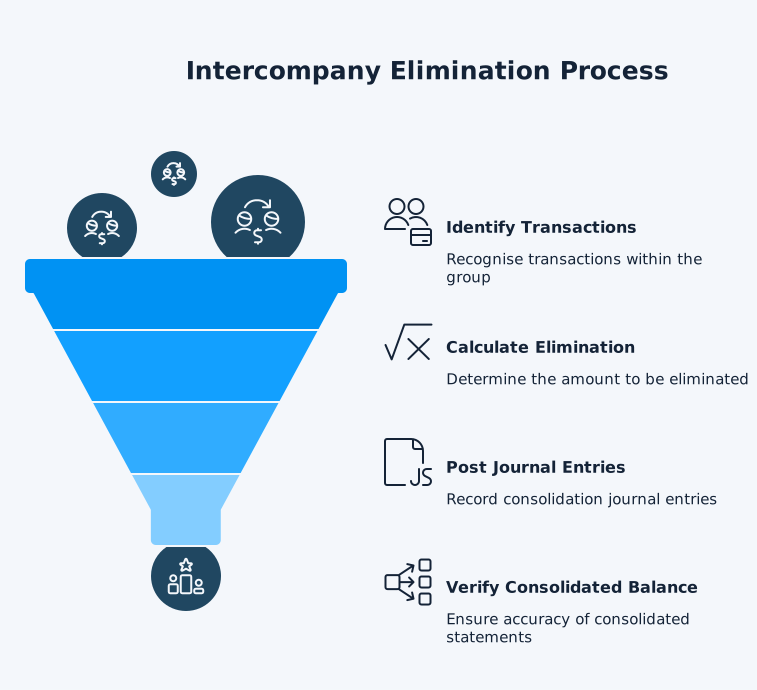
Intercompany Loan Elimination: The £500,000 loan and related interest represent internal group financing with no external economic impact:
Dr Loan Payable (Sub A) £500,000 Cr Loan Receivable (Parent) £500,000
Dr Interest Income (Parent) £25,000 Cr Interest Expense (Sub A) £25,000
Both the loan balance and interest flows eliminate in consolidation. Consolidated statements show only external debt and genuine interest cost.
Trial Balance Foundation for Accurate Consolidation
Every consolidation starts with trial balances from each entity. Pull full trial balance data from each entity to ensure accuracy before eliminations. Manual Excel consolidations often stall here when source balances do not reconcile or when the chart of accounts changes mid-year. dataSights syncs trial balance data from multiple Xero entities so you can start from consistent source balances and then apply elimination rules with an audit trail.
Intercompany Elimination Examples with Journal Entries
Revenue and Expense Elimination: Entity A sells services to Entity B for £100,000. On consolidation, both the revenue in Entity A and the expense in Entity B eliminate:
Dr Revenue (Entity A) £100,000 Cr Expense (Entity B) £100,000
The group hasn’t earned anything on its own. Only external revenue remains in consolidated statements.
Receivable and Payable Elimination: If Entity A still hasn’t received payment, an intercompany receivable/payable exists:
Dr Accounts Payable (Entity B) £100,000 Cr Accounts Receivable (Entity A) £100,000
Consolidated balance sheet shows only external receivables and payables.
Unrealised Profit on Inventory: Entity A sells inventory to Entity B at a 25% markup on cost. Entity B holds £50,000 at the intercompany transfer price at year-end.
Dr Cost of Goods Sold £10,000 Cr Inventory £10,000
This reduces consolidated inventory to group cost and defers the profit until the goods are sold externally.
Intercompany Dividend Elimination: Subsidiary pays £80,000 dividend to parent:
Dr Dividend Income (Parent) £80,000 Cr Dividends Declared / Distributions (Subsidiary) £80,000
Dividends within the group do not create external income in consolidated results.
Non-Controlling Interest Consolidation Example
When parent ownership is less than 100%, non-controlling interest (NCI) represents external shareholders’ portion of subsidiary equity and profit.
Scenario: Parent owns 80% of Sub for £800,000. Sub’s fair value of identifiable net assets at acquisition is £750,000. Using the fair value method, NCI is measured at acquisition-date fair value. If Sub’s total fair value is £1,000,000, NCI’s 20% share equals £200,000.
Goodwill Calculation:
Purchase consideration £800,000 NCI fair value £200,000 Total £1,000,000 Less: Fair value of net assets (£750,000)
Goodwill £250,000
Under IFRS 3, you can measure NCI at fair value or at NCI’s proportionate share of identifiable net assets. Fair value method recognises more goodwill attributable to NCI.
Profit Attribution: Sub reports £100,000 profit for the year (after intercompany eliminations). Consolidated income statement includes the full £100,000 but attributes £20,000 (20%) to NCI:
Profit for the year £100,000 Attributable to: Parent shareholders £80,000
Non-controlling interests £20,000
Balance Sheet Presentation: NCI appears as a separate line within consolidated equity:
The £170,000 NCI comprises £200,000 acquisition-date fair value + £20,000 profit share – £50,000 dividends paid to NCI shareholders (their share of distributions).
Complete Consolidation Process Example: Step-by-Step
Here’s a comprehensive consolidation workflow with realistic numbers:
1. Gather Individual Entity Balances (Amounts in £000s)
Parent Ltd (including the investment in Sub):
Assets: 2,500 (includes Investment in Sub: 600)
Liabilities: 1,200
Equity: 1,300
Revenue: 800
Expenses: 500
Sub Ltd:
Assets: 900
Liabilities: 300
Equity: 600
Revenue: 400
Expenses: 250
2. Align Accounting Policies and Reporting Dates
IFRS 10 (together with IAS 8) requires uniform accounting policies across group entities and restricts different reporting dates to no more than three months where alignment is impracticable (with adjustments for significant intervening transactions/events).
3. Identify Intercompany Transactions
Sub sold goods to Parent for 150 (cost 120)
Parent holds all of this inventory at year-end
Total unrealised profit in closing inventory: 150 − 120 = 30
4. Post Elimination Entries
Investment elimination (removes double-counting): Dr Equity (Sub) 600 Cr Investment in Sub (Parent) 600
Intercompany sale + unrealised profit elimination (inventory still on hand): Dr Revenue (Sub) 150 Cr Cost of Goods Sold (Sub) 120 Cr Inventory (Parent) 30
This removes the internal revenue and defers the internal profit by reducing closing inventory to group cost.
5. Calculate NCI (If Applicable)
With 100% ownership, no NCI is required. If ownership is less than 100%, allocate the subsidiary’s post-elimination profit between the parent and NCI based on their respective ownership percentages.
6. Produce Consolidated Trial Balance (After Eliminations)
Assets: 2,770 (2,500 + 900 − 600 − 30)
Liabilities: 1,500 (1,200 + 300)
Equity: 1,270 (balancing figure)
Revenue: 1,050 (800 + 400 − 150)
Expenses: 630 (500 + 250 − 120)
7. Generate Consolidated Financial Statements
Consolidated Income Statement (£000s):
Revenue: 1,050
Expenses: (630)
Profit for the year: 420
Consolidated Balance Sheet (£000s):
Assets: 2,770
Liabilities: (1,500)
Equity: 1,270
Watch how dataSights automates the consolidation process from multiple Xero entities into Excel with pre-formatted management packs and near real-time refresh capabilities:
Xero Multi-Entity Consolidation Example
A real-world scenario: a professional services group operates 5 Xero entities (1 holding company + 4 trading subsidiaries). Monthly consolidation requirements include:
Consolidated P&L with intercompany eliminations
Balance sheet reconciliation across entities
Trial balance roll-forward for management reporting
KPI dashboards tracking group performance
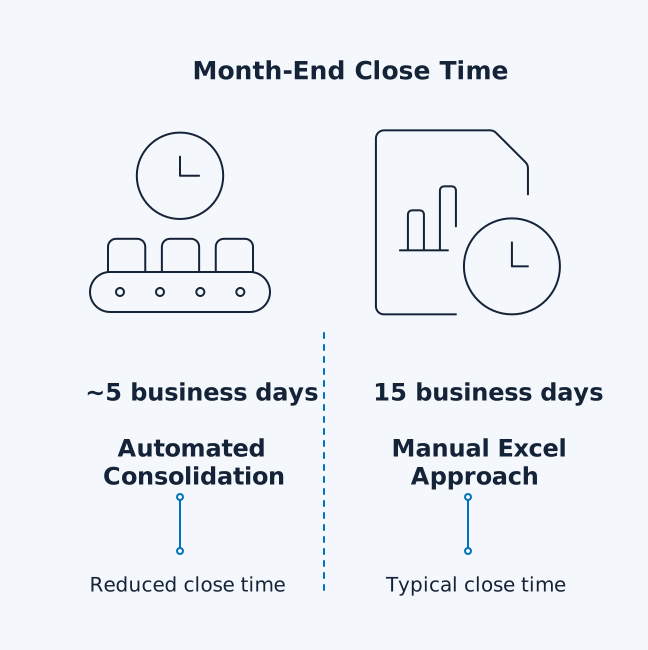
Manual Excel Approach: Month-end close typically takes 12-15 business days
Day 1-3: Export trial balances from each Xero entity to CSV
Day 4-7: Manual elimination identification and calculation in Excel
Day 8-10: Consolidation worksheet preparation and reconciliation
Day 11-12: Management pack formatting and review
Day 13-15: Corrections and re-consolidation for errors
Common issues include:
Intercompany mismatches discovered too late
Elimination formulas breaking when new accounts added
No audit trail for consolidation adjustments
Inability to refresh for corrections without starting over
Automated dataSights Consolidation: The close timeline can often be reduced to around 5 business days, depending on entity count, elimination complexity, and review requirements:
Automated trial balance sync from all 5 Xero entities
Configured elimination rules applied consistently
Consolidation processing runs quickly once data is synced (timing depends on data volume and rules)
Management packs refresh from the same consolidated model
Audit trail for elimination entries and adjustments
In well-configured setups, teams may reduce month-end close effort from over 15 business days to around 5, depending on entity count, elimination complexity, and review requirements. Once data is synced and rules are configured, teams can refresh consolidated reporting without rebuilding spreadsheets for each correction cycle.
How dataSights Automates Consolidation Examples Like These
dataSights delivers pre-formatted management packs through our web platform, including consolidated P&L, balance sheet, trial balance, and KPI metrics. If you want to automate custom Excel reports or month-end tasks, you can refresh consolidated Xero data into Excel using the dataSights OfficeAddIn and Power Query. That lets teams work with current numbers without exporting CSVs or reshaping files each close. For advanced visualisation and drill-down, Power BI connects to the same consolidated model. Depending on your setup, dashboards can refresh near real-time.
Foreign Currency Consolidation Example
UK parent (GBP functional and presentation currency) consolidates US subsidiary (USD functional currency).
US Subsidiary Trial Balance (USD):
Revenue: $1,000,000
Expenses: $700,000
Assets: $500,000
Liabilities: $200,000
Exchange Rates:
Average rate for the year: £0.79 per $1
Closing rate at balance sheet date: £0.81 per $1
Translation Under IAS 21: Subsidiaries measure transactions in their functional currency (USD for the US sub), then translate to the parent’s presentation currency (GBP) for consolidation.
Income statement items translate at average rates:
Revenue: $1,000,000 × £0.79 = £790,000
Expenses: $700,000 × £0.79 = £553,000
Profit: $300,000 × £0.79 = £237,000
Balance sheet items translate at closing rates:
Assets: $500,000 × £0.81 = £405,000
Liabilities: $200,000 × £0.81 = £162,000
Net assets: $300,000 × £0.81 = £243,000
Cumulative Translation Adjustment (CTA): The £6,000 difference (£243,000 translated net assets – £237,000 translated profit) arises from translating income statement items at average exchange rates and net assets at the closing rate. This translation difference is recognised in Other Comprehensive Income and accumulated in the foreign currency translation reserve until the foreign operation is disposed of.
Equity items translate at historical rates (rates at the dates transactions occurred). The opening balance would use the rate when the subsidiary was acquired or when equity was contributed.
Goodwill Recognition and Impairment Example
Parent acquires 100% of Target for £800,000. At acquisition date:
Target’s Book Values:
Assets: £700,000
Liabilities: £300,000
Net Assets: £400,000
Fair Value Adjustments:
Property undervalued by £150,000
Brand not recognised on balance sheet: £100,000
Fair value of identifiable net assets: £650,000
Goodwill Calculation:
Purchase consideration £800,000 Less: Fair value of net assets (£650,000)
Goodwill recognised £150,000
Under IFRS 3, goodwill represents future economic benefits from the combined business value, assembled workforce, and other intangibles that don’t qualify for separate recognition. Goodwill is tested annually for impairment under IAS 36 rather than amortised.
Annual Impairment Test Example: Year 2 after acquisition, the cash-generating unit (CGU) containing Target shows:
Carrying amount including goodwill: £750,000
Recoverable amount (higher of fair value less costs to sell or value in use): £700,000
Impairment loss: £750,000 – £700,000 = £50,000
The impairment reduces goodwill first:
Dr Impairment Loss (P&L) £50,000 Cr Goodwill £50,000
Consolidated financial statements present a parent and its controlled subsidiaries as a single economic entity, with full line-by-line combination and elimination of intercompany transactions. Combined financial statements aggregate entities under common ownership or management without a parent-subsidiary control structure. Combined statements are not defined in IFRS; practice is jurisdiction-specific. Many combined presentations still eliminate intercompany transactions to avoid overstatement, but policies should be disclosed.
IFRS 10 permits a reporting date difference of up to 3 months when alignment is impracticable, provided adjustments are made for significant transactions and events in the intervening period. For example, if Parent’s year-end is 31 December and Subsidiary’s is 30 September, the Subsidiary’s September results can be consolidated with adjustments for material October-December transactions.
No. Associates (typically 20-50% ownership with significant influence) and joint ventures use the equity method under IAS 28 and IFRS 11, not full consolidation. Your consolidated balance sheet shows a single line item for the investment. Your consolidated income statement includes your share of the associate’s profit or loss. This differs from full consolidation, where you combine all assets, liabilities, income, and expenses line-by-line.
Direction matters for NCI attribution. Downstream eliminations (parent sells to subsidiary) reduce the parent’s profit without affecting NCI. Upstream eliminations (subsidiary sells to parent) reduce the subsidiary’s profit, so NCI’s share decreases accordingly. For example, if Sub (80% owned) sells to Parent with £10,000 unrealised profit, the elimination reduces Sub’s profit by £10,000, meaning NCI’s profit share falls by £2,000 (20% × £10,000).
Consolidated retained earnings equals parent’s retained earnings plus parent’s share of subsidiary’s post-acquisition retained earnings, adjusted for consolidation entries. If Parent acquired Sub when Sub’s retained earnings were £100,000, and Sub now has £200,000 retained earnings with 80% parent ownership: consolidated retained earnings include Parent’s full retained earnings + 80% × (£200,000 – £100,000) = Parent’s RE + £80,000.
When one group member sells inventory to another at a markup, profit remains unrealised until the goods are sold to external customers. Eliminate the unrealised profit from both consolidated profit and closing inventory. If Entity A sells to Entity B at a 25% markup on cost and Entity B holds £80,000 of this inventory at the intercompany transfer price, the £16,000 unrealised profit (£80,000 × 25 ÷ 125) is eliminated by reducing consolidated inventory to £64,000 (cost to the group) and deferring the profit.
NCI appears as a separate line within consolidated equity on the balance sheet, distinct from parent shareholders’ equity. On the income statement, consolidated profit includes 100% of subsidiary results, then allocates the portion attributable to NCI separately. For example: “Profit for the year £100,000. Attributable to: Parent shareholders £80,000, Non-controlling interests £20,000.”
For accounting periods beginning on or after 6 April 2025, the Companies Act thresholds for the small companies regime include aggregate turnover of not more than £15m net (or £18m gross), aggregate balance sheet total of not more than £7.5m net (or £9m gross), and 50 or fewer employees (meeting two of three tests).
Equity method shows the investment as a single line on the balance sheet (initially at cost, then adjusted for the investor’s share of investee profit/loss and dividends received). Consolidation combines all assets, liabilities, revenues, and expenses line-by-line with elimination of intercompany transactions and recognition of NCI. Equity method is used for associates and joint ventures where you have significant influence or joint control but not full control, requiring consolidation.
Automation eliminates manual CSV exports and Excel formula management. SQL database architecture enables proper financial consolidation with configured elimination rules, currency tables, and account mappings. Once consolidation rules are configured, reporting connects to clean, transformed, ready-to-use data structures. dataSights handles multi-entity Xero consolidation with pre-formatted management packs, Excel automation capabilities, and Power BI integration for 300+ businesses globally.
Close With Fewer Spreadsheet Failure Points
Clean consolidations come from reconciled source balances, consistent policies, and elimination entries that you can repeat each period. Use the examples above to remove intercompany sales, loans, dividends, and unrealised profit, so group numbers reflect only external activity. If you’re consolidating in spreadsheets, prioritise an audit trail for every adjustment and a process that can be rerun without breaking formulas. If you need faster refresh cycles, automate the data sync and apply eliminations through configured rules rather than manual worksheets.
Streamline Your Financial Consolidation with Xero Automation
Ready to reduce manual consolidation time and refresh reporting without CSV exports? With dataSights’ Xero consolidation solution – rated 5.0 by 90+ users – you can automate consolidations and refresh reporting faster, depending on entity count and elimination complexity. Join 300+ businesses already transforming their multi-entity reporting with consolidated trial balances, automated eliminations, and management packs that refresh automatically.
I’m Kevin Wiegand, and with over 25 years of experience in software development and financial data automation, I’ve honed my skills and knowledge in building enterprise-grade solutions for complex consolidation and reporting challenges. My journey includes developing custom solutions for data teams at Gazprom Marketing & Trading and E.ON, before founding dataSights in 2016. Today, dataSights helps over 300 businesses achieve 100% report automation. I’m passionate about sharing my expertise to help CFOs and Financial Controllers reduce their month-end close time and eliminate the manual Excel exports that drain their teams’ valuable time.