
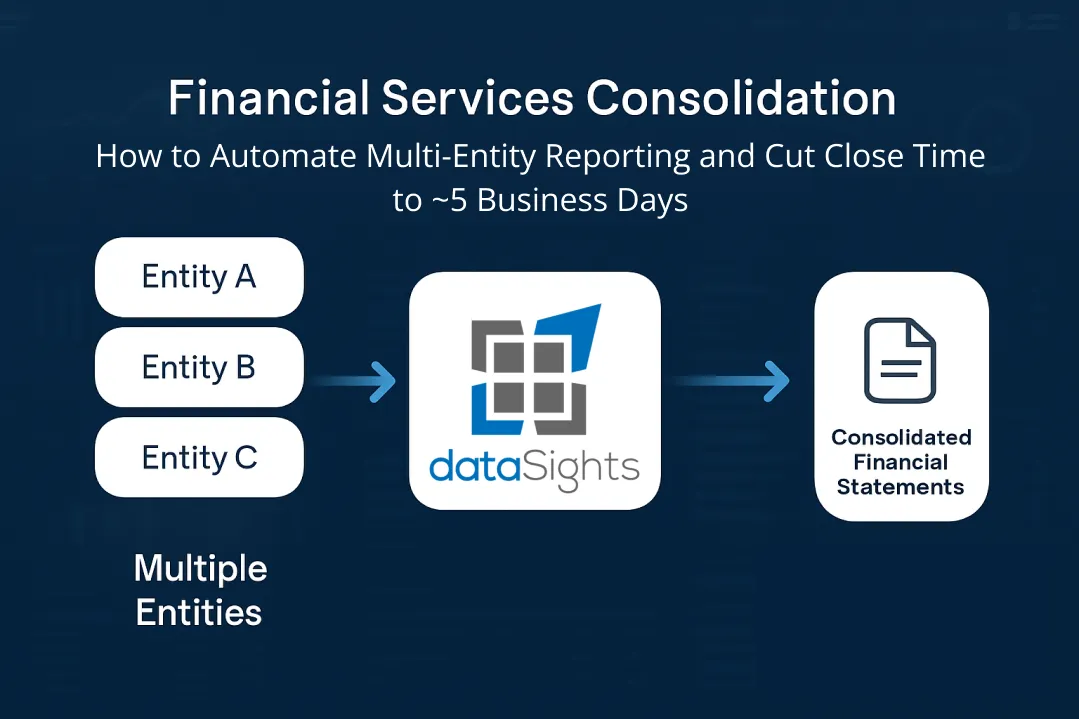
Financial services consolidation across multiple entities often takes finance teams over 15 business days at month-end. You’re manually combining spreadsheets, eliminating intercompany transactions, and reconciling accounts that won’t balance. Your board waits two weeks for numbers that should take days. This guide explains the steps finance teams use to standardise trial balances, eliminate intercompany activity, and reduce close time to around 5 business days.
What Is Financial Services Consolidation?
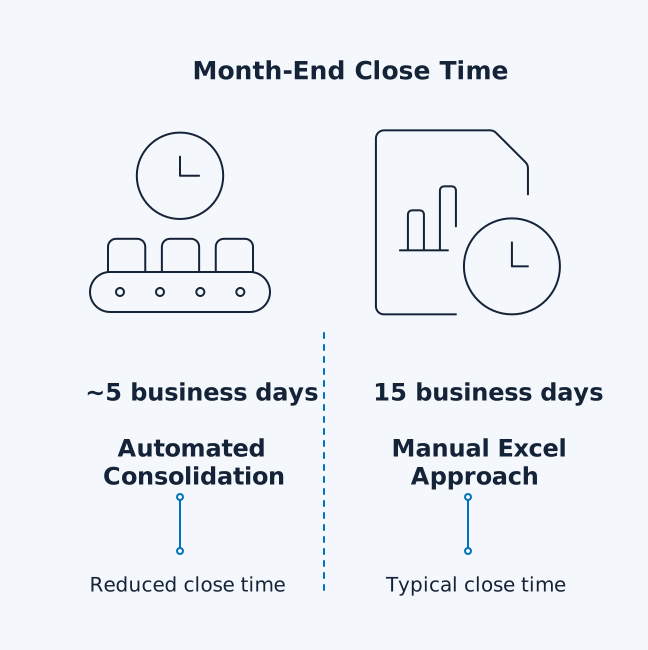
Financial services consolidation combines multiple entities into one set of International Financial Reporting Standards (IFRS) or Generally Accepted Accounting Principles (GAAP)-compliant group financial statements by aggregating trial balances, translating currencies where required, and eliminating intercompany balances and transactions so the group reports as a single economic entity. Many finance teams still spend 15+ business days on spreadsheet-driven consolidation; automation can shorten the cycle once mappings and elimination rules are standardised.
Ready to Automate Your Financial Consolidation?
Stop wrestling with manual consolidations and broken formulas. dataSights automates multi-entity reporting, Xero consolidations, and Power BI connections. Join 300+ businesses already transforming their financial reporting with our platform, rated 5.0 out of 5 by 90+ verified Xero users.
Table of Contents
Why Financial Services Consolidation Matters
Financial services consolidation impacts both industry structure and finance team operations. Industry-wide merger activity reshapes competitive landscapes while regulatory requirements force multi-entity groups to prepare consolidated financial statements. Understanding both trends helps CFOs navigate strategic decisions and operational reporting requirements.
Industry Consolidation Trends
Industry research shows that financial services mergers continue to accelerate, particularly across asset management and regional banking groups. Larger institutions are expanding through acquisition to increase scale, reduce cost structures, and broaden their product offerings. Regulatory changes, economic conditions, and investor preferences for larger, multi-product institutions continue to drive consolidation activity across the sector.
US bank M&A activity is tracked in FDIC merger decision reporting, and the long-run decline in the number of FDIC-insured institutions can be explored via FDIC historical datasets. These trends increase multi-entity reporting complexity post-deal.
Financial Reporting Consolidation
Under IFRS 10, a parent must consolidate an investee when it has control. Control exists when the parent has power over relevant activities, exposure or rights to variable returns, and the ability to use that power to affect returns. Ownership of more than 50% is a common indicator, but not the test itself. Under US GAAP ASC 810, consolidation is assessed under voting-interest or Variable Interest Entity (VIE) guidance, depending on the nature of the entity and the investor’s involvement.
Finance teams managing multiple Xero entities, Employment Hero Payroll across subsidiaries, or complex international structures need accurate consolidation for:
- Regulatory compliance (IFRS, GAAP, SOX)
- Board reporting and strategic decision-making
- Investor transparency and due diligence
- Internal performance management
The Financial Consolidation Process
Framework note: This guide references IFRS requirements (IFRS 10, IFRS 3, IAS 21, IAS 1), which most UK-listed and large groups apply as UK-adopted IFRS. UK groups using FRS 102 follow similar principles with key differences (e.g., goodwill and NCI measurement) noted in the FAQ. Legal requirements under the Companies Act 2006 apply regardless of framework.
Consolidation follows six mandatory steps that transform individual entity Trial Balances into unified financial statements. Each step introduces specific technical requirements – from currency translation under IAS 21 to elimination entries that prevent double-counting revenue. Missing any step produces consolidated statements that won’t reconcile.
Step 1: Data Collection and Trial Balance Aggregation
Consolidation begins with collecting Trial Balances from each subsidiary. Each entity provides final general ledger account balances and key financial statements. A standard reporting package ensures consistency in how entities submit their data and reduces time spent validating formats or correcting classification issues.
Manual collection using spreadsheets introduces delays measured in days, not hours. Teams managing 10+ entities spend entire work weeks chasing down subsidiary data, validating account codes, and standardising formats before consolidation even begins.
Step 2: Currency Conversion
Under IAS 21, each subsidiary measures transactions in its functional currency, which reflects the primary economic environment in which it operates. For consolidation, balances are translated into the parent’s presentation currency. Assets and liabilities are translated at the closing rate; income and expenses use average rates.
Equity is typically translated at historical rates, and translation differences for foreign operations are recognised in other comprehensive income (often accumulated in a foreign currency translation reserve). In practice, groups apply closing/average/historical rates based on their IAS 21 policy and disclosure – software should apply the rates you configure, not invent the policy.
Example: A EUR subsidiary reports cash of €100,000 at year-end. At a closing rate of GBP/EUR = 1.10 (i.e., 1 GBP = 1.10 EUR), consolidated cash includes €100,000 ÷ 1.10 = £90,909 (if GBP presentation). Revenue may use an average rate for the period, per policy.
Step 3: Intercompany Eliminations
Intercompany transactions must be eliminated to prevent overstating revenue, expenses, assets, or liabilities at group level. When one entity sells goods or services to another, both parties record the transaction in their own books. Consolidated statements reverse these entries so results reflect only external activity.
Elimination entries require:
- Intercompany loans and interest income/expense
- Internal sales revenue and corresponding cost of goods sold
- Management fees and service charges between entities
- Unrealised profit in inventory
Unrealised profit must be eliminated whenever one group entity sells goods or assets to another entity and those items remain unsold to external parties at period end. Inventory must be reduced to the group’s original cost. Profit is deferred until the inventory is sold to third parties, with attribution split appropriately between parent and NCI depending on transaction direction.
Manual eliminations in spreadsheets create significant risk. A single missed or incorrect elimination can materially distort consolidated results, especially when group structures include several entities with frequent intercompany activity.
Example: Sub sells inventory to Parent for £50,000 with £10,000 profit, and £20,000 remains unsold at period end. Unrealised profit = £10,000 × (£20,000 ÷ £50,000) = £4,000. Defer the £4,000 unrealised profit in consolidation so inventory is carried at group cost until sold externally.
Example elimination (intercompany sale):
- Dr Sales (or Intercompany Sales, if separately tracked) £X
- Cr COGS/Purchases (or Intercompany Purchases, if separately tracked) £X
If inventory is still on hand (unrealised profit):
- Dr COGS £Y
- Cr Inventory £Y
Note: The exact account names depend on your chart of accounts design. Some groups use dedicated intercompany accounts; others post directly to standard sales/COGS accounts. The key is that both the revenue and cost sides of the intercompany transaction are reversed.
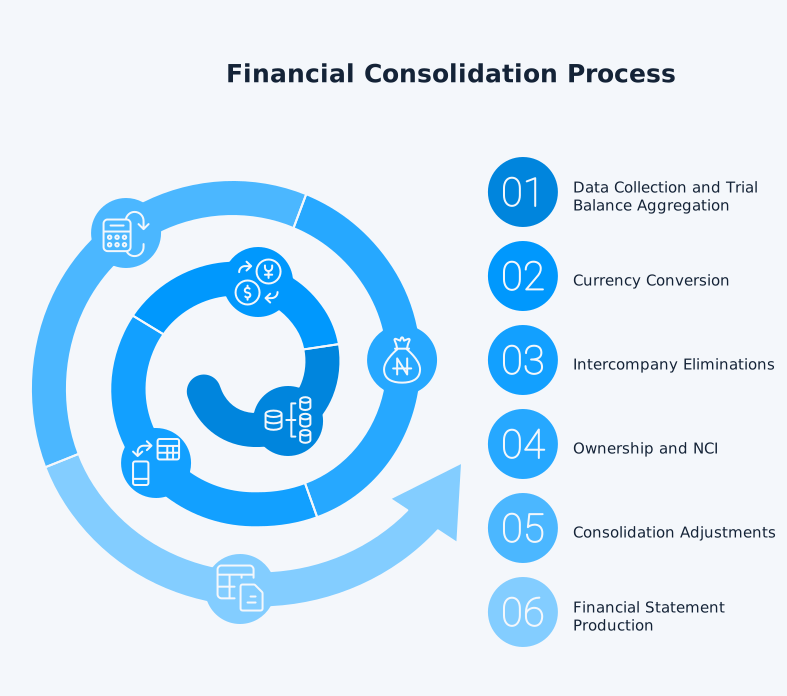
Step 4: Ownership and Non-Controlling Interest (NCI)
Non-Controlling Interest (NCI) represents the portion of a subsidiary not owned by the parent. Under IFRS 3, NCI can be measured at fair value or at the proportionate share of net assets at acquisition. When eliminating unrealised profit, direction matters: downstream transactions (parent to subsidiary) reduce the parent’s profit, while upstream transactions (subsidiary to parent) reduce the subsidiary’s profit and therefore reduce NCI’s attribution.
NCI appears as a separate line in consolidated equity. The subsidiary’s profit is allocated between parent shareholders and NCI based on ownership percentages after intercompany eliminations.
Example: Parent owns 80% of Sub. After eliminations, Sub’s adjusted profit is £1,000,000 (allocated as £800,000 parent share and £200,000 NCI share) to parent equity holders and £200,000 to NCI.
Step 5: Consolidation Adjustments
Final consolidation requires adjustments for:
- Goodwill recognised at acquisition under IFRS 3
- Fair value adjustments from purchase price allocation
- Different accounting policies across subsidiaries
- Tax consolidation entries
Each adjustment requires documentation, creating audit trails that external auditors review during year-end procedures.
Step 6: Financial Statement Production
The consolidated financial statements include:
- Statement of financial position (balance sheet)
- Statement of profit or loss and other comprehensive income
- Statement of changes in equity
- Statement of cash flows
- Notes including significant accounting policies and supporting disclosures
These requirements follow IAS 1.
Consolidated statements typically take several days to weeks for finance teams using manual processes. Companies implementing automated consolidation reduce this timeline to 5 or less business days.
dataSights delivers consolidated management reports directly through its platform as the primary output, including:
- Consolidated P&L
- Balance Sheet
- Trial Balance
- AR/AP
- Budgets
- Variance analysis
For teams preferring spreadsheets, Excel automation refreshes consolidated data using the OfficeAddIn and Power Query. For advanced analytics, Power BI connects directly to the consolidated SQL database for always-current drill-down dashboards.
Financial Services Consolidation Challenges
Manual consolidation creates bottlenecks that extend month-end close beyond two weeks. Technology integration failures, inconsistent data formats, and missing audit trails compound delays. Finance teams managing 10+ entities face challenges that spreadsheets cannot solve efficiently.
1. Technology Integration Complexity
Bank mergers encounter significant obstacles when integrating disparate systems. Few institutions rely on identical infrastructure, making integration delicate and expensive. Legacy systems and fragmented back-office functions exacerbate difficulties.
Groups with decentralised finance functions often take longer to close because each entity maintains differing systems, charts of accounts, and reporting processes. Merged institutions also inherit legacy infrastructure that can complicate data standardisation and slow down consolidation.
2. Data Quality and Consistency
Data quality represents one of the most significant challenges in financial consolidation. Inconsistent data structures, incorrect classifications, and manual data entry errors can compromise accuracy. When source data lacks integrity, consolidation requires additional reconciliation layers, extending the close timeline.
Financial institutions typically operate with disparate systems and applications, each with its own data format. This inconsistency impedes integration of data from multiple sources and creation of a unified customer view.
3. Regulatory Compliance Requirements
The 2010 Dodd-Frank Act amended the Bank Holding Company Act to require consideration of financial stability risks during mergers. Federal banking agencies must assess “the extent to which a proposed acquisition, merger, or consolidation would result in greater or more concentrated risks to the stability of the United States banking or financial system.”
Compliance requirements include:
- IFRS and GAAP adherence in consolidated statements
- Pillar Two global minimum tax: groups with consolidated revenue of €750 million or more must calculate a jurisdictional GloBE effective tax rate and disclose or report any top-up tax required under local Pillar Two legislation. Implementation is jurisdiction-specific.
- In the US, resolution planning (‘living will’) and related consolidation expectations apply to large banking organisations – thresholds and categories change, so finance teams should confirm current requirements for their group.
- Enhanced prudential standards and liquidity stress testing
4. Manual Process Limitations
Manual consolidation using spreadsheets creates bottlenecks that delay reporting. Finance teams often spend several days gathering information from each subsidiary, validating balances, and resolving inconsistencies. Combined with reconciliation requirements and multiple approval layers, manual consolidation frequently pushes month-end close beyond two weeks.
Manual processes lack:
- Automated elimination entries
- Currency conversion at scale
- Automated checks that surface exceptions earlier
- Complete audit trails
- Version control capabilities
Automation Solutions for Financial Consolidation
Consolidation software eliminates manual data collection and automates elimination entries that take days to process manually. Direct API connections pull Trial Balance data from all entities, while configured rules handle intercompany transactions automatically. Implementation often delivers measurable time savings within the first few close cycles, depending on entity count, currency complexity, and intercompany volume.
Benefits of Consolidation Software
Automated consolidation significantly reduces reporting timelines by removing manual data gathering, repetitive eliminations, and spreadsheet-driven reconciliation.
Key automation advantages include:
- Always-current visibility via scheduled or on-demand refresh
- Automated intercompany elimination entries
- Support for IFRS/GAAP workflows (e.g., IAS 21 translation logic, audit trails, elimination rules) – with policy configured by the customer
- Complete audit trails documenting every adjustment
- Currency translation using configured closing/average rates (per your IAS 21 policy and chosen data source)
Key Automation Features
Modern consolidation platforms provide:
- Automated Data Collection: Pull financial data from multiple ledgers and supplementary source systems without manual exports. Direct API connections to accounting systems eliminate CSV file handling.
- Elimination Automation: Configure elimination rules that automatically identify and remove intercompany transactions. Automated eliminations ensure accurate financial reporting by handling loans, revenue, and expenses with adjusting journal entries.
- Currency Management: Calculate balance sheet and profit & loss conversions with accurate cumulative translation adjustment (CTA) reporting. Automated foreign exchange translation ensures compliance with IAS 21 requirements.
- Ownership Structures: Handle multi-level consolidations with unlimited hierarchies. Calculate minority interest and equity adjustments automatically across complex organisation structures.
Automated rules improve accuracy and create repeatable, auditable consolidation workflows.
Implementation Considerations
Implementation timeframes vary depending on group complexity, but successful projects typically rely on:
- Chart-of-accounts standardisation
- Clearly defined elimination rules
- Reliable integrations with accounting systems
- Strong change management across finance teams
dataSights Xero Consolidation Solution
Finance teams managing multiple Xero entities face unique consolidation challenges. Xero is strong for entity-level accounting, but group consolidation typically requires a workflow outside the core organisation – either exporting and consolidating in spreadsheets, or using a consolidation add-on.
dataSights automates Xero consolidation through direct API connections that pull Trial Balance data from all entities into a dedicated Azure SQL database. Consolidation rules handle eliminations automatically, while Excel and Power BI connect directly for always-current reporting via on-demand or scheduled refresh.
The platform delivers:
- Pre-formatted management packs with consolidated P&L, Balance Sheet, and Trial Balance
- Automated elimination entries with complete audit trails
- Multi-currency support across all Xero organisations
- Board-ready reports that update automatically
dataSights customers reduce month-end close from over 15 days to ~5 days. With 90+ five-star Xero user reviews and 300+ businesses using the platform, automated consolidation transforms financial reporting from reactive processing to proactive management.
Frequently Asked Questions
What Is the Difference Between Financial Consolidation and Combination?
Financial consolidation combines parent and subsidiary financial statements when control exists, eliminating intercompany transactions to present the group as one economic entity under IFRS 10 or GAAP. Combined financial statements are not defined in IFRS; practice is jurisdiction-specific. They often aggregate entities managed together or under common ownership (e.g., carve-outs or pre-IPO presentations). Many combined presentations still eliminate intra-group transactions and balances to avoid overstatement – policies should be disclosed.
How Long Should Financial Consolidation Take?
Manual consolidation timelines extend beyond 15 business days for organisations with decentralised processes or complex structures. Automated consolidation software reduces this to ~5 business days by eliminating manual data collection, automating eliminations, and providing near-real-time validation. Implementation complexity affects exact timelines.
Do Small Groups Need Consolidation Software?
Groups managing 2-3 simple entities may handle consolidation in spreadsheets temporarily. However, as entity count, transaction volume, or intercompany complexity increases, manual processes become unsustainable. Automation becomes valuable when elimination volumes increase or when multi-currency reporting increases complexity.
What Accounting Standards Govern Financial Consolidation?
IFRS 10 Consolidated Financial Statements governs international consolidation requirements, defining control as the basis for consolidation. US companies follow GAAP ASC 810, which provides similar control-based consolidation guidance. Both standards require eliminating intercompany transactions and presenting unified financial statements.
How Do You Handle Different Subsidiary Reporting Dates?
IFRS permits reporting date differences up to three months between parent and subsidiary when alignment proves impractical, provided adjustments cover significant intervening transactions and events. Many organisations adopt accounting policies consolidating subsidiaries on a one-quarter lag, disclosed in financial statement notes.
What Are Intercompany Eliminations?
Intercompany eliminations remove transactions between group entities to avoid double-counting in consolidated statements. Common eliminations include intercompany sales revenue and corresponding purchases, loan balances and related interest, management fees between entities, and unrealised profit in inventory. All eliminations require documentation, creating audit trails. When non-controlling interests exist, the direction of eliminations matters (parent→sub vs sub→parent) because it affects whether the adjustment changes the NCI share of profit.
Can Automation Handle Complex Ownership Structures?
Modern consolidation software manages unlimited organisational hierarchies with multiple consolidation levels. Automated platforms calculate non-controlling interest proportions, handle step acquisitions where ownership increases over time, and apply equity method accounting for associates. Configuration defines ownership percentages and consolidation rules at each level.
What Data Security Standards Apply to Consolidation Software?
Because consolidation platforms handle sensitive financial data, buyers typically look for controls such as encryption in transit/at rest, role-based access, MFA, and independent assurance (for example, SOC 2 Type II), where applicable. Cloud-based solutions implement encryption at rest and in transit, role-based access controls, multi-factor authentication, and regular security audits to protect sensitive financial data. Ask your vendor for their latest security documentation and attestations rather than assuming a standard applies.
Your Consolidations Shouldn't Take Three Weeks
Finance teams waste entire work weeks chasing subsidiary data, reconciling intercompany accounts, and fixing elimination entries that don’t balance. Boards wait for numbers while you’re stuck validating Trial Balances across separate Xero files. Automated consolidation processes your eliminations, convert currencies, and produce reconciled statements without the manual Excel work. The difference between three working weeks close cycles and 5-day completions isn’t working harder – it’s connecting your entities to consolidated reporting that updates automatically.
Automate Xero Consolidation With Direct API Connections
dataSights connects all your Xero organisations into a single consolidated database. Pull the complete Trial Balance data automatically via the API. Configure elimination rules and mappings once – then eliminations process automatically based on the rules you’ve defined, with an audit trail. Excel and Power BI connect directly for scheduled or on-demand consolidated P&L dashboards, Balance Sheet, and cash flow. Rated 5.0 on the Xero App Store by 90+ verified Xero users. 300+ businesses already running automated multi-entity reporting with dataSights.
About the Author
Kevin Wiegand
Founder & Client happiness
I’m Kevin Wiegand, and with over 25 years of experience in software development and financial data automation, I’ve honed my skills and knowledge in building enterprise-grade solutions for complex consolidation and reporting challenges. My journey includes developing custom solutions for data teams at Gazprom Marketing & Trading and E.ON, before founding dataSights in 2016. Today, dataSights helps over 300 businesses achieve 100% report automation. I’m passionate about sharing my expertise to help CFOs and Financial Controllers reduce their month-end close time and eliminate the manual Excel exports that drain their teams’ valuable time.