
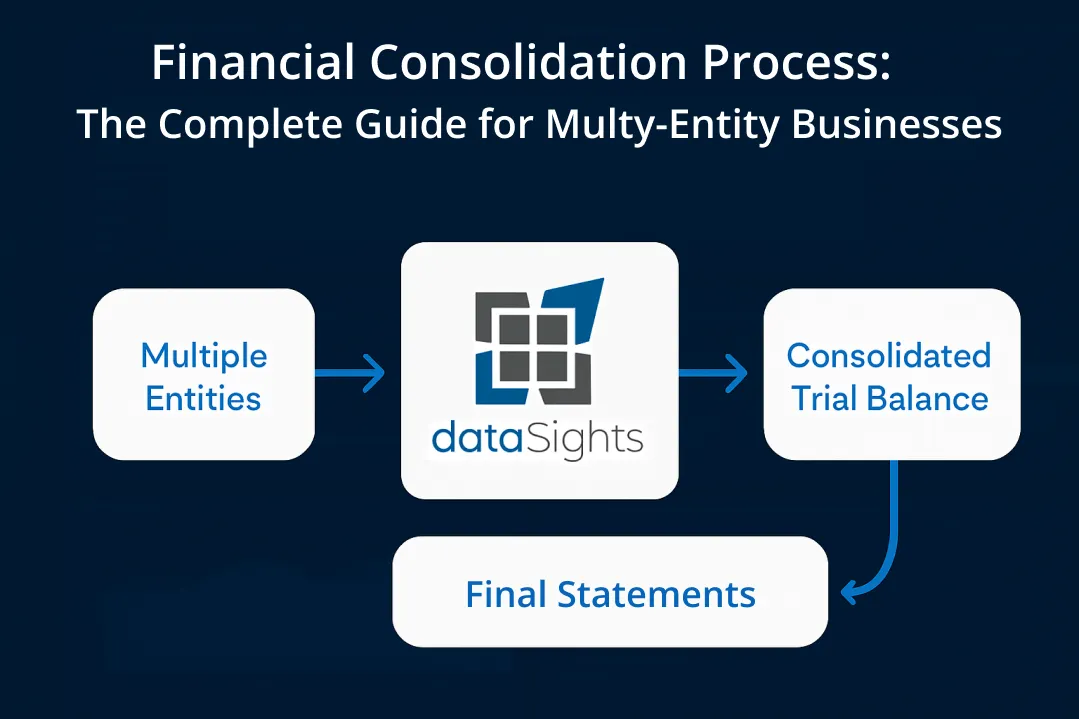
Your finance team is buried in spreadsheets two weeks after month-end, trying to make the consolidated Trial Balance balance. One entity’s figures keep changing. Intercompany eliminations don’t reconcile. Your CFO needs the group P&L yesterday. Sound familiar? Manual financial consolidation turns what should be a 5-day close into a 15-day nightmare. This guide walks you through the complete financial consolidation process, from collecting Trial Balances to generating audit-ready consolidated statements, and shows you how to reduce your consolidation time by up to 70%.
What Is the Financial Consolidation Process?
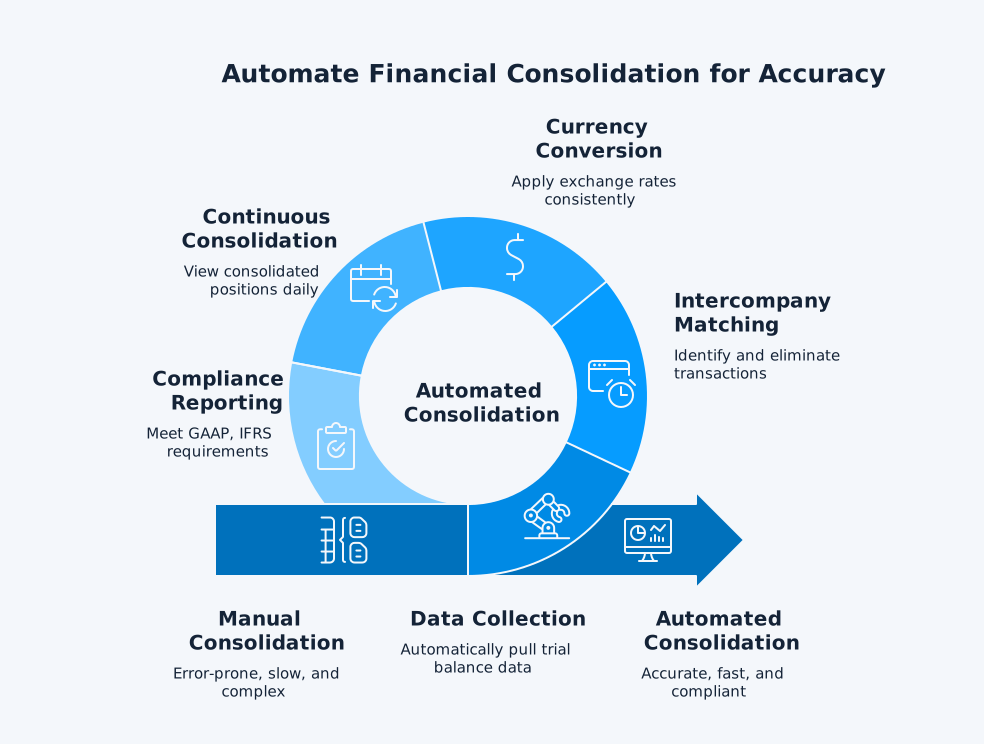
The financial consolidation process combines financial data from multiple subsidiaries into unified financial statements for a parent company. Benchmarking studies consistently show that financial consolidation offers crucial insights into company performance by providing an accurate representation of finances across all entities. A typical process includes six key steps: data collection, currency conversion, intercompany elimination, adjustments, Trial Balance reconciliation, and final statement generation. With dataSights, businesses reduce month-end close from weeks to days by automating these steps across both small and large consolidation of entities.
Ready to Automate Your Financial Consolidation?
Stop wrestling with manual consolidations and broken formulas. dataSights automates multi-entity reporting, Xero consolidations, and Power BI connections. Join 300+ businesses already transforming their financial reporting with our platform, rated 5.0 out of 5 by 90+ verified Xero users.
Table of Contents
Why the Financial Consolidation Process Matters
Consolidated financial statements aren’t optional paperwork.
- Public companies are required under IFRS or US GAAP to prepare consolidated statements whenever they control subsidiaries.
- Private businesses utilise consolidation for strategic decision-making, investor reporting, and to understand their true group performance.
Your individual entity reports hide the complete picture. Parent Company might show £5 million profit while subsidiaries show £3 million combined. But if £2 million of that profit came from intercompany sales, your actual external revenue is lower. Without proper consolidation, you’re making decisions on inflated numbers.
The stakes are higher for multi-entity finance teams. You’re reconciling data across different systems, currencies, and accounting policies. One missed elimination entry throws off your entire group position. Financial teams report spending late nights and early mornings just trying to get the consolidated Trial Balance to balance.
Watch dataSights consolidate multiple Xero entities to Power BI and Excel:
This 12-minute demonstration shows real-world consolidated statements, including automated eliminations and how Trial Balances reconcile across entities, providing a practical example of the consolidation process in action.
The 6 Steps of the Financial Consolidation Process
Every consolidation follows the same systematic workflow, whether you’re combining 3 entities or 30. These six steps ensure your consolidated Trial Balance reconciles to entity-level data, your eliminations balance, and your final statements pass audit. Master this process, and you’ll pinpoint exactly where manual workflows break down and where automation yields the most significant time savings.
Step 1: Collect Financial Data From All Entities
- Start by gathering Trial Balances and financial statements (balance sheet, income statement, cash flow statement) from each subsidiary, pulling information from various general ledger systems. Your Trial Balance serves as your foundation – without balanced Trial Balances at the entity level, your consolidation will never balance. Each subsidiary must close its books completely before you begin group-level consolidation. For Xero users, this means manually exporting Trial Balances from each organisation unless you use automation. Xero has no native intercompany/consolidation module; eliminations and consolidation journals are done in your consolidation/reporting layer (e.g., dataSights).
- Standardise your chart of accounts across entities where possible. This mapping step saves hours during consolidation. If Subsidiary A refers to an account as “Office Rent” and Subsidiary B refers to it as “Premises Costs”, you’ll spend time manually aligning them every month. Apply uniform accounting policies across all consolidated entities (IFRS 10).
Note: IFRS permits up to a 3-month reporting date gap; adjust for significant transactions in the intervening period.
Step 2: Convert All Data to a Single Reporting Currency
When subsidiaries operate in different countries, currency conversion becomes essential. Your US parent company requires UK subsidiary data to be converted from pounds to dollars.
- Translate income and expense items at transaction-date rates (an average rate is acceptable if it approximates spot).
- Translate monetary assets and liabilities at the closing rate; non-monetary items at historical rates (or the rate of the date fair value was measured). Equity items remain at historical rates. The balancing difference is recorded in OCI as a cumulative translation adjustment (CTA).
- Manual currency conversion increases your risk of error. One incorrect exchange rate can affect multiple accounts. Automation calculates and applies rates correctly every time, eliminating this common consolidation bottleneck.
- For income and expenses, average rates for the period are commonly used where they reasonably approximate transaction-date rates.
On full disposal of a foreign operation, reclassify the related CTA from OCI to profit or loss.
Step 3: Eliminate Intercompany Transactions
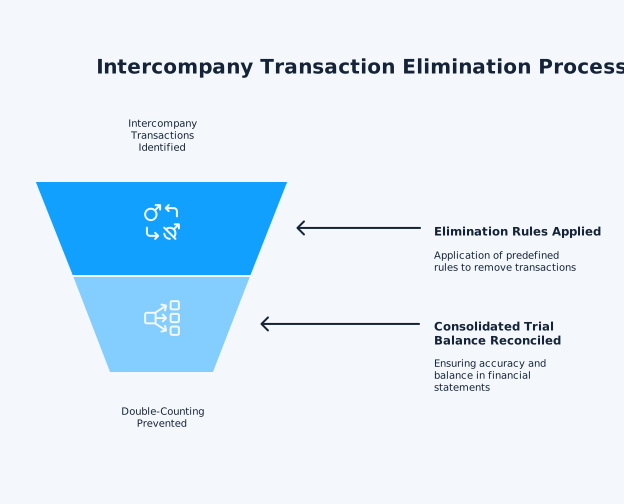
Intercompany eliminations cancel transactions that don’t impact the parent company’s net assets. When Subsidiary A sells to Subsidiary B for £100,000, both entities record the transaction. Subsidiary A shows revenue, Subsidiary B shows expense. From the group’s perspective, no external revenue occurred.
Without elimination, your consolidated income statement inflates both revenue and expenses by the intercompany amount. Your group appears larger than it actually is. ASC 810 requires that intercompany income between parent companies and subsidiaries must be eliminated.
There are four main types of eliminations:
- Intercompany debt: Loans between subsidiaries or parent/subsidiary relationships
- Intercompany revenue and expenses: Sales, service fees, or charges between entities
- Intercompany equity: Ownership interests that must be removed from the consolidated view
- Intercompany dividends and intercompany interest: Also eliminate with the related receivable/payable.
Eliminate unrealised intercompany profit in closing inventory and PP&E. Defer profit until the goods are sold to third parties (and reduce inventory/PP&E to cost to the group).
Eliminate intra-group transactions and balances in full. For attribution, direction matters:
- Downstream (parent→sub): elimination affects the parent only (no NCI impact).
- Upstream (sub→parent): elimination reduces the subsidiary’s profit and therefore reduces NCI’s share of profit.
Consider deferred tax effects arising from eliminations (IAS 12), especially for unrealised profit in inventory/PP&E.
The complexity grows exponentially with entity count. Ten entities create 45 potential intercompany relationships. Twenty entities could have 190 combinations to track and eliminate.
Manual elimination management in spreadsheets across multiple Xero files is the number one source of reconciliation errors. You’re tracking relationships in your head or basic Excel lists, with no system-level audit trail showing who made which adjustments and when.
dataSights automates eliminations with pre-defined rules. Once configured, intercompany transactions clear automatically with full audit documentation. No more hunting through spreadsheets to find that missing £50,000 elimination entry.
Step 4: Make Adjustments for Non-Controlling Interest and Goodwill
When you own less than 100% of a subsidiary, non-controlling interest (NCI) represents the portion owned by others. Full consolidation includes 100% of the subsidiary’s balances, then separately accounts for NCI.
Worked Example – Non-Controlling Interest:
- Parent owns 80% of Sub A
- Sub A profit = £100,000
- Consolidated income statement shows £100,000 profit, but £20,000 is attributed to NCI
- On the balance sheet, NCI appears as a separate equity line
Goodwill is recognised under IFRS 3/ASC 805 at acquisition and maintained in the consolidation layer (not usually in entity ledgers like Xero). It is not amortised under IFRS; test annually for impairment (IAS 36). For foreign operations, goodwill is treated as an asset of the foreign operation and translated at the closing rate.
Goodwill calculation follows the formula: Purchase Price – Fair Value of Net Assets Acquired = Goodwill.
Note for Xero users: Xero doesn’t calculate or track goodwill. This adjustment must be made manually during consolidation, typically via journals in your consolidation software or reporting layer.
Step 5: Reconcile the Consolidated Trial Balance
Your consolidated Trial Balance must balance; debits must equal credits. If they don’t, you’ve missed an elimination, made a currency conversion error, or have a data quality issue. Research confirms that unbalanced Trial Balances mean late nights for finance teams, with errors becoming harder to find the longer you wait. Real-time consolidation surfaces issues daily when context is fresh, allowing you to fix mismatched intercompany transactions in minutes instead of investigating them two weeks after month-end.
dataSights pulls full Trial Balance data from each entity, ensuring consolidations always tie back to source systems. When your consolidated statements don’t balance, you can drill down to the exact transaction causing the discrepancy.
Step 6: Generate Consolidated Financial Statements
The final step produces your consolidated profit and loss, balance sheet, and cash flow statement. These reports combine the financial results of multiple entities into a single set of financial statements.
But compliance statements aren’t enough. CFOs need management intelligence:
- Board packs with commentary
- KPI dashboards
- Variance analysis
- Drill-down capabilities from group to transaction level
Produce the following statements:
- Statement of financial position (balance sheet)
- Statement of profit or loss and other comprehensive income
- Statement of changes in equity
- Statement of cash flows, and notes
Static consolidation at month-end gives you discovery mode. You find problems after they’ve occurred. Continuous consolidation gives you a confirmation mode. Issues surface as they happen, and month-end becomes validation rather than investigation.
Intercompany Eliminations: The Hardest Part (and How to Automate Them)
Manual eliminations in spreadsheets are error-prone:
- Mismatched counterparties
- Timing differences
- Duplicated entries
- Unbalanced consolidating trial balances.
Without a clear audit trail, month-end reviews turn into detective work.
What “good” looks like is a controlled, rule-based engine that consistently clears:
- Intercompany AR/AP
- Revenue and cost
- Loans and interest
- Unrealised profit in inventory/PP&E
- Equity transactions.
dataSights centralises mappings and applies reusable rules by counterparty, account, currency and period, with tolerances and date windows. Matching pairs auto-clear, exceptions land in a queue, and reviewers can drill straight from the consolidated view back to the original entity transaction.
Governance is built in: every elimination is documented in a posted journal, including the user, timestamp, and rationale. You can rerun rules, compare runs, and export a complete audit pack so audits shift from interrogation to confirmation.
The approach scales from a handful to large groups of entities without performance degradation, keeping close cycles short as your structure grows.
Common Financial Consolidation Challenges
Manual consolidation creates predictable problems that worsen with entity count:
- Data quality issues delay your close.
- Intercompany eliminations don’t reconcile.
- Currency conversions contain errors.
- Your consolidated Trial Balance refuses to balance at 11 PM on day 14.
These challenges aren’t unique to your finance team – they’re systematic failures of manual processes trying to handle work that demands automation.
Data Quality and Collection Errors
Entry errors from manual processes, late reporting, inadequate validation controls, and poor integration across close processes all contribute to data quality issues. Financial consolidation can only be as good as the data it’s built on.
Missing or incorrect data from one subsidiary delays the entire group consolidation. When Subsidiary C submits balances three days late, your whole timeline shifts. Manual data collection exacerbates this problem, often resulting in chaos due to emails, shared drives, and version control issues.
Automation solves collection challenges. Data flows from source systems automatically on your schedule. No more chasing subsidiaries for their monthly numbers. No more “which version is final?” confusion.
Slow Reconciliation Processes
Financial consolidation involves resource-intensive tasks, such as eliminating intercompany transactions and calculating group ownership. These take time. When reporting deadlines are tight, time isn’t a luxury finance teams have.
A typical 20-entity group might spend:
- 3-4 hours downloading and formatting Trial Balances
- 6-8 hours mapping accounts and reconciling differences
- 4-6 hours on intercompany eliminations
- 2-3 hours on currency conversions
- 5-7 hours investigating why the consolidated Trial Balance doesn’t balance
That’s your 5-day close stretched to 15 days, with your team buried in spreadsheets instead of analysing results. Benchmarking from APQC has reported bottom-quartile closes at ~10+ days; manual consolidation is a common driver.
Lack of Automation
Many financial consolidation processes can be automated. Even basic automation helps accelerate processes and eliminate mistakes. But this is an area where companies fail to invest.
Excel-based consolidation exposes organisations to the risk of data manipulation. The control environment of Excel is generally poor, with the ability to change and overwrite formulae and a lack of version control.
Spreadsheet consolidation can’t provide the audit trails that PCAOB and IFRS disclosure requirements demand. You need system-level documentation showing who made which adjustments, when, and why.
Complex Organisational Structures
Companies with complex structures face significant obstacles:
- Globally distributed units
- Newly integrated entities
- A lack of communication
- Poorly synchronised financial processes
- Evolving regulatory requirements
Different accounting standards across jurisdictions further complicate matters. Country-specific variations in accounting standards and regulations necessitate that parent companies adjust each incoming statement to their own standards.
Multi-level consolidation structures add another layer. If Holding Company A owns Holding Company B, which owns three operating subsidiaries, you’re consolidating at multiple levels before reaching the ultimate parent.
How Automation Transforms the Financial Consolidation Process
Manual consolidation made sense when businesses had 2-3 entities. At scale, it breaks down. Specialist consolidation software handles what manual processes cannot.
dataSights syncs data from multiple Xero accounts via API. This data flows into the dataSights cloud database, where Power BI connects directly to create real-time dashboards and reports. No Excel file processing. No manual data handling.
The platform delivers:
- Automated Trial Balance consolidation across both small and large entities
- Pre-formatted management packs including Profit & Loss, Balance Sheet, Trial Balance, Budget & Budget Variance, AR & AP Summary and Detailed reports
- Real-time updates across all consolidated reports with automatic eliminations
- Complete audit trails documenting every adjustment with timestamp, user, and rationale
One client consolidated data from 72 Xero entities within 3 seconds. Without automation, this would have been impossible in Excel, especially with eliminations, NCI, and multi-currency requirements.
The time savings are measurable. Reduce month-end close from over 15 days to under 5 days. Reduce investigation time by 60% when issues arise daily, rather than two weeks after close. Transform the audit from interrogation to confirmation with the complete elimination of documentation.
Regulatory Requirements: GAAP vs IFRS Consolidation
Both US GAAP and IFRS require consolidated statements for public companies with controlling interests. While IFRS 10 and US GAAP ASC 810 have different detailed rules, the principle is the same: groups must present consolidated financial statements.
The key differences between frameworks:
- GAAP uses a two-tier model: Under US GAAP (ASC 810), assess VIE status first; if the entity is not a VIE, apply the voting interest model.
- IFRS uses a single control-based model: Focuses on power over significant activities and exposure to variable returns.
- Related parties: Handled differently. GAAP considers related parties under specific circumstances, while IFRS evaluates whether parties act on the investor’s behalf.
For Xero users: Neither standard changes the fact that Xero has no native intercompany module. All eliminations must be managed outside Xero through specialist consolidation software or your reporting layer, regardless of whether you report under GAAP or IFRS.
Jurisdictional Exemptions and Requirements
Not every business is legally required to prepare consolidated statements, but most should do so anyway. Thresholds vary by country and are subject to regular changes, so it is essential to verify current requirements with local authorities rather than relying on outdated guidance. Even when you’re exempt from statutory filing, your board and investors expect group-level visibility into financial performance.
- UK: Under the Companies Act 2006, small groups may be exempt from preparing consolidated accounts. Check current Companies House guidance for latest thresholds, as these change periodically.
- Australia/NZ: Subsidiaries may be exempt if consolidated into higher-level group accounts. AASB 10 (which aligns with IFRS 10) governs Australian consolidation requirements.
Practical Note: Even if statutory consolidation isn’t required, many Xero-using groups still prepare management consolidations for boards and investors. The insights justify the effort, even without legal obligation.
Different Year-End Consolidation Handling
If subsidiaries have different reporting dates, IFRS 10.22 requires aligning them with the parent’s date, with a maximum 3-month gap allowed. Adjustments should be made for significant transactions occurring between the subsidiary’s close and the parent’s reporting date.
This creates practical challenges for monthly consolidation. If your parent reports on calendar month-end but one subsidiary closes mid-month, you’re constantly making gap-period adjustments or running two consolidation cycles.
Standardising fiscal periods across your group eliminates this complexity. When possible, align all entities to the same month-end to simplify consolidation timing.
Frequently Asked Questions
What's the Difference Between Financial Consolidation and Business Consolidation?
Financial consolidation combines financial statements while maintaining the legal separation of entities. Business consolidation merges multiple companies into one legal entity. With financial consolidation, Subsidiary A and Parent Company continue operating as distinct legal entities; only their financial reporting is combined.
How Long Should the Financial Consolidation Process Take?
Research from the Institute of Management Accountants surveying corporations found that the majority complete their annual close within 11 to 30 days, with manual consolidation processes being a significant contributor to extended timelines. Automated consolidation reduces this dramatically. dataSights customers complete consolidation in under 5 days compared to manual processes exceeding 15 days. Up to 70% faster close, with full audit trails and handles both small and large groups of entities without performance degradation.
Can I Consolidate With Different Accounting Policies Across Subsidiaries?
IFRS requires consistent accounting policies within a consolidated group. US GAAP allows different policies for specialised industries. If subsidiaries use different policies, you’ll need to make adjustments during consolidation to ensure comparability.
Do I Need to Consolidate if I Own Less Than 50% of a Subsidiary?
Consolidate when you control (IFRS 10/ASC 810). If you have significant influence but not control (often presumed at ≥20%), apply the equity method (IAS 28). Joint arrangements are scoped by IFRS 11.
How Do I Handle Foreign Currency in Consolidation?
Convert each transaction at the exchange rate on the transaction date, not the consolidation date. Cumulative translation adjustments capture discrepancies from rate fluctuations. Automation handles these conversions automatically, reducing manual calculation errors that commonly occur with multi-currency consolidation.
What if My Consolidated Trial Balance Doesn't Balance?
An unbalanced Trial Balance indicates missing eliminations, currency errors, or data quality issues. Work systematically: verify all intercompany eliminations are complete, check currency conversions, confirm all subsidiary Trial Balances submitted are balanced, and review adjustment journals. Real-time consolidation platforms surface these issues immediately rather than days after month-end.
Is Excel Sufficient for Financial Consolidation?
Excel works for small, simple consolidations but lacks adequate control environment and audit trails for complex groups. Formula errors, version control issues, and no system-level documentation create risk. Most organisations outgrow Excel-based consolidation as entity count or complexity increases.
Transform Your Manual Financial Consolidation
Manual consolidation turns a 5-day close into 15+ days of spreadsheet chaos. dataSights automates data sync from all your Xero entities, applies pre-configured eliminations with full audit trails, and delivers consolidated Trial Balances that reconcile to entity-level data. Issues surface daily while context is fresh, so month-end becomes confirmation rather than investigation. Your team analyses results instead of fixing data, with corrections taking minutes, not hours.
Streamline Your Financial Consolidation with Xero Automation
Ready to cut month-end close from weeks to days? With dataSights’ Xero consolidation solution, you connect multiple entities once, and reports update automatically. No CSV exports. No manual eliminations. No unbalanced Trial Balances. Rated 5.0 out of 5 by 90+ Xero users who’ve already transformed their consolidation process. Join 300+ businesses consolidating both small and large entities with complete audit trails and management-ready reports.
About the Author
Kevin Wiegand
Founder & Client happiness
I’m Kevin Wiegand, and with over 25 years of experience in software development and financial data automation, I’ve honed my skills and knowledge in building enterprise-grade solutions for complex consolidation and reporting challenges. My journey includes developing custom solutions for data teams at Gazprom Marketing & Trading and E.ON, before founding dataSights in 2016. Today, dataSights helps over 300 businesses achieve 100% report automation. I’m passionate about sharing my expertise to help CFOs and Financial Controllers reduce their month-end close time and eliminate the manual Excel exports that drain their teams’ valuable time.