
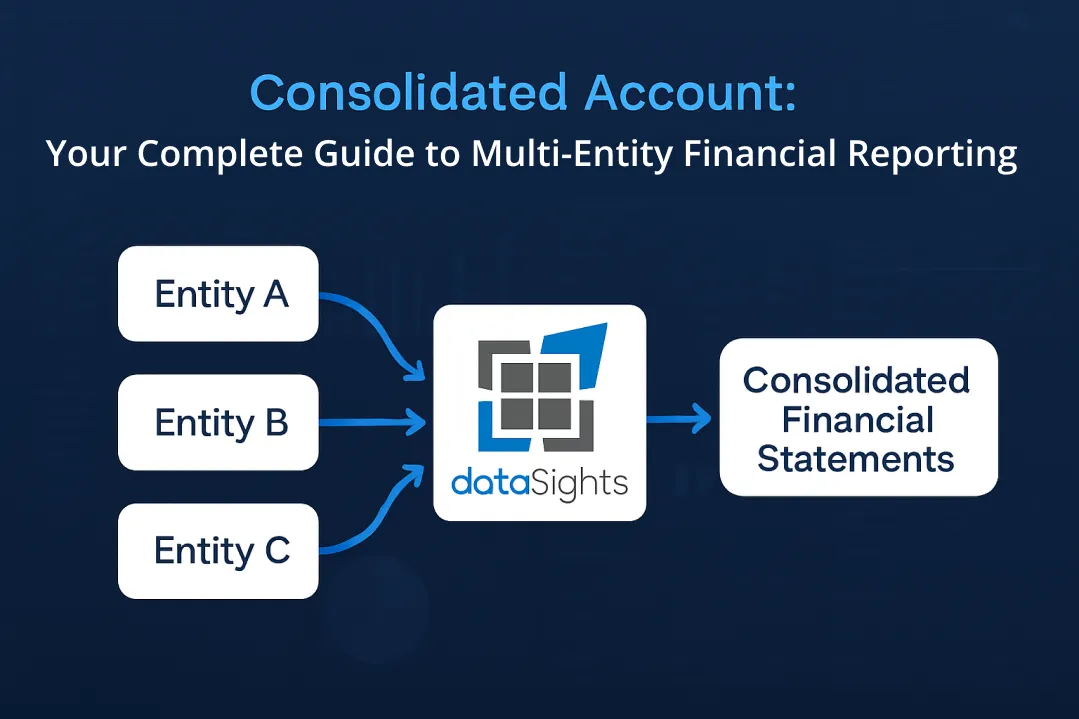
Ever wondered why month-end consolidation drags on for weeks? For finance teams managing multiple entities, manual consolidation often takes over 15 business days – spent chasing mismatches and juggling spreadsheets. This guide explains what consolidated accounts are, why they matter, and how automation makes multi-entity reporting accurate, fast, and compliant.
What Is a Consolidated Account?
A consolidated account combines assets, liabilities, equity, income, and expenses from a parent company and its subsidiaries into a single financial statement. Under IFRS 10 and GAAP ASC 810, you must consolidate when you control subsidiaries. The consolidation eliminates intercompany transactions, including sales and purchases, receivables and payables, loans, interest, dividends, and the parent’s investment in subsidiary equity to prevent double-counting. Your consolidated statements show only external transactions, giving stakeholders an accurate group-level financial position.
Ready to Automate Your Financial Consolidation?
Stop wrestling with manual consolidations and broken formulas. dataSights automates multi-entity reporting, Xero consolidations, and Power BI connections. Join 300+ businesses already transforming their financial reporting with our platform, rated 5.0 out of 5 by 90+ verified Xero users.
Table of Contents
Why Consolidated Accounts Matter for Multi-Entity Groups
Consolidated accounts serve several critical purposes for organisations managing multiple entities.
- First, they’re legally required under accounting standards when a parent exercises control over subsidiaries.
- Second, they provide investors, lenders, and stakeholders with transparent visibility into the entire group’s financial position rather than fragmented entity-level views.
- Beyond regulatory compliance, consolidated accounts enable better strategic decision-making. You can track group-wide performance metrics, compare subsidiary contributions, and identify consolidation opportunities across your organisation.
- Finance teams use consolidated accounts to spot trends, allocate resources effectively, and demonstrate financial strength to external parties.
How Consolidated Accounts Differ from Individual Entity Accounts
Individual entity accounts show the financial position of a single legal entity – one company’s assets, liabilities, and results. Each subsidiary maintains separate accounting records, generates its own financial statements, and reports its own performance. These standalone accounts remain necessary for tax compliance, statutory filings, and entity-level management.
Consolidated accounts combine multiple entity accounts into group-level financial statements. The consolidation process:
- Eliminates intercompany transactions
- investments
- Balances to prevent double-counting
For example, if your parent company lends £500,000 to a subsidiary, this loan appears as an asset on the parent’s books and a liability on the subsidiary’s books. In consolidated accounts, both sides of this intercompany transaction are eliminated because the group as a whole hasn’t gained or lost anything.
The consolidated balance sheet shows only external assets and liabilities. The consolidated income statement reports only revenues and expenses from transactions with parties outside your group structure. This elimination process ensures your consolidated accounts accurately reflect your economic reality rather than inflated figures from internal transfers.
The Consolidated Account Structure Explained
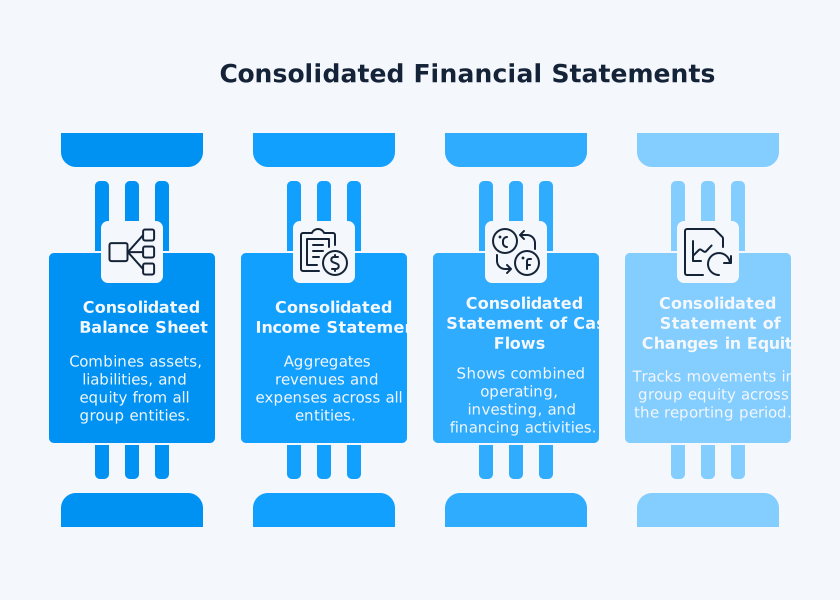
Consolidated accounts consist of four primary financial statements:
- Consolidated balance sheet
- Consolidated income statement
- Consolidated statement of cash flows
- Consolidated statement of changes in equity
The consolidated balance sheet combines assets, liabilities, and equity from all group entities after elimination adjustments. You’ll see goodwill recognised when acquisition costs exceed the fair value of net assets acquired. Non-controlling interests appear as a separate equity line, representing the portion of subsidiaries owned by external shareholders.
The consolidated income statement aggregates revenues and expenses across all entities, eliminating intercompany sales and purchases. Profit attributable to non-controlling interests is separated from profit attributable to parent company shareholders, ensuring accurate earnings allocation.
The consolidated statement of cash flows shows combined operating, investing, and financing activities. Intercompany cash transfers are eliminated to present only external cash movements. The statement reconciles opening and closing consolidated cash positions.
The consolidated statement of changes in equity tracks movements in group equity across the reporting period. Opening equity balances roll forward through:
- Profit for the period
- Dividends paid
- Share capital changes
- Other comprehensive income items to reach closing equity
The statement separates equity attributable to parent shareholders from equity attributable to non-controlling interests, showing how each portion changes through profits, losses, dividends, and capital transactions.
Consolidated Chart of Accounts: The Foundation
A consolidated chart of accounts (Group COA) provides a standardised template of account codes used across all divisions, departments, or subsidiaries within your group. This unified structure ensures consistency and comparability of financial data across your entire organisation.
Without a well-structured Group COA, automated consolidation becomes impossible. Subsidiaries with different account structures require mapping to consolidate properly. For example, one subsidiary might code rent expense as account 3200 while another uses 3300. Your Group COA maps to a single consolidated rent expense account.
The Group COA:
- Simplifies financial consolidation
- Ensures compliance with accounting standards
- Enables accurate, timely consolidated reporting
When designing your consolidated chart of accounts, balance detail against simplicity. Too few accounts provide insufficient visibility for decisions. Too many accounts create complexity that obscures meaningful patterns in your consolidated financial data.
Consolidated Account vs Combined Account
Consolidated accounts and combined accounts serve different purposes and follow different rules.
- Consolidated accounts are prepared when a parent company controls subsidiaries. Investments with significant influence are accounted for using the equity method. Control usually arises when a parent owns more than 50% of the voting rights, but it can also exist with a smaller holding if the investor has de facto control – such as dominant decision-making rights or dispersed minority shareholders.
- Combined accounts aggregate entities that are managed together or under common ownership, even if there isn’t a parent-subsidiary control structure.
The key distinction lies in control relationships and regulatory requirements. Consolidated accounts follow strict IFRS 10 and GAAP guidelines regarding elimination entries, non-controlling interests, and goodwill recognition. Combined accounts face less standardisation and may be prepared voluntarily for management purposes rather than regulatory compliance.
Preparing Consolidated Accounts: The Process
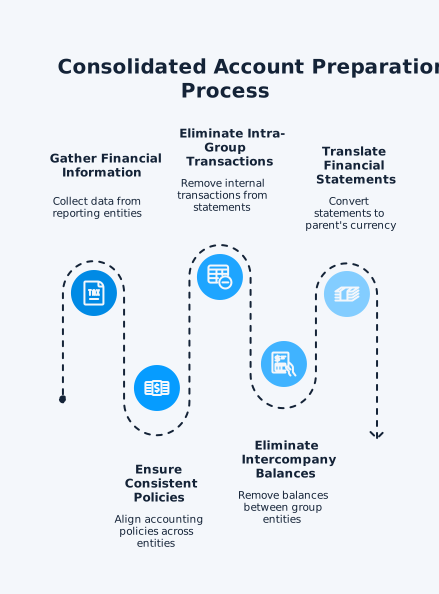
Preparing consolidated accounts involves:
- Gathering financial information from each reporting entity, including trial balances, general ledgers, and supporting documentation.
- Ensuring all entities follow consistent accounting policies aligned with the parent company’s standards.
The consolidation process requires eliminating intra-group transactions. When one subsidiary sells goods to another, the revenue and cost of goods sold associated with that transaction must be eliminated from consolidated statements. These entries represent internal transfers, not external economic activity.
Intercompany account balances – receivables, payables, and investments between group entities – are eliminated in full. The elimination process ensures consolidated financial statements reflect only transactions with external parties.
Multi-currency consolidation adds complexity. Subsidiaries operating in different currencies must have their financial statements translated into the parent’s reporting currency. Assets and liabilities typically translate at closing rates, while income and expenses use average rates for the period. Equity items stay at historical rates and translation differences go to OCI as a foreign currency translation reserve until disposal.
Consolidated Account Automation: Modern Solutions
Manual consolidation through spreadsheets creates risk. Studies across industries indicate that spreadsheets contain errors of varying materiality, leading to exponential growth in time investment with entity count. Finance teams at mid-to-large organisations report spending over 15 days on month-end consolidation when managing multiple entities manually.
Automation transforms consolidation from a month-end ordeal into a continuous process. dataSights automates consolidated management reporting by connecting multiple Xero organisations via API into a dedicated Azure SQL database.
- Finance teams access board-ready management packs with consolidated P&L, balance sheet, and KPIs directly through the web platform.
- For teams preferring Excel, the dataSights OfficeAddIn and Power Query automate data imports with one-click refresh. Over 75% of customers use Excel automation to manage month-end tasks without exporting CSVs.
- For advanced analytics, Power BI connects directly to consolidated data for interactive dashboards and visualisation.
Automated consolidation typically reduces month-end close from over 15 days to under 5 days while maintaining audit trails and reconciliation accuracy that manual processes cannot achieve.
Common Consolidated Account Challenges
The biggest challenges in consolidation include:
- Intercompany eliminations: Matching intercompany sales and expenses across entities is time-consuming and error-prone.
- Multi-currency translation: Different subsidiaries operate in different currencies, requiring accurate exchange rate application.
- Reporting period differences: IFRS allows up to a three-month gap, but adjustments must be made for significant transactions.
Non-controlling interests require precise calculation. When you own 80% of a subsidiary, consolidated statements include 100% of its financial results, but 20% of profit must be allocated to non-controlling interests. Getting this attribution wrong misrepresents both group profit and equity.
Consolidated Account Best Practices
Managing multi-entity consolidations effectively requires more than just technical accuracy – it demands consistent processes, automation, and disciplined controls. The following best practices outline how leading finance teams maintain audit-ready, real-time consolidated reporting while reducing month-end workloads and error risk.
- Start with trial balance foundations. All consolidations must tie back to entity-level trial balances. This non-negotiable starting point ensures your consolidations reconcile to source systems and audit trails remain intact.
- Implement elimination rules systemically rather than manually. Document intercompany transaction types, define elimination logic, and automate the application of these rules. Centralised elimination rules in database procedures reduce risk compared to ad-hoc spreadsheet eliminations scattered across workbooks.
- Maintain continuous consolidation rather than period-end only. With proper automation, issues surface daily instead of two weeks after month-end. Real-time visibility enables proactive correction while context remains fresh rather than reactive investigation when memories fade.
- Establish robust audit trails. Every elimination entry, currency conversion, and consolidation adjustment must be traceable to source transactions. System-level documentation with timestamps and user identification supports compliance requirements that manual processes struggle to deliver.
- Close subsidiary and parent ledgers at period-end. This flag indicates that accounts have been consolidated and prevents retrospective changes that would throw off your consolidated reporting.
Consolidated Account Reporting Requirements
Consolidated financial statements typically include the following:
- Statement of financial position (balance sheet)
- Statement of profit or loss and other comprehensive income
- Statement of changes in equity
- Statement of cash flows
- Notes including significant accounting policies
IFRS and GAAP both require extensive disclosures in consolidated account notes. These explain:
- Consolidation policies
- Subsidiaries included in consolidation
- Non-controlling interest amounts
- Goodwill calculations
- Intercompany elimination methodologies
Notes provide context that financial statement numbers alone cannot convey.
UK company law under the Companies Act 2006 requires parent companies to prepare group accounts unless they qualify for small group exemptions. The threshold criteria include total net assets below £5.1m, annual turnover under £10.2m, or fewer than 50 employees on average. Two of these three conditions must be met for exemption. Public companies face stricter requirements, including half-yearly consolidated reporting and detailed segment analysis.
External audits focus heavily on consolidation procedures. Auditors scrutinise elimination entries, test intercompany reconciliations, verify acquisition accounting, and validate non-controlling interest calculations. Strong audit trails and documented consolidation procedures streamline the audit process.
Frequently Asked Questions
What Is the Difference Between a Consolidated Account and a Separate Account?
A separate account shows financial information for a single legal entity in isolation. A consolidated account combines financial data from a parent company and its subsidiaries into unified group financial statements that eliminate intercompany transactions.
When Must a Company Prepare Consolidated Accounts?
Companies must prepare consolidated accounts when they control one or more subsidiaries, typically through owning more than 50% of voting shares, but it can also exist with a smaller holding if the investor has de facto control – such as dominant decision-making rights or dispersed minority shareholders. UK small groups may qualify for exemption if they meet size criteria for net assets, turnover, and employee count.
Do Consolidated Accounts Eliminate All Intercompany Transactions?
Yes. Consolidated accounts eliminate intercompany sales, purchases, receivables, payables, loans, and investments in full to prevent double-counting and accurately reflect the group’s economic reality as a single entity.
Can Subsidiaries With Different Fiscal Years Be Consolidated?
Yes, but IFRS permits maximum three months difference between subsidiary and parent reporting dates. Significant transactions occurring between the subsidiary’s year-end and parent’s reporting date must be adjusted for in the consolidation.
How Are Non-Controlling Interests Shown in Consolidated Accounts?
Non-controlling interests appear as a separate line within consolidated equity on the balance sheet. On the income statement, profit attributable to non-controlling interests is separated from profit attributable to parent company shareholders.
What Is a Consolidated Chart of Accounts?
A consolidated chart of accounts is a standardised template of account codes used across all entities within a group structure. It ensures consistent classification and enables automated consolidation by mapping subsidiary accounts to group-level reporting categories.
Do I Need Consolidation Software for Multi-Entity Reporting?
While manual spreadsheet consolidation is possible for small groups, automated consolidation software significantly reduces errors, saves time, and improves audit trails. Groups managing more than a few entities benefit substantially from purpose-built consolidation solutions.
Your Path to Accurate Multi-Entity Consolidation
Consolidated accounts combine multiple entities into unified financial statements that eliminate intercompany transactions and present accurate group-level results. Manual consolidation through spreadsheets creates error risk and consumes weeks monthly – automated solutions reduce month-end close from over 15 days to under 5 while maintaining complete audit trails. Your trial balance must reconcile to source systems, your eliminations need system-level documentation, and your balance sheet must balance every time. Master consolidation fundamentals, implement proper automation, and transform month-end from discovery mode to confirmation mode.
Transform Your Xero Consolidation Reporting Today
Ready to cut your month-end close from weeks to days? Try automated multi-entity consolidation with dataSights. Rated 5.0 by over 90 Xero users, our platform delivers board-ready management packs, automated Excel imports, and Power BI integration.
About the Author
Kevin Wiegand
Founder & Client happiness
I’m Kevin Wiegand, and with over 25 years of experience in software development and financial data automation, I’ve honed my skills and knowledge in building enterprise-grade solutions for complex consolidation and reporting challenges. My journey includes developing custom solutions for data teams at Gazprom Marketing & Trading and E.ON, before founding dataSights in 2016. Today, dataSights helps over 300 businesses achieve 100% report automation. I’m passionate about sharing my expertise to help CFOs and Financial Controllers reduce their month-end close time and eliminate the manual Excel exports that drain their teams’ valuable time.