
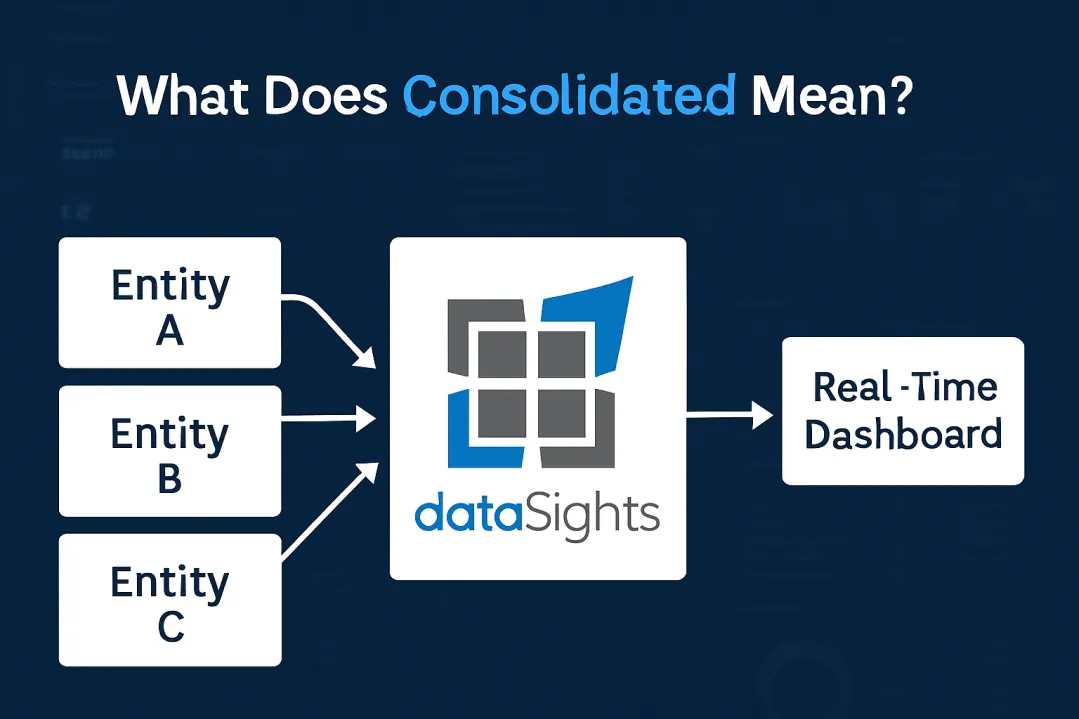
You’re drowning in spreadsheets from multiple entities, spending weeks on month-end close, and your board wants unified reports yesterday. The word “consolidated” keeps appearing in your accounting software, financial regulations, and business discussions – but what does consolidated mean for your multi-entity operations? Whether you’re combining financial statements, merging businesses, or simply trying to understand consolidation requirements, this guide breaks down everything from basic definitions to automated solutions that reduce month-end close cycles from weeks to just a few days.
What Does Consolidated Mean?
Consolidated means combined into a single, unified whole. In finance, it’s the process of combining a parent and subsidiaries into one set of financial statements by aligning policies and eliminating intercompany activity. Teams that automate consolidation often cut month-end from around 15 days to roughly 3-5 days, with real-time, audit-ready outputs based on our customer implementations.
Ready to Automate Your Financial Consolidation?
Stop wrestling with manual consolidations and broken formulas. dataSights automates multi-entity reporting, Xero consolidations, and Power BI connections. Join 300+ businesses already transforming their financial reporting with our platform, rated 5.0 out of 5 by 90+ verified Xero users.
Table of Contents
Understanding Consolidation in Different Contexts
The term “consolidated” adapts to various business situations, each with distinct purposes and processes. While the core concept remains consistent – combining multiple elements into one – the application varies significantly across financial reporting, corporate structures, and personal finance.
- In financial reporting, consolidation starts with determining which entities fall within the group. Under IFRS 10, an investor consolidates an investee when it has control – power over relevant activities, exposure or rights to variable returns, and the ability to use its power to affect those returns, which can exist even without owning more than 50% of the voting rights. Under US GAAP (ASC 810 and the VIE guidance), voting-interest entities are consolidated by the majority voting holder, while variable interest entities (VIEs) are consolidated by the primary beneficiary. This assessment covers both domestic and international subsidiaries and, under IFRS, structured entities, with IFRS 12 requiring disclosures where the group has interests but does not consolidate.
- Beyond accounting, consolidation shapes major business decisions. Corporate consolidations have reduced the number of US school districts by 88% since 1940, while tech industry consolidations have led to the creation of today’s dominant platforms. Understanding consolidation’s various forms helps you recognise opportunities and requirements in your own business context.
Financial Consolidation in Accounting
Financial consolidation combines financial data from a parent company and its subsidiaries into a single set of financial statements. This process provides a comprehensive view of the entire group’s financial position, treating multiple legal entities as one economic unit for reporting purposes.
Consolidation also introduces non-controlling interests (NCI) where the parent does not own 100% of a subsidiary. Under IFRS 10, the NCI share of equity is presented separately from the parent’s equity in the consolidated statement of financial position, and the NCI share of profit or loss is shown separately in the consolidated income statement. This makes it clear which part of the group’s results belongs to other shareholders.
The Purpose of Financial Consolidation
Companies consolidate financial statements to present accurate, complete pictures of their financial health. When you own or control subsidiaries, showing only the parent company’s numbers misrepresents your true position. Consolidated statements eliminate intercompany transactions and provide stakeholders with transparent, meaningful insights into overall performance.
The process serves multiple critical functions:
- It ensures regulatory compliance with accounting standards
- It builds investor confidence through transparency, and
- It enables strategic decision-making based on complete data.
Without consolidation, your financial reporting would show inflated revenues from intercompany sales and duplicate assets across entities.
Key Components of the Consolidation Process
- Practically, your consolidation workflow starts by defining the scope of entities to include. Identify each subsidiary, joint operation or other entity that the parent controls under IFRS 10/ASC 810, across both domestic and international structures, and note any variable interest entities that must also be brought into the group results.
- Next comes data collection and standardisation. Each subsidiary’s trial balance, general ledger, and supporting documentation must align with consistent accounting policies. Currency conversion adds another layer of complexity for international operations, requiring accurate exchange rate calculations for each reporting period.
- The elimination of intercompany transactions represents the most challenging step. Every transaction between group entities – sales, loans, transfers – must be identified and removed to avoid double-counting. Manual elimination often leads to errors and can extend the month-end close well beyond acceptable timeframes.
This video shows how dataSights syncs all Xero entities via secure API into the dataSights cloud database. From there, the platform delivers board-ready management reports with consolidated P&L, balance sheet, and trial balance, while Excel and Power BI connect to the same single source for automated models and interactive dashboards with real-time, balanced consolidations and auto-eliminations.
Consolidation Challenges and Solutions
Manual consolidation creates significant operational burdens. Finance teams spend days gathering data from disparate systems, reconciling differences, and creating elimination entries. In practice, manual consolidation across multiple entities often stretches beyond 15 days, leaving little time for analysis or strategic planning.
Modern consolidation software transforms this process. dataSights pulls data directly from all your Xero entities into a centralised SQL database, applies rule-driven elimination entries consistently, and delivers consolidated management packs through its web platform – with P&L, balance sheet, trial balance, AR/AP, budgets, and KPI metrics ready to use.
For teams that prefer spreadsheets or dashboards, the same consolidated data is available in Excel (via automated refresh) and Power BI for advanced analytics. For businesses with multiple Xero entities, our customer implementations typically reduce month-end close from more than 15 days to around 3-5 days while improving accuracy and maintaining detailed audit trails.
Note for Xero users: Xero has no native intercompany module. All eliminations must be managed outside Xero – typically in your reporting layer or specialist consolidation software. dataSights handles this automatically by applying rule-based logic to generate elimination entries in a centralised SQL database rather than in spreadsheets.
Business Consolidation: Mergers and Acquisitions
Business consolidation occurs when two or more companies combine to create a larger, more powerful entity. Unlike financial consolidation that simply combines reports, business consolidation fundamentally restructures corporate entities through mergers, acquisitions, or other strategic combinations.
From an accounting perspective, most mergers and acquisitions that qualify as business combinations are accounted for under IFRS 3. The acquirer recognises identifiable assets and liabilities at fair value and records goodwill – the premium paid for expected future economic benefits that are not separately identifiable – which is then tested for impairment over time rather than amortised.
Types of Business Consolidation
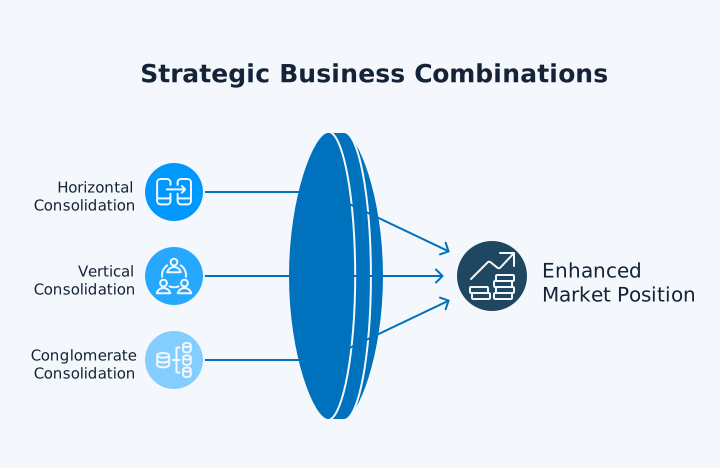
- Horizontal consolidation joins companies within the same industry to increase market share and eliminate competition, subject to antitrust and competition-law constraints. The Exxon-Mobil merger created the world’s largest private oil company through horizontal consolidation, achieving significant cost savings and operational efficiencies.
- Vertical consolidation connects companies at different stages of the supply chain. When manufacturers acquire distributors or retailers purchase suppliers, they gain greater control over their value chain. This integration can reduce costs, improve coordination, and create competitive advantages.
- Conglomerate consolidation brings together companies from unrelated industries. These combinations aim to diversify risk and create new growth opportunities. Recent examples include Microsoft’s acquisition of Activision Blizzard, expanding from software into gaming entertainment.
Strategic Drivers of Consolidation
Companies pursue consolidation for various strategic reasons.
- Growth acceleration tops the list, as acquiring established businesses provides immediate market presence and customer bases. Consolidation can deliver expansion that would take years to achieve organically.
- Cost synergies drive many consolidation decisions. Combined operations can eliminate duplicate functions, negotiate better supplier terms, and achieve economies of scale. According to a McKinsey public-sector study, consolidating IT systems and using shared services enabled some agencies to lower IT costs by up to 20%, especially by eliminating redundant infrastructure and better procurement. While this doesn’t directly translate to every expense line, it shows that in certain support or overhead functions, substantial savings are achievable.
- Technology acquisition has become increasingly important. Companies consolidate to gain capabilities in artificial intelligence, data analytics, or digital platforms.
The Role of Automation in Modern Consolidation
Traditional consolidation methods rely on manual processes that create bottlenecks and errors. Finance teams:
- Export data from multiple systems
- Manipulate spreadsheets, and
- Hope formulas don’t break.
This approach worked when businesses had fewer entities and simpler structures, but modern multi-entity operations demand better solutions.
Automation transforms consolidation from a dreaded month-end marathon into an efficient, controlled process. With dataSights, consolidated Trial Balance data flows into pre-formatted management reports on the web platform first, giving you a single, reconciled group view. The same data is then available in Excel for automated models and in Power BI for deeper visual analysis. Real-time consolidation replaces period-end surprises with continuous visibility.
The impact on business operations is dramatic. When consolidation happens automatically:
- Finance teams shift focus from data manipulation to analysis and strategy
- Board reports generate instantly
- Audit trails maintain themselves
- Errors surface immediately rather than after books close.
Making Consolidation Work for Your Business
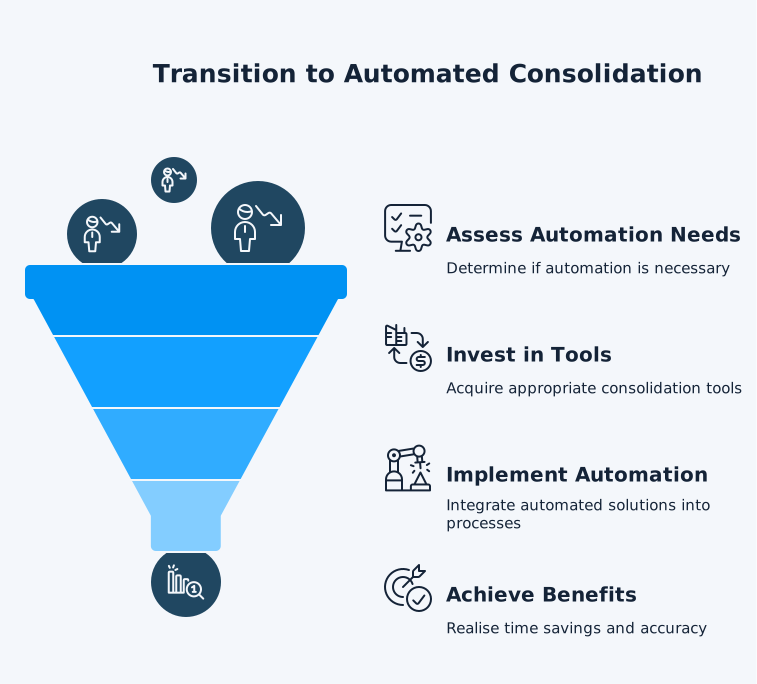
Successful consolidation requires matching your approach to your specific needs. Small businesses with simple structures might manage with spreadsheets initially, but growth quickly overwhelms manual methods. Understanding when to transition to automated solutions can mean the difference between scalable growth and an operational crisis.
Consider your current consolidation pain points and decide if automation becomes essential:
- Month-end close takes more than a week
- Errors regularly appear in elimination entries
- You’re avoiding expansion due to consolidation complexity
The investment in proper consolidation tools pays returns through time savings, accuracy improvements, and strategic insights.
Modern businesses face increasing consolidation complexity. Multiple currencies, various entity structures, and changing regulations create challenges that manual processes cannot address efficiently. dataSights handles this complexity by consolidating full Trial Balances into governed management packs on its web platform, with eliminations, FX, and audit trails built in. For teams that prefer spreadsheets or dashboards, the same governed data powers automated Excel models and Power BI analytics, while maintaining the detailed documentation that auditors and regulators require.
Frequently Asked Questions
What Is the Difference Between Consolidated and Combined Financial Statements?
Consolidated statements present multiple entities as a single economic unit, with intra-group transactions and balances eliminated in full. Combined statements show related entities together but do not necessarily assume a parent–subsidiary relationship – for example, entities under common control. IFRS does not formally define combined financial statements, so practice is jurisdiction-specific. In many cases, intra-group transactions and balances are still eliminated to avoid overstating revenues or assets, and the basis of combination should be clearly disclosed.
When Is Financial Consolidation Required by Law?
Public companies and those issuing securities in public markets must present consolidated financial statements when they control other entities. Under IFRS 10 and US GAAP ASC 810, consolidation is based on control – power over relevant activities, exposure or rights to variable returns, and the ability to use that power – rather than a simple ownership percentage. Ownership of more than 50% of voting rights often indicates control, but it is the control assessment that matters in practice. Exemptions from presenting consolidated financial statements are narrow – for example, certain intermediate parent entities or investment entities when higher-level consolidated statements are available. Materiality typically affects presentation and disclosures, not the requirement to consolidate subsidiaries that meet the control definition, although local regulations may introduce additional jurisdiction-specific exemptions.
How Long Should Financial Consolidation Take?
For many dataSights customers, manual consolidation across multiple entities took 15-20 days before automation. With automated data flows and repeatable, rule-driven elimination entries, they now complete consolidation in 3-5 days while maintaining audit-ready trails.
What’s the Difference Between a Merger and Consolidation?
In a merger, one company absorbs another, with the acquiring company surviving. In consolidation, multiple companies combine to create an entirely new entity, with previous companies ceasing to exist legally.
What Are Variable Interest Entities (VIEs) in Consolidation?
VIEs require consolidation even without majority ownership when the parent company absorbs risks and rewards of the entity’s activities. Control through contracts, board influence, or economic dependence can trigger VIE consolidation requirements under accounting standards.
Why Do Small Schools Consolidate?
Rural schools consolidate to maintain educational quality despite declining enrolments and limited resources. Consolidation enables smaller districts to offer advanced courses, specialised programmes, and improved facilities that individual schools cannot afford independently.
How Do Currency Conversions Affect Consolidation?
International consolidation requires converting subsidiary financials to the parent company’s reporting currency. Exchange rate fluctuations create translation adjustments – often recognised in Other Comprehensive Income (OCI) under IAS 21 for foreign operations – that must be tracked separately in consolidated statements, adding complexity to multi-currency operations.
What Elimination Entries Are Required in Consolidation?
Consolidation requires eliminating all intercompany transactions, including sales, purchases, loans, dividends, and management fees between group entities. These eliminations prevent double-counting and ensure consolidated statements reflect only external transactions. For example, a simple intercompany loan between a parent and subsidiary is eliminated by debiting the intercompany loan payable and crediting the intercompany loan receivable for the same amount. For intercompany sales of inventory, consolidation removes the internal sale and, where relevant, adjusts inventory and cost of sales to eliminate any unrealised profit on goods still held within the group.
When Should a Company Consider Consolidation Software?
Companies should evaluate consolidation software when manual processes exceed 5 days, when managing 3+ entities, or when errors regularly appear in eliminations. Growth plans, audit requirements, and reporting frequency also indicate when automation becomes essential.
Master Your Consolidation Journey Today
Whether you’re consolidating financial statements, considering business mergers, or managing complex multi-entity structures, understanding consolidation fundamentals empowers better decisions. The shift from manual to automated consolidation isn’t just about saving time – it’s about gaining the visibility and control that modern businesses demand.
Transform Your Multi-Entity Financial Consolidation
Stop spending weeks on manual consolidation that leaves you questioning accuracy and missing strategic opportunities. dataSights automates Xero consolidation for businesses ready to reduce month-end close from more than 15 days to around 3-5 days. The platform delivers consolidated management packs through the web app, with optional Excel automation and Power BI dashboards for teams that need custom models and visual analysis. With 90+ five-star reviews from finance teams and 300+ businesses already on board, you get real-time visibility across all entities without relying on manual spreadsheets.
About the Author
Kevin Wiegand
Founder & Client happiness
I’m Kevin Wiegand, and with over 25 years of experience in software development and financial data automation, I’ve honed my skills and knowledge in building enterprise-grade solutions for complex consolidation and reporting challenges. My journey includes developing custom solutions for data teams at Gazprom Marketing & Trading and E.ON, before founding dataSights in 2016. Today, dataSights helps over 300 businesses achieve 100% report automation. I’m passionate about sharing my expertise to help CFOs and Financial Controllers reduce their month-end close time and eliminate the manual Excel exports that drain their teams’ valuable time.