
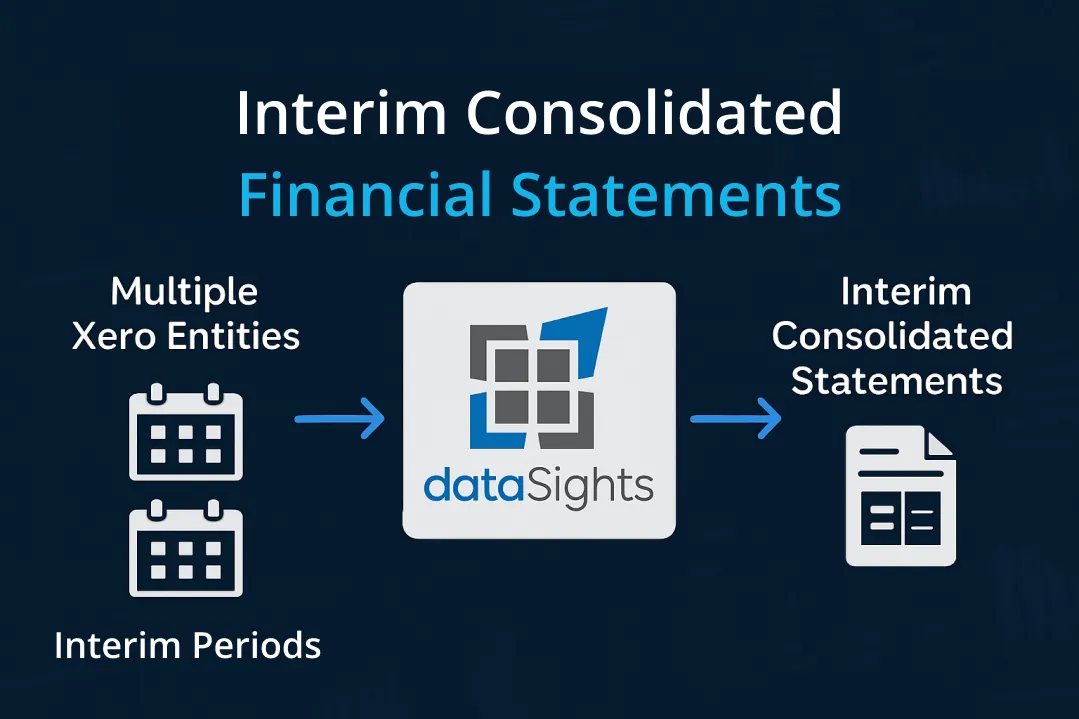
Your quarter-end close deadline is approaching. You manage twelve Xero entities across three countries, and the board wants interim consolidated results by next Tuesday. Sound familiar? Interim consolidated financial statements use the same consolidation mechanics as annual reporting – but with tighter timelines, heavier reliance on estimates, and higher risk of late adjustments. This guide breaks down what IAS 34 requires and how to produce interim group reporting that’s both compliant and board-ready.
What Are Interim Consolidated Financial Statements?
Interim consolidated financial statements are group financial statements (parent + subsidiaries) prepared for a period shorter than a full financial year – such as a quarter or half-year – using either a complete or condensed format under IAS 34. They provide timely group-level performance and financial position without waiting for year-end reporting.
Ready to Automate Your Financial Consolidation?
Stop wrestling with manual consolidations and broken formulas. dataSights automates multi-entity reporting, Xero consolidations, and Power BI connections. Join 300+ businesses already transforming their financial reporting with our platform, rated 5.0 out of 5 by 90+ verified Xero users.
Table of Contents
Interim Consolidated Financial Statements in Practice
An interim financial report is a complete or condensed set of financial statements for a period shorter than a financial year, and IAS 34 applies when an entity publishes an interim report that claims compliance with IFRS Accounting Standards. Importantly, IAS 34 does not dictate which entities must publish interim reports (that’s typically set by laws, regulators, or listing rules).
In a group context, “consolidated” means presenting the assets, liabilities, equity, income, expenses, and cash flows of the parent and subsidiaries as a single economic entity – consistent with IFRS 10.
When Are Interim Consolidated Financial Statements Required?
IAS 34 itself does not mandate interim reporting frequency or deadlines, but it is commonly required by:
- Securities regulators/stock exchanges (e.g., half-yearly or quarterly reporting rules)
- Listing rule frameworks (for example, the UK FCA’s DTR requirements for half-yearly financial reports)
- Lenders and investor agreements (bank covenants, private equity reporting packs, etc.)
Framework Note for UK GAAP Readers
This guide focuses on IAS 34 (IFRS). If you prepare annual financial statements under FRS 102, interim reporting is typically guided by FRS 104 Interim Financial Reporting (UK GAAP).
IAS 34 Interim Financial Reporting Requirements
IAS 34’s objective is to prescribe the minimum content of an interim financial report and the recognition and measurement principles for interim periods.
Minimum Components of an Interim Financial Report
At a minimum, an interim financial report includes:
- A condensed statement of financial position
- A condensed statement of profit or loss and other comprehensive income
- A condensed statement of changes in equity
- A condensed statement of cash flows
- Selected explanatory notes
Condensed vs. Complete Financial Statements Under IAS 34
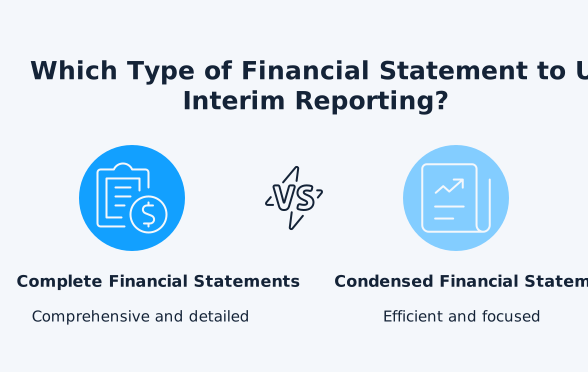
IAS 34 allows either:
- A complete set of IFRS financial statements, or
- A condensed set (most common for interim periods), provided it includes the key headings/subtotals and enough detail to avoid being misleading.
Most groups opt for condensed interim financial statements for practicality and efficiency, as illustrated in Grant Thornton’s example interim IFRS financial statements.
Recognition and Measurement at Interim Dates
Interim reporting is not “lighter accounting” – it’s the same IFRS foundation applied to shorter periods. Practically, that means:
- Consistent accounting policies with the most recent annual financial statements (unless a new standard or amendment is adopted)
- Greater reliance on estimates, because not every valuation or accrual can be finalised at speed
- Materiality assessed for the interim period, not annual materiality (so some items can become material earlier)
Disclosure Focus for Interim Periods
IAS 34’s disclosures are designed to explain what changed since the last annual reporting date. Typical high-impact areas include:
- Seasonality and cyclicality
- Significant unusual items
- Changes in group structure (acquisitions/disposals)
- Significant judgments and estimation uncertainty
- Changes in debt, liquidity, or covenant risk
- Related party and intercompany activity (where relevant to understanding the period)
Management-Defined Performance Measures and IFRS 18
In April 2024, the IASB issued IFRS 18 Presentation and Disclosure in Financial Statements, effective for annual reporting periods beginning on or after 1 January 2027 (early application permitted).
The IFRS Foundation notes that IAS 34 was amended to require entities to disclose management-defined performance measures (MPMs) in interim financial statements when IFRS 18 requires such disclosures.
Practical implication: if your group reports non-GAAP measures internally (e.g., “Adjusted EBITDA”), you should prepare now for tighter rules on how those measures are defined, reconciled, and presented – especially in interim reporting.
Key Differences Between Interim and Annual Consolidated Statements
Interim consolidation uses the same IFRS consolidation mechanics as year-end reporting, but the shorter timeline changes how teams apply:
- Materiality
- Estimates
- Review controls
The differences below highlight where interim closes most often run into avoidable delays (and where a repeatable process matters most).
Materiality Is Assessed for the Interim Period
Interim materiality thresholds are often lower in absolute terms than annual thresholds. Items that would be immaterial annually (e.g., one-off fees, FX movements, inventory write-downs) can become material over a quarter or half-year.
Estimates and Tax Calculations Are Often More Prominent
Interim closes typically rely more on:
- Accrual estimates (bonuses, rebates, provisions)
- Cut-off judgments (revenue and expenses)
- Interim tax computations (often using an estimated annual effective tax rate approach)
Timelines, Controls, and Audit Trail Pressure Increase
Because interim reporting cycles are shorter, weak process controls show up quickly:
- Late intercompany confirmations
- Inconsistent FX rates
- Mapping gaps between entities
- Manual eliminations without traceability
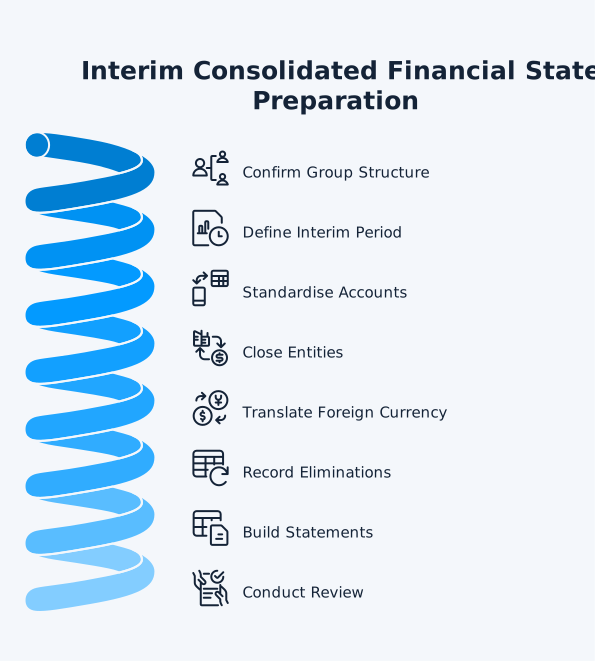
How to Prepare Interim Consolidated Financial Statements
Below is a practical, compliance-aligned workflow you can adapt for quarterly or half-yearly reporting.
Step 1: Confirm Group Structure and Consolidation Basis
Confirm which entities must be consolidated and why – based on control under IFRS 10 (not just ownership percentage).
Document:
- Subsidiaries consolidated line-by-line
- Non-controlling interests (NCI) treatment
- Any entities excluded (and the rationale)
Step 2: Define the Interim Period and Reporting Timetable
Lock:
- Interim period end date
- Reporting currency and presentation currency
- Close calendar (entity close deadlines, consolidation cut-off, board pack date)
If you’re listed or regulated, confirm filing windows and any required review language (jurisdiction-dependent). For example, UK issuers must publish a half-yearly report under DTR 4.2.
Step 3: Standardise Charts of Accounts and Mapping
Interim consolidation fails fastest when accounts aren’t aligned.
Ensure:
- Entity trial balances map cleanly into a consolidated chart
- Consistent classification (operating vs financing, current vs non-current)
- Entity-level disclosures captured consistently (leases, revenue splits, segments where relevant)
Step 4: Close the Entities and Validate the Trial Balances
At interim dates, focus on completeness and cut-off:
- Subledger-to-GL reconciliations
- Bank and intercompany reconciling items flagged
- Reasonableness checks against prior quarter/half-year and budget
Step 5: Translate Foreign Currency Entities Under IAS 21
For foreign operations, apply IAS 21 principles consistently:
- Closing rate for statement of financial position items
- Average rate (often) for income and expense items
- Translation differences are recognised in other comprehensive income and accumulated in a separate component of equity (commonly the foreign currency translation reserve).
Mini Example (FX Translation):
A UK parent consolidates a US subsidiary. The subsidiary reports:
- Revenue: $1,000,000 → translated at average rate £0.79 = £790,000
- Net assets: $500,000 → translated at closing rate £0.81 = £405,000
The translation difference is recognised in OCI and accumulated in equity as part of the translation reserve.
Step 6: Record Intercompany Eliminations and Consolidation Adjustments
At interim dates, eliminations usually include:
- Intercompany revenue/expense
- Intercompany receivables/payables
- Intercompany dividends
- Unrealised profit in inventory (where applicable)
- Group-level journals (reclasses, policy alignment, impairment indicators)
Key interim risk: eliminations done “in a spreadsheet” without a robust audit trail.
Step 7: Build the Interim Statements (Condensed or Complete)
If using condensed interim financial statements, ensure:
- Headings/subtotals align with the most recent annual financial statements
- Additional line items are included where omission would be misleading
- Comparative information is presented appropriately
Step 8: Disclosures, Review, and Governance Checks
Before release, run a disclosure and governance checklist:
- Major variances explained
- Significant transactions disclosed
- Consistency of accounting policies confirmed
- MPM disclosures evaluated (where relevant, given IFRS 18 amendments)
- Full tie-out to entity trial balances and consolidation journals
Automating Interim Consolidation for Xero Multi-Entity Groups
Manual interim consolidation creates intense time pressure, often consuming days every quarter:
- Exporting trial balances
- Mapping accounts
- Translating currencies
- Processing eliminations by hand
dataSights delivers pre-formatted Management Reports through the platform first, with Excel automation and Power BI integration available for teams that prefer those workflows.
Key advantages for interim consolidated reporting:
- Continuous Consolidated View: See group numbers throughout the period – not just after close – so issues surface earlier.
- Automated Eliminations With Audit Trail: Elimination rules are documented and repeatable, with traceability by period and entity.
- Trial Balance Reconciliation: Consolidations tie back to source trial balances, improving confidence and review efficiency.
Repeatable Interim Consolidation With Eliminations and Adjustments (Best for Board Packs)
Use this when your interim consolidated reporting needs to be consistent every month/quarter (account mappings, eliminations, FX handling, adjustment journals, consistent formats).
Step 1: Connect and Consolidate Your Xero Organisations
Connect all Xero organisations into one consolidated reporting dataset (dataSights positions this as the first “getting started” step).
Step 2: Configure Mappings, Eliminations, and Adjustments Once
Set up account mappings, auto eliminations, and journal adjustments so your interim runs don’t become a spreadsheet exercise each period.
Step 3: Run Web-Based Consolidated Management Reports “As At” Your Interim Date
Run the web-based management reports (dataSights states you can generate these in seconds once configured).
For an interim “as at” date:
- Run Consolidated Balance Sheet (As At: [date])
- Run Consolidated Trial Balance (As At: [date])
For interim performance for the period:
- Run Consolidated P&L (From: [start] To: [end])
Step 4: Export or Automate Delivery
Export to Excel or PDF, or automate Excel refreshes via Power Query / Office add-in workflows (as described in the dataSights + Xero listing).
Frequently Asked Questions
Do Interim Consolidated Financial Statements Need to Be Audited?
Often, interim consolidated financial statements are unaudited, but they may be subject to a review depending on jurisdiction, listing rules, and agreements with lenders/investors. For example, in the US context, interim financial statements in Form 10-Q may be unaudited, but they must be reviewed by an independent public accountant prior to filing.
What Is the Difference Between Quarterly and Half-Yearly Interim Statements?
The accounting foundation is the same, but half-yearly reports often carry broader narrative disclosure expectations, stronger regulator focus (for listed entities), and a higher likelihood of external review requirements in some jurisdictions.
Can Subsidiaries Have Different Interim Reporting Dates?
In practice, groups typically align reporting cut-offs to enable consistent consolidation. If dates differ, you’ll need a controlled approach to ensure consistent cut-off and material adjustments, and document the approach so the interim report is not misleading.
What Happens if Interim Accounting Policies Differ From Annual?
IAS 34 expects consistency with the most recent annual financial statements unless a new standard is adopted or a policy change is required. If there are changes, disclose them clearly and explain the impact.
What Management-Defined Performance Measures Must Be Disclosed?
IFRS 18 requires disclosures for management-defined performance measures (MPMs). These apply if you present subtotals of income and expenses in public communications outside the financial statements, and those subtotals meet IFRS 18’s definition of MPMs. IAS 34 has been amended so that those disclosures also appear in interim financial statements for the relevant interim period.
How Do Materiality Thresholds Differ at Interim Dates?
Materiality is assessed in relation to the interim period. That typically means lower absolute thresholds than annual reporting, more sensitivity to one-off items and seasonality, and earlier escalation of matters that could be “immaterial annually” but material in a quarter.
Streamline Your Interim Consolidated Financial Reporting
Interim consolidated financial statements require the same consolidation discipline as annual reporting – just delivered faster, with less room for late fixes. If your interim close still depends on manual exports, spreadsheet mapping, and hand-built eliminations, the bottleneck isn’t IAS 34 – it’s the process.
Automate Your Xero Interim Consolidation Today
Ready to cut your interim close from weeks to days? dataSights helps multi-entity finance teams consolidate Xero data with automated eliminations, traceable adjustments, and board-ready reporting packs.
About the Author
Kevin Wiegand
Founder & Client happiness
I’m Kevin Wiegand, and with over 25 years of experience in software development and financial data automation, I’ve honed my skills and knowledge in building enterprise-grade solutions for complex consolidation and reporting challenges. My journey includes developing custom solutions for data teams at Gazprom Marketing & Trading and E.ON, before founding dataSights in 2016. Today, dataSights helps over 300 businesses achieve 100% report automation. I’m passionate about sharing my expertise to help CFOs and Financial Controllers reduce their month-end close time and eliminate the manual Excel exports that drain their teams’ valuable time.