
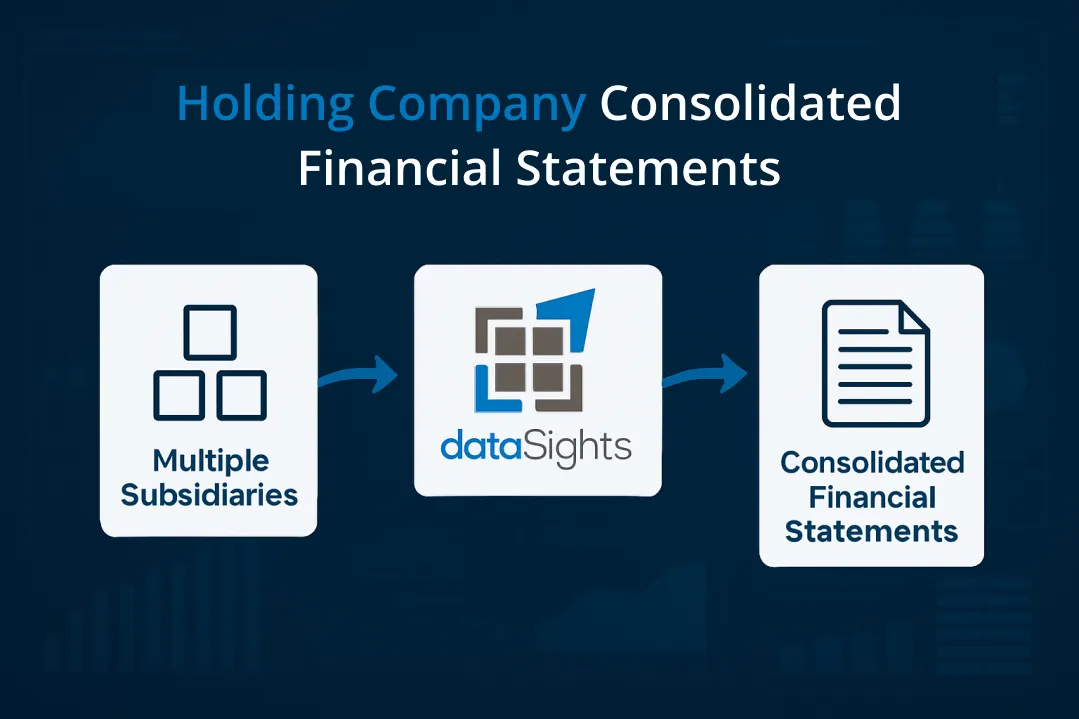
When you control multiple subsidiaries through a holding company structure, understanding consolidated financial statement requirements isn’t optional. Parent companies that control one or more entities must combine their financial data into unified statements that present the entire group as a single economic entity. This comprehensive guide explains exactly what holding company consolidated financial statements involve, when you’re required to prepare them, and how to navigate the consolidation process from data gathering through intercompany eliminations to final reporting.
Why Holding Company Consolidated Financial Statements Matter
Holding company consolidated financial statements combine the financial position, performance, and cash flows of a parent entity and its subsidiaries into a single set of statements. Under IFRS 10, consolidation is required whenever control exists, defined as power over relevant activities, exposure to variable returns, and the ability to use power to affect those returns. Accurate consolidation allows holding companies to present a unified financial view, reconcile intercompany activity, and maintain compliance across jurisdictions.
Ready to Automate Your Financial Consolidation?
Stop wrestling with manual consolidations and broken formulas. dataSights automates multi-entity reporting, Xero consolidations, and Power BI connections. Join 300+ businesses already transforming their financial reporting with our platform, rated 5.0 out of 5 by 90+ verified Xero users.
Table of Contents
What Are Holding Company Consolidated Financial Statements?
A holding company exists primarily to own controlling interests in other companies rather than produce goods or services itself. Consolidated financial statements for these structures aggregate data from the parent holding company and all controlled subsidiaries, eliminating internal transactions to show only external business activities.
The Fundamental Purpose
Consolidated financial statements serve multiple critical purposes for holding company structures. They:
- Provide investors and lenders with a complete picture of the group’s financial health
- Enable accurate performance assessment across the entire corporate structure
- Support regulatory compliance requirements
- Facilitate informed strategic decision-making at the group level
The holding company itself might generate minimal revenue, existing primarily to manage subsidiary investments and provide centralised services. Despite this operational structure, consolidated statements are mandatory when control exists, creating a comprehensive view that individual entity statements cannot provide.
Control Assessment Under IFRS 10
IFRS 10 establishes control as the basis for consolidation, defining it through three elements. An investor controls an investee when the investor has power over the investee through:
- Existing rights that give current ability to direct relevant activities
- Exposure or rights to variable returns from involvement with the investee
- The ability to use its power over the investee to affect the amount of returns
Control requires judgement when rights, decision-making power, and exposure to returns are not obvious, as outlined by IFRS 10.B38–B40. Holding companies must consolidate subsidiaries where control exists, even with ownership below 50% if other control indicators are present.
Components of Consolidated Statements
Complete consolidated financial statements for holding companies include specific components mandated by accounting standards. The consolidated statement of financial position shows all assets and liabilities of the holding company and its subsidiaries, with investment in subsidiaries replaced by underlying assets and liabilities. The consolidated statement of profit or loss and comprehensive income presents:
- Revenues
- Expenses
- Results from the entire group’s operations, with non-controlling interests’ share separately disclosed
Additional required components include:
- The consolidated statement of changes in equity, showing movements in total equity including non-controlling interests
- The consolidated statement of cash flows reflecting cash movements across the entire group
- Extensive notes providing details about the:
- Basis of consolidation
- Accounting policies
- Subsidiary information
- Intercompany eliminations
When Holding Companies Must Prepare Consolidated Financial Statements
Not every holding company faces identical consolidation requirements. Understanding when consolidated financial statements become mandatory requires examining control thresholds, regulatory frameworks, and specific exemption criteria that might apply to your structure.
Control Threshold Requirements
Control determines the consolidation requirement, not a fixed ownership percentage. IFRS 10 assesses control through power, variable returns, and the link between them. A holding company with only 40% voting rights might still control a subsidiary if the remaining ownership is widely dispersed among thousands of shareholders with no coordination agreements.
Variable interest entities (VIEs) present particular assessment challenges. When a holding company’s involvement with another entity is through variable interests such as contractual arrangements rather than straightforward voting equity, and that entity meets the definition of a VIE under ASC 810, the reporting entity must apply the VIE primary beneficiary model to determine whether it has a controlling financial interest that requires consolidation.
Regulatory Requirements by Jurisdiction
Bank holding companies face specific regulatory reporting requirements. In the United States, bank holding companies with total consolidated assets of $3 billion or more must file Consolidated Financial Statements for Holding Companies (FR Y-9C) quarterly with the Federal Reserve, regardless of public listing status.
Securities and Exchange Commission (SEC) registrants encounter additional requirements. Regulation S-X Rule 5-04 mandates parent company financial statements when restricted net assets of consolidated subsidiaries exceed 25% of consolidated net assets. Bank holding companies must present this information in financial statement footnotes rather than as separate schedules.
Consolidation Exemptions
Several categories of holding companies may qualify for exemptions from presenting consolidated financial statements. IFRS 10 paragraph 4 provides an exemption when the parent meets all these conditions:
- The parent is itself a wholly-owned subsidiary, or a partially-owned subsidiary where all other owners approve non-preparation
- The parent’s securities are not publicly traded
- The parent did not file securities for public trading
- The ultimate or intermediate parent produces consolidated financial statements compliant with IFRS
Investment entities receive special treatment under both IFRS 10 and US GAAP ASC 946. These entities obtain funds from investors for investment management purposes, measuring their performance primarily through fair value. Investment entity holding companies measure controlled subsidiaries at fair value through profit or loss rather than consolidating them, with exceptions for subsidiaries providing investment-related services.
Small and medium-sized entities may qualify for exemptions in certain jurisdictions, though requirements vary significantly. UK small groups meeting specific criteria regarding turnover, total assets, and employee count may be exempt from preparing group accounts, though exemption thresholds change periodically and require verification with current regulations.
Preparing Holding Company Consolidated Financial Statements
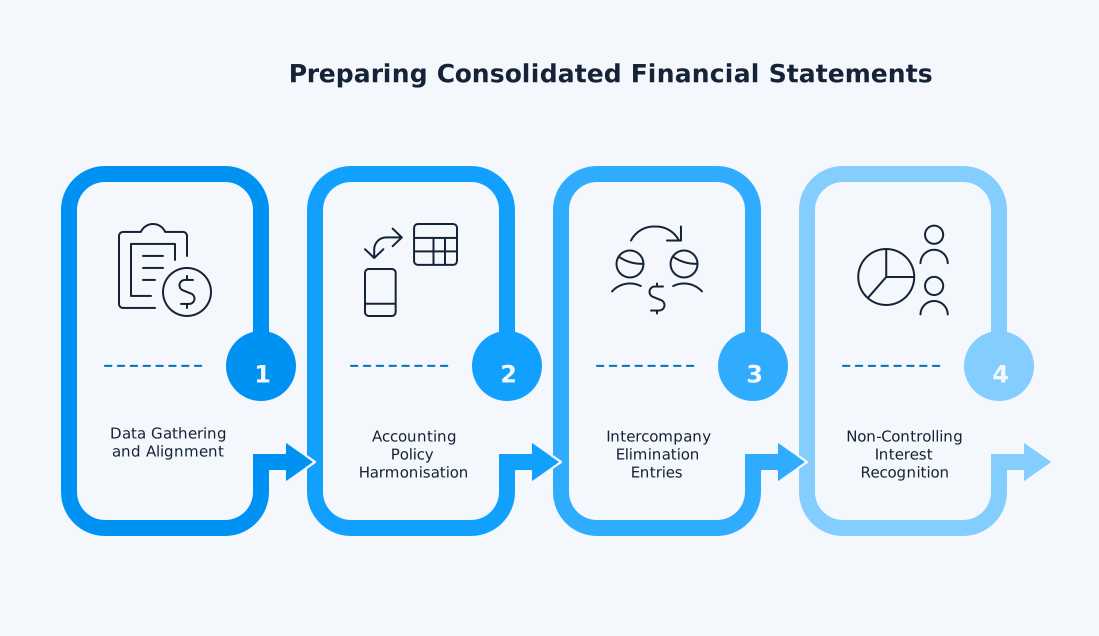
The consolidation process transforms individual entity statements into unified group reporting through systematic procedures. Each step requires precision to ensure accurate presentation of the holding company’s true financial position. Every accurate holding company consolidation begins with entity-level Trial Balances. If subsidiary Trial Balances do not reconcile, eliminations will not balance at group level. This is why consistent, automated TB extraction is fundamental for reliable consolidation.
Data Gathering and Alignment
Begin consolidation by collecting complete financial information from the holding company and all controlled subsidiaries. This includes:
- Trial balances
- General ledgers
- Supporting documentation covering transaction records, invoices, and reconciliations
All entities must follow consistent accounting policies to facilitate accurate consolidation.
Reporting date alignment presents practical challenges. IFRS 10.22 allows reporting dates to differ by up to three months when alignment is impracticable, but requires adjustments for significant transactions during the gap. Consistency in measurement dates across all consolidated entities strengthens the reliability of consolidated information.
Accounting Policy Harmonisation
Subsidiaries often adopt accounting policies differing from the holding company parent, particularly in multinational groups or following acquisitions. IFRS 10 requires uniform accounting policies across the consolidated group. Where differences exist, adjustments align subsidiary policies with those applied by the parent company.
Common policy differences requiring adjustment include revenue recognition methods, inventory valuation approaches, depreciation methods and useful lives, and foreign currency translation techniques. The holding company’s policies prevail, requiring restatement of subsidiary financial information before consolidation proceeds.
Intercompany Elimination Entries
Eliminating internal transactions between group companies represents the most technically complex consolidation step. All intercompany balances and transactions must be eliminated to avoid double-counting revenues, expenses, assets, and liabilities that inflate the consolidated statements.
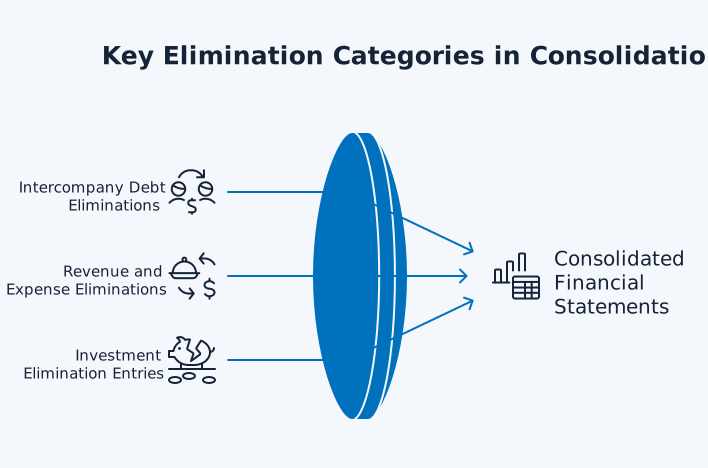
Three primary elimination categories require attention in holding company consolidations.
- Intercompany debt eliminations remove loans between the holding company and subsidiaries or between subsidiaries themselves, eliminating both the receivable and payable along with associated interest income and expense.
- Revenue and expense eliminations cancel sales transactions between group entities, ensuring consolidated statements reflect only external sales to third parties.
- Investment elimination entries remove the holding company’s investment in subsidiary equity against the subsidiary’s share capital and reserves, avoiding double-counting of equity.
The direction of intercompany transactions affects attribution to controlling and non-controlling interests.
- Downstream transactions from parent to subsidiary see the full elimination attributed to the controlling interest.
- Upstream transactions from subsidiary to parent reduce the subsidiary’s profit, affecting both the controlling interest and the non-controlling interest proportionately.
- Lateral transactions between subsidiaries at different ownership levels require careful consideration of attribution.
Unrealised profit eliminations adjust inventory or fixed assets when intra-group sales include markup. Profit is deferred until the asset is sold to an external party. Adjustment allocation depends on whether the transaction is upstream or downstream.
Non-Controlling Interest Recognition
When the holding company owns less than 100% of a subsidiary, non-controlling interests must be separately presented. Non-controlling interests represent the equity and results attributable to shareholders outside the holding company’s control.
- In the consolidated statement of financial position, non-controlling interests appear within equity but separately from the equity attributable to the holding company owners.
- The consolidated statement of profit or loss shows profit or loss attributable to non-controlling interests as a separate line, with the total profit or loss allocated between controlling and non-controlling interests based on ownership percentages after intercompany eliminations.
IFRS 3 permits two measurement approaches for non‑controlling interests at acquisition.
- Under the fair value (full‑goodwill) method, the acquirer measures non‑controlling interests at their fair value, so goodwill includes both the parent’s and the non‑controlling interests’ share.
- Under the proportionate share (partial‑goodwill) method, non‑controlling interests are measured at their proportionate share of the acquiree’s identifiable net assets, so goodwill is recognised only for the parent’s interest. This measurement choice affects the amount of goodwill recognised but does not change how post‑acquisition profit or loss is allocated between the parent and non‑controlling interests.
Non‑controlling interests are determined after consolidation, including all intercompany eliminations.
- For upstream transactions (subsidiary to parent), unrealised profit eliminations reduce the subsidiary’s profit and therefore affect both the parent and non‑controlling interests in proportion to their ownership interests.
- For downstream transactions (parent to subsidiary), unrealised profits are eliminated against the parent’s profit only, so the non‑controlling interests’ share of the subsidiary’s profit is not adjusted.
Goodwill and Fair Value Adjustments
When a holding company acquires control of a subsidiary, the purchase price typically exceeds the fair value of identifiable net assets acquired. Goodwill is recognised under IFRS 3 and subsequently tested for impairment under IAS 36, rather than amortised.
Fair value adjustments arise when subsidiary assets and liabilities are carried at amounts differing from fair values at acquisition. The holding company must adjust these carrying amounts to fair value in consolidated statements, with corresponding impacts on depreciation, amortisation, and profit recognition in subsequent periods.
Common Challenges in Holding Company Consolidation
Even with clear procedures, holding companies encounter recurring obstacles during consolidation. Understanding these challenges helps finance teams implement controls to prevent errors and delays.
1. Multi-Currency Consolidation
Holding companies with subsidiaries operating in different countries must translate foreign subsidiary financial statements into the holding company’s presentation currency. Under IAS 21, subsidiaries first measure transactions in their functional currency (the currency of their primary economic environment). During consolidation, these balances are translated into the parent’s presentation currency. Assets and liabilities use the closing rate; income and expenses use average rates; translation differences accumulate in OCI until disposal.
Foreign currency translation differences accumulate in other comprehensive income rather than profit or loss, representing unrealised gains and losses from exchange rate fluctuations. These cumulative translation adjustments remain in equity until disposal of the foreign operation.
2. Timing and Cutoff Issues
Timing differences arise when intercompany transactions are not recorded in the same reporting period. AS 1 requires financial statements (other than cash flow information) to be prepared on an accrual basis, so entities must recognise assets, liabilities, income, and expenses in the periods when they occur, which implies that intercompany transactions should be recorded in the appropriate reporting period in each entity.
A holding company might record a loan to a subsidiary in December while the subsidiary records receipt in January, creating a reconciliation challenge. Establishing strict cutoff procedures and requiring all intercompany transactions to be confirmed by both parties before close reduces these discrepancies.
Finance teams often struggle with data fragmentation across multiple systems, creating delays during consolidation. Holding companies with numerous subsidiaries using different enterprise resource planning systems face particular difficulty gathering timely, consistent data for consolidation.
3. Complex Ownership Structures
Indirect ownership through chains of subsidiaries complicates consolidation. When a holding company owns 80% of Subsidiary A, which owns 75% of Subsidiary B, determining the consolidated group’s interest in Subsidiary B requires calculating effective ownership. The holding company effectively controls 60% of Subsidiary B (80% × 75%), with 40% representing non-controlling interests split between external shareholders at each level.
Cross-holdings where a subsidiary owns shares in its parent company require treasury stock treatment. The subsidiary’s investment in the parent must be eliminated in consolidation and reflected as treasury shares, not as outstanding shares.
Automation Solutions for Holding Company Consolidation
Manual consolidation processes create bottlenecks in month-end close, particularly for holding companies with complex structures. Modern automation addresses these challenges through systematic elimination logic and real-time data integration.
1. Automated Elimination Rules
Consolidation software enables configuration of elimination rules mapping subsidiary chart of accounts to the parent structures. These rules automatically identify and eliminate intercompany transactions without manual intervention, reducing close times while improving accuracy.
For holding companies using Xero across multiple entities, dataSights automates Xero consolidation by pulling data from each subsidiary’s Xero organisation into a centralised Azure SQL database. Automated eliminations include timestamped audit trails, allowing auditors to trace every adjustment back to source transactions – something manual Excel models cannot provide.
2. Real-Time Consolidation
Traditional holding company consolidation occurs monthly or quarterly after subsidiary books close. Modern approaches enable continuous consolidation by synchronising subsidiary data throughout the period. Finance teams identify intercompany discrepancies and balance sheet issues as they occur rather than discovering problems weeks after month-end.
Automated consolidation platforms connect to subsidiary accounting systems, extract transaction-level details, and continuously apply elimination rules. Holding companies gain real-time visibility into consolidated positions without waiting for formal closing procedures.
3. dataSights for Holding Company Consolidation
dataSights delivers pre-formatted management packs through the web platform, including:
- Consolidated P&L
- Balance Sheet
- Trial Balance
- AR/AP
- Budget variance reports
For teams working in Excel, automated data imports via the dataSights OfficeAddIn and Power Query eliminate manual CSV exports and allow custom reporting models to refresh automatically. For advanced analytics, Power BI connects directly to the consolidated SQL dataset for drill-down dashboards.
The platform handles elimination entries automatically once configured, with full audit trails documenting every intercompany adjustment. Multi-currency translation occurs at the database level using configured exchange rate tables, ensuring consistent treatment of foreign currency across all entities. With 90+ five-star reviews from Xero users and over 300 businesses automated, dataSights reduces month-end close from more than 15 days to under 5 through systematic holding company consolidation.
Regulatory Compliance for Holding Company Statements
Consolidated financial statements face scrutiny from regulators, auditors, and investors. Understanding compliance requirements prevents restatements and audit qualifications.
IFRS 10 and ASC 810 Requirements
IFRS 10 establishes principles for presenting consolidated financial statements when an entity controls one or more other entities. The standard requires elimination of intra-group balances and transactions in full, uniform accounting policies across consolidated entities, and separate presentation of non-controlling interests within equity.
US GAAP consolidation follows ASC 810, which establishes similar principles for consolidating subsidiaries and variable interest entities. The standard mandates full elimination of intercompany transactions, with the amount of elimination unaffected by non-controlling interests. Attribution of eliminated profits differs based on transaction direction and entity type.
Disclosure Requirements
Consolidated financial statements require comprehensive disclosures that provide transparency into the group structure and consolidation approach. Required disclosures include:
- The basis of consolidation
- Listing all significant subsidiaries with ownership percentages
- Accounting policies applied
- The nature and extent of restrictions on subsidiary distributions to the parent
Additional disclosures address non-controlling interests, showing amounts attributable to non-controlling interests for profit or loss and equity separately. Consolidated statements must disclose judgments made in determining control, particularly for entities where control exists without majority ownership or where significant influence creates complexity.
Audit Considerations
Auditors examining consolidated financial statements focus particular attention on control assessments, elimination completeness, and non-controlling interest calculations. Holding companies must maintain documentation supporting control conclusions, especially for non-traditional arrangements like variable interest entities or contractual control mechanisms.
Intercompany reconciliations require robust documentation showing how elimination entries were calculated and verified. Auditors test whether all significant intercompany transactions were identified and eliminated, with particular focus on revenue and profit recognition from internal sales. Inadequate elimination controls often result in audit adjustments and extended field work.
Frequently Asked Questions
When Must a Holding Company Prepare Consolidated Financial Statements?
A holding company must prepare consolidated financial statements when it controls one or more subsidiaries, regardless of ownership percentage. Control exists when the holding company has power over relevant activities, exposure to variable returns, and the ability to use power to affect returns. Consolidation is required in most jurisdictions when these control criteria are met, with specific exemptions for investment entities and certain intermediate holding companies.
What Ownership Threshold Triggers Consolidation Requirements?
No fixed ownership percentage automatically triggers consolidation. While owning more than 50% of voting rights often indicates control, IFRS 10 bases consolidation on control assessment rather than ownership thresholds. A holding company might control a subsidiary with only 40% ownership if remaining shares are widely dispersed, or might lack control despite 60% ownership if other shareholders hold protective rights.
Can Holding Companies Exclude Small or Immaterial Subsidiaries From Consolidation?
No, materiality does not exempt subsidiaries from consolidation when control exists. IFRS 10 requires all controlled entities to be consolidated regardless of size, unless specific exemptions apply. Materiality considerations affect presentation detail and disclosure extent, not the consolidation requirement itself. Investment entity exemptions provide the primary exception, not subsidiary size or materiality.
How Often Must Holding Companies Prepare Consolidated Financial Statements?
Reporting frequency depends on regulatory requirements and listing status. Bank holding companies with consolidated assets exceeding $3 billion file quarterly with the US Federal Reserve. Public companies typically prepare consolidated statements quarterly and annually. Private holding companies without regulatory requirements commonly consolidate annually, though monthly or quarterly consolidation provides better management insight.
What Is the Difference Between Consolidated and Parent-Only Financial Statements?
Consolidated statements combine the holding company and all controlled subsidiaries into a single economic entity, showing combined assets, liabilities, revenues, and expenses after eliminating internal transactions. Parent-only statements show the holding company’s separate accounts with investments in subsidiaries recorded as single-line items. Consolidated statements are the primary general-purpose financial statements, while parent-only statements serve specific purposes like covenant compliance or restricted net asset disclosures.
Do Investment Entity Holding Companies Consolidate Subsidiaries?
Investment entity holding companies measure most controlled subsidiaries at fair value through profit or loss rather than consolidating them. IFRS 10 and ASC 946 provide this exception for entities obtaining funds from investors to provide investment management services and measuring performance primarily through fair value. Investment entities must consolidate subsidiaries providing investment-related services like fund administration, but measure other controlled investments at fair value.
How Should Holding Companies Eliminate Intercompany Loans in Consolidation?
Intercompany loans between the holding company and subsidiaries or between subsidiaries must be eliminated by removing both the loan receivable and loan payable from the consolidated statement of financial position. Associated interest income and interest expense are also eliminated from the consolidated statement of profit or loss. This treatment reflects that loans within the consolidated group are internal transfers, not economic transactions with external parties.
What Happens to Non-Controlling Interests When Subsidiaries Generate Losses?
When consolidated subsidiaries generate losses, those losses are attributed to non-controlling interests even if the attribution results in a deficit balance. Non-controlling interest deficits appear in consolidated equity as negative amounts. Future profits first absorb the deficit before increasing non-controlling interest back to positive amounts. The holding company does not absorb subsidiary losses belonging to non-controlling shareholders.
Can Holding Companies Use Different Accounting Policies Across Subsidiaries?
No, IFRS 10 requires uniform accounting policies across all entities in the consolidated group. When subsidiaries initially apply different policies, the holding company must adjust subsidiary financial information to align with parent company policies before consolidation. This ensures comparability and consistency throughout consolidated financial statements. Only in specialised industries do accounting standards permit different policies within a single set of consolidated statements.
What Are the Penalties for Failing to Prepare Required Consolidated Financial Statements?
Penalties vary by jurisdiction and regulatory framework. Public holding companies failing to file required consolidated statements face securities law violations, trading suspensions, and potential delisting. Bank holding companies not filing mandated reports face supervisory action from banking regulators. Private holding companies may encounter audit qualifications, covenant violations, and limitations on future financing if consolidated statements are required by loan agreements but not prepared.
Your Holding Company Consolidation Roadmap
Holding company consolidated financial statements require control assessment, intercompany eliminations, and non-controlling interest calculations across all subsidiaries. Manual consolidation takes over two weeks, creates balance sheet mismatches, and leaves auditors questioning your elimination entries. dataSights automates Xero consolidation with pre-formatted management packs, elimination audit trails, and Trial Balance reconciliation across small and large entities. Your holding company balances deserve consolidation that actually works.
Transform Your Holding Company Consolidation Today
Cut month-end close from over 15 days to under 5 with automated Xero consolidation. dataSights delivers elimination entries with full audit trails, consolidated management reports across all entities, and Trial Balance reconciliation that actually balances. Rated 5.0 by 90+ Xero users. Join 300+ businesses who’ve already automated their holding company consolidation.
About the Author
Kevin Wiegand
Founder & Client happiness
I’m Kevin Wiegand, and with over 25 years of experience in software development and financial data automation, I’ve honed my skills and knowledge in building enterprise-grade solutions for complex consolidation and reporting challenges. My journey includes developing custom solutions for data teams at Gazprom Marketing & Trading and E.ON, before founding dataSights in 2016. Today, dataSights helps over 300 businesses achieve 100% report automation. I’m passionate about sharing my expertise to help CFOs and Financial Controllers reduce their month-end close time and eliminate the manual Excel exports that drain their teams’ valuable time.