
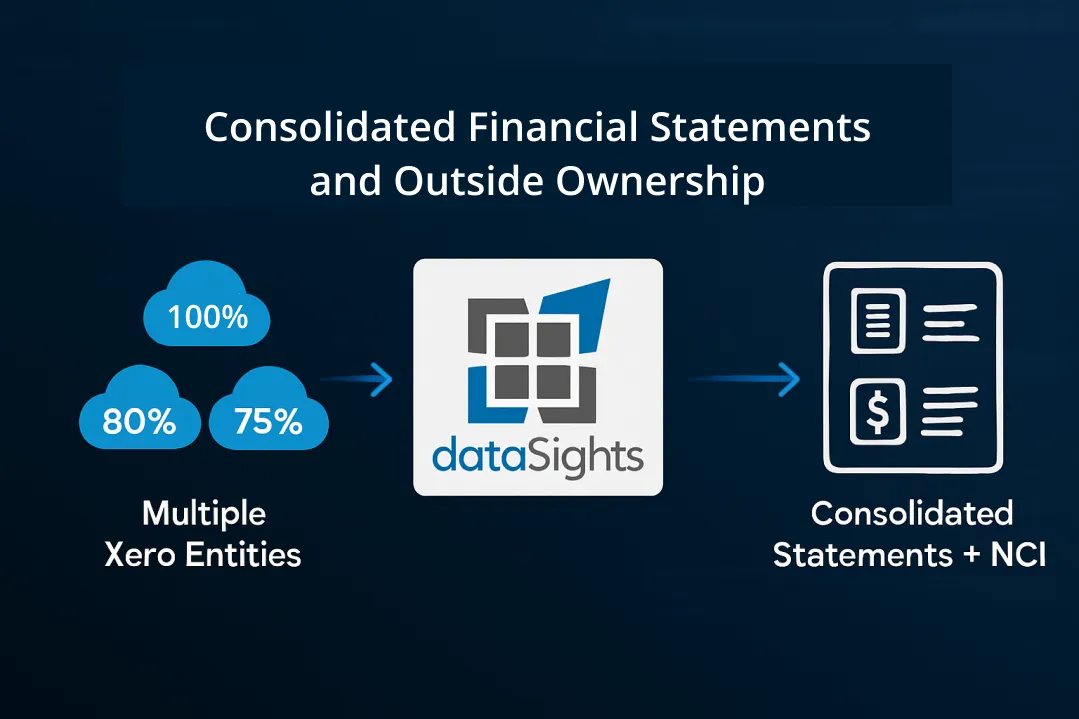
Consolidated financial statements and outside ownership raise one core question: if you own 80% of a subsidiary, what happens to the other 20%? That remaining stake is outside ownership (non-controlling interest, or NCI). It affects how you present equity and allocate profit in the group accounts. Get it wrong, and your group accounts won’t reflect the economic reality of your business structure. This guide walks you through everything CFOs and Financial Controllers need to know about handling outside ownership in consolidated financial statements.
Consolidated Financial Statements and Outside Ownership Explained
Consolidated financial statements and outside ownership require presenting the parent and its controlled subsidiaries as a single economic entity, combining 100% of assets, liabilities, revenues, and expenses regardless of ownership percentage. Outside ownership – also called non-controlling interest (NCI) – is the portion of a subsidiary’s equity not attributable to the parent. Under both US GAAP (ASC 810) and IFRS 10, NCI is presented as a separate component of equity on the consolidated balance sheet, with net income allocated separately between owners of the parent and NCI on the income statement.
Ready to Automate Your Financial Consolidation?
Stop wrestling with manual consolidations and broken formulas. dataSights automates multi-entity reporting, Xero consolidations, and Power BI connections. Join 300+ businesses already transforming their financial reporting with our platform, rated 5.0 out of 5 by 90+ verified Xero users.
Table of Contents
What Triggers the Requirement to Consolidate
The relevant criterion for preparing consolidated financial statements is whether one company controls the decision-making process of another – not simply the ownership percentage. Both IFRS and US GAAP establish specific frameworks for assessing control, though they approach the analysis differently. While ownership exceeding 50% typically indicates control, the standards focus on actual power over relevant activities rather than numerical thresholds alone.
Control Under IFRS 10
IFRS 10 establishes three elements that must all be present for control to exist:
- Power over the investee through existing rights
- Exposure or rights to variable returns from involvement
- Ability to use power to affect those returns
A parent might control a subsidiary with less than 50% ownership through voting agreements, potential voting rights, or contractual arrangements. Holding more than 50% of voting rights is a strong indicator of control, but it is not the whole analysis. If decision-making over relevant activities is constrained or transferred (for example, through legal or contractual arrangements), you may need to reassess who actually has power and whether consolidation is still required.
Control Under US GAAP (ASC 810)
ASC 810 uses the concept of a “controlling financial interest” to determine consolidation requirements. For voting interest entities, this typically means owning more than 50% of outstanding voting shares. For variable interest entities (VIEs), the primary beneficiary – the party with both power and the obligation to absorb losses or right to receive benefits – must consolidate.
Understanding Non-Controlling Interest
Non-controlling interest represents the equity stake in a subsidiary held by parties other than the parent company. NCI is formally defined as the “portion of equity (net assets) in a subsidiary not attributable, directly or indirectly, to a parent”. This definition replaced the older term “minority interest” following FASB Statement No. 160, which became effective for fiscal years beginning after December 2008.
Why Non-Controlling Interests Exist
Several business scenarios create outside ownership in subsidiaries:
- The parent didn’t acquire all available shares
- Some shareholders were unwilling to sell their stakes
- Local laws prevent complete foreign ownership
- Strategic reasons for maintaining outside investors
- Joint venture structures with defined ownership splits
Measurement of NCI at Acquisition
When a parent acquires controlling but less-than-100% interest, IFRS 3 offers a choice for measuring NCI at the acquisition date:
- Fair value method (full goodwill approach): NCI is measured at its acquisition-date fair value, including a share of goodwill attributable to outside owners. This produces higher goodwill on the consolidated balance sheet.
- Proportionate interest method (partial goodwill approach): NCI is measured at its proportionate share of the acquiree’s identifiable net assets. Goodwill reflects only the parent’s portion.
US GAAP requires the fair value method exclusively – there is no proportionate interest option available.
How Consolidation Works With Outside Ownership
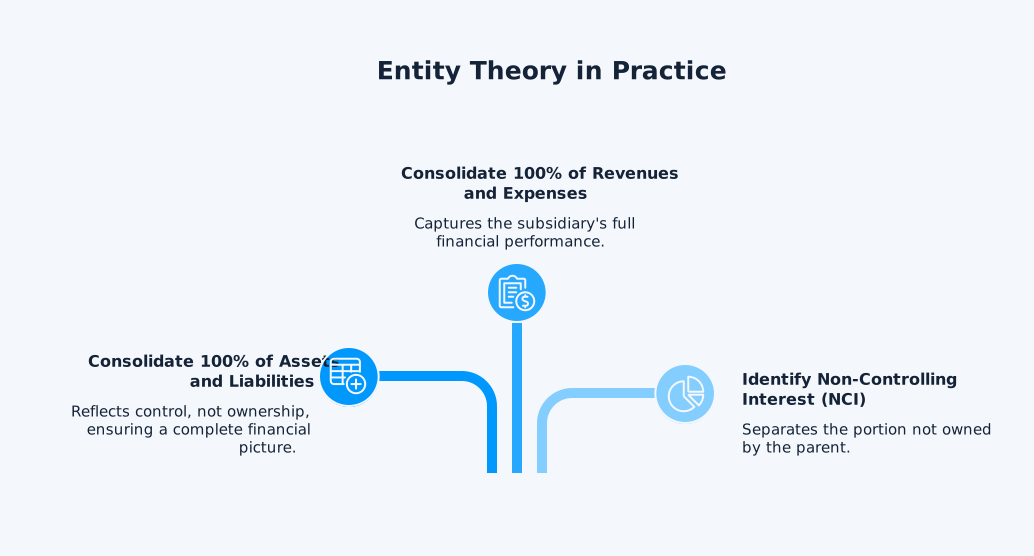
When a parent owns less than 100% of a subsidiary, the consolidation process must account for both the controlling interest and the outside shareholders. Consolidated financial statements still include 100% of the subsidiary’s:
- Revenues
- Expenses
- Assets
- Liabilities
This follows the entity theory of consolidation: if you control an entity, you report all of it, then separately identify the portion belonging to outside owners.
The Entity Theory Explained
Although a parent might own only 75% of a subsidiary, consolidated statements reflect control, not ownership. The ACCA confirms that it would be “a fundamental mistake in any consolidation question to ever pro-rate a subsidiary’s statement of financial position where there is less than 100% ownership.”
Consider this example: Parent Co owns 80% of Subsidiary Co. On consolidation:
- 100% of Subsidiary Co’s assets appear on the consolidated balance sheet
- 100% of Subsidiary Co’s liabilities are consolidated
- 100% of revenues and expenses flow through the consolidated income statement
- The 20% not owned by Parent Co is separately identified as NCI
Balance Sheet Presentation
In general, NCI is presented within equity, separately from equity attributable to owners of the parent. Under US GAAP, if a noncontrolling interest is redeemable (for example, subject to a put option outside the issuer’s control), SEC guidance may require presentation outside permanent equity (often called temporary equity or “mezzanine”). Always assess the instrument terms. This placement reflects that NCI holders have an ownership stake in the consolidated group, not a claim that ranks ahead of shareholders.
The consolidated equity section typically shows:
- Share capital (parent only)
- Share premium (parent only)
- Retained earnings (parent’s share)
- Other comprehensive income (parent’s share)
- Non-controlling interest (separate line)
Income Statement Presentation
The consolidated income statement presents net income for the entire enterprise, then shows the allocation between parent and NCI shareholders. Under Statement no. 160, consolidated income statements present net income attributable to both the parent and NCI. Earnings per share calculations use only income attributable to the parent.
Worked example – NCI income allocation: Parent owns 80% of Subsidiary. Subsidiary reports £100,000 profit after intercompany eliminations.
- Full £100,000 appears in consolidated net income
- £80,000 allocated to Parent shareholders
- £20,000 allocated to NCI
The NCI share isn’t an expense – it’s an allocation of consolidated profit to the rightful owners.
Intercompany Eliminations and Outside Ownership
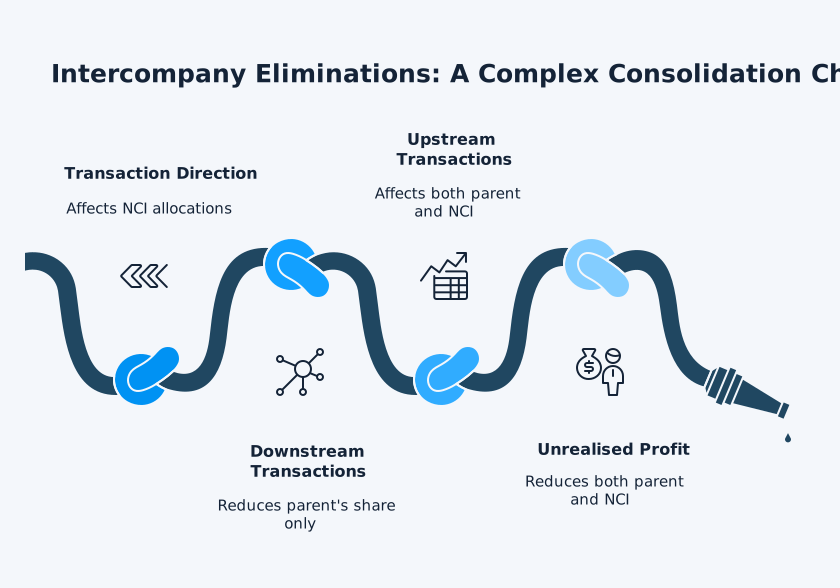
All intercompany transactions must be eliminated during consolidation, and the treatment becomes more nuanced when outside ownership exists. The direction of transactions affects how eliminations impact NCI allocations, making this one of the most technically demanding aspects of partial ownership consolidation.
Why Eliminations Matter
Consolidated financial statements only report income and expense activity from outside the economic entity. Intercompany revenues and expenses are eliminated to avoid double-counting. Without proper eliminations, group accounts would overstate both revenues and expenses.
Downstream Versus Upstream Transactions
- Downstream transactions (parent sells to subsidiary): The parent recorded the profit, so eliminations reduce the parent’s share only. NCI is unaffected.
- Upstream transactions (subsidiary sells to parent): The subsidiary recorded the profit, so eliminations reduce the subsidiary’s profit – and therefore affect both parent and NCI shareholders proportionally.
This matters because upstream profit sits in the subsidiary’s results – and NCI participates in the subsidiary’s profit. So removing unrealised upstream profit reduces both the parent’s share and the NCI share.
Worked example – intercompany inventory: Parent owns 80% of Subsidiary. Subsidiary sells inventory to Parent for £50,000 (cost: £40,000). Parent hasn’t resold this inventory at year-end.
- Unrealised profit: £10,000
- Elimination entry reduces consolidated inventory by £10,000
- £8,000 reduces parent’s share of profit (80%)
- £2,000 reduces NCI’s share (20%)
Intercompany Balances Elimination
Beyond profit eliminations, intercompany receivables and payables must also be eliminated from the consolidated balance sheet. If Parent shows a receivable of £50,000 from Subsidiary, and Subsidiary shows a corresponding payable, both are removed. The group hasn’t earned anything from itself.
IFRS Versus US GAAP Differences
While both frameworks require consolidation based on control and similar NCI presentation, finance teams managing international groups must understand the key differences between standards. These variations affect acquisition accounting, impairment testing, and control assessments.
| Aspect | IFRS (IFRS 10 / IFRS 3) | US GAAP (ASC 810 / ASC 805) |
|---|---|---|
| NCI measurement at acquisition | Choice for each business combination: measure NCI at fair value or at proportionate share of the acquiree’s identifiable net assets (IFRS 3) | Fair value required for NCI at acquisition (ASC 805) |
| Goodwill recognised | Full goodwill if NCI measured at fair value; partial goodwill if NCI measured at proportionate share | Full goodwill only (NCI measured at fair value) |
| Control assessment model | Single, principles-based control model: power over relevant activities + exposure to variable returns + ability to use power to affect returns (IFRS 10) | Dual model: voting interest entity model and VIE model, applied based on entity characteristics (ASC 810) |
| De facto control | Explicitly recognised; control may exist without majority voting rights (e.g. widely dispersed shareholders, historical voting patterns) | Not explicitly defined; control without majority ownership generally addressed through VIE primary beneficiary guidance rather than the voting-interest model |
| Potential voting rights | Considered in control assessment if substantive (currently exercisable and economically meaningful) | Considered only in specific circumstances based on detailed guidance; no general principle equivalent to IFRS |
| Changes in ownership without loss of control | Treated as equity transactions; no gain or loss recognised in profit or loss (IFRS 10) | Treated as equity transactions; no gain or loss recognised in earnings (ASC 810) |
| Loss of control | Gain or loss recognised in profit or loss; retained interest remeasured to fair value (IFRS 10) | Gain or loss recognised in earnings; retained interest remeasured to fair value (ASC 810) |
Both IFRS and US GAAP present non-controlling interests within equity and split income between the parent and non-controlling interests.
Changes in Ownership Without Loss of Control
When a parent buys or sells shares in a subsidiary but retains control, the accounting treatment differs from a business combination. The transaction is treated as an equity transaction under both IFRS and US GAAP. No gain or loss flows through the income statement.
Example: Parent owns 80% of Subsidiary. Parent acquires an additional 10% from NCI shareholders for £100,000. The fair value of that 10% stake is £120,000.
- No goodwill is recorded (not a business combination)
- NCI decreases by £120,000
- The £20,000 difference (£120,000 fair value minus £100,000 paid) adjusts the parent’s equity directly
This treatment recognises that transactions with NCI shareholders are transactions between equity holders, similar to treasury share transactions.
Loss of Control
When control is lost – whether through sale, dilution, or contractual changes – the accounting treatment differs significantly from transactions that maintain control. The parent must derecognise the former subsidiary entirely and recognise any retained interest at fair value.
Key steps when control is lost:
- Derecognise the former subsidiary’s assets and liabilities
- Derecognise any NCI
- Recognise any retained investment at fair value
- Recognise gain or loss in the income statement
The retained investment, if significant influence remains, would then be accounted for using the equity method going forward.
Automating NCI Calculations in Multi-Entity Groups
Manual consolidation with outside ownership compounds complexity exponentially. Each consolidation requires accurate tracking of:
- Ownership percentages
- Elimination entries
- NCI allocations across every entity
For finance teams managing multiple subsidiaries with varying ownership structures, automation becomes essential for accuracy and efficiency.
The Manual Consolidation Challenge
Finance teams managing consolidations in spreadsheets face several NCI-specific problems:
- Tracking multiple ownership percentages across entities
- Ensuring elimination direction is correctly applied
- Maintaining audit trails for NCI calculations
- Reconciling NCI movements period to period
- Handling ownership changes without recalculating everything
Manual consolidation with outside ownership compounds complexity quickly – especially when you’re tracking the following across multiple entities:
- Ownership
- Eliminations
- Journals
- NCI movements
How Automation Addresses NCI Complexity
dataSights delivers pre-formatted management packs with consolidated P&L, Balance Sheet, and Trial Balance that handle NCI calculations automatically. The platform’s Xero consolidation solution enables teams to:
- Configure ownership percentages once across all entities
- Apply elimination rules automatically with full audit trails
- Allocate income to parent and NCI based on configured percentages
- Track NCI movements through the consolidation period
- Generate board-ready reports that correctly present NCI within equity
Teams using automated consolidation routinely reduce month-end close from over 15 days to under 5, with NCI calculations that balance first time.
dataSights helps finance teams start with web-based Management Reports, producing board-ready packs in minutes. You can then automate Excel reporting using Power Query or the dataSights Excel Add-In. When you’re ready to scale, you can connect the same consolidated data model to Power BI in Import or DirectQuery mode.
Disclosure Requirements for NCI
Both IFRS and US GAAP require disclosures that help users understand who owns what, how profits are shared, and what judgements management made in deciding which entities are consolidated.
IFRS (IFRS 12, Alongside IFRS 10)
For each subsidiary with material non-controlling interest (NCI), IFRS 12 generally expects disclosures such as:
- The subsidiary’s name, principal place of business, and key ownership information.
- The profit or loss allocated to NCI for the period and accumulated NCI at the reporting date.
- Summarised financial information about the subsidiary to show the NCI’s interest in its financial position and performance (typically prepared before intragroup eliminations).
- Any significant restrictions on the subsidiary’s ability to transfer cash or assets to the group.
- The significant judgements and assumptions made when assessing control and determining the consolidation boundary.
US GAAP (ASC 810 + SEC Overlay Where Relevant)
ASC 810 disclosures are aimed at clearly depicting the NCI holder’s claim on the subsidiary’s net assets and net income. Common elements include:
- Separate presentation of NCI within equity and net income attributable to NCI in the financial statements.
- A reconciliation of opening and closing NCI balances (commonly presented in the notes).
- Disclosure of significant judgements in consolidation and control assessments.
- A separate schedule when the parent’s ownership interest changes in a subsidiary during the period.
In practice: Your notes should clearly set out the basis of consolidation, ownership percentages and voting rights (where different), and the policy choices affecting NCI (e.g., measurement choices at acquisition under IFRS, and any SEC “temporary equity” considerations for redeemable NCI under US reporting).
Frequently Asked Questions
What Is the Difference Between Minority Interest and Non-Controlling Interest?
They refer to the same concept. “Non-controlling interest” replaced “minority interest” as the standard term following FASB Statement No. 160 in 2008. The name change reflected that some majority ownership positions don’t lead to consolidation, making “minority” technically inaccurate in certain scenarios.
Does NCI Affect Earnings per Share Calculations?
Yes, but only indirectly. Reported earnings per share are based only on the income attributable to the parent. The NCI portion of consolidated net income is excluded from the EPS numerator.
Where Does Non-Controlling Interest Appear on the Balance Sheet?
Non-controlling interest (NCI) is usually shown within equity on the consolidated balance sheet, separately from equity attributable to the parent’s shareholders. Under US GAAP, if the NCI is redeemable (for example, subject to a put option outside the issuer’s control), SEC presentation guidance may require it to be shown outside permanent equity (often called temporary equity or “mezzanine”). Always assess the specific terms of the arrangement.
How Is NCI Calculated on the Income Statement?
Multiply the subsidiary’s net income (after intercompany eliminations) by the NCI ownership percentage. For example, if a subsidiary earns £20M and the parent owns 60%, the NCI portion is £8M (40% x £20M).
Why Is NCI Added in Enterprise Value Calculations?
Since consolidated financials include 100% of a subsidiary’s operations but the parent doesn’t own 100%, NCI must be added to bridge from equity value to enterprise value. This ensures valuation multiples using consolidated EBITDA are consistent.
Can a Company Consolidate With Less Than 50% Ownership?
Yes. Consolidation is based on control, not ownership percentage. A parent might achieve control through voting agreements, potential voting rights, or contractual arrangements even with a minority stake.
What Happens to NCI When Additional Shares Are Purchased?
If the parent buys additional shares but already had control, the transaction is treated as an equity transaction. NCI decreases, parent equity adjusts, and no gain or loss flows through the income statement.
Does FRS 102 Treat NCI Differently?
FRS 102 follows similar principles but allows only the proportionate interest method for NCI measurement at acquisition. UK groups must choose whether to apply UK-adopted IFRS or FRS 102 based on their circumstances, with consolidated accounts following the chosen framework.
How Are Losses Allocated When NCI Would Become Negative?
Under current standards, losses continue to be allocated to NCI even if this creates a negative balance. The NCI share continues to be allocated proportionally regardless of the result, reflecting the economic substance that outside shareholders bear their proportionate share of losses.
Are Intercompany Dividends Eliminated?
Yes. Dividends paid from subsidiary to parent are eliminated on consolidation since they represent internal cash movement. However, dividends paid by the subsidiary to NCI shareholders are real cash outflows from the group and reduce the NCI balance.
Your Next Steps for Managing Outside Ownership
Correct NCI accounting requires consistent application of three core principles: consolidate 100% of controlled subsidiaries, present NCI within equity (never as a liability), and allocate income proportionally based on ownership percentages. The complexity multiplies with each additional subsidiary and varying ownership structure. For multi-entity groups using Xero, automated consolidation eliminates the manual calculations that consume finance team time and create reconciliation errors during month-end close.
Automate Your Multi-Entity Consolidation With NCI
Ready to eliminate manual NCI calculations and intercompany reconciliation headaches? dataSights’ Xero consolidation solution handles outside ownership automatically with full audit trails. Rated 5.0 by 90+ Xero users, our platform helps 300+ businesses complete month-end close in under 5 days. Configure ownership percentages once, and let the system handle allocations, eliminations, and NCI presentation correctly every period.
About the Author
Kevin Wiegand
Founder & Client happiness
I’m Kevin Wiegand, and with over 25 years of experience in software development and financial data automation, I’ve honed my skills and knowledge in building enterprise-grade solutions for complex consolidation and reporting challenges. My journey includes developing custom solutions for data teams at Gazprom Marketing & Trading and E.ON, before founding dataSights in 2016. Today, dataSights helps over 300 businesses achieve 100% report automation. I’m passionate about sharing my expertise to help CFOs and Financial Controllers reduce their month-end close time and eliminate the manual Excel exports that drain their teams’ valuable time.