
You’re staring at mismatched intercompany balances, your consolidation won’t balance, and month-end close is already at day 12. Sound familiar? If you’re asking, “Are reconciliation and consolidation the same?” while your financial close feels like solving a Rubik’s Cube blindfolded, you’re not alone. These two processes confuse even experienced finance teams, yet understanding their relationship could mean the difference between a 2-week close and a 5-day close. Let’s clear up the confusion and show you how mastering both processes transforms your month-end chaos into a streamlined workflow.
Are Reconciliation and Consolidation the Same?
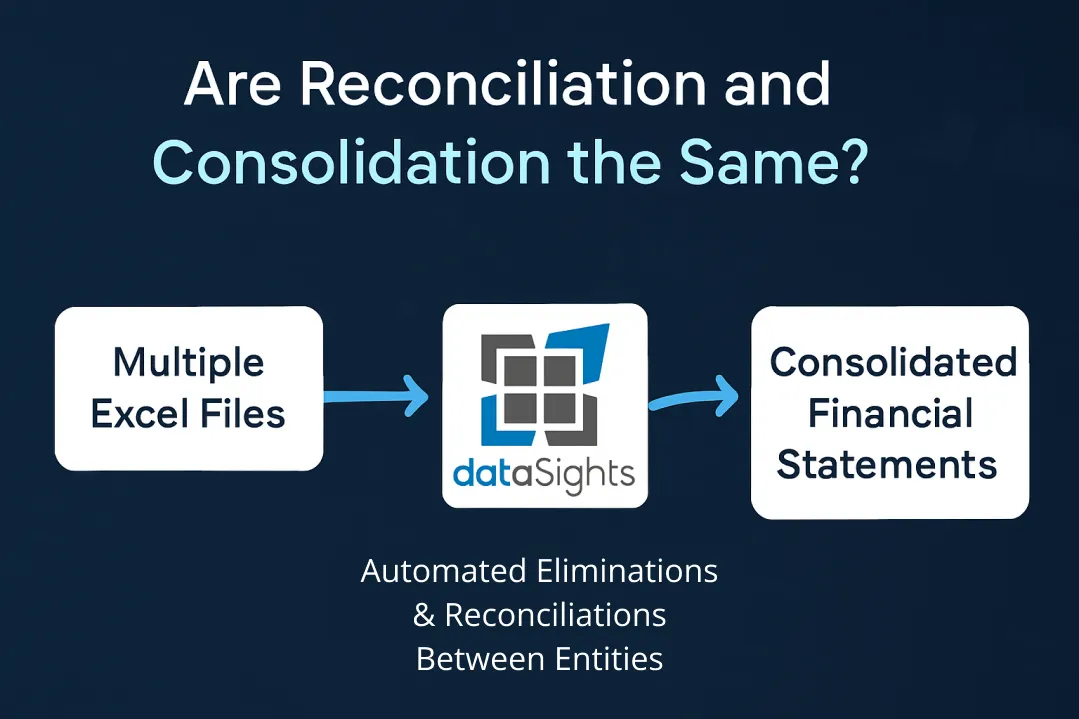
No, reconciliation and consolidation are not the same. Reconciliation involves comparing and verifying transactions between different accounts or entities to ensure accuracy, while consolidation combines financial data from multiple entities into unified statements. Think of reconciliation as quality control that happens before consolidation – you can’t build accurate group financials on unverified data.
Ready to Automate Your Financial Consolidation?
Stop wrestling with manual consolidations and broken formulas. dataSights automates multi-entity reporting, Xero consolidations, and Power BI connections. Join 300+ businesses already transforming their financial reporting with our platform, rated 5.0 out of 5 by 90+ verified Xero users.
Table of Contents
Understanding the Core Difference: Reconciliation vs Consolidation
Before we define each process, here’s the practical lens: reconciliation cleans and validates the data; consolidation assembles the group story. The following sections unpack what each one does and why order matters.
What Is Reconciliation in Financial Reporting?
Reconciliation is the process of comparing two sets of records to ensure figures match accurately. In multi-entity organisations, this means verifying that transactions between subsidiaries align perfectly. If Company A records a £50,000 sale to Company B, then Company B must show a £50,000 purchase from Company A.
Reconciliation verifies transactions and balances before consolidation. It catches discrepancies before they snowball into bigger problems. Whether you’re matching bank statements to general ledgers or verifying intercompany loans, reconciliation ensures your source data is clean and accurate.
What Is Consolidation in Financial Reporting?
Financial consolidation combines financial data from multiple entities within a parent company structure into a single, unified financial statement. This process transforms individual entity reports into group-level financials that represent the entire organisation as one economic unit.
Consolidation goes beyond simple addition. It involves:
- Currency conversions
- Elimination of intercompany transactions, and
- Complex adjustments to present accurate group performance.
The goal is to accurately represent each company’s assets and liabilities while reconciling what would otherwise be duplicate transactions.
How Reconciliation and Consolidation Work Together
These aren’t rival processes – they’re sequential. Done in the right order, reconciliation removes noise so consolidation runs cleanly, avoiding last-minute investigations and deadline pressure.
Why Reconciliation Must Come First
In practice, reconciliation must precede consolidation to ensure accuracy. You cannot consolidate what you haven’t verified.
During the consolidation process, reconciliations and adjustments must be made to verify that the business’s data is accurate. If discrepancies surface during consolidation, you’re already behind. Each mismatch then needs investigation, intercompany follow-up, and adjustments – under deadline pressure.
The Intercompany Reconciliation Challenge
Intercompany reconciliation balances transactions between different entities within a company, which is a significant burden in the financial consolidation process. It typically takes an extraordinary amount of time to understand the root causes of account differences and balance transactions. Match at document ID/date/amount, agree currency and rate, and maintain a counterparty matrix (who trades with whom).
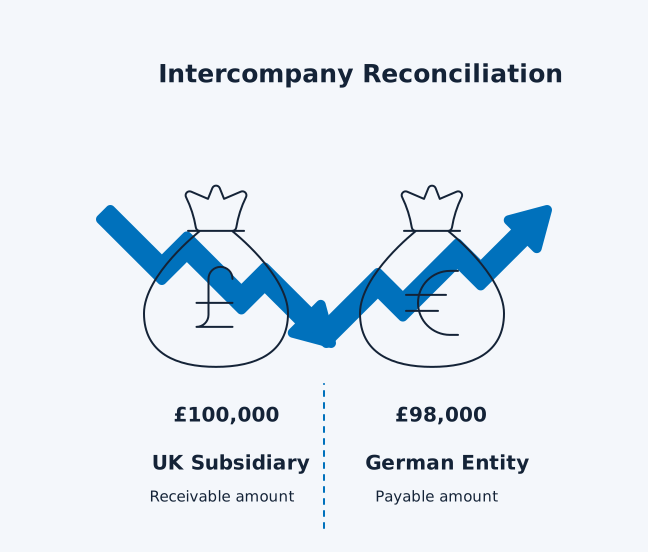
Consider this scenario: Your UK subsidiary shows a £100,000 receivable from the German entity, but Germany only shows £98,000 payable. Without reconciliation, this £2,000 difference would create an imbalance in your consolidated statements. The discrepancy might stem from exchange rate timing, unrecorded transactions, or simple data entry errors – but you won’t know until you reconcile. Resolve FX timing, missing postings, or data entry errors at source before consolidation.
The Financial Consolidation Process: Where Reconciliation Fits
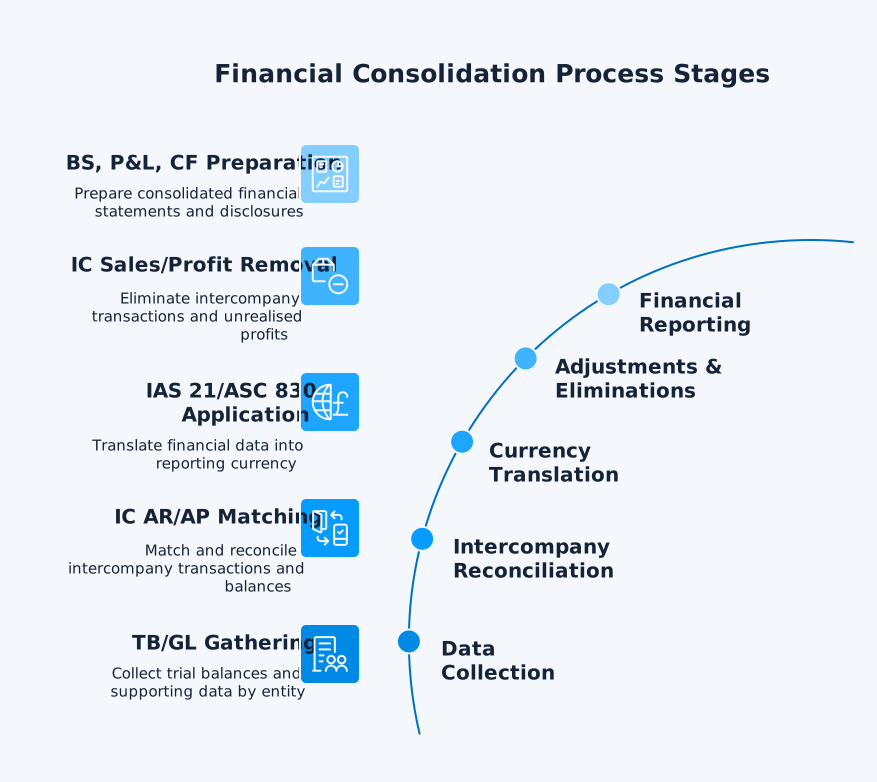
Think of consolidation as a flow. The five stages below show where reconciliation sits in the journey and what must be true before eliminations and reporting can be trusted.
Stage 1: Data Collection (TB/GL/support by entity)
Before any reconciliation or consolidation can begin, you need complete financial data from all entities. This includes trial balances, general ledgers, and supporting schedules from each subsidiary.
Stage 2: Intercompany Reconciliation (match IC AR/AP, loans, fees in functional currency, fix timing/missing entries)
This is where reconciliation becomes critical. You need to perform intercompany reconciliation to avoid discrepancies in your consolidation statement by verifying the status of each intercompany exchange. Every intercompany transaction must match perfectly between entities before proceeding.
Stage 3: Currency Translation (apply IAS 21/ASC 830 to each TB for group reporting)
Under IAS 21/ASC 830, translating a foreign operation uses closing rate for assets and liabilities, average rates for income/expenses, and historical rates for equity, with cumulative translation differences to OCI. If remeasurement is required (books ≠ functional currency), monetary items use the closing rate and non-monetary items use historical rates, with remeasurement gains/losses in P&L. In practice, intercompany reconciliation is performed in each entity’s functional currency first; eliminations are then posted on the translated balances in consolidation.
Stage 4: Adjustments & eliminations (IC sales/COGS, loans/interest, unrealised profit in inventory/PP&E; elimination journals documented with audit trail)
After reconciliation confirms all intercompany balances match, you can process eliminations. Intercompany sales, balances, and loans are eliminated on consolidation, so group statements reflect only third-party activity. Eliminate intragroup profits (goods/services still within the group) and IC balances/transactions; do not eliminate translation differences (CTA in OCI) that arise from consolidating foreign operations. Document elimination journals with a timestamped audit trail.
Stage 5: Financial Reporting (BS, P&L, CF; disclosures)
Finally, with reconciled data and completed eliminations, finance teams can produce accurate consolidated balance sheets, income statements, and cash flow statements for internal and external stakeholders.
Regulatory Note
Small groups in some jurisdictions (e.g., UK Companies Act small-group exemption; certain AU/NZ parent-subsidiary scenarios) may be exempt from statutory consolidated accounts. Many still prepare management consolidations for boards and investors. Always confirm current thresholds with your regulator and advisors. Consolidation is driven by control (IFRS 10/ASC 810). Jurisdictions such as the UK (Companies Act 2006) and AU/NZ offer limited filing exemptions (e.g., intermediate-parent), but many groups still prepare management consolidations.
Common Challenges When Reconciliation and Consolidation Collide
Even with the right workflow, teams hit predictable pitfalls. Here we spotlight the most common failure modes – from spreadsheet drift to timing and FX mismatches – and why they derail close timelines.
The Excel Nightmare
Academic and industry research consistently finds high error rates in complex spreadsheets, which compound across multi-entity close workflows – supporting the move to controlled, logged processes.
Version control issues and broken formulas are common when teams manage reconciliations across multiple spreadsheets. Finance teams often manage multiple versions of the same spreadsheet, which can lead to confusion about which numbers are current and which reconciliations are complete.
Timing Differences and Mismatches
One company’s records might not match another’s due to timing differences, such as recording a sale in different months. Currency exchange rates add another layer of complexity – a transaction might reconcile perfectly in local currency but create mismatches when converted to group currency.
Lack of Standardisation
For global organisations with several entities, the balance sheet reconciliation process can become complex when separate entities operate with different procedures and varying spreadsheet formats. Without standardised processes, reconciliation becomes a game of detective work rather than systematic verification. Standardise a group chart of accounts and reconciliation checklist across entities.
Streamlining Both Processes: From Manual to Automated
If spreadsheets slow you down, this section outlines the shift to an integrated, controlled workflow – encompassing continuous matching, rule-based eliminations, and real-time visibility – that shortens the close.
Breaking Free from Spreadsheet Dependency
Manual spreadsheets delay reconciliations, which delays consolidation and reporting, which increases pressure for the next period. Automated reconciliation streamlines the process with real-time matching, built-in controls, and exception management.
The Power of Integrated Solutions
Modern consolidation platforms recognise that reconciliation and consolidation are inseparable. Automated data integration from varied sources with smart validations can help reduce manual errors and save hours. When reconciliation happens automatically within your consolidation workflow, discrepancies are flagged immediately rather than discovered days later.
With automated consolidation tools like dataSights, reconciliation becomes part of a continuous process rather than a month-end scramble. Continuous intercompany matching, rule-based eliminations, and FX translation are handled in-platform, with drill-through to transaction detail. Real-time visibility into intercompany balances means issues surface daily, not after two weeks of manual checking. The result? Companies using integrated automation report reducing close times from over 15 days to under 5.
Important Note: Xero doesn’t provide native intercompany/consolidation; groups use a consolidation/reporting layer (SQL/Power BI or specialist software) for IC matching, eliminations, FX and audit trails.
Frequently Asked Questions
Can You Consolidate Without Reconciling First?
Possible, but high-risk. Consolidating unreconciled data leads to investigation and rework under time pressure. Any intercompany mismatches will create imbalances in your consolidated statements, requiring you to go back and reconcile anyway – but now under time pressure with less context about the original transactions.
How Often Should Reconciliation Happen Before Consolidation?
Best practice is continuous reconciliation throughout the period rather than waiting for month-end. Starting the matching process at the beginning of the reporting period makes it almost continuous, achieving significant gains in closing time. Daily or weekly reconciliation catches issues while they’re fresh and manageable.
What's the Biggest Risk of Poor Reconciliation in Consolidation?
Financial misstatements pose an immediate risk, but their ripple effects are even more severe. Poor reconciliation can result in major reporting and accuracy issues, leading board meetings or earnings calls to go terribly off the rails. Regulatory penalties, audit qualifications, and damaged investor confidence can follow.
Do All Intercompany Transactions Need Reconciliation?
Yes, every intercompany transaction requires reconciliation before elimination in consolidation. This includes intercompany sales, loans, service charges, dividends, and any other transactions between entities. Missing even one category can throw off your entire consolidation.
How Long Should Intercompany Reconciliation Take?
With manual processes, intercompany reconciliation often takes weeks for complex organisations. Automated reconciliation delivers up to 70% faster close times and reduces manual workload by 80%. Companies report saving up to 70% on time spent on reconciliations each month.
What's the Difference Between Account Reconciliation and Intercompany Reconciliation?
Account reconciliation verifies individual account balances against supporting documentation (like bank statements). Intercompany reconciliation specifically matches transactions between entities within the same group. Both are essential, but intercompany reconciliation directly impacts consolidation accuracy.
Can Power Query Help With Xero Reconciliation and Consolidation?
Power Query, the data transformation engine in both Excel and Power BI, can automate data prep. However, neither platform offers a native Power Query connector for Xero. Third-party solutions like dataSights bridge this gap, enabling automated reconciliation and consolidation for Xero multi-entity setups.
What Happens After Reconciliation in the Consolidation Process?
After successful reconciliation, elimination entries are created to remove intercompany transactions from consolidated statements. These eliminations ensure consolidated financials only reflect external transactions, preventing double-counting of internal activities.
Master Your Multi-Entity Financial Close
Understanding that reconciliation and consolidation are complementary, not competing processes, transforms how you approach month-end close. Reconciliation provides the foundation of verified, accurate data that makes consolidation possible. Together, they ensure your consolidated financial statements truly represent your organisation’s financial position. The difference between struggling with 15-day closes and achieving 5-day closes often comes down to how well these two processes work together.
Automate Your Xero Consolidation and Reconciliation Today
Stop wrestling with manual reconciliation that delays your consolidation every month. dataSights automates both processes in one integrated platform – rated 5.0 out of 5 by over 90 Xero users. Join 300+ businesses who’ve already cut their month-end close from weeks to days with automated reconciliation and real-time consolidation.
About the Author
Kevin Wiegand
Founder & Client happiness
I’m Kevin Wiegand, and with over 25 years of experience in software development and financial data automation, I’ve honed my skills and knowledge in building enterprise-grade solutions for complex consolidation and reporting challenges. My journey includes developing custom solutions for data teams at Gazprom Marketing & Trading and E.ON, before founding dataSights in 2016. Today, dataSights helps over 300 businesses achieve 100% report automation. I’m passionate about sharing my expertise to help CFOs and Financial Controllers reduce their month-end close time and eliminate the manual Excel exports that drain their teams’ valuable time.